Ruofan Jin

24 posts

Ruofan Jin

Ruofan Jin

@Rufee0105

Katılım Eylül 2024
50 Takip Edilen7 Takipçiler
Ruofan Jin
Ruofan Jin@Rufee0105·
Participating in the iGEM competition @iGEMCommunity during my undergraduate studies was a pivotal moment. It gave me the privilege of diving into synthetic biology during my sophomore year. Working alongside my teammates, we combined synthetic biology principles with cutting-edge biotechnology to execute everything from experimental design and verification to product packaging and real-world implementation. Synthetic biology is a discipline that ingeniously merges engineering with science. My hands-on experience in iGEM instilled in me a deep sense of bioethics and biosecurity. My team and I frequently debated the future of these unique bioengineering technologies: Could they negatively impact our environment? Might they disrupt the delicate balance of ecosystems? Could they inadvertently lead us down an unhealthy or unsafe path? Coincidentally, as the influence of Generative AI deepens within biomedical R&D, my doctoral journey has once again granted me the opportunity to explore and scrutinize biosecurity issues—this time through a new lens. We recently hosted an exciting workshop at NeurIPS 2025 titled "Biosecurity Safeguards for Generative AI". I was fortunate to discuss the risks and value of GenAI in biomedicine with some of the brightest minds globally. We delved deep into how to define biosecurity risks, how to implement true risk control across the modeling, inference, and generation stages, and how to design scientific benchmarks to address these challenges. We believe that addressing these risks head-on is essential to ensuring the robust and enduring future of Generative AI. For everyone, we have summarized the workshop here: zaixizhang.github.io/blog.html. Embracing the shared responsibility that comes with generative AI, we welcome everyone to review the workshop's key moments and contribute to the ongoing conversation on biosecurity safeguards. Finally, a heartfelt thank you to all the mentors and co-organizers who have supported the workshop along the way. @Yoshua_Bengio @PeterHndrsn @jmuiuc @Rbaltman @ericxing @Tkaraletsos @MeganBlewett @MengdiWang10 @lecong @amritsinghbedi3 @alvarove @ZaixiZhang @SOURADIPCHAKR18 @nebiusai @ValthosTech Workshop Page: biosafe-gen-ai.github.io/index.html
Ruofan Jin tweet mediaRuofan Jin tweet mediaRuofan Jin tweet media
English
0
1
4
260
Ruofan Jin retweetledi
Zaixi Zhang
Zaixi Zhang@ZaixiZhang·
2025 has been a landmark year for AI for Science. From the realization of Virtual Cells to fully autonomous AI Scientists, we are rewriting the code of life. But great power requires a new safety philosophy. Reflecting on the NeurIPS 2025 Biosecurity Safeguards Workshop, we explored how to navigate the "Empty Quadrant" of biological risk and revive the "Spirit of Asilomar" for the modern age. As we look toward 2026, the future lies in Physical Intelligence—closing the loop between digital simulation and wet-lab validation. Read our full reflection and roadmap here: 👉 zaixizhang.github.io/blog.html @Yoshua_Bengio @PeterHndrsn @jmuiuc @Rbaltman @Tkaraletsos @MeganBlewett @geochurch @SOURADIPCHAKR18 @lecong @MengdiWang10 @amritsinghbedi3 @Rufee0105 @NatureBiotech @naturemethods @Nature @ScienceMagazine @NatMachIntell @NatComputSci
Zaixi Zhang tweet media
English
0
2
8
410
Ruofan Jin retweetledi
Zaixi Zhang
Zaixi Zhang@ZaixiZhang·
Introducing STELLA — a Self-Evolving LLM agent that autonomously creates its own tools to navigate and accelerate biomedical research. 🤖 Why It Matters: ⛓️ The Limitation: Most AI agents are fundamentally limited by a fixed set of predefined tools. This is a major bottleneck for complex, real-world scientific discovery. 🚀 The Breakthrough: STELLA shatters this limitation. It doesn't just use tools; it writes its own code to create new ones on the fly, allowing it to adapt and solve novel problems far beyond the scope of static systems. Top Highlights: 🛠️ Autonomous Tool Creation: At its core, STELLA features a self-evolving architecture that writes and integrates new bioinformatics tools into its own "Tool Ocean," moving beyond any reliance on a predefined library. 🎯 Novel Target Discovery: By creating custom workflows, STELLA successfully identified multiple novel therapeutic targets for Acute Myeloid Leukemia (AML) and melanoma. 🧬 Automated Enzyme Design: Designed novel enzymes with a 3-fold efficiency improvement over the wild type, showcasing its power in creative protein engineering tasks. 🏆 SOTA Performance: Significantly outperforms leading models on major biomedical benchmarks, achieving ~26% on Humanity's Last Exam, ~54% on LAB-Bench: DBQA, and ~63% on LAB-Bench: LitQA. Explore: 📜 Preprint: arxiv.org/abs/2507.02004 💻 Code: github.com/zaixizhang/STE…
Zaixi Zhang tweet mediaZaixi Zhang tweet mediaZaixi Zhang tweet media
English
0
5
33
2.6K
Ruofan Jin retweetledi
Zaixi Zhang
Zaixi Zhang@ZaixiZhang·
A remarkable milestone: AI-designed whole bacteriophage genomes with demonstrated viability and fitness. At the same time, it raises important biosafety and biosecurity questions. Meet our GenAI Biosafety Workshop @ NeurIPS25 biosafe-gen-ai.github.io
Samuel King@samuelhking

Many of the most complex and useful functions in biology emerge at the scale of whole genomes. Today, we share our preprint “Generative design of novel bacteriophages with genome language models”, where we validate the first, functional AI-generated genomes 🧵

English
1
1
6
622
Ruofan Jin retweetledi
Samuel King
Samuel King@samuelhking·
Many of the most complex and useful functions in biology emerge at the scale of whole genomes. Today, we share our preprint “Generative design of novel bacteriophages with genome language models”, where we validate the first, functional AI-generated genomes 🧵
English
39
313
1.3K
576K
Ruofan Jin retweetledi
NeurIPS Conference
NeurIPS Conference@NeurIPSConf·
NeurIPS decisions have now been released! To provide transparency into our reviewing and decision-making process, we asked chairs from the Main Program and Dataset and Benchmarks Tracks to write a blog post reflecting on their process this year: Main Program: blog.neurips.cc/2025/09/30/ref… Datasets & Benchmarks: blog.neurips.cc/2025/09/30/ref… The Position Paper Track Chairs are also planning to release a blog outlining their process. Look forward to this blog post in the next few days!
English
5
27
160
44.6K
Ruofan Jin retweetledi
Biology+AI Daily
Biology+AI Daily@BiologyAIDaily·
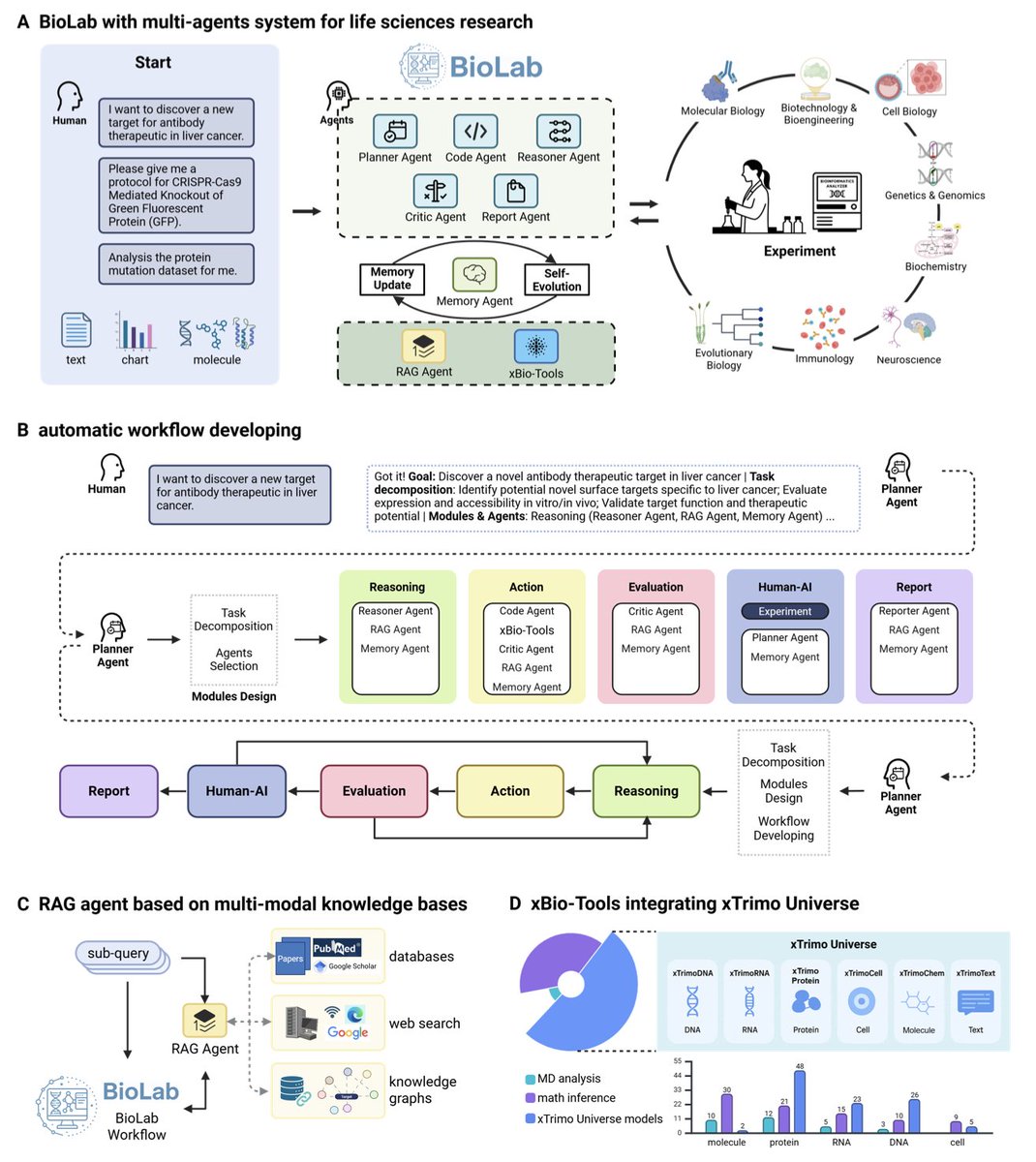
BioLab: End-to-End Autonomous Life Sciences Research with Multi-Agents System Integrating Biological Foundation Models 1. BioLab is a groundbreaking multi-agent system that integrates domain-specialized foundation models to automate end-to-end biological research. It comprises eight collaborating agents, including a Planner, Reasoner, and Critic, orchestrated through a Memory Agent that enables iterative refinement via retrieval-augmented generation. 2. The system is built on the xTrimo Universe, a collection of 104 models derived from six foundation models (xTrimoChem, Protein, RNA, DNA, Cell, and Text), the majority of which achieve state-of-the-art performance on domain benchmarks. 3. BioLab consistently outperformed leading large language models, including GPT-4, Gemini-2.5, and DeepSeek-R1, in standard reasoning tasks such as PubMedQA, MMLU-Pro/Biology, and GPQA-diamond. 4. In a fully computational pipeline for de novo macrophage-targeting antibody design, BioLab progressed from target mining to multi-objective antibody optimization, revealing structural mechanisms underlying enhanced affinity of optimized variants through molecular dynamics simulations. 5. Closing the computational-experimental loop, BioLab designed optimized antibodies (Pem-MOO-1, Pem-MOO-2) that achieved IC50 values of 0.01–0.016 nM, surpassing the parental Pembrolizumab (0.027 nM) for PD-1. Functional assays confirmed enhanced pathway blockade and improved multi-parameter performance profiles. 6. The study demonstrates BioLab as a generalizable framework for AI-native scientific discovery, showing how multi-agent systems coupled with foundation models can autonomously generate, execute, and experimentally validate novel biological hypotheses. @lecong @MengdiWang10 @ZaixiZhang @YuanhaoQ @Rufee0105 📜Paper: biorxiv.org/content/10.110… #BioLab #AI #LifeSciences #AutonomousResearch #MultiAgentSystems #FoundationModels #AntibodyDesign #ComputationalBiology
Biology+AI Daily tweet media
English
1
7
24
2.3K
Natalia Galvis Arias
Natalia Galvis Arias@ngalvisarias·
Is anyone else experiencing issues with @Overleaf? It's completely down for me, and I'm genuinely panicking—my entire academic life is stored there. Hoping this gets resolved quickly! ¿Alguien más está teniendo problemas con @Overleaf? 💀
English
6
0
7
1.1K
Ruofan Jin retweetledi
Kaushik Sengupta
Kaushik Sengupta@KSG_Princeton·
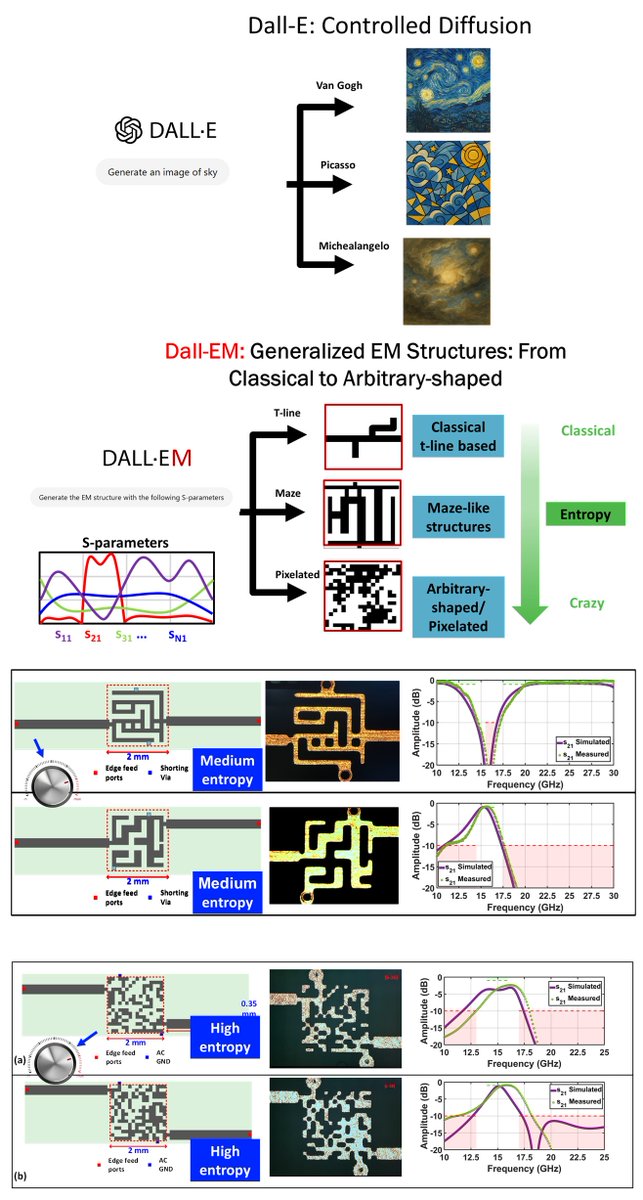
This paper has garnered quite a bit of interest in the community. We call this Dall-EM: Diffusion model to synthesize RF with designer scattering parameters. This picture should explain. We do controlled synthesis of RF design varying from classical to maze (weird looped t-lines) to completely arbitrary looking as desired. Synthesis time ~ 1 minute.
Kaushik Sengupta tweet media
outside five sigma@jwt0625

ok it actually works, uggghhh

English
12
62
335
27.9K
Ruofan Jin retweetledi
Le Cong@Stanford, AI+Bio+Gene-Editing
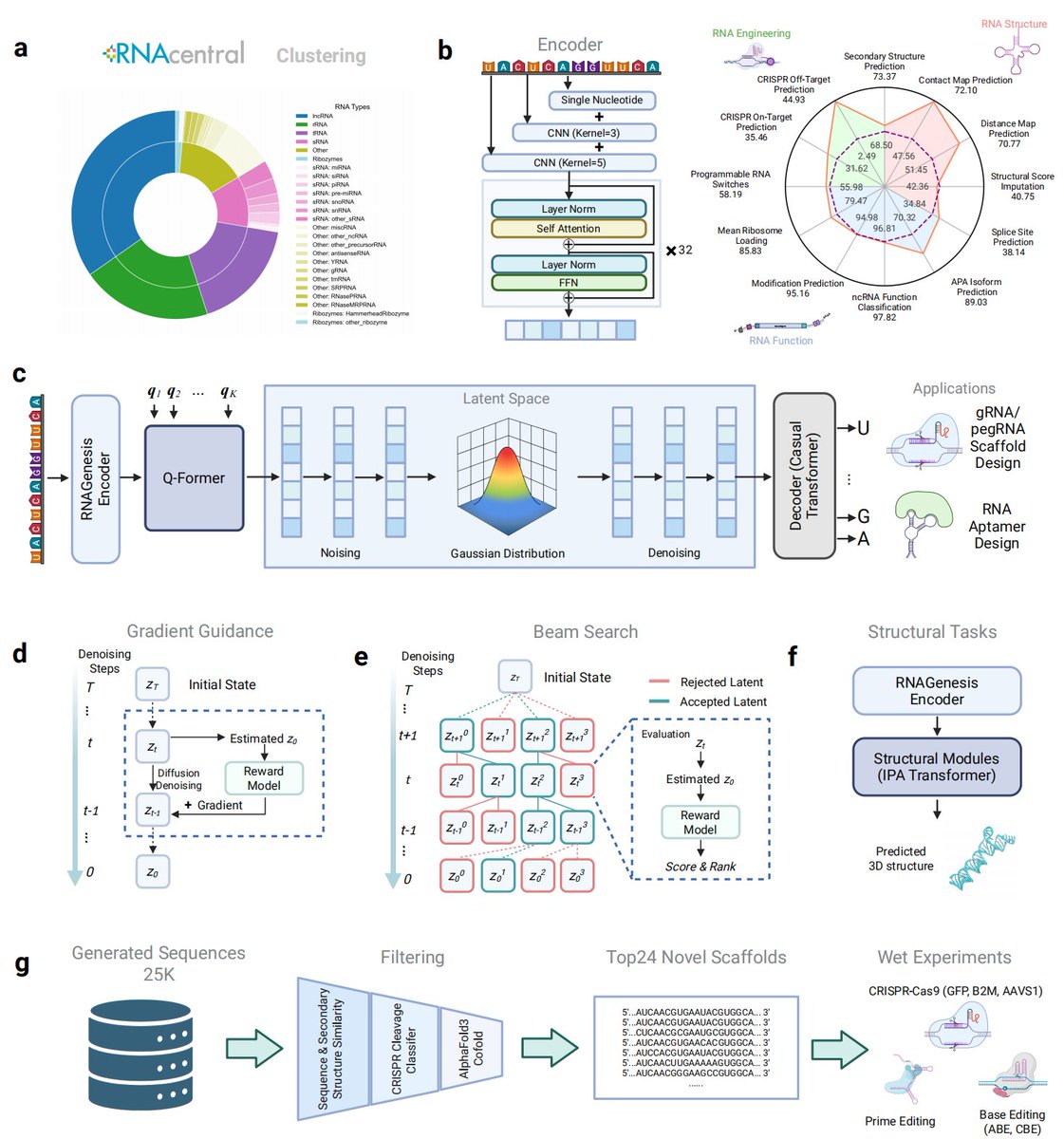
Our collaborative work, #RNAGenesis, led by @ZaixiZhang and team, delivers a Generalist RNA Foundation Model (full weights released!), end-to-end pipeline that understand, design, validate functional RNAs—from nM affinity aptamers to CRISPR scaffolds that lift editing efficiency up to 2.5×, when tested across nuclease, base-editing, and prime-editing. Let's move beyond prediction tasks, start applying generative AI design for RNA therapeutics! Please check out our preprint: lnkd.in/gqwq56nd Full model released at: lnkd.in/gtGJKa2G Thanks to all of amazing collaborators especially at #Princeton and #Stanford #RNA #CRISPR #GeneEditing #RNAtherapeutics #DrugDiscovery
Zaixi Zhang@ZaixiZhang

🚀 Introducing 𝗥𝗡𝗔𝗚𝗲𝗻𝗲𝘀𝗶𝘀 — a 𝗚𝗲𝗻𝗲𝗿𝗮𝗹𝗶𝘀𝘁 𝗙𝗼𝘂𝗻𝗱𝗮𝘁𝗶𝗼𝗻 𝗺𝗼𝗱𝗲𝗹 for 𝗳𝘂𝗻𝗰𝘁𝗶𝗼𝗻𝗮𝗹 𝗥𝗡𝗔 𝘁𝗵𝗲𝗿𝗮𝗽𝗲𝘂𝘁𝗶𝗰𝘀, unifying sequence understanding, de novo design, and 3D structure prediction. From 𝗔𝗽𝘁𝗮𝗺𝗲𝗿𝘀 to 𝗚𝗲𝗻𝗲 𝗘𝗱𝗶𝘁𝗶𝗻𝗴, RNAGenesis powers next-gen RNA engineering across modalities. 🧬 Key results: ➡ De novo aptamer design with 𝗻𝗮𝗻𝗼𝗺𝗼𝗹𝗮𝗿 𝗞𝗗 (as low as 4.02 nM) ➡ sgRNA scaffolds boosting 𝗴𝗲𝗻𝗲 𝗲𝗱𝗶𝘁𝗶𝗻𝗴 𝗲𝗳𝗳𝗶𝗰𝗶𝗲𝗻𝗰𝘆 𝘂𝗽 𝘁𝗼 𝟮.𝟱× (CRISPR-Cas9, Base Editing, Prime Editing) ➡ SOTA on 𝟭𝟭 𝗼𝗳 𝟭𝟯 tasks in the BEACON benchmark ➡ Outperforms 𝗔𝗹𝗽𝗵𝗮𝗙𝗼𝗹𝗱𝟯 (structure prediction), 𝗥𝗵𝗼𝗗𝗲𝘀𝗶𝗴𝗻 (inverse folding), and 𝗥𝗡𝗔-𝗙𝗿𝗮𝗺𝗲𝗙𝗹𝗼𝘄 (de novo structure generation) ➡ Built 𝗥𝗡𝗔𝗧𝘅-𝗕𝗲𝗻𝗰𝗵 — a focused benchmark for RNA therapeutics with 100K+ validated sequences; RNAGenesis outperforms 𝗘𝘃𝗼𝟮 and 𝗥𝗡𝗔-𝗙𝗠 across ASO, siRNA, shRNA, circRNA, and UTR tasks 🧠 Powered by: A hybrid 1B-param model: BERT-style encoder + latent diffusion decoder Inference-time alignment (gradient guidance + beam search) Multi-modal design unifying sequence, structure, and function 🧪 Wet-lab validation confirms high-affinity aptamer binding and improved gene-editing activity 🧮 Computational analysis reveals stronger G–C pairing, more hydrogen bonds, and lower MFE/MMBPSA in designed RNAs 📌 Explore: 🧾 Paper: biorxiv.org/content/10.110… 💻 Code: github.com/zaixizhang/RNA… 🧪 Benchmark: RNATx-Bench Team effort from @PrincetonAInews @StanfordMed @ZJU_China @PKU1898 @lecong @MengdiWang10 and more. #RNA #CRISPR #GeneEditing #RNAtherapeutics #DrugDiscove

English
1
1
10
1.2K
Ruofan Jin retweetledi
Zaixi Zhang
Zaixi Zhang@ZaixiZhang·
🚨 Introducing FoldMark — a generalist watermark framework to fortify protein generative AI against biosecurity threats 🧬 Why It Matters: • AI‑designed proteins could enable novel pathogens (e.g., SARS‑CoV‑2 variants), posing dual‑use risks arxiv.org/abs/2505.23839 • FoldMark delivers the first model‑level watermarking solution, ensuring traceability, accountability, and IP protection from outputs to creators 🔍 Top Highlights: • > 95% recovery accuracy for 32‑bit watermarks on AlphaFold3, ESMFold, RFDiffusion, RFDiffusionAA, while maintaining structural fidelity (scTM > 0.9) • Detection: 99% true positive rate at 10⁻⁵ FPR; trace creators among over 1 Million users • Wet‑lab validation: watermarked EGFP & CRISPR‑Cas13 retained >98% fluorescence and >95% editing efficiency, with ≥90% watermark recovery 🛡️ Medium Coverage: • FoldMark pioneers biosecurity safeguard measures directly in protein‑design AI—endorsed as “feasible and of great potential value in reducing risks” (science.org/content/articl…) by @ScienceMagazine • “The only known model-level safeguard for biosecurity in generative AI” (nature.com/articles/s4158…) by @NatureBiotech 📌 Explore: • Preprint: biorxiv.org/content/10.110… • Code: github.com/zaixizhang/Fol… • HuggingFace: huggingface.co/spaces/Zaixi/F… 🙏 Kudos: Ruofan Jin, Guangxue Xu, Xiaotong Wang, @marinkazitnik, @lecong , @MengdiWang10 & collaborators at @PrincetonAInews , @ZJU_China , @Tsinghua_Uni , @StanfordMed , @Harvard #biosecurity #ProteinAI #GenerativeBiology #AI4Science #FoldMark #AISafety
Zaixi Zhang tweet media
English
2
7
21
2.7K
Ruofan Jin retweetledi
Zaixi Zhang
Zaixi Zhang@ZaixiZhang·
🚀 Introducing 𝗥𝗡𝗔𝗚𝗲𝗻𝗲𝘀𝗶𝘀 — a 𝗚𝗲𝗻𝗲𝗿𝗮𝗹𝗶𝘀𝘁 𝗙𝗼𝘂𝗻𝗱𝗮𝘁𝗶𝗼𝗻 𝗺𝗼𝗱𝗲𝗹 for 𝗳𝘂𝗻𝗰𝘁𝗶𝗼𝗻𝗮𝗹 𝗥𝗡𝗔 𝘁𝗵𝗲𝗿𝗮𝗽𝗲𝘂𝘁𝗶𝗰𝘀, unifying sequence understanding, de novo design, and 3D structure prediction. From 𝗔𝗽𝘁𝗮𝗺𝗲𝗿𝘀 to 𝗚𝗲𝗻𝗲 𝗘𝗱𝗶𝘁𝗶𝗻𝗴, RNAGenesis powers next-gen RNA engineering across modalities. 🧬 Key results: ➡ De novo aptamer design with 𝗻𝗮𝗻𝗼𝗺𝗼𝗹𝗮𝗿 𝗞𝗗 (as low as 4.02 nM) ➡ sgRNA scaffolds boosting 𝗴𝗲𝗻𝗲 𝗲𝗱𝗶𝘁𝗶𝗻𝗴 𝗲𝗳𝗳𝗶𝗰𝗶𝗲𝗻𝗰𝘆 𝘂𝗽 𝘁𝗼 𝟮.𝟱× (CRISPR-Cas9, Base Editing, Prime Editing) ➡ SOTA on 𝟭𝟭 𝗼𝗳 𝟭𝟯 tasks in the BEACON benchmark ➡ Outperforms 𝗔𝗹𝗽𝗵𝗮𝗙𝗼𝗹𝗱𝟯 (structure prediction), 𝗥𝗵𝗼𝗗𝗲𝘀𝗶𝗴𝗻 (inverse folding), and 𝗥𝗡𝗔-𝗙𝗿𝗮𝗺𝗲𝗙𝗹𝗼𝘄 (de novo structure generation) ➡ Built 𝗥𝗡𝗔𝗧𝘅-𝗕𝗲𝗻𝗰𝗵 — a focused benchmark for RNA therapeutics with 100K+ validated sequences; RNAGenesis outperforms 𝗘𝘃𝗼𝟮 and 𝗥𝗡𝗔-𝗙𝗠 across ASO, siRNA, shRNA, circRNA, and UTR tasks 🧠 Powered by: A hybrid 1B-param model: BERT-style encoder + latent diffusion decoder Inference-time alignment (gradient guidance + beam search) Multi-modal design unifying sequence, structure, and function 🧪 Wet-lab validation confirms high-affinity aptamer binding and improved gene-editing activity 🧮 Computational analysis reveals stronger G–C pairing, more hydrogen bonds, and lower MFE/MMBPSA in designed RNAs 📌 Explore: 🧾 Paper: biorxiv.org/content/10.110… 💻 Code: github.com/zaixizhang/RNA… 🧪 Benchmark: RNATx-Bench Team effort from @PrincetonAInews @StanfordMed @ZJU_China @PKU1898 @lecong @MengdiWang10 and more. #RNA #CRISPR #GeneEditing #RNAtherapeutics #DrugDiscove
Zaixi Zhang tweet media
English
4
3
12
16.9K