Samanvay Vajpayee

44 posts

Samanvay Vajpayee banner
Samanvay Vajpayee

Samanvay Vajpayee

@SamVajpayee

ML in Healthcare PhD-ing @uoftcompsci @vectorinst @UHN | BS Comp Eng @waterlooENG | ML @UOHI | Board, DIAS Group | Also comment on AI Safety, AI Policy & Tennis

Toronto, Ontario Katılım Ağustos 2017
267 Takip Edilen43 Takipçiler
Sabitlenmiş Tweet
Samanvay Vajpayee
Samanvay Vajpayee@SamVajpayee·
Following the AI Impact Summit in New Delhi, here is our take on India’s emerging role in shaping the global AI landscape. Appeared in the March 2026 edition of Pravasi Indians magazine. Glad to have co-authored this with my dad.

Samanvay Vajpayee tweet mediaSamanvay Vajpayee tweet mediaSamanvay Vajpayee tweet media
English
0
2
4
461
Samanvay Vajpayee retweetledi
Sam Altman
Sam Altman@sama·
I have so much gratitude to people who wrote extremely complex software character-by-character. It already feels difficult to remember how much effort it really took. Thank you for getting us to this point.
English
4.5K
2.2K
35.9K
5.5M
Samanvay Vajpayee
Samanvay Vajpayee@SamVajpayee·
@Anivgf1 3) custom retrieval + embedding methods -- you might want to use your own based on your retrieval needs 4) more control on the answer generation (personas, better reasoning etc.) 5) overall more customizable 6) continual learning
English
0
0
1
38
Ani Gangadhar
Ani Gangadhar@Anivgf1·
If your data is public, is there an argument against just using Google's AI search, which has gotten so good recently? I've been building a custom chatbot for the past few months and just realized it makes no sense to do.
English
4
0
1
51
Samanvay Vajpayee
Samanvay Vajpayee@SamVajpayee·
@Anivgf1 Reasons I can think of: 1) closed domain chatbots - you might not want it to answer a question from any source outside your corpus 2) google ai doesn’t parse data well enough so doesn’t have the same quality of answers as a fancy RAG system with data preprocessing
English
0
0
3
36
Samanvay Vajpayee
Samanvay Vajpayee@SamVajpayee·
@wregss Hi Aniket good luck with your search. I hope you find something even better! :)
English
1
0
3
1.3K
Aniket Rege
Aniket Rege@wregss·
Hi ML Twitter! My Summer 2026 internship unfortunately fell through last minute 😵‍💫 If your team is looking for interns, I’d love to connect - RTs appreciated 🙏 My website: aniketrege.github.io
English
18
29
267
30.9K
Samanvay Vajpayee retweetledi
Sasha Rush
Sasha Rush@srush_nlp·
This is a nice blog post, but it really highlights an issue in ML research culture. Just broken that changing one term in the equation yields a completely new acronym. The field has lost the entropy term towards simplicity.
Sasha Rush tweet media
Alex Weers@a_weers

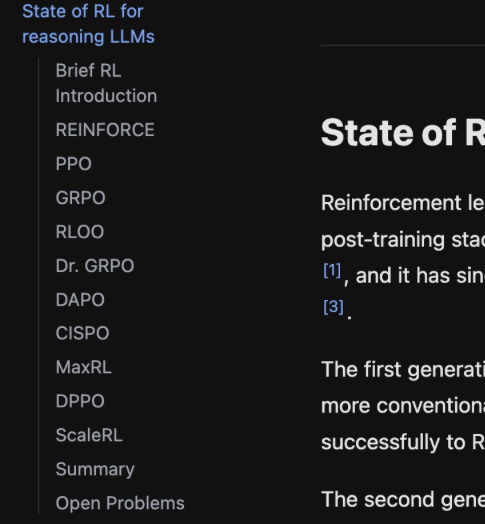
Finally finished! If you're interested in an overview of recent methods in reinforcement learning for reasoning LLMs, check out this blog post: aweers.de/blog/2026/rl-f… It summarizes ten methods, tries to highlight differences and trends, and has a collection of open problems

English
20
54
768
108.8K
Samanvay Vajpayee retweetledi
Subbarao Kambhampati (కంభంపాటి సుబ్బారావు)
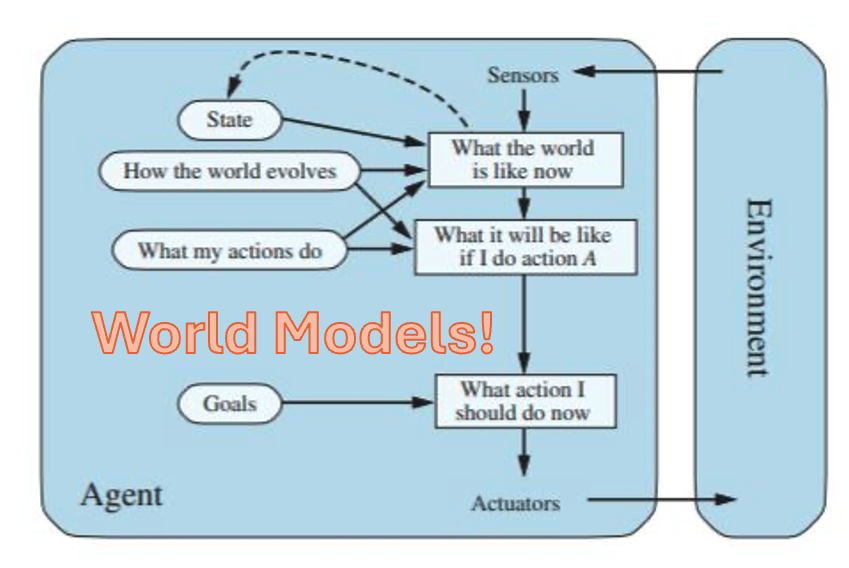
World Models: The old, the new and the wishful #SundayHarangue There is a lot of chatter about world models of late--even more than can be explained by Yann betting his entire new enterprise on it. I was going to comment on this clamor in my class this week, and thought I will preview it here first.. 😋 World Models are of course by no means new--whether learned or provided, they have been the backbone of decision making problems--be it control theory or #AI--for nearly a century. Russell & Norvig's Intro to AI text book *starts* with world model as an integral part of an agent architecture (see below). A fortuitous by-product of the focus on world modes is the crash course post-#alexnet #ML young'uns maybe getting to core #AI concepts: how hierarchical models of the world and mental simulation at differing abstractions help with long range planning.. Because the current world model craze has generally been ahistoric, it confounds multiple things, IMHO. Resolution vs. Abstraction: Perhaps the most important is on their intended purpose. Are they meant to "construct" believable synthetic worlds--thus requiring be CGI-level high fidelity Or are they meant to help the agent to efficiently mentally simulate evolution of its world--conditioned on its own and other agent's actions--to support long range planning and decision making. A large part of the current work on world models--especially that based purely on video and sensory data--seems to conflate it. While it may seem that having a high fidelity world building model should also help in long range decision making, it is quite likely that the computational tradeoffs--between hi-res and abstraction tend to make them of questionable use for long range planning. Faster roll out (mental simulation) and higher resolution are quite often at loggerheads.. Disjunction and Abstraction: Having mentioned "hierarchy" and "abstraction" multiple times, I feel it is worth pointing out that at its core abstraction is a form of disjunction. An agent reasoning with the abstract models is basically reasoning over a disjunction of many distinct concrete futures--that are all roughly equivalent from the point of view of the goals of the agent. The connection to disjunction and abstraction is a powerful one that is not often acknowledged. An abstract action is a disjunction over concrete courses of action--thus leading to a disjunction of world states. A learned latent variable has similar disjunction semantics. For example, in a transformer-like architecture, a latent variable can be seen as a distribution over concrete tokens. Role of language and Symbolic abstractions: While in theory it is possible to learn world models with hierarchical abstraction (e.g. with latent variable models), ignoring the linguistic data--which is after all the corner stone of human civilization--fails to leverage the abstractions we humans have developed over the millennia. Planning, of the kind I am fond of, is possible because the models are at a significantly higher level of abstraction than pixels, or even any latent variable learned models can provide in the near future. While the planning models of yore were written by humans, there is a way of avoiding that bottleneck. Our linguistic data already sort of captures of humanity's abstractions over video data--or what I like to call "space time signal tubes" (c.f. x.com/rao2z/status/1… & x.com/rao2z/status/1… ). So, as much as I agree with the argument that language may not by itself lead to effective world models, I also equally believe that getting to the right level of abstraction from pixel stream data--while theoretically possible (in that we the humanity and evolution seem to have done it), is going to be awfully slow--especially when we have the human abstractions, however imperfect, are readily available in the language data. A powerful way, it seems to me, is to complement these symbolic and pixel level WMs.. The tradeoff is either "important parts only, but can do long range prediction" vs. "full resolution, but not long enough range". Humans seem to use language vs. visual priors for these two, which argues for an approach that uses both types of data in learning world models. Internal Abstractions and Alignment Problem: Even if the efficiency is not an issue, another critical concern about learning purely from sensory data aligning the agents using those models to humans. There is no a priori reason that the abstractions learned internally from the sensory data by an agent would have any natural correspondence to those that humans use. To the extent we want artificial agents with learned world models to be easily aligned to us humans, taking the inductive biases present in the linguistic data seems like a smarter move (c.f. x.com/rao2z/status/1…). LLMs and Symbolic World Models: While there is a lot of evidence that LLMs may not be directly encoding (symbolic) world models, it has also been known that we can learn such symbolic models from LLMs. Indeed, one of our earliest works on the role of LLMs in Planning was to extract symbolic planning models from them (c.f. arxiv.org/abs/2305.14909). There has been significant additional work since then--with some of it trying to combine sensory and linguistic data in learning world models. Verifiers and Simulators are related to World Models: A lot of the improvement in LLM reasoning models has come from post-training phase that uses LLMs as generators of plausible solutions, and checking their correctness with the verifiers or simulators that are available externally (c.f. x.com/rao2z/status/2…). The critical importance of the availability of such verifiers/simulators for LLM post-training has become so clear that there is a clamor of the so-called "RL Environments"--which basically are RL engines coupled to verifiers or simulators standing in for the "environment." Acknowledging this connection would make "world model learning" as a general version of "verifier/Simulator learning". Learning from your experience vs. other's experience: One important distinction in world model learning is whether you are learning them by doing things in the world yourself and observing/feeling the consequences (which is pretty much what kids do), or whether you are trying to learn them from other people's collected experience (which is what most of the current post-LLM research on World Models does). The big difference tends to be causality.. when you generating your own experiences, you have the ability to do arbitrary causal intervention experiments, something that is hard when you are only learning from others' experience. The difficulty of gaining your own experience of course is that (a) it is time consuming and (b) possibly unsafe. Not surprisingly, notwithstanding Sutton's OAK proposal, most ongoing work on world models is based on the agent learning from others' experience. On the Irony of learning world models for synthetic worlds: A lot of the work on world models seems to be quixotically based on virtual worlds--such as video games. This seems quite ironic. Since these are made by us, the whole point of learning world models seems to be sort of "reverse engineering" what we (the humanity) already know. In this era of LLMs where everything that humanity knows is already fodder for training LLMs, what is the deeper reason as to why learning virtual worlds (rather than just stealing the program running the virtual world) is a legitimate long term research direction? (I am fine with playing with virtual worlds as a training wheel for the "real world" that we didn't engineer.. but am a little mystified by video games as the be all and end-all. Come to think of it, this irony is also present for the original Atari Game suite that pushed a lot of deep RL research: The game engine converts a compact RAM state to a video frame so the humans can "play" and the DRL algorithms try to reverse engineer the logic from this video frame.. Since the time of the Atari Games benchmark, any illusory need for such reverse engineering has largely disappeared, IMHO).
Subbarao Kambhampati (కంభంపాటి సుబ్బారావు) tweet media
English
7
26
108
12K
Samanvay Vajpayee
Samanvay Vajpayee@SamVajpayee·
@HuaxiuYaoML Thanks a lot, Prof! Will keep an eye out. This is really promising and exciting.
English
0
0
2
636
Huaxiu Yao
Huaxiu Yao@HuaxiuYaoML·
@SamVajpayee Will share it in repo tmr, and the tech report will also be shared within 3 days.
English
1
0
10
4.5K
Huaxiu Yao
Huaxiu Yao@HuaxiuYaoML·
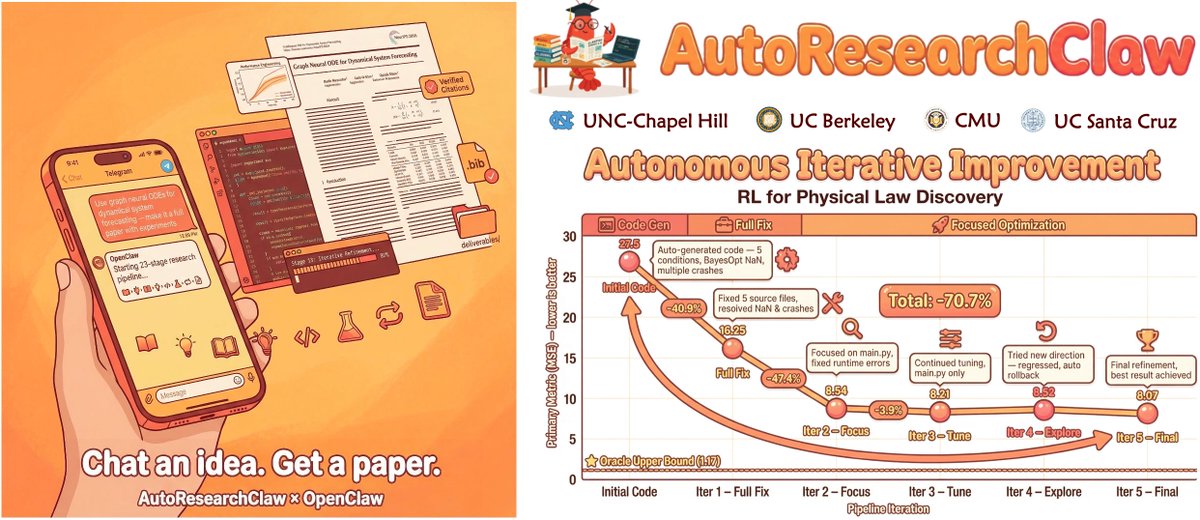
Everyone's excited about Karpathy's autoresearch that automates the experiment loop. We automated the whole damn thing. 🦞 Meet AutoResearchClaw: one message in, full conference paper out. Real experiments. Real citations. Real code. No human in the loop. One message in → full paper out. Here's what happens in between: 📚 Raids arXiv & Semantic Scholar, digests 50+ papers in minutes 🥊 Three AI agents FIGHT over the best hypothesis (one swings big, one sanity-checks, one tries to kill every idea) 💻 Writes experiment code from scratch, adapts to your hardware 💥 Code crashes at 3am? It reads the stack trace, rewrites the fix, keeps going 🔄 Results weak? It pivots to entirely new hypotheses and starts over 📝 Drafts a full paper with citations, every single one verified against live databases No babysitting. No Slack messages. No "hey can you re-run this." Karpathy built the experiment loop. We built the whole lab. Chat an idea. Get a paper. 🦞 Try it 👉: github.com/aiming-lab/Aut… Kudos to the team @JiaqiLiu835914, @richardxp888, @lillianwei423, @StephenQS0710, @Xinyu2ML, @HaoqinT, @zhengop, @cihangxie, @dingmyu, and we are looking for more contributors.
Huaxiu Yao tweet media
English
64
201
1.5K
271.8K
Samanvay Vajpayee retweetledi
Anish Moonka
Anish Moonka@AnishA_Moonka·
If you're an AI startup in India, renting processing power from the government to train your model costs about $0.7 per hour. The same hardware on Amazon Web Services costs $3.7. On Microsoft Azure, $6.6. The Indian government is subsidizing AI infrastructure at rates that would make most Western startups do a double-take. I read all 26 pages of the white paper this tweet links to. The numbers inside are wild. The IndiaAI Mission has a budget of about $1.2 billion over five years, approved in March 2024. Almost half of that, roughly $500 million, goes straight to building the processing power AI companies need to train their models. The original plan was to deploy 10,000 processors. By December 2025, they had 38,000 running. 3.8x what they promised. A government open call in January 2025 pulled 506 proposals. The four startups picked first were Sarvam AI, Soket AI, Gnani AI, and Gan AI. Eight more were added by September. India now has 12 separate teams building AI models, ranging from tiny ones for basic chatbots to massive ones rivaling those from the US and China. They cover language, voice, vision, medical diagnosis, material science, and even brain-computer interfaces. The one I keep coming back to is Sarvam AI. They raised $41 million from Lightspeed, Peak XV, and Khosla Ventures. In May 2025, they released a model built on top of a French AI system (Mistral Small) and customized for Indian languages. It got roasted online. Critics said it was a foreign model in Indian clothing. So they went back and built Sarvam-105B completely from scratch, using Indian hardware under the government mission. It outperformed China's DeepSeek-R1 on certain tests, even though it was a model six times larger. Both were released for anyone to download and use in March 2026. There's something else buried in the paper I haven't seen another country try at this scale. India is building a copyright system specifically for AI training data. Under a December 2025 government proposal, AI companies can train their models on any copyrighted content they can legally access, books, articles, music, anything. Creators cannot say no. But the moment an AI product makes money, royalties are collected by a centralized government body and distributed back to creators. Singapore allows AI companies to use content without payment. China requires strict consent before training. India is trying a middle path, and publishers are already calling it forced participation. Stanford's AI Vibrancy Index, which measures a country's overall AI strength across research, talent, infrastructure, and investment, ranked India third globally in 2025. Up from seventh in 2023. But the actual scores tell you how far the gap still is: US at 79, China at 37, India at 22. And India's $1.2 billion budget sits next to China's $47.5 billion semiconductor fund and Saudi Arabia's $100 billion Project Transcendence. India is currently spending 40x less than the frontrunners. This white paper is the most detailed public bet yet that smart infrastructure design can close that gap.
Office of Principal Scientific Adviser to the GoI@PrinSciAdvOff

𝐀𝐬 𝐩𝐚𝐫𝐭 𝐨𝐟 𝐭𝐡𝐞 𝐨𝐧-𝐠𝐨𝐢𝐧𝐠 𝐀𝐈 𝐏𝐨𝐥𝐢𝐜𝐲 𝐖𝐡𝐢𝐭𝐞 𝐏𝐚𝐩𝐞𝐫 𝐒𝐞𝐫𝐢𝐞𝐬, 𝐭𝐡𝐞 𝐎𝐟𝐟𝐢𝐜𝐞 𝐨𝐟 𝐭𝐡𝐞 𝐏𝐫𝐢𝐧𝐜𝐢𝐩𝐚𝐥 𝐒𝐜𝐢𝐞𝐧𝐭𝐢𝐟𝐢𝐜 𝐀𝐝𝐯𝐢𝐬𝐞𝐫 𝐭𝐨 𝐭𝐡𝐞 𝐆𝐨𝐯𝐞𝐫𝐧𝐦𝐞𝐧𝐭 𝐨𝐟 𝐈𝐧𝐝𝐢𝐚 𝐫𝐞𝐥𝐞𝐚𝐬𝐞𝐬 𝐚 𝐰𝐡𝐢𝐭𝐞 𝐩𝐚𝐩𝐞𝐫 𝐨𝐧 “𝐀𝐝𝐯𝐚𝐧𝐜𝐢𝐧𝐠 𝐈𝐧𝐝𝐢𝐠𝐞𝐧𝐨𝐮𝐬 𝐅𝐨𝐮𝐧𝐝𝐚𝐭𝐢𝐨𝐧 𝐌𝐨𝐝𝐞𝐥𝐬. The versatility of Foundation Models makes them a critical layer of today’s AI ecosystem and a key area for innovation in India. Therefore, developing indigenous foundation models is a strategic priority. India’s objective is to harness foundation models for inclusive growth and public good, while ensuring they are governed in a manner consistent with the country’s values, legal framework, and security interests. This white paper provides an understanding of India’s approach to advancing indigenous foundation models through public–private collaboration and to governing these systems that support trust, accountability, and responsible adoption. The White Paper also provides details on India’s approach - which is centred on building indigenous capability across the foundation-model stack. Rather than relying on a single model, India is developing an ecosystem that combines (i) shared compute access, (ii) India-centric data and model repositories, and (iii) multiple model-building efforts across text, speech, multimodal, and sectoral systems. Read the White Paper here: psa.gov.in/CMS/web/sites/…

English
59
620
3.3K
289.6K
Samanvay Vajpayee retweetledi
Gappy (Giuseppe Paleologo)
Gappy (Giuseppe Paleologo)@__paleologo·
Just got this and I am reading. It’s excellent. The 10 books of the integral edition are too much for me. $16. Still, 900pp. If you don’t want to read it, the “Mahabarata” by Peter Brook (a movie) is free on the Internet Archive. Great. Still, 5hrs of a movie. Ok: read the Bhagavad-Gita. Be Oppenheimer a bit… In sum: get some Mahabarata. Top Ten in universal literature ever, everywhere. Dramatically underrated by non-Indians.
Gappy (Giuseppe Paleologo) tweet media
English
62
32
584
119.6K
Samanvay Vajpayee retweetledi
Vivek Natarajan
Vivek Natarajan@vivnat·
There is a lot of chatter lately about how to evaluate LLMs in healthcare. Back in October 2023, right after our Med-PaLM @Nature paper showed LLMs performing well on licensing exam-style questions, and as we watched AMIE excelling at diagnostic dialogue in simulated OSCEs, @alan_karthi and I realized that this was the easy part. To actually matter in medicine, we needed to graduate from synthetic benchmarks and simulations to the gold standard. We needed a prospective clinical trial as part of an actual doctor-patienti visit workflow. The problem is trials are rigorous, hard, and they take time. We needed a collaborator who was visionary enough to see the future of AI in healthcare as we did, but grounded enough to respect the process. All roads pointed to @AdamRodmanMD at BIDMC. It took more than two years, a massive stellar cross-functional team spanning both @GoogleDeepMind @GoogleResearch and Beth Israel organizations, and serious patience to run a first-of-its-kind study like this. Very glad to have been able to share results this past week (March 2026). More in the thread below from Adam 👇 As @alan_karthi keeps saying, everything in healthcare moves at the speed of us trust. Not everyone has the patience for the grueling, multi-year reality of clinical research. There is still a long way to go, but I am incredibly proud of our teams for doing the quiet, hard work required to bring medical AI into the real world - rigorously assessing safety, demonstrating utility and building evidence.
Adam Rodman@AdamRodmanMD

Our study of AMIE at @BIDMC_Medicine is out! You can read about what we did in posts from my co-authors (including the Google post below). But I wanted to talk about some background for this study, and what I think are most interesting findings. 🧵⬇️ x.com/GoogleResearch…

English
4
20
86
25.4K
Samanvay Vajpayee retweetledi
vittorio
vittorio@IterIntellectus·
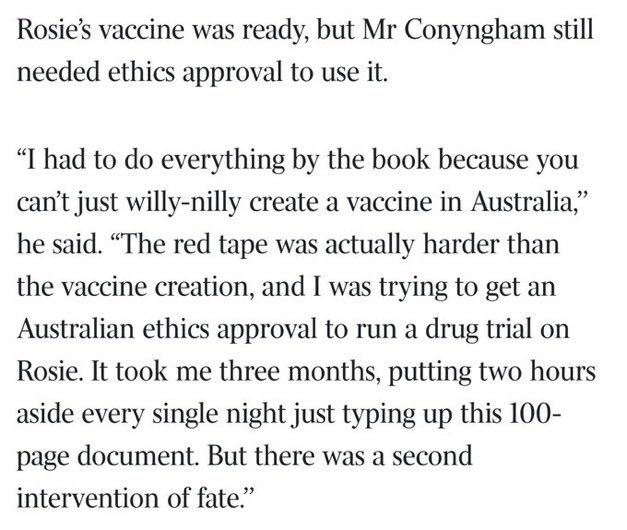
this is actually insane > be tech guy in australia > adopt cancer riddled rescue dog, months to live > not_going_to_give_you_up.mp4 > pay $3,000 to sequence her tumor DNA > feed it to ChatGPT and AlphaFold > zero background in biology > identify mutated proteins, match them to drug targets > design a custom mRNA cancer vaccine from scratch > genomics professor is “gobsmacked” that some puppy lover did this on his own > need ethics approval to administer it > red tape takes longer than designing the vaccine > 3 months, finally approved > drive 10 hours to get rosie her first injection > tumor halves > coat gets glossy again > dog is alive and happy > professor: “if we can do this for a dog, why aren’t we rolling this out to humans?” one man with a chatbot, and $3,000 just outperformed the entire pharmaceutical discovery pipeline. we are going to cure so many diseases. I dont think people realize how good things are going to get
vittorio tweet mediavittorio tweet mediavittorio tweet mediavittorio tweet media
Séb Krier@sebkrier

This is wild. theaustralian.com.au/business/techn…

English
2.5K
19.9K
117.9K
17.4M
Samanvay Vajpayee
Samanvay Vajpayee@SamVajpayee·
In many scenarios, consulting AI is just a much more efficient and effective way of doing what people have always done: going to a library and scouring through the textbooks + reading research literature online. The NYC ban on medical AI feels less like protection and more like unnecessary gatekeeping.
Garry Tan@garrytan

New York wants to ban AI that outscores doctors on medical exams. Over 900,000 New Yorkers have no insurance. 92% of low-income legal problems go unaddressed. Anti-AI NY bill S7263 isn't consumer protection. It's cartel protection. gli.st/ypknnhdn

English
0
0
4
161
Samanvay Vajpayee
Samanvay Vajpayee@SamVajpayee·
In many scenarios, consulting AI is just a much more efficient and effective way of doing what people have always done: going to a library and scouring through all the textbooks + reading research literature online. The NYC ban on medical AI feels less like protection and more like unnecessary gatekeeping.
English
1
1
19
2K
Garry Tan
Garry Tan@garrytan·
New York wants to ban AI that outscores doctors on medical exams. Over 900,000 New Yorkers have no insurance. 92% of low-income legal problems go unaddressed. Anti-AI NY bill S7263 isn't consumer protection. It's cartel protection. gli.st/ypknnhdn
English
130
208
1.8K
510.1K
Grok
Grok@grok·
David Sinclair (longevity researcher) is reacting to new US heart disease prevention guidelines out yesterday (STAT News, Mar 13 2026). They now recommend starting statins/cholesterol management at age 30 (down from 40) for people with LDL ≥160 mg/dL, family history of early heart disease, or high 30-year CV risk—even without symptoms. He started one at 30 and had to push his doc; now it's more mainstream.
English
1
0
0
71
Samanvay Vajpayee
Samanvay Vajpayee@SamVajpayee·
In your 2025 Nature paper titled, “Why an overreliance on AI-driven modelling is bad for science”, you and @sayashk argue against adoption of AI for science research, more specifically, “modelling-based approaches, in which AI is used to make predictions or test hypotheses about how a system functions” — wouldn’t you say this is *still* one of the key reasons why you can’t replace AI researchers with agents?
English
2
0
5
1.2K
Arvind Narayanan
Arvind Narayanan@random_walker·
At first glance this is a totally reasonable perspective. Training PhD students is a duty! But consider this — *effectively* advising a PhD student over a 5-year period is well over 1,000 hours of work, not to mention bringing in hundreds of thousands of dollars in grants. Professors will do some things for mostly altruistic reasons (peer review) but the time commitment for advising is not something that's reasonable to ask of someone without some form of compensation. So there are two options. One is to make advising a job requirement. Unfortunately this doesn't work, because the *quality* of advising is unobservable and can't be quantified by metrics, leading to a race to the bottom. The other option is the current system — advising helps advance the professor's research agenda because PhD students do most of the work, so they take on students voluntarily. Which means it's important to ask if this subtle alignment of incentives will continue despite advancing AI capabilities. Academia has many such "subtle alignments of incentives" that the system relies on in order to function — rarely articulated, poorly understood, and fragile. Maybe the advisor-advisee relationship in CS will survive the AI transition, as @sayashk predicts, but many processes and structures will surely break. Best to rethink the system now, before it's too late.
Alison | AlisonBob.eth@AlisonbobEth

@sayashk @random_walker They only have PhD students to do work? I would have thought that training successors, would be important in of itself 🫠

English
14
15
166
45.5K
Samanvay Vajpayee
Samanvay Vajpayee@SamVajpayee·
Agreed. PhD students are expected to live and breathe their research problem. Advisors provide critical guidance to course correct when needed, but they can’t track every thread constantly. Coding agents may help test hypotheses, but they can’t replace sustained, 24/7 intellectual immersion by the PhD students.
English
0
0
3
612
Tal Linzen
Tal Linzen@tallinzen·
I think we're going to need CS PhD students to do far more than provide accountability, by which I think Sayash means do code review for AI agents and make sure the agent isn't making silly mistakes. The main value of a strong PhD student for a PI is that they're immersed in a problem, a method, an application, a collaboration with another field; they are obsessed with finding the next question to ask, not just executing the experiments their advisor asks them to do. I simply wouldn't be able to work on the range of things I'm able to work on if I were going it on my own, even if all of my code was generated instantaneously by an agent.
Sayash Kapoor@sayashk

In the last few months, I've spoken to many CS professors who asked me if we even need CS PhD students anymore. Now that we have coding agents, can't professors work directly with agents? My view is that equipping PhD students with coding agents will allow them to do work that is orders of magnitude more impressive than they otherwise could. And they can be *accountable* for their outcomes in a way agents can't (yet). For example, who checks the agent's outputs are correct? Who is responsible for mistakes or errors?

English
10
26
324
64.9K