Save Right Whales Coalition

397 posts

Save Right Whales Coalition banner
Save Right Whales Coalition

Save Right Whales Coalition

@SaveNARW

The Save Right Whales Coalition is a nonpartisan group dedicated to protecting the critically endangered North Atlantic right whale on the East Coast.

Katılım Kasım 2021
520 Takip Edilen986 Takipçiler
Save Right Whales Coalition retweetledi
Miss Belmar Whale Watching
Miss Belmar Whale Watching@missbelmar·
🇺🇸 @missbelmar extends our deepest gratitude and takes a moment today to remember the heroes who gave their all for our country. 🙏🏻 We know one day isn't enough to thank all those who've bravely served. Your sacrifices ensure our freedom and we honor your courage every day.
Miss Belmar Whale Watching tweet media
Belmar, NJ 🇺🇸 English
0
3
11
705
Save Right Whales Coalition retweetledi
Environment Progress
Environment Progress@envprogress·
People say that wind energy is good for the environment, but a new study finds that East Coast offshore wind industry activity since 2015 strongly correlates with whale deaths. Wind Industry Activity Strongly Correlated With Whale Deaths, New Study Finds “An Investigation of Large Whale Mortality and Offshore Wind Development Activity in the U.S. Since 2015.” by Lisa Linowes @LinowesLisa and Eric Turner Since 2016, the National Oceanic and Atmospheric Administration (NOAA) has declared three Unusual Mortality Events (UME) involving large whale species in the Atlantic Ocean. These are specifically the Atlantic humpback whale UME in 2017, the North Atlantic right whale (NARW) UME in 2017, and the Atlantic minke whale UME in 2018. The UMEs for the humpback and minke whales include deaths in 2016 and 2017, respectively. The beginning of these declarations coincides with increased offshore wind (OSW) vessel activity in waters where whale deaths were observed. Prior to the closing months of 2015, no notable OSW survey, construction, or maintenance vessel traffic existed in the Atlantic Ocean.1 Commencing with the preparation and construction of five wind turbines off the southeast coast of Block Island, significant and frequently intense OSW vessel traffic has been observed. This report documents geographic and volume-based evidence of marine mammal deaths that correlate directly to OSW vessel activity from 2016 forward. Using maps of whale deaths and OSW vessel tracks, the authors endeavor to graphically display an increase in mortality against OSW vessel activity. FINDINGS This study identified a direct correlation between increased OSW vessel activity and whale mortality. Key findings of the study include: a) A connection between OSW vessel activity within ocean areas and whale deaths has been an ongoing concern in the United States since the 5-turbine Block Island wind facility was under construction in 2016. OSW developers employ high-resolution geophysical (HRG) equipment that uses sonar to map the seabed in the lease areas. Sound from sonar surveys and wind turbine pile driving is recognized as harmful to marine mammals. b) Research and press accounts from the United Kingdom and Europe dating back more than a decade suggest whales and other marine mammals experienced displacement and mortality events in the North Sea related to offshore wind development. Scientific evidence detailing the impacts of OSW on marine life continues to be limited. Where studies have been performed, it is not clear the outcomes can be applied to environmental conditions of the coasts of the United States. Testimonies from the United Kingdom show that resolving the climate crisis has been the priority for the government over concerns related to wildlife and environmental impacts. c) Ocean vessel tracks in the Atlantic prior to 2016 show that very little marine traffic beyond fishing and pleasure boats occurred within the wind lease areas. Annual aggregate vessel tracks within established shipping lanes and in areas close to shore appear relatively constant over the period from 2015 to 2023 with nominal changes year-over-year. The change in vessel activity after 2015 coincided with the U.S. Bureau of Ocean Energy Management (BOEM) finalizing lease agreements with OSW developers. Traffic within the lease areas materially increased. d) In the period from 2007 to 2023, 60% of total whale mortality along the east coast from Maine to North Carolina occurred after 2015 (n=470 of 788 whales). This represents a 48% increase in whale deaths overall. In several states where OSW activity was significant, the percent increase in mortality was well over 60% (Tables 2 and 3). The increase in whale deaths and NOAA’s declarations of unusual mortality events correlate directly with the increase in OSW activities within federally leased areas. e) Vessel track data show whale deaths occurring within the same timeframe as the OSW sonar surveys and in proximity to the sonar activity. As the amount of OSW activity increased within an area, so did whale deaths. Shortly after pile driving to install wind turbines was initiated in late spring 2023 for the Vineyard Wind 1 and South Fork Wind facilities, additional whale deaths were observed in southern New England. f) Using commercially and publicly available tools and data, this investigation found a positive relationship between OSW vessel activity and whale mortality. Additional in-depth investigations are necessary to determine if there is a causal connection between OSW activity and the increase in whale mortality. saverightwhales.org/media/wind-ind…
Environment Progress tweet media
English
20
108
269
35.2K
Save Right Whales Coalition
New documentary, "Thrown To The Wind, Part 2," provides more hard evidence that the wind industry is harming whales
Michael Shellenberger@shellenberger

Illegal Levels Of Whale-Killing Pile-Driving Noise By Wind Industry Documented New documentary, "Thrown To The Wind, Part 2," provides more hard evidence that the wind industry is harming whales The wind industry is not killing endangered whales off the East Coast, say government agencies and the news media. But it is. Before 2016, when the wind industry’s increased boat traffic, sonar mapping, and construction began, eight humpback whales were found dead per year between Virginia and Maine. Since 2016, an average of 25 humpbacks were found dead annually. And last year, there were a record 83 whales found dead. And yet the Associated Press insisted last month that “there’s no evidence that limited wind farm construction on the Atlantic Coast has directly resulted in any whale deaths.” [Emphasis added.] That’s true. But there’s also no evidence that smoking directly causes cancer. Nor is there evidence that more carbon dioxide directly warms the planet. AP is playing the exact same, deliberately misleading, game that it accuses the tobacco and fossil fuels industries of playing. This is disturbing because the US government and media are blaming the spike in whale deaths on climate change, which is far less direct than the wind industry’s huge increase in boat traffic in previously untrafficked sea lanes, its high-decibel sonar, and its high-decibel pile driving. Last year, the most thorough investigation to date of whale deaths found a strong correlation with wind industry activity. Lisa Linowes of Save the Right Whales Coalition did the study. Linowes tracked whale deaths within the same timeframe and location as offshore wind sonar surveys. “As the amount of offshore wind activity increased within an area,” she notes, “so did whale deaths.” In last year’s “Thrown To The Wind” documentary, Rand documented illegally high levels of whale-harming sonar noise by the wind industry. And now, in a sequel, “Thrown To the Wind, Part 2,” filmmaker Jonah Markowitz documents Rand measuring illegal levels of noise from pile-driving by the wind industry off of Martha’s Vineyard. The boat crew can hear the noise through the air. “That’s loud to hear from here,” says one of the men. “And I got my ear muffs on and everything.” It’s so loud that Rand has to adjust his equipment. “I am overloading,” he says. “I need to change my gain.” Says one sailor, “Sounds like a noise from a horror movie.” “Sounds like thunder coming in,” says another. “It's insane.” The sound is equivalent to the blast from a 155-millimeter Howitzer. The environmental groups and Democratic governors championing the illegal pile-driving off the East Coast are the same groups that fought oil drilling there just a few years ago, claiming it would be too noisy. It is illegal to harm or kill endangered species. The North Atlantic right whale is critically endangered, with fewer than 400 individuals in the species left. The push by the US government, the wind industry, and the news media to build industrial wind projects proven to kill whales is the biggest environmental scandal in the world. A handful of honest conservationists are fighting billions in wind industry/taxpayer money. That money has financially corrupted the politicians, the regulatory agencies, and the news media through political donations and advertisements. The money has even corrupted the people who do the autopsies of the whales. We won a big victory last year, in helping to halt a wind project off the coast of New Jersey. Unfortunately, the US government and wind industry are moving forward with plans to build wind projects along the rest of the East Coast. If they go forward, they will make the North Atlantic right whale extinct.

English
2
23
28
1.4K
Save Right Whales Coalition retweetledi
Michael Shellenberger
Michael Shellenberger@shellenberger·
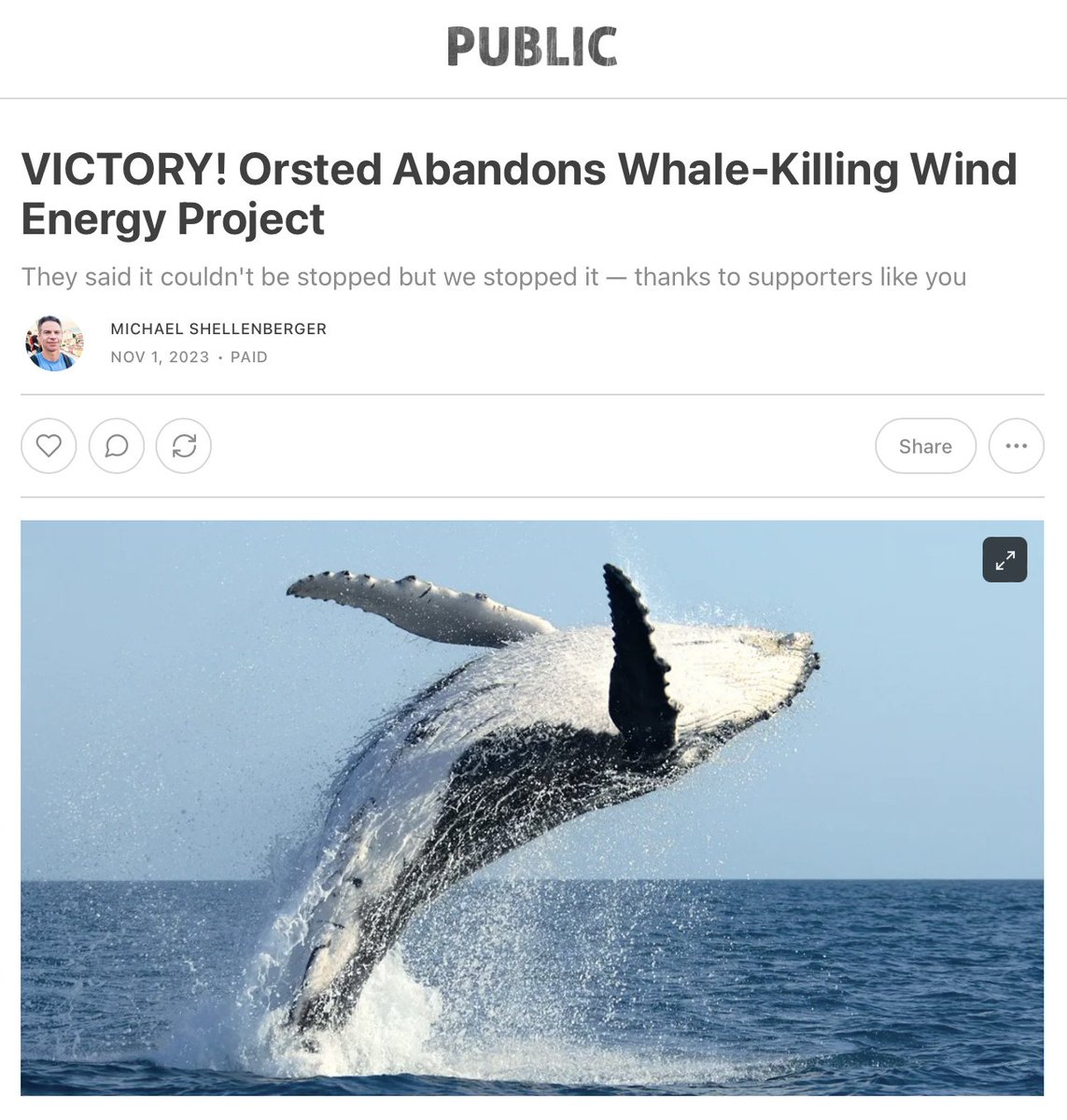
Experts said wind energy was good for the environment and the economy, but it wasn't. And now, with the cost of wind energy rising, along with industry demands for subsidies, @Orsted has abandoned the projects it had planned to build off the coast of New Jersey. Victory!!!
Michael Shellenberger tweet media
English
148
1.8K
7.2K
202.9K
Save Right Whales Coalition
The future of these magnificent endangered creatures hangs in the balance. Help us by spreading the word, sharing the letters and demanding accountability from @NOAA and @BOEM .
English
0
5
6
332
Save Right Whales Coalition
We’re not going to stop until we get some answers, and you shouldn’t either.
English
1
4
7
377