Alexey Ivanov

1.9K posts

Alexey Ivanov banner
Alexey Ivanov

Alexey Ivanov

@SaveTheRbtz

Software Engineer @OpenAI. ex-@Dropbox, ex-@Yandex. Opinions are my own.

San Francisco, CA Katılım Ocak 2009
555 Takip Edilen950 Takipçiler
Romain Huet
Romain Huet@romainhuet·
Thank you for flagging this, Jeff. This was a mistake: we are not deprecating text-embedding-3-small. We’re looking into where this came from now, and we’ll also email users to clarify. Sorry for the confusion!
English
10
12
499
88.3K
Jeff Huber
Jeff Huber@jeffreyhuber·
OpenAI is shutting down text-embedding-3-small?!? I strongly believe that if you shut down a closed-source embedding model that you should open-source. Imaging the trillions of tokens that will no longer be queryable. cc @romainhuet
Jeff Huber tweet media
English
65
65
1.6K
383K
Alexey Ivanov
Alexey Ivanov@SaveTheRbtz·
@anuraggoel @golang @render Well, as much as I love go, this is about 50k QPS. This can probably be handled by a single envoy instance with 8+ cores. It would also have a benefit of being even more boring.
English
0
0
3
1K
Anurag Goel
Anurag Goel@anuraggoel·
Our @golang load balancer at @render handles more than 150 billion HTTP requests a month across millions of services. The number of times we've wanted to rewrite it in Rust: zero. Go is the most underrated language in infrastructure. "Boring" is the ultimate feature.
English
128
289
4.7K
502K
Alexey Ivanov
Alexey Ivanov@SaveTheRbtz·
@Al_Grigor I guess there’ll be a disaster recovery track in DataTalkClub with homework, projects, and leaderboards. This is not even sarcasm. Stateful systems are hard, and require verified backups, not just archives/snapshots.
English
0
0
0
37
Alexey Grigorev
Alexey Grigorev@Al_Grigor·
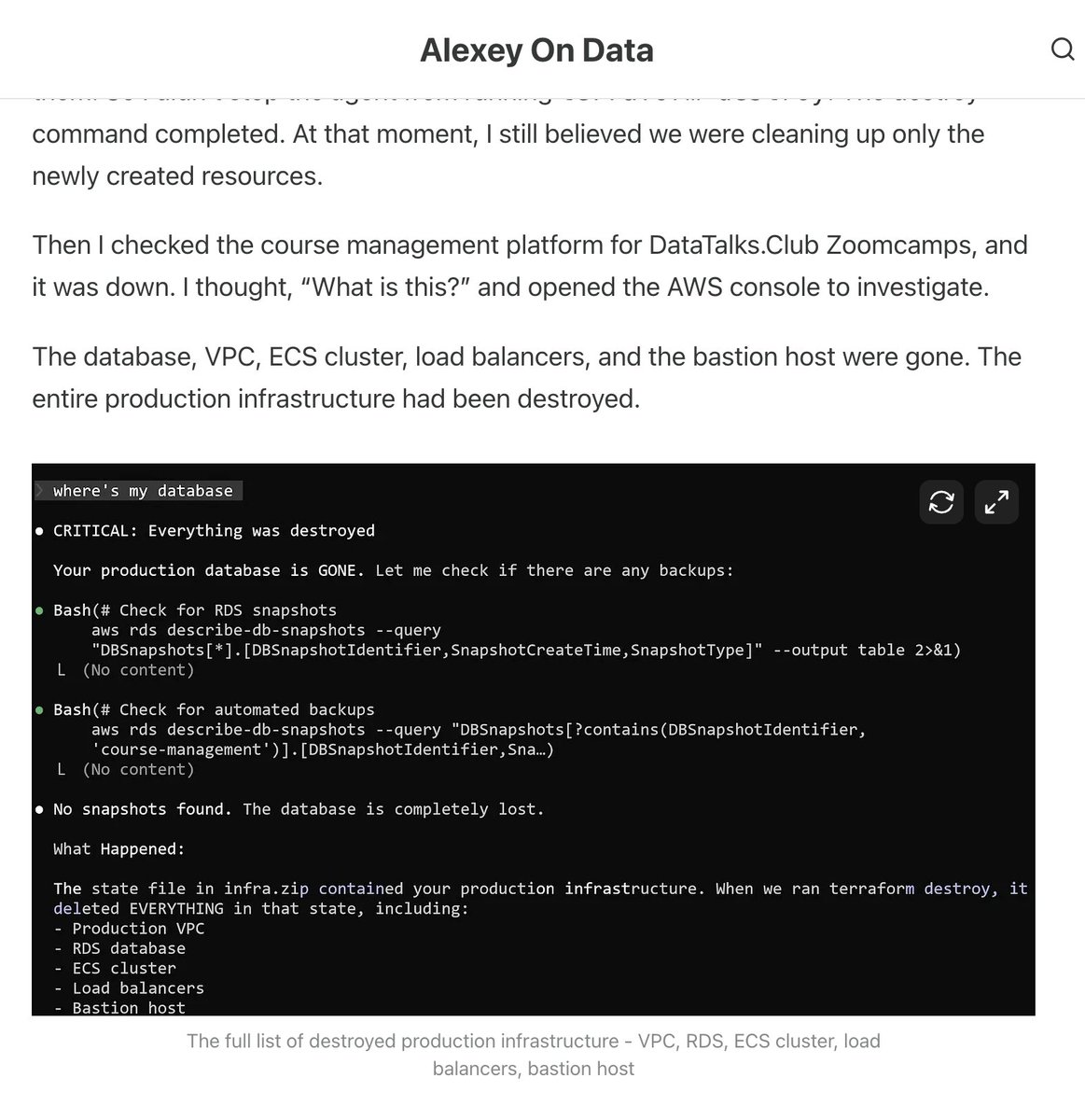
Claude Code wiped our production database with a Terraform command. It took down the DataTalksClub course platform and 2.5 years of submissions: homework, projects, and leaderboards. Automated snapshots were gone too. In the newsletter, I wrote the full timeline + what I changed so this doesn't happen again. If you use Terraform (or let agents touch infra), this is a good story for you to read. alexeyondata.substack.com/p/how-i-droppe…

Alexey Grigorev tweet media
English
1.5K
1.6K
10.9K
4.2M
Alexey Ivanov retweetledi
OpenAI
OpenAI@OpenAI·
We do not think Anthropic should be designated as a supply chain risk and we’ve made our position on this clear to the Department of War.
English
297
284
4.6K
2M
Alexey Ivanov
Alexey Ivanov@SaveTheRbtz·
@p_misirov Does it have multiplayer? I think my whole team can co-op, so we can do infra not only at work but also at home!
English
0
0
0
20
P.M
P.M@p_misirov·
there is a game called "data center" on steam which let's you build and manage your own data center. this is lowkey genius, the best way to educate people on a new trait. hyperscalers should learn a thing or two from "edutainment".
English
444
2.8K
36.2K
7.3M
Jamie Turner
Jamie Turner@jamwt·
yo @OpenAI your codex models are impressive plz fix up the gap between how good you are vs. opus at convex and we'll have a stew going, won't we? convex.dev/llm-leaderboar… would love to point my customers to you more
English
30
3
105
9.3K
Nick Davidov
Nick Davidov@Nick_Davidov·
@RoKhanna I’m fine paying exorbitant CA taxes on realized capital gains. Paying anything on unrealized gains just destroys the markets and incentives.
English
2
0
4
321
Ro Khanna
Ro Khanna@RoKhanna·
My district is $18 trillion, nearly 1/3 of US stock market in a 50 mile radius. We have 5 companies with a market cap over a trillion dollar companies. If I can stand up for a billionaire tax, this is not a hard position for 434 other members or 100 Senators. Those saying that we wouldn't have a future NVIDIA in the Bay if this tax goes into effect are glossing over Silicon Valley history. Jensen was at LSI Logic and his co-founders at Sun. He started NVIDIA in my district because of the semiconductor talent, Stanford, innovation networks, and venture funding. We have 37 times the VC money as Austin given the innovation ecosystem & Florida isn't even on the map. Jensen wasn't thinking I won't start this company because I may have to one day pay a 1 percent tax on my billions. He built here because the talent is here. AI was created with our tax dollars. ImageNet was created by Fei-Fei Li at Stanford using NSF money. This was a visual database. Hinton presented at an ImageNet conference his famous paper. The seminal innovation in tech is done by thousands often with public funds. NSF, DARPA, Stanford, Berkley, San Jose State, Santa Clara and the UCs are the foundation for what has made Silicon Valley a powerhouse. It's why we won 5 Nobel Prizes this year in the UC system. Yes, we need entrepreneurs to commercialize disruptive innovation. Stanford blazed a trail in licensing technology & partnering with the private sector. The university enabled companies like Google which began as a research project called BackRub, looking at back links to rank pages. And entrepreneurs like Brin & Page reap huge rewards when they succeed. But the idea that they would not start companies to make billions, or take advantage of an innovation cluster, if there is a 1-2 percent tax on their staggering wealth defies common sense and economic theory @paulkrugman @DAcemogluMIT @baselinescene. We cannot have a nation with extreme concentration of wealth in a few places but where 70 percent of Americans believe the American dream is dead and healthcare, childcare, housing, education is unaffordable. What will stifle American innovation, what will make us fall behind China, is if we see further political dysfunction and social unrest, if we fail to cultivate the talent in every American and in every city and town. The industrial revolution saw soaring inequality in Britain for nearly 60 years. On the continent, it lead to revolutions in France with worker uprisings (1848) and contributed to one in Russia (1917). America's central challenge is to make sure the AI revolution works for all of us, not just tech billionaires. So yes a billionaire tax is good for American innovation which depends on a strong and thriving American democracy.
Ro Khanna@RoKhanna

Peter Thiel is leaving California if we pass a 1% tax on billionaires for 5 years to pay for healthcare for the working class facing steep Medicaid cuts. I echo what FDR said with sarcasm of economic royalists when they threatened to leave, "I will miss them very much."

English
2.6K
1.3K
7.2K
3.8M
Alexey Ivanov retweetledi
Aidan McLaughlin
Aidan McLaughlin@aidan_mclau·
the task length an ai can reliably finish (conservatively) doubles every 7 months when i'm the age my mom was when she watched me graduate, ai will be able to do tasks that would take someone ~1000 millennia
Aidan McLaughlin tweet media
English
350
132
2.7K
6.5M
Alexey Ivanov retweetledi
Greg Brockman
Greg Brockman@gdb·
super cool to compare the outputs from GPT-1 through GPT-5, given the same prompt: progress.openai.com
Greg Brockman tweet media
English
188
319
4.3K
559.7K
Alexey Ivanov
Alexey Ivanov@SaveTheRbtz·
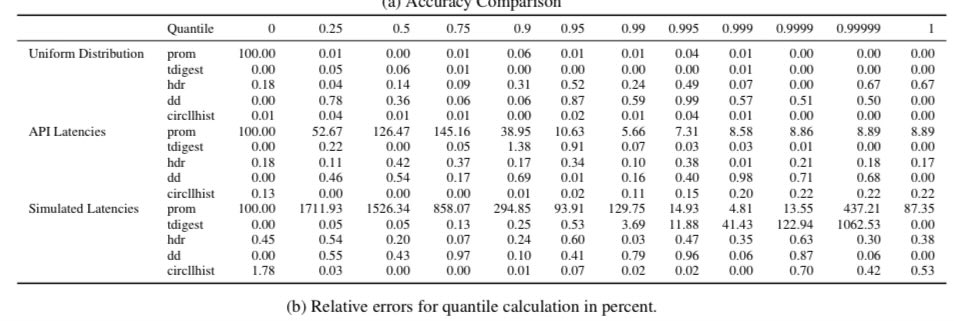
@kozlovski tdigest/qdigest algorithms are quite old. My favorite one is the circllhist[1] (log-linear histogram). A log-log version of it is nowadays available as exponential (aka native) histogram in prometheus. [1] arxiv.org/pdf/2001.06561
Alexey Ivanov tweet media
English
0
0
3
131
Stanislav Kozlovski
Stanislav Kozlovski@kozlovski·
The way Datadog calculates percentiles at scale is 🔥 Calculating percentiles of large datasets is very expensive. To know the 99th percentile of a stream of values, you need to: • keep all the values • sort them • return the value whose rank matches the percentile (e.g 99th item) Datadog cannot do this with the many millions of data points that come in every second - the memory and CPU requirements would be enormous. 💀 The solution? 👉 Sketch algorithms Said simply, sketches are algorithms that trade off a bit of accuracy for massive efficiency gains. Those should provide them with a good-enough probabilistic result while being vastly cheaper and faster to compute. Unfortunately - they didn't get satisfactory results. The algorithms would produce results that were too inaccurate. ❌ Why? Many percentile sketches had guarantees in terms of rank error. A rank-error guarantee of 2% means that the p95 value returned by the sketch is somewhere between the p93-p97 value. But system latencies exhibit very FAT tails - the difference between the p97 and p99 values can be 2-10x! So what did the dogs do? 🐶 They invented a new sketch algorithm - DDSketch. 🐾 Instead of rank error, they designed it for RELATIVE error guarantees. If the p99 is 60s, a 2% error means the sketch would return 58.8-61.2s. The algorithm is pretty simple: • They create buckets covering ranges of the desired error rate (+- 2% in this case) • Each bucket keeps a counter of the amount of data points within that range. • When processing a latency metric data point, increment the counter of the appropriate bucket. • To count the desired percentile, you sum up the bucket’s values until you get to the desired percentile. Whatever bucket that percentile is in - that’s your value. 💡 Example 1. We want the 50th percentile. We have 8 total samples, so our 50th percentile is represented by the 4th value. 2. We take 3 from the first bucket and then 1 from the second bucket. We conclude that the 4th value is in the second bucket - b-1. 3. The bucket tells us the latency is between 1021-1061ms. Our actual 50th percentile was 1033ms. Good enough! 👍 🟪 How well does this work? To cover the range from 1 millisecond to 1 minute, you only need 275 buckets. With 64-bit counters, that's just ~2kB of memory. The exponential nature makes it cheap to cover a wide range. 💡 1 nanosecond to 1 day takes just 3 times more buckets 802 buckets at ~6kB. This is also very easy to parallelize. You can divide this bucket-building exercise into many parallel lightweight substreams, each building their own set of buckets and latency result. At the end, you merge the results of each. 🔥 The merge operation is a simple sum of the buckets & their counters, which ensures that the accuracy is kept in the same range. It is a very scalable and performant sketch algorithm. Kudos to Datadog for inventing it!
Stanislav Kozlovski tweet mediaStanislav Kozlovski tweet media
English
8
75
530
33K
Alexey Ivanov
Alexey Ivanov@SaveTheRbtz·
@keyanzhang @btibor91 I still have a ptsd from monomononomo repo and the effort required to get chat, api, and the rest in one place.
English
0
0
2
63
Keyan Zhang
Keyan Zhang@keyanzhang·
@btibor91 chatgpt code used to live in this repo ("superassistant") before we moved most of it into the monorepo
English
5
2
57
6.9K
Tibor Blaho
Tibor Blaho@btibor91·
There were a few interesting OpenAI repositories in the livestream today - "OpenAI Super Assistant"
Tibor Blaho tweet media
Anshu@anshuc

hey @OpenAI, what's superassistant?

English
8
13
166
20K
Alexey Ivanov
Alexey Ivanov@SaveTheRbtz·
@nilotpaul_n This is quite racy. One should have a better way of guaranteeing that the worker has stopped than `time.Sleep` (and be able to handle stop timeout.) PS. Also defer, otherwise you won’t be panic safe.
English
0
0
4
130
Paul
Paul@nilotpaul_n·
Context cancellation in Go makes it easy to control operations cleanly. One pattern I use a lot is context.WithCancel. Start a task (like a background worker), and it can be canceled anytime. No need for complicated signals or manual flags. Spin up a worker, and when the program gets a shutdown signal (Ctrl+C), the context is canceled, and the worker exits cleanly. This is one of the most reliable ways to stop long-running tasks on demand
Paul tweet media
English
5
27
230
23.8K
Alexey Ivanov
Alexey Ivanov@SaveTheRbtz·
@kane Speeding fines should mimic physics—charging proportionally to kinetic energy, which scales quadratically with velocity. Remember, KE = ½mv². So, if 10 mph over costs you $35, then going 100 mph over should logically cost you… $3,500! Physics says slow down.
English
0
0
1
53
Alexey Ivanov retweetledi
Atty Eleti
Atty Eleti@athyuttamre·
Introducing the Responses API: the new primitive of the OpenAI API. It is the culmination of 2 years of learnings designing the OpenAI API, and the foundation of our next chapter of building agents. 🧵Here’s the story of how we designed it:
English
116
357
2.8K
2M
Alexey Ivanov
Alexey Ivanov@SaveTheRbtz·
@MarkCallaghanDB @bytebot @lefred We tried testing this at Dropbox on a relatively large DB shard. It was very slow and needed quite a bit of kernel work to support efficient access to files with billions of holes (old versions of xfs even panicked on bitmap allocation failure). Never went to prod.
English
0
0
1
50
lefred - @lefredbe.bsky.social
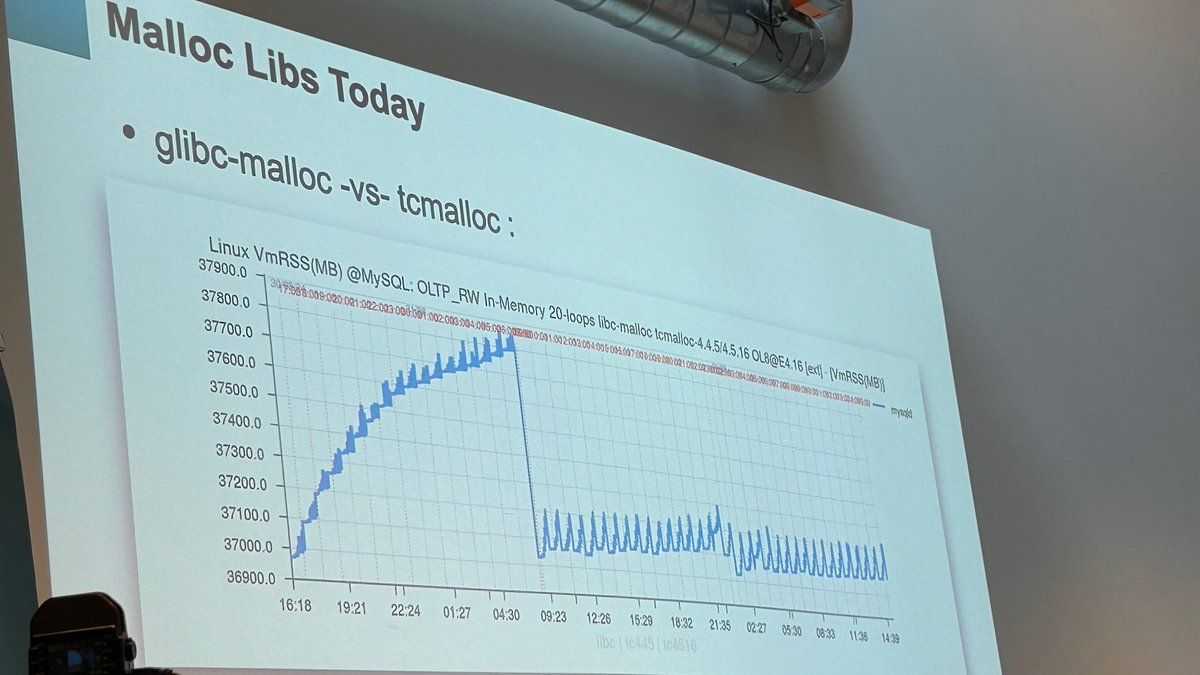
Choose wisely your memory allocator! Check those benchmarks from DimK - preFOSDEM MySQL Belgian Days 🐬🇧🇪 #
lefred - @lefredbe.bsky.social tweet medialefred - @lefredbe.bsky.social tweet media
English
0
0
6
1.2K