Sean

1.3K posts

Sean

Sean

@SeanRumrill

Katılım Ekim 2012
634 Takip Edilen56 Takipçiler
Sean retweetledi
Math Files
Math Files@Math_files·
One day, mathematician Shizuo Kakutani was teaching a class at Yale University. During the lecture, he wrote a lemma on the blackboard and told the students that its proof was obvious. A student hesitantly raised his hand and said that the proof was not obvious to him. He politely asked if Professor Kakutani could explain it. Kakutani paused for a moment and tried to think through the argument. After a while, he realized something surprising—he could not immediately prove the lemma himself. Smiling a little awkwardly, he apologized to the class and said he would return with the proof in the next lecture. After the class ended, Kakutani went straight to his office and began working on it. He spent a long time trying different ideas, but the proof would not come. The problem kept bothering him. Eventually, he decided to search the library for the original source of the lemma. After some effort, he finally located the paper where the lemma first appeared. The statement was written clearly. Then he looked at the proof. Instead of a detailed explanation, it simply said: “Exercise for the reader.” At that moment, Kakutani realized something amusing—the paper had been written years earlier… by himself. It was a gentle reminder that even great mathematicians sometimes forget the details of their own work.
Math Files tweet media
English
40
377
4.8K
312.5K
Sean
Sean@SeanRumrill·
@choffstein @ptuomov sorry, can we go back to the part where volatility drag was referred to as "misapplied math"? long-time follower of both you guys, so i know you're informed and arguing in good faith. Corey has a blogpost on this topic I have revisited several times over the years.
English
0
0
0
9
Corey Hoffstein 🏴‍☠️
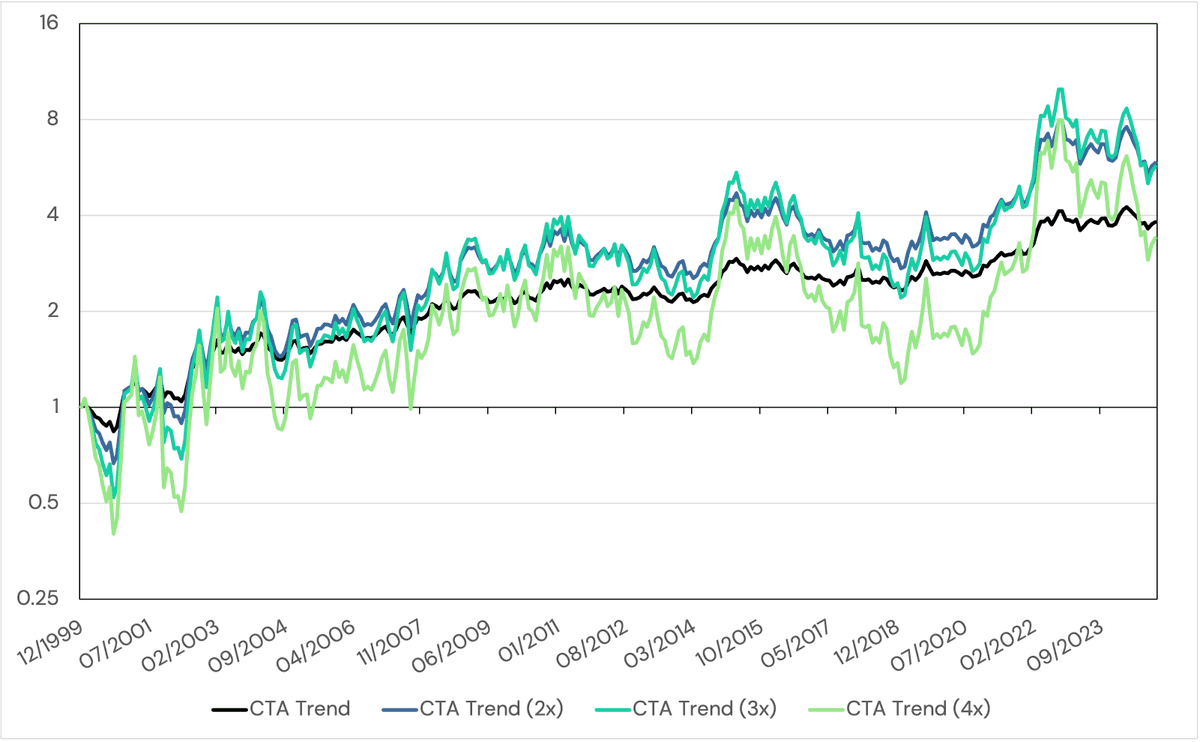
A lot of people ask me for higher volatility alternatives for "capital efficiency" reasons. And on it's face, it makes sense. Instead of putting $100 in a 10% vol strategy, you can just put $25 in a 40% vol strategy. But there are two problems: 1. Versus turnkey portable alpha programs, it pushes the rebalancing onus onto the allocator. 2. It forces the manager to inherit variance drain into their track record, which ruins salability.
Corey Hoffstein 🏴‍☠️ tweet media
English
17
2
84
13.4K
Sean
Sean@SeanRumrill·
@egr_investor very nifty tool, thanks for making and sharing it
English
0
0
1
30
Engineer Investor
Engineer Investor@egr_investor·
James Choi’s framework treats future labor income as a bond-like asset, which helps justify more stocks when you’re young. But that assumption seems shakier in tech or venture-backed industries. If 60–70% of your comp is RSUs and layoffs hit every 12–18 months, your human capital may be part bond, part risky equity-like claim. That doesn’t feel “safe” at all, especially if your next job could pay half as much. #Investing #Finance #PersonalFinance #StockMarket
Engineer Investor@egr_investor

How much should you invest in stocks? A Yale finance professor (James Choi) has a new “practical finance” formula that often says: you probably need MORE stocks than 60/40 or “100−age.” The twist: it uses your income + savings + risk tolerance, not a one-size rule. Let’s dive in! 🧵👇 #investing #finance #personalfinance

English
4
0
11
2K
Sean
Sean@SeanRumrill·
@Alpha_Ex_LLC @dampedspring yeah, i suppose it comes down to what was meant by "asymmetry". seems like everyone is aligned regarding the facts.
English
0
0
1
21
Alpha_Ex_LLC
Alpha_Ex_LLC@Alpha_Ex_LLC·
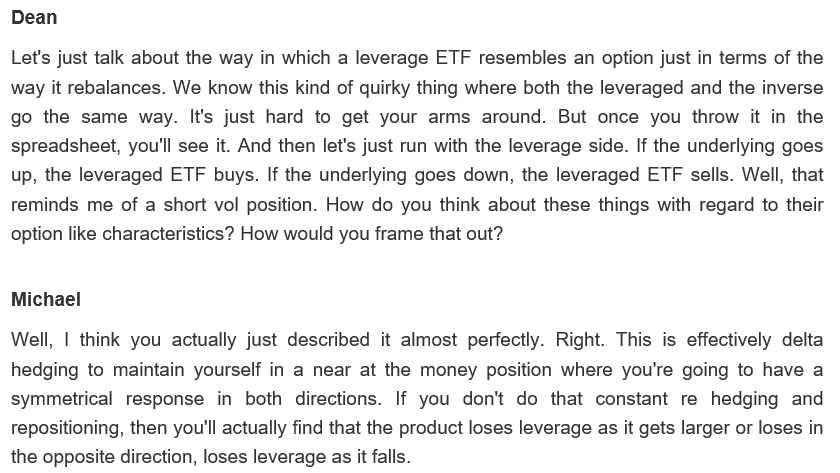
I think this is a "short form" failure of twitter conversations where it's easy to misunderstand each other ... I can promise you he gets the math quite well...I hosted Mike on my podcast back in 2024 to discuss lev ETFs with attention to those on MSTR. btw, Andy, you are an exceptional thinker on markets. Mike is also super sharp. Perhaps I can broker an unwind of the blocking. I'm a good salesperson. podcasts.apple.com/us/podcast/mic…
Alpha_Ex_LLC tweet media
English
1
0
1
59
Andy Constan
Andy Constan@dampedspring·
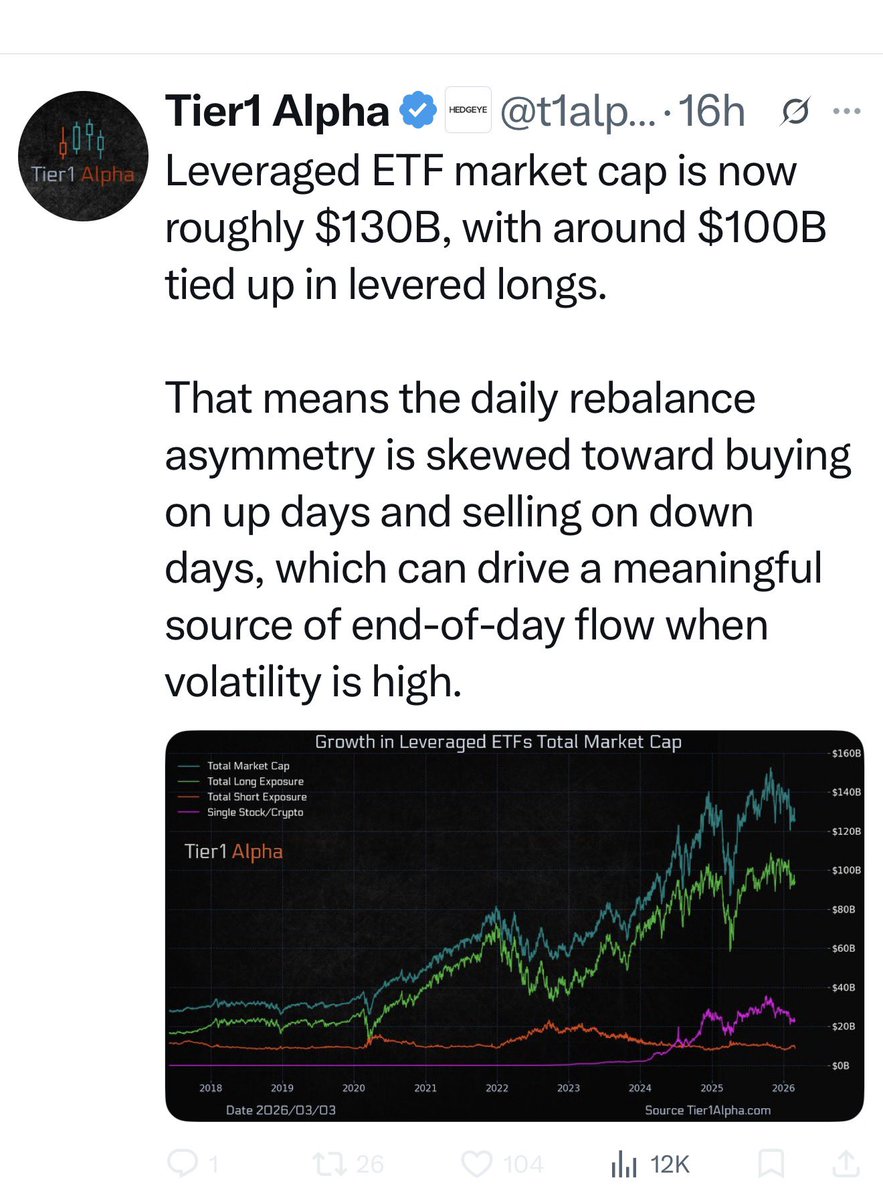
I'm blocked for a reason unknown to me but this tweet is wrong. Both long and short leveraged ETF's rebalance by selling into weakness and buying into strength. The fact that long leveraged ETF's dominate the AUM is irrelevant
Andy Constan tweet media
English
12
4
54
40.6K
Sean
Sean@SeanRumrill·
@dampedspring @Alpha_Ex_LLC Agree with Andy. The original tweet suggests the asymmetry in AUM btw levered long vs. short funds is contributing to end of day flow when market is volatile. Andy is saying both long and short funds do same thing in up/down market, so the “asymmetry” of AUM is irrelevant.
English
1
0
0
30
Andy Constan
Andy Constan@dampedspring·
The big risk for a major risk premium expansion would be a Fed balance sheet roll down and or an unpaid for government spending plan
English
9
4
37
0
Andy Constan
Andy Constan@dampedspring·
Risk premium 101. What is risk premium? It is the extra return that is offered to someone with cash to purchase an asset with market risk. Cash can be spent today. Cash can be used to pay off debt today cash can be saved today in a bank or mattress or a money market fund.
English
16
71
343
0
Sean
Sean@SeanRumrill·
@grok @dampedspring So now we are talking about a lot of effort to understand the expected return of even just the basic “beta” portfolio, making us reliant on someone with the skill of understanding these technical facets or to develop the skills to navigate it oneself (expensive either way)
English
1
0
0
5
Grok
Grok@grok·
Endogeneity of money means supply adjusts to demand (e.g., via bank lending), so track credit creation metrics like M2 growth alongside central bank actions. For shifting cash definitions, include near-money assets (e.g., money market funds, stablecoins) in liquidity measures. In risk premium models, adjust by monitoring broad money aggregates and velocity to gauge true availability vs. asset supply.
English
1
0
0
14
Sean
Sean@SeanRumrill·
@dampedspring @grok was this an accurate market top call in hindsight, and if so, was the causal/risk claim supported by the actual unfolding of events
English
1
0
0
11
Sean
Sean@SeanRumrill·
@dampedspring @grok how to account for endogeneity of money, shifting definitions of cash
English
1
0
0
8
Andy Constan
Andy Constan@dampedspring·
When cash is plentiful and issuers of debt and equity need very little cash. Risk premiums tend to be low. When cash is tight and/or issuers are looking to sell a lot of debt and equity risk premiums tend to be high.
English
2
2
28
0
Sean retweetledi
⟠Palis⟠🐍
⟠Palis⟠🐍@palis·
It’s messing with my head how emblematic they are of the two schools. Alysa Liu is a Berkeley alt skater girl and Eileen looks like she was made in a Stanford laboratory (skier) If this was a fictional movie about the two school’s rivalry expressed in an apropos wasian competition, the actresses you’d cast for each school would look exactly like these two people We live in some kind of simulation
English
68
208
8.5K
784.4K
Sean
Sean@SeanRumrill·
@choffstein thanks for helping me understand!
English
1
0
3
300
Corey Hoffstein 🏴‍☠️
Corey Hoffstein 🏴‍☠️@choffstein·
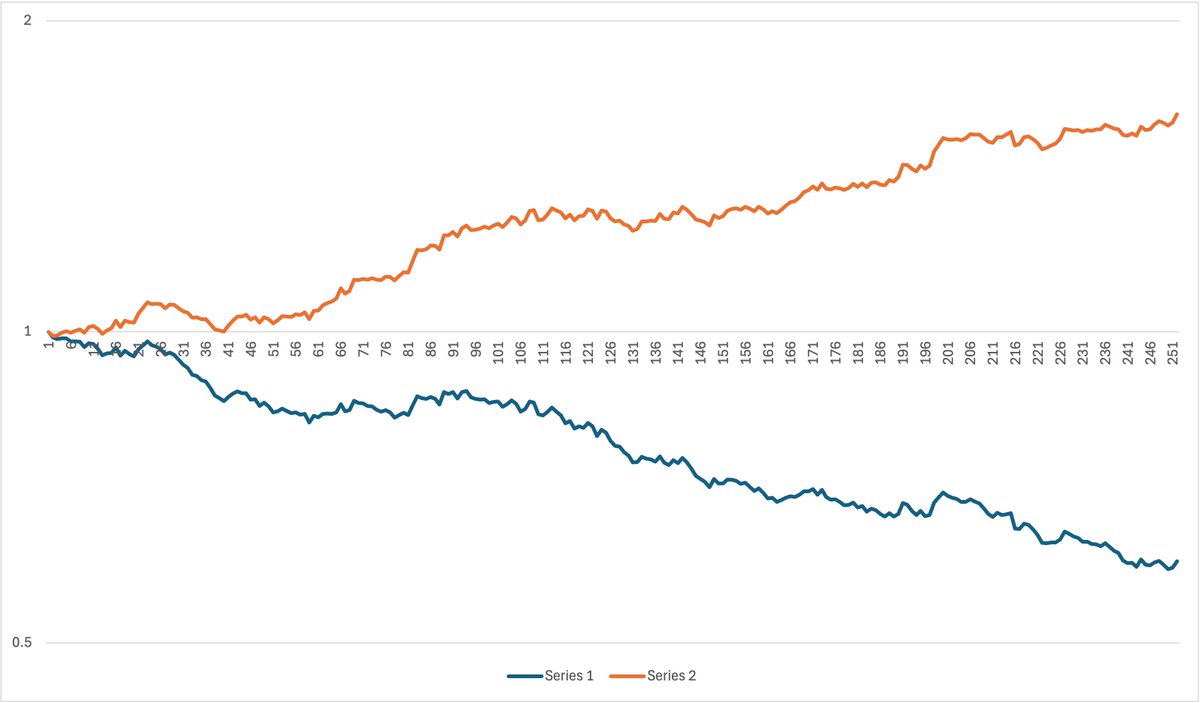
The returns of these series have a correlation of 1. Remember, covariance measures how the variables co-vary around their means.
Corey Hoffstein 🏴‍☠️ tweet media
English
4
0
18
744
Corey Hoffstein 🏴‍☠️
Corey Hoffstein 🏴‍☠️@choffstein·
Why Bonds Still Belong: Rethinking Fixed Income in Modern Portfolios There’s also a common misconception around correlation itself. Two assets can be perfectly correlated and still move in different directions. Correlation captures relative movement, not absolute return. So, while it’s possible that bonds no longer hedge the short-term volatility of stocks, they may still drift differently over time. Combining stocks and bonds, then, may do less to dampen volatility but can still significantly dampen dispersion in expected terminal wealth.
Vik Pansare@pansareV

Great article that hits on some subtle but important points by @choffstein returnstacked.com/why-bonds-stil…

English
9
10
101
41.6K
Sean retweetledi
Dr Kareem Carr
Dr Kareem Carr@kareem_carr·
statistics is cool
Dr Kareem Carr tweet media
English
33
354
2.1K
62K
Sean
Sean@SeanRumrill·
@cullenroche But the risk of extreme losses gets bigger with time. As does magnitude of within horizon losses. Markets can and do go to zero. Or are just flat for 30+ years.
English
0
0
0
19
Sean
Sean@SeanRumrill·
@cullenroche I’ll have to go back and reread your paper. But my sense is that any approach that assumes stocks will work if just given long enough is guilty of the time div fallacy.
English
1
0
0
37
Cullen Roche
Cullen Roche@cullenroche·
@SeanRumrill That's not the premise here. The premise is that stocks are long duration instruments and have a significant and unpredictable sequence of returns risk which requires diversification across OTHER assets with shorter time horizons.
English
1
0
0
61
Cullen Roche
Cullen Roche@cullenroche·
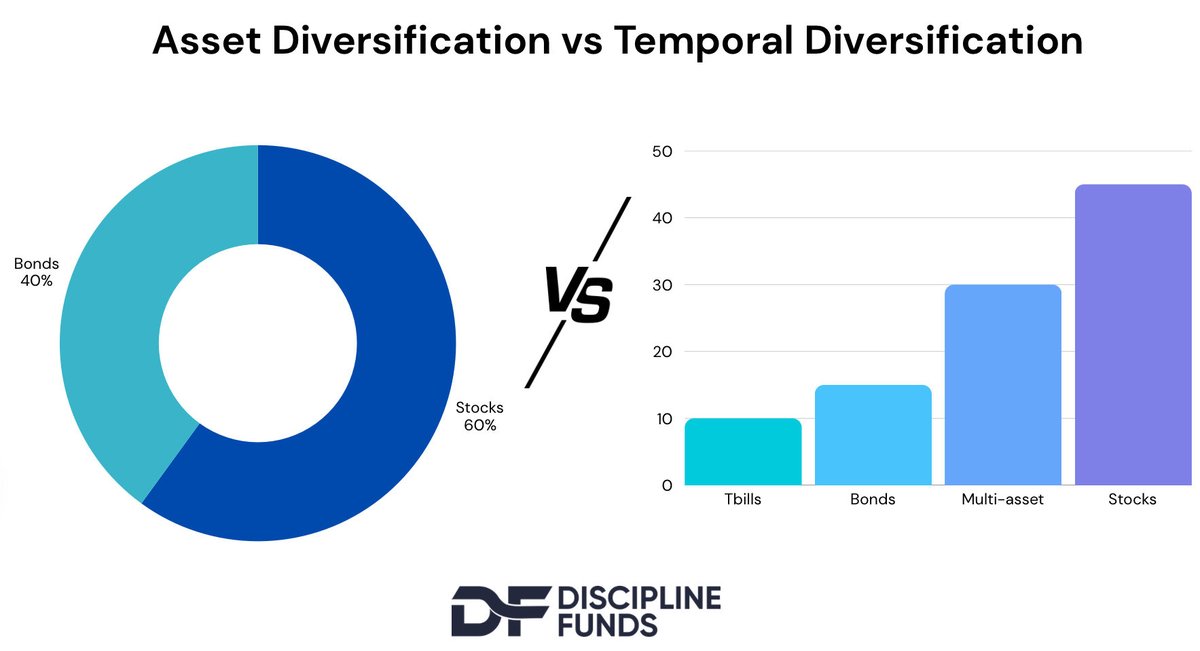
The power of asset-liability matching in one image. The chart on the left is a traditional presentation of asset diversification. The chart on the right is an ALM based presentation of temporal diversification. The chart on the right could be roughly 60/40, but unlike a simple 60/40 index its disaggregated components tell a very different story. Not only does the chart on the right have a lower sequence of returns risk, but it communicates a totally different story to the investor because it shows you more clearly, how certain assets align with your life’s corresponding financial needs. Good asset allocation can’t only be a process in asset diversification. For good financial planning it needs to also be a process in quantifying and communicating time horizons.
Cullen Roche tweet media
English
3
2
20
5.8K