Sebastian Asprella

5.7K posts

Sebastian Asprella banner
Sebastian Asprella

Sebastian Asprella

@SebaAsprella

Accelerating EU and protecting the skies from rogue drones

Mars Katılım Kasım 2021
253 Takip Edilen697 Takipçiler
Sebastian Asprella
Sebastian Asprella@SebaAsprella·
C-UAS built around does it look like a drone? will break. Bird-like ISR attacks the false-positive boundary: biological motion, low acoustic cues, natural silhouette, ambiguous radar/visual signature. The answer is not one better classifier. It is decision-quality sensing: fusion, continuity, context, and uncertainty
Atoms Not Bits@AtomsNotBits

Breaking: Ornadyne has launched out of YC to build robotic birds for military reconnaissance. C-UAS has a potential blind spot: birds. Traditional systems are built to detect rotor and fixed-wing drones, while flapping-wing platforms introduce a different signature set, closer to how birds move, look, and sound in the field. The U.S. has been here before. AeroVironment built the Nano Hummingbird in partnership with DARPA, a miniature drone engineered to look and fly like a hummingbird. It flew for 11 minutes and ran surveillance mission sets in tight indoor environments, a key proof point for urban operations. Earlier still, in the 1970s, the CIA developed a dragonfly-shaped, gas-powered drone for intelligence collection. The platform never made it past crosswind control problems. America has had a few notable ornithopter projects (robotic bird-scale flapping wing), but development has lagged behind countries like China, which has fielded dove look-alike drones reportedly capable of mimicking 90% of a real bird's movement. America has a potential answer via YC. Ornadyne, which just launched, builds "Robot Birds for Reconnaissance." We spoke with the team. Their first target customer is U.S. SOCOM. "Special operations users have an acute need for small, portable ISR systems that can operate close to the target while minimizing visual and acoustic cues," the team told us. "That mission profile maps well to what a bird-like Group 1 aircraft is designed to do." Law enforcement is a longer-term market expansion. Below is our Q&A with the team, lightly edited for clarity: Question: How does Ornadyne's bird-like form factor help it evade today's counter-UAS systems compared to quadcopters or FPV drones? Ornadyne's advantage is not that a bird-like drone is "invisible," but that it presents a very different signature than the drones most counter-UAS systems are optimized to find. Most small drones today have obvious cues: exposed propellers, strong tonal acoustic signatures, rigid-body flight paths, and visual profiles that look like quadcopters or fixed-wing aircraft. A flapping-wing platform changes that signature. It removes propeller-driven flight as the dominant acoustic and visual cue, uses a more natural silhouette, and moves in a way that looks closer to biological flight. In many counter-UAS systems, birds are not the target. They are the noise. This is because counter-UAS systems have to manage false positives. Birds, clutter, and harmless objects can overwhelm detection pipelines, so many systems are tuned to classify or filter those out. Ornadyne's thesis is that by building ornithopters that look, move, and sound more like birds than drones, we can operate in a harder-to-classify signature space: falling into that noise instead of standing out as another quadcopter, FPV drone, or fixed-wing UAS. Question: The U.S. had DARPA’s Nano Hummingbird over a decade ago. Why has there been so little visible progress since? DARPA clearly understood the value of biomimetic flight early. The Nano Hummingbird was an incredible technical achievement. The issue was not that the concept lacked value. The issue was that the timing was early. At that scale, endurance, payload, manufacturability, control, and cost were not yet aligned with what the military needed. A drone that looks exactly like a bird is awesome, but if it only flies for minutes and is difficult to build or ruggedize, it's not really productizable. The market just rewarded much simpler architecture. Quadcopters, fixed-wing Group 1 UAS, and systems like the Black Hornet by Teledyne, which ultimately took the place of the Nano Hummingbird. The U.S. helped pioneer bird-like flight with the Nano Hummingbird, but after that lead we didn't really pursue it much further. Now, Europe and China are far ahead in both academia and industry with bird robotics. Ornadyne’s mission is to put the U.S. back at the forefront of bird-like aerial systems starting with the longest-flying ornithopter produced in the states. Question: How much processing can happen on the edge given the size, weight, and power limits? For the first version, we're prioritizing flight performance and payload over heavy onboard AI. The near-term architecture is to stream imagery to the ground station, where more compute-intensive processing can happen offboard. Over time, as chips get more power efficient, and model distillation gets better, we'll begin to integrate basic perception, navigation, and lightweight autonomy features. The key is not to overload the first aircraft with every autonomy feature on day one. Our near-term goal is to build a useful low-signature ISR platform. Then progressively add onboard intelligence as the aircraft’s power and payload margins improve. Question: What new / unique mission sets does this unlock? The first mission set is low-signature close-range reconnaissance in environments where conventional drones are too obvious. A bird-like aircraft creates a different option: persistent or semi-persistent observation from a platform that looks and sounds less like a traditional drone. That unlocks missions where the goal is not just to see the target, but to observe without immediately changing the target’s behavior. Examples include reconnaissance in contested areas, surveillance around sensitive facilities, route observation, perimeter monitoring, etc. Basically, anywhere where drone presence would compromise the mission. Our birds can also be configured with mission-specific colorways and proportions based on bird species common to the operating region. Question: If Ornadyne works, how does it change the battlefield? If Ornadyne works, it changes the assumption that every useful aerial ISR platform has to look like a drone. Today, the battlefield is adapting quickly to quadcopters, FPV aircraft, and fixed-wing UAS. Fighters can hear them, spot them, jam them, and increasingly treat anything drone-shaped as a threat. Ornadyne is taking a different approach. Instead of making a conventional drone slightly quieter, slightly smaller, or slightly harder to see, we are building aircraft that blend into the natural aerial environment and are quieter via first principles. There is no camouflage or “invisible paint” for something flying in the open sky. The best camouflage is to look like something that already belongs there (especially at low altitudes). Birds are already everywhere, and most people do not treat them as suspicious. If we can make that practical for ISR, bird-like aircraft become a new class of reconnaissance platform: one designed around ambiguity, low observability, and naturalistic flight from the beginning. Question: Are you building a better small drone, or a new class of ISR platform current counter-UAS systems were not built to recognize? We are building a new class of ISR platform. A better quadcopter is still a quadcopter. A better fixed-wing drone is still a fixed-wing drone. Ornadyne is building around the assumption that the final frontier of close-range ISR should not just be smaller, faster, or cheaper. It should be harder to notice, harder to classify, and easier to mistake for something already present in the environment. So the product is not just a better small drone. It is a robot bird designed for a world where conventional drones are becoming easier to detect and counter.

English
0
0
2
97
Sebastian Asprella
Sebastian Asprella@SebaAsprella·
@adcock_brett @jspujji Interesting how it decides to climb stairs sideways. How long until we start learning from robots about most optimal mobility?
English
0
0
0
69
Brett Adcock
Brett Adcock@adcock_brett·
F.03 can now walk up/down stairs purely using it's onboard camera perception Our robots now walk from manufacturing when built to HQ This is trained end-to-end with reinforcement learning in simulation
English
85
129
1.9K
170.1K
Sebastian Asprella
Sebastian Asprella@SebaAsprella·
@SamaHoole We will look back at ultra-processed foods, as we look back today at tobacco, or lead in gasoline/ paint..
English
1
1
26
1.1K
Sama Hoole
Sama Hoole@SamaHoole·
Before 1850: all milk was raw, drunk by the gallon, and considered medicine. Before 1900: everyone ate eggs, beef, and butter without a single thought about cholesterol. Before 1910: every household used salt to preserve meat and fish through the winter. Before 1920: everything was cooked in tallow, lard, dripping, and butter. Before 1950: there was no obesity epidemic, no diabetes epidemic, no childhood ADHD diagnosis on every street. Now consider the timeline. The seed oils arrived. The margarine arrived. The breakfast cereal arrived. The low-fat yoghurts arrived. The packaged convenience food arrived. The supermarket aisles filled up with products that had no equivalent on a 1900 dinner table. And the experts are still trying to convince you that chronic disease is caused by the foods that fed humanity for the entire stretch of recorded history. Not the new arrivals. The old reliables. Have a think about who benefits from that conclusion.
English
215
548
1.6K
308.9K
Jakob Diepenbrock
Jakob Diepenbrock@jakobdiepen·
🇺🇸 EXCLUSIVE: @PalmerLuckey x @DiscipulusVent Spring Demo Day Fireside Chat. We cover Why El Segundo, Founding Anduril, Defense Tech Incentives, State of Hardtech VC, SVB Collapse, Erebor, Founder Advice, & more. Highlights: (00:00) Palmer Luckey (00:20) Why Anduril chose El Segundo over the Bay Area (01:20) The Facebook acquisition & Bay Area mercenary problem (02:43) Building across veterans, Democrats, Republicans & libertarians (03:33) How the four Anduril founders' roles have evolved (04:21) "Want to work on tech? Don't start a company" (06:02) What Palmer learned from Oculus about delegation (06:44) How not to become Lockheed or Raytheon (07:33) Why the government rewards being slow & expensive (09:25) Anduril's real failure mode: becoming Google, not Lockheed (10:21) The state of hardtech venture capital (10:55) Why ZIRP killed serious investing (12:31) The vibe shift toward energy, defense & agriculture (13:01) Erebor & the SVB collapse that almost killed Anduril (13:32) Why no American bank is actually aligned with America (15:18) How Biden accidentally saved Anduril (17:10) Palmer's one piece of advice for founders (17:38) Bonus: the One Piece anime fan edit
English
15
35
303
25.9K
Sebastian Asprella
Sebastian Asprella@SebaAsprella·
Europe’s defence budgets are rising. That does not reduce buyer diligence. In C-UAS and site protection, the bottleneck is still documented performance in relevant operating conditions.
English
0
1
2
156
Aakash Gupta
Aakash Gupta@aakashgupta·
68 college students played video games an hour a day for 30 weeks. They got measurably smarter. EEG brain scans confirmed it. The setup was simple. Half the group played League of Legends, an action game. The other half played Legends of the Three Kingdoms, a strategy card game. Same hours, same schedule, no gaming experience for anyone going in. Both groups improved on attention, working memory, and executive function. The League group's gains were significantly larger in spatial attention and spatial working memory. The benefits were still measurable 10 weeks after the gaming stopped. None of this is new. Daphne Bavelier's lab at the University of Geneva has been replicating this finding since the early 2000s. Her 2018 meta-analysis in Psychological Bulletin pulled data from 8,970 participants across 15 years and found the same thing. Action games train attentional control, a brain skill that transfers to other tasks. Strategy games train deliberation, which mostly stays inside the strategy game. The mechanism is the counterintuitive part. Action games train your brain by giving you no time to think. The brain can't deliberate. League of Legends throws 9 champions, hundreds of minions, dozens of abilities, mana, cooldowns, and map state at you, all updating in milliseconds. The brain learns to perceive faster instead. That perceptual speed transfers to anything else that demands the same skill. Including surgery. The 2007 Rosser study in Archives of Surgery found that laparoscopic surgeons who played video games more than 3 hours a week made 37% fewer errors, completed procedures 27% faster, and scored 42% higher on overall performance. The top third of gamers made 47% fewer errors. Laparoscopic surgery is a 2D screen with distorted depth perception, remote-controlled instruments, and multiple data streams updating in real time. The cognitive profile is almost identical to an action video game. The 10-week persistence is the part that should change how this gets discussed. If the gains were just from practicing the game, they would have disappeared the moment the students stopped playing. They didn't. The 30 weeks rewired the perceptual system, and the rewiring stayed.
Aakash Gupta tweet media
English
177
644
4.9K
1.4M
Sebastian Asprella
Sebastian Asprella@SebaAsprella·
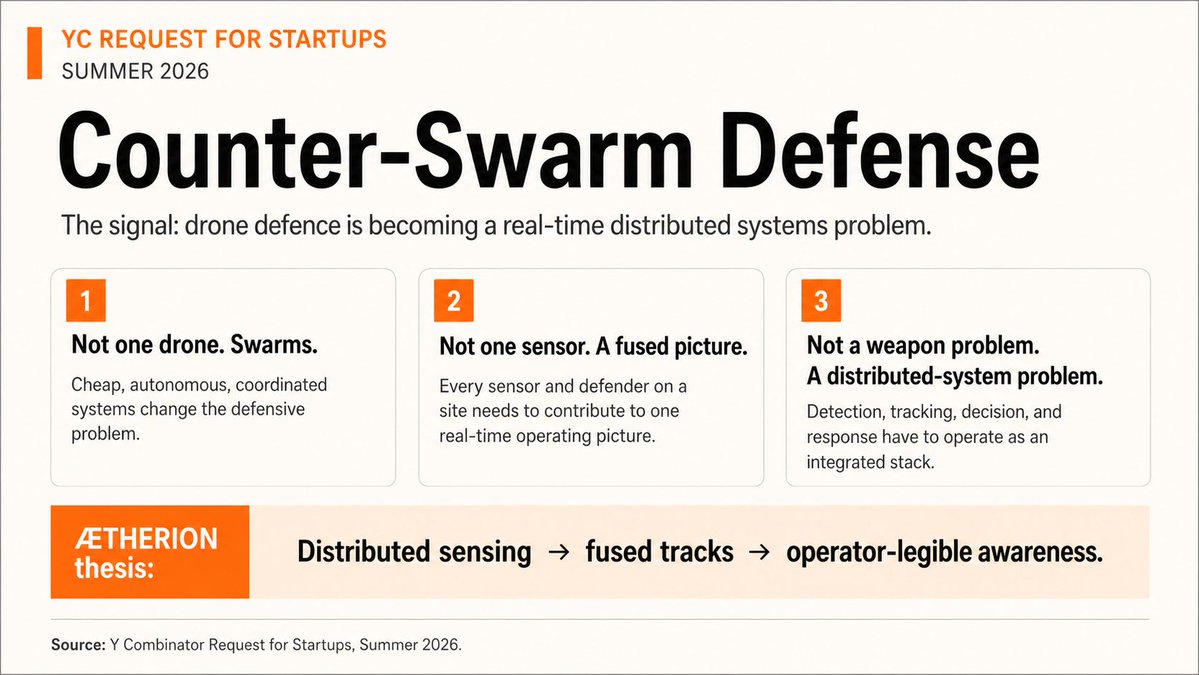
YC’s latest Requests for Startups includes Counter-Swarm Defense. The important signal: counter-drone defence is shifting from standalone hardware to real-time distributed systems. Not one drone. Swarms. Not one sensor. A fused picture. Not a weapon problem. An integrated sensing + decision stack. That is the architecture shift we are building for at ÆTHERION.
Sebastian Asprella tweet media
English
0
1
4
260
Sebastian Asprella
Sebastian Asprella@SebaAsprella·
I’ve been posting about the sensing layer, clutter, procurement, and low-altitude airspace for a reason. This is what we’re building at ÆTHERION: EU-sovereign sensing for low-altitude airspace awareness at critical infrastructure. Near-term: counter-UAS. Bigger thesis: infrastructure-grade airspace awareness for Europe. Website in bio.
English
0
2
6
216
Sebastian Asprella
Sebastian Asprella@SebaAsprella·
YC is right. The next counter-UAS wave is not one exquisite sensor or one expensive interceptor. It is a real-time distributed system: distributed sensing → fused tracks → intent gating → C2 integration → optional effectors. At ÆTHERION, we are building the EU-sovereign site layer for this: low-cost mmWave radar fabric for airports, ports, energy sites, data centres and defence infrastructure. The bottleneck is no longer “can a drone be detected?” It is: can you do it affordably, at density, in clutter, with low false alarms, and with evidence strong enough for procurement?
Y Combinator@ycombinator

Counter-Swarm Defense @bosmeny A Patriot missile costs $3 million. An FPV drone costs $500. All the cost advantage lies with the attackers, and the next wave isn't one drone, it's swarms. Drone defense is starting to look less like operating a weapon and more like running a real-time distributed system. We want to fund founders building the counter-swarm stack.

English
0
0
4
131
Sebastian Asprella
Sebastian Asprella@SebaAsprella·
@noverloop @bosmeny Exactly. Defence company structure is not cosmetic, it affects sovereignty, export controls, market access, and customer trust. ÆTHERION is Europe-first by design, with allied interoperability in mind.
English
0
0
0
19
Nicolas Overloop
Nicolas Overloop@noverloop·
@SebaAsprella @bosmeny There’s ITAR downside when you setup an American company fyi. Your company needs to be controlled by an American (board control)
English
1
0
1
34
Tyler Bosmeny
Tyler Bosmeny@bosmeny·
If you want to help make America safer, I want to meet to you.
Y Combinator@ycombinator

Counter-Swarm Defense @bosmeny A Patriot missile costs $3 million. An FPV drone costs $500. All the cost advantage lies with the attackers, and the next wave isn't one drone, it's swarms. Drone defense is starting to look less like operating a weapon and more like running a real-time distributed system. We want to fund founders building the counter-swarm stack.

English
22
3
112
38.4K
Sebastian Asprella
Sebastian Asprella@SebaAsprella·
Exactly. Counter-swarm is becoming a distributed systems problem: sensing density, edge fusion, track continuity in clutter, EW resilience, and cost per defended metre. Interceptors matter, but the winning stack starts with cheap, persistent, sovereign detection/tracking at the edge. That is the layer we are building at ÆTHERION, Tyler. TRL-5 reached.
English
1
0
3
936
Y Combinator
Y Combinator@ycombinator·
Counter-Swarm Defense @bosmeny A Patriot missile costs $3 million. An FPV drone costs $500. All the cost advantage lies with the attackers, and the next wave isn't one drone, it's swarms. Drone defense is starting to look less like operating a weapon and more like running a real-time distributed system. We want to fund founders building the counter-swarm stack.
English
26
13
271
163.9K
Y Combinator
Y Combinator@ycombinator·
AI has stopped being a feature and started being the foundation. We're excited about a new wave of startups rebuilding software, services, and silicon— and pushing AI into the physical world. ycombinator.com/rfs
Y Combinator tweet media
English
196
959
8.9K
4.3M
Sebastian Asprella
Sebastian Asprella@SebaAsprella·
@MPrinParr That is a suboptimal solution. We need intelligent sensing, that will also allow low airspace last mile delivery, first responder, etc
English
0
0
1
192
Sama Hoole
Sama Hoole@SamaHoole·
A comprehensive troubleshooting guide for new carnivores, compiled over five years of answering the same questions: Tired in the afternoon? Add more butter. Hungry between meals? Add more butter. Headache in the first week? Add more butter. Also salt. But mostly butter. Constipated? Add more butter. Loose stools? Add more butter. Craving carbs? Add more butter. Cold hands and feet? Add more butter. Dry skin? Add more butter. On the steak, not the skin. Poor sleep? Add more butter. Bad mood? Add more butter. Gym performance dropping? Add more butter. Gym performance fine but you just want it to be better? Add more butter. Wife complaining about the butter? More butter. Different problem, same answer. Doctor concerned about your LDL? The doctor is not the patient. Add more butter. Keto flu? Butter. Plateau on the scales? Butter. Hair feeling dry? You're not eating enough fat. Add butter. Feeling bored of the food? The food is not the problem. The amount of butter on the food is the problem. Friend telling you this can't be healthy? Offer them some butter. Watch their face. Thinking about quitting because it's not working? You are almost certainly eating lean meat with insufficient butter. Add butter. Report back in a week. Already added butter and still have the problem? Add more butter. There is no problem in the first thirty days of carnivore that cannot be solved, improved, or entirely dissolved by the addition of more butter. I am aware this sounds like a joke. It is not. It is the single most common mistake new carnivores make, and the single most effective intervention anyone has ever suggested on this account. The fat is the mechanism. The butter is the fat in its most accessible, most concentrated, most delicious form. Add more butter. That's the tweet. That's the whole guide. Five years of experience compressed into two words. Save it.
Sama Hoole tweet media
English
200
790
3.9K
75.2K