Seyone Chithrananda

2.1K posts

Seyone Chithrananda banner
Seyone Chithrananda

Seyone Chithrananda

@SeyoneC

🇨🇦 | 1st yr phd @stanford, bear @ucberkeley

Stanford Katılım Ocak 2019
3.5K Takip Edilen2.7K Takipçiler
Sabitlenmiş Tweet
Seyone Chithrananda
Seyone Chithrananda@SeyoneC·
Really excited to finally share this work from my internship at @MSFTResearch in summer 2023! This project began when Judith and Kevin raised a simple question: can we develop better latent mappings of olfactory stimuli, such as molecules to odor perception? Summary (1/12):
Kevin K. Yang 楊凱筌@KevinKaichuang

Smell is the least-understood of our senses. With @jdthamores and @SeyoneC, we trained biologically-inspired models that first map odorant molecules to their receptor activation profiles and subsequently predicts their odor percepts.

English
8
24
150
39K
Anjney Midha
Anjney Midha@AnjneyMidha·
one of the @CS153Systems students (grad student in bioengineering) and i were walking in the hallway today after class ‘hey anj, thx for doing this class. the optimism is pretty cool’ he sort or conceded felt good! hard to get emotions out of these genius kids sometimes
English
9
1
200
11.7K
Seyone Chithrananda retweetledi
Seyone Chithrananda
@melkuo this seems like addressing a symptom not a problem… I agree that subsidizing tuition for postgrad is counterproductive given the earning power new grads command in the US, but holding back people from going where they can do the best work in their field is 🤷‍♂️
English
0
0
2
169
melody
melody@melkuo·
YOU HEARD IT FROM MELKUO FIRST
English
118
39
344
401K
Seyone Chithrananda retweetledi
Roth_Lab
Roth_Lab@Roth_Lab·
The size of new DNA sequences that can be integrated into the human genome is a foundational constraint for engineering and enhancing human cells. In a new collaborative study, we’ve now almost doubled the maximum size of DNA sequences that can be efficiently inserted into primary human cells. biorxiv.org/content/10.648…
English
5
34
126
31.4K
Seyone Chithrananda retweetledi
Egan Peltan
Egan Peltan@EganPeltan·
@zachweinberg is 100% on the money here FDA also largely doesn’t inspect China cGMP manufacturing sites - experimental, branded, and generic drugs! But, at your US cGMP facility? F-up? Start praying
The Hill & Valley Forum@HillValleyForum

"Why does our FDA still incentivize all of this innovation to go to China?" @zachweinberg: "You can go to China, you can run a first-in-human study in a Chinese population at a Chinese hospital, you get your result, and then you can take that result back to America and skip the line." "I don't have to redo that Phase 1 and Phase 2 in a Western nation. I can use my Chinese data to open a Phase 3 study here and go for an approval." "Think about the incentive structure for a US biotech. You have to go to China. There is no alternative path because you've got competition on the other side who is racing ahead with infrastructure that you can't use." "We don't inspect, we don't audit, we don't send inspectors to these clinical trial sites. We have no idea what's actually going on." The Hill & Valley Forum 2026 @HillValleyForum

English
2
4
17
3.6K
Seyone Chithrananda retweetledi
Justin Eyquem
Justin Eyquem@j_eyquem·
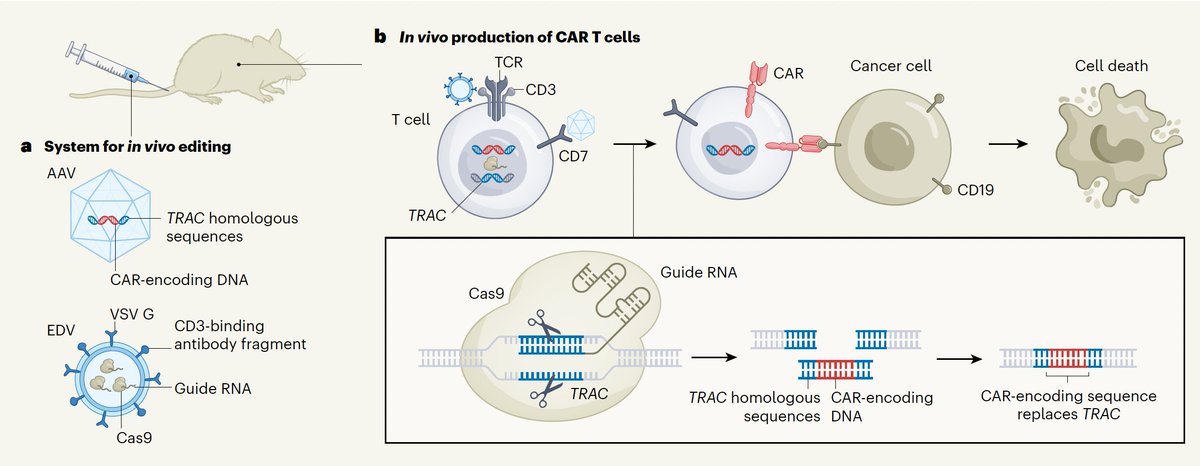
I am so excited to share our new paper in @Nature: the first programmable, site-specific integration of a large DNA payload into T cells in vivo. A single IV injection results in therapeutic levels of TRAC-targeted CAR T cells in multiple models. #Ack1" target="_blank" rel="nofollow noopener">nature.com/articles/s4158… a 🧵
Justin Eyquem tweet media
English
21
143
538
31.3K
Seyone Chithrananda retweetledi
Alice Ting
Alice Ting@aliceyting·
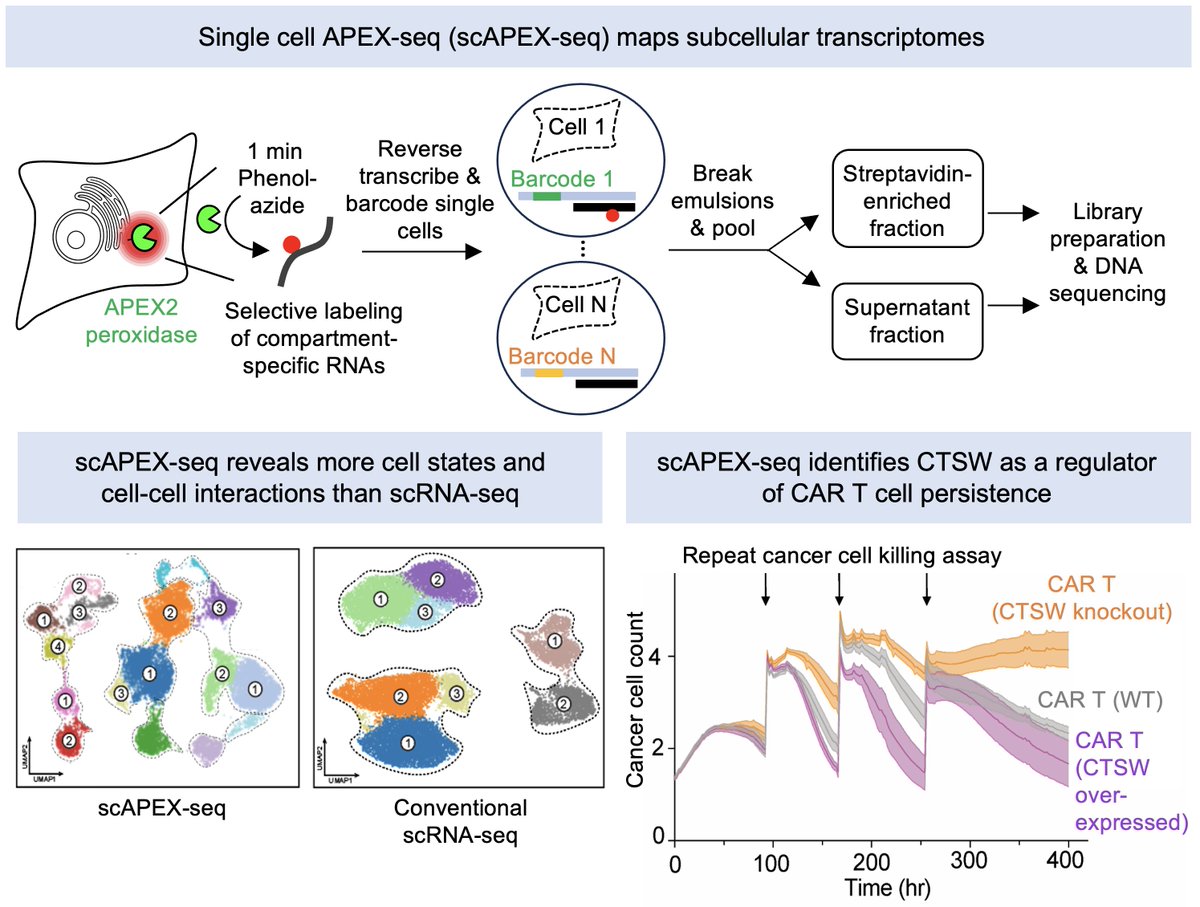
Today we report single-cell APEX-seq (scAPEX-seq) — a new method for unbiased mapping of *subcellular* transcriptomes at single-cell resolution. This approach reveals cell states that are not detectable by standard scRNA-seq, and enabled us to identify regulators of CAR T function that improve solid tumor killing. biorxiv.org/cgi/content/sh…
Alice Ting tweet media
English
2
121
529
40.1K
Seyone Chithrananda retweetledi
Claire Bedbrook
Claire Bedbrook@clairebedbrook·
Aging may feel gradual… but what if it’s not? In our paper out today, we tracked fish continuously from puberty until death. This gave us a unique view of how aging unfolds across the adult lifespan. 🧵
English
22
145
555
70.1K
Seyone Chithrananda retweetledi
Chang Liu
Chang Liu@chang_c_liu·
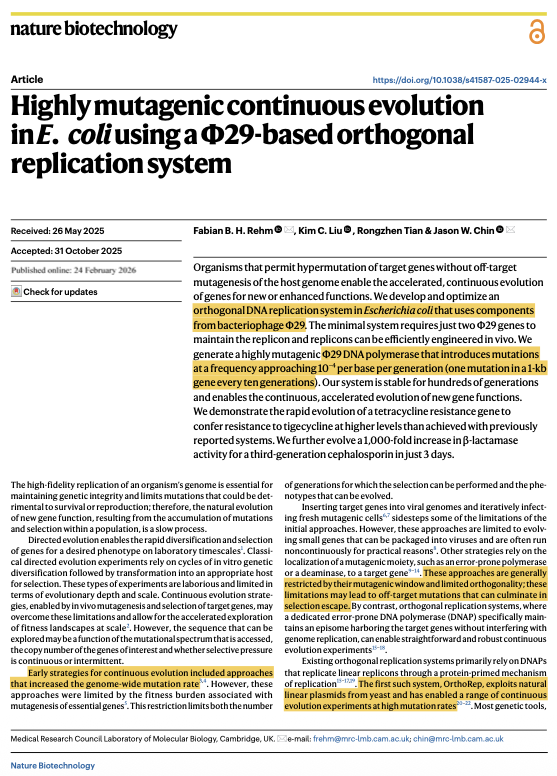
Very happy to see this work from Fabian Rehm, Jason Chin, and team on the development of a high error-rate orthogonal DNA replication system in E. coli, thus supporting continuous hypermutation and evolution of target genes in vivo. The system is based on a protein-primed linear plasmid replication mechanism, which has become a reliable way of realizing the orthogonal replication concept through which hypermutation is durably targeted to an orthogonal plasmid while sparing the genome. Our original orthogonal DNA replication (OrthoRep) system in yeast, Rongzhen Tian's and Jason Chin's BacORep and EcORep systems in bacteria, and now this promising new system all repurpose protein-primed replication to achieve orthogonality. I look forward to seeing how these systems continue to be applied to gene and biomolecular evolution at scale! nature.com/articles/s4158…
English
0
11
79
5.3K
Seyone Chithrananda retweetledi
Niko McCarty.
Niko McCarty.@NikoMcCarty·
An orthogonal polymerase for hypermutation in E. coli. Often, we want to mutate genes really quickly to make better variants. Jason Chin’s group created a molecular tool to increase E. coli mutation rates by six orders of magnitude. First, they took two genes from bacteriophage Φ29, a virus that does not naturally infect E. coli. One gene primes the cell for DNA replication (called the “terminal protein”), and the other copies the DNA (called “polymerase”). They engineered the latter protein to make *more* mistakes than it naturally would. This polymerase, as it runs along a strand of DNA, has an error rate of about 10⁻⁴ per base per generation, meaning it makes one error every 1,000 bases of DNA, every ten cell divisions. (This mutation rate is about one-million-fold higher than the natural error rate in E. coli.) Importantly, this error-prone polymerase will only copy linear DNA that has been introduced into the cell by the scientist; it doesn’t touch the host cell’s genome. But why is this needed? Can’t we just mutate genes in a test tube instead? Yes, of course! But there are two big advantages with doing hypermutations inside *living cells*: 1. Scale: A small tube contains billions of cells, each running its own mutation experiments in parallel. 2. Selection: Living cells act as a sort of “auto-selection” mechanism. The very fact that they are “alive” tells us that a mutated gene is “acceptable.” If you evolve a gene that works really well *in vitro* and then try putting it into a living cell, it might kill the cell! But if *E. coli* makes mutations itself, and continues growing, then you already know that the mutation did not kill the cell. This is valuable info. Of course, this new paper isn’t the first to do orthogonal hypermutations in living cells. Chang Liu’s laboratory, at UC Irvine, made a similar tool, called OrthoRep, many years ago. But OrthoRep only works in yeast. And the nice thing about using E. coli is that they can grow to much higher densities in tubes and, thus, you can run more evolution experiments in parallel. Last year, Peter Schultz’s group also reported a continuous hypermutation tool for E. coli, using a T7 polymerase and replisome. Their system reportedly introduced mutations ~100,000-times faster than the normal mutation rate. But the problem with their approach is that it seems to leak with the genome; it kills cells from time to time. This new tool appears to be fully orthogonal, doesn’t damage the host genome, works in E. coli, has a very high mutation rate, and only requires two genes to function (so it’s lightweight and thus easy to engineer.) We can do so many things with this. We could evolve thousands of nanobodies in parallel, screening each for binding affinity and stability and then using the data to train predictive models. Or, we could evolve entire biosynthetic pathways to optimize chemical production. Etc etc.
Niko McCarty. tweet media
English
7
37
215
13.2K
bilal
bilal@bilaltwovec·
working towards solving all disease with some brilliant colleagues has been a very rewarding experience, the future looks very exciting (and healthy)! 🔬🚀
Isomorphic Labs@IsomorphicLabs

“One of the great things about Iso is how interdisciplinary everyone is, people come from so many different backgrounds.” We spoke with Bilal Khan, Software Engineer at @IsomorphicLabs, about our unique, collaborative culture and frontier AI built to tackle the world's most complex problems. Watch the video and head to the comments to explore our current roles.

English
4
0
69
6K
Seyone Chithrananda retweetledi
Anastasios Nikolas Angelopoulos
Anastasios Nikolas Angelopoulos@ml_angelopoulos·
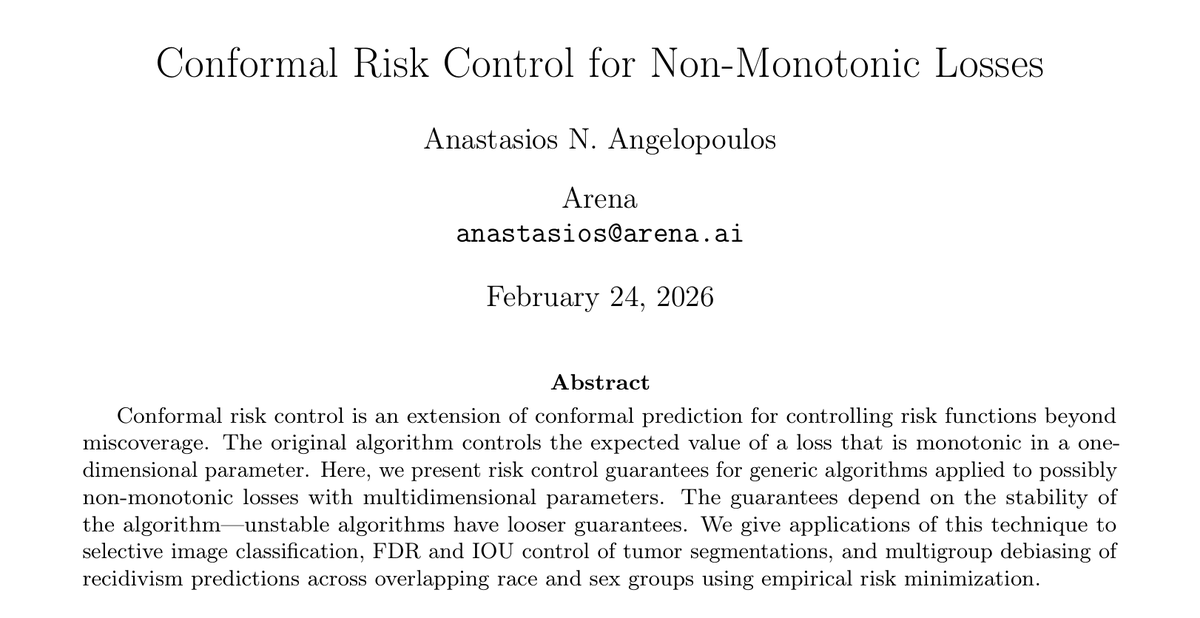
Today I'm sharing a preprint on conformal risk control for non-monotonic losses, a paper three years in the making. The key idea: validity of conformal can be reframed as a consequence of algorithmic stability. Therefore, any stable algorithm inherits a conformal guarantee. 🧵
Anastasios Nikolas Angelopoulos tweet media
English
3
13
94
8.4K
Seyone Chithrananda retweetledi
Yun S. Song
Yun S. Song@yun_s_song·
Can we simulate realistic evolutionary trajectories and “replay the tape of life”? In this work, we propose a flexible, generalizable framework for modeling how the entire protein seq evolves over time while capturing complex interactions across sites. 1/n doi.org/10.64898/2026.…
English
5
81
286
33.2K
Seyone Chithrananda retweetledi
Jason Sheltzer
Jason Sheltzer@JSheltzer·
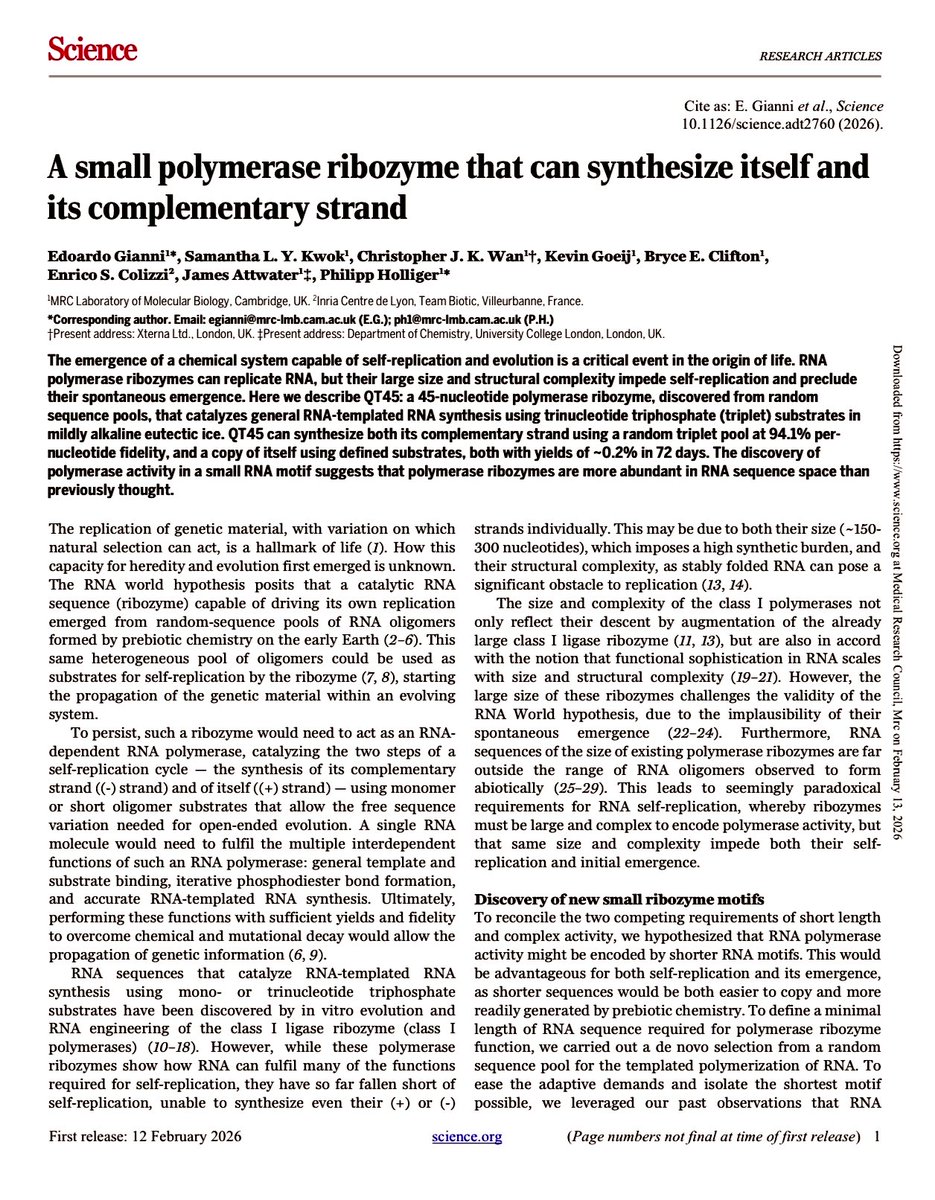
AI is cool and all... but a new paper in @ScienceMagazine kind of figured out the origin of life? The paper reports the discovery of a simple 45-nucleotide RNA molecule that can perfectly copy itself.
Jason Sheltzer tweet media
English
180
1K
6.2K
863.1K
Seyone Chithrananda retweetledi
Parth Asawa
Parth Asawa@pgasawa·
Continual learning from natural language is data-hungry. Can we make it sample-efficient? SIEVE distills natural language context (instructions, feedback, rules, etc.) into model weights using as few as 3 examples only of queries—outperforming prior methods and even in-context learning baselines. (1/n)
Parth Asawa tweet media
English
9
44
214
47K