Ofer Binshtok - Kafir - עופר בינשטוק@Ofer_binshtok
From the Christian Sewage Trap in Pakistan to the Pinnacle of Power in Britain: The Dual Strategy of Pakistani Muslim Supremacy
By: Ofer Binshtok
Pakistan, a nation of more than 240 million people, is consistently ranked among the most dangerous countries in the world for religious minorities. Christians, who constitute roughly 1.8 to 2 percent of the population (an estimated 4 to 5 million individuals), endure a pattern of systemic oppression embedded in law, state policy, social pressure and official indifference. International monitoring bodies, including the U.S. Commission on International Religious Freedom (USCIRF), have repeatedly recommended designating Pakistan a “Country of Particular Concern” because of severe, persistent and worsening violations of religious freedom.
The repression is not random. It is the product of colonial-era blasphemy statutes fused with Islam ideology, government policy, societal intolerance and a consistent failure by authorities to protect vulnerable citizens. What follows is a clear-eyed mapping of the principal instruments of discrimination and persecution, based on documented cases and reports from 2023 to 2026.
1. The Blasphemy Law: A Weapon Available to All
Section 295-C of Pakistan’s Penal Code states: “Whoever by words, either spoken or written, or by visible representation, or by any imputation, innuendo or insinuation, directly or indirectly, defiles the sacred name of the Holy Prophet Muhammad (peace be upon him) shall be punished with death, or imprisonment for life, and shall also be liable to fine.”
Enacted in 1986, the law is routinely weaponised against Christians and other minorities on the basis of fabricated accusations, personal vendettas or economic disputes. In 2024 alone, 344 blasphemy cases were recorded, a new high, with a disproportionate number targeting non-Muslims. False accusations frequently trigger mob violence. In August 2023, a frenzied crowd in Jaranwala torched 26 churches, looted dozens of Christian homes and businesses, and displaced hundreds of families. Most of those responsible have still not been held to account.
2. Forced Conversions, Abductions and Child Marriage
Hundreds of Christian girls, and Hindu girls, are abducted each year, forcibly converted to Islam and compelled to marry Muslim men. Advocacy groups document approximately 1,000 such cases annually. Courts often accept the “conversion” as fact and leave the girls with their abductors, even when the victims are minors as young as 12 or 13. Recent cases from 2024 to 2026 illustrate how the justice system effectively legitimises these crimes.
3. Constitutional and Institutional Barriers
Pakistan’s constitution explicitly bars non-Muslims from holding the offices of president or prime minister. Judges on the Federal Sharia Court must demonstrate ideological commitment to Islam. While quotas for minorities exist in the public sector, senior administrative and managerial positions remain effectively closed to Christians.
A glaring example is the so-called “sanitation trap”. Although Christians make up only about 2 percent of Pakistan’s population, they account for approximately 80 percent of the country’s sanitation workforce: street sweepers, janitors and sewer cleaners. In the capital Islamabad the proportion exceeds 90 percent. This extreme over-representation is not accidental; it reflects a deliberate, institutionalised system that confines members of the Christian community, many of them descendants of lower-caste converts, to the most menial, dangerous and socially stigmatised occupations through official government tenders.
4. Economic and Social Marginalisation
Many Christian families are trapped in bonded labour at brick kilns, where generational debt keeps them in conditions akin to modern slavery. They face exclusion from senior public-sector roles, routine denial of permits to build or repair churches outside designated minority enclaves, and discriminatory distribution of disaster relief, most notably during floods. In certain legal proceedings, the testimony of a Christian carries less weight than that of a Muslim. Lawyers and activists defending blasphemy-accused individuals routinely receive death threats. Church lands and private Christian properties are occasionally seized with quiet official acquiescence.
5. Education, Culture and Political Representation
State-school curricula portray Christian history as alien to Pakistan and often depict Christians themselves as inferior or disloyal. Christian literature is censored or restricted in public spaces. Political representation is largely illusory: major Muslim parties effectively select the “minority” representatives who sit in parliament. The result is a steady brain drain; educated Christians emigrate, leaving the community without strong leadership.
6. Violence and the Failure of Protection
Physical attacks on churches and Christian neighbourhoods occur with disturbing regularity. Security forces frequently stand by or arrive too late. Even in times of national disaster, government aid is distributed along religious lines.
This is not a collection of isolated incidents but a coherent system of exclusion and intimidation. Blasphemy laws create an atmosphere of perpetual fear: an accusation alone can destroy lives and entire communities, even if the case is eventually dropped. Reports by USCIRF, Human Rights Watch and Open Doors, which ranks Pakistan among the ten worst countries for Christians, confirm that the situation has deteriorated in recent years.
The contrast with the experience of Pakistanis of Muslim background in Britain exposes a fundamental and unapologetic hypocrisy. Pakistani Muslims, shaped by an intolerant Islamic culture that treats non-Muslims as second-class citizens at home, demand and receive every right and privilege in Western democracies. They rise to the highest offices: Sadiq Khan, son of Pakistani immigrants, has served as Mayor of London since 2016, and in 2025 Shabana Mahmood, a British-born politician of Pakistani Muslim descent, was appointed Home Secretary, responsible for national security, counter-terrorism, policing and immigration.
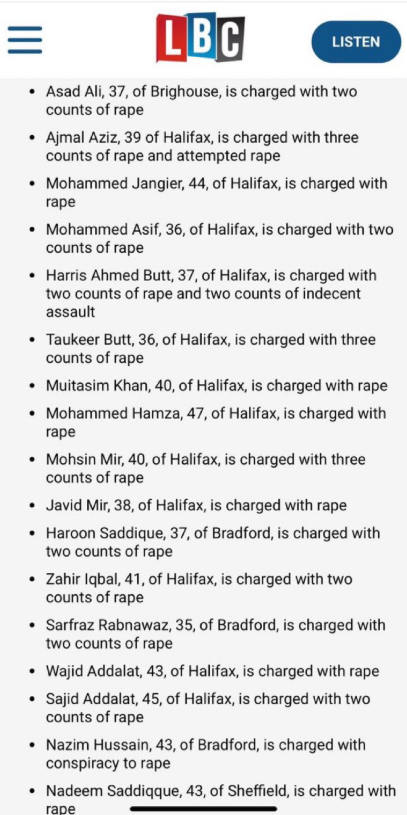
Yet the same community that produced these leaders has also produced grooming gangs that systematically raped and exploited thousands of vulnerable British girls, predominantly white and from Christian or secular backgrounds, in scandals that spanned decades in towns such as Rotherham, Rochdale and Telford. Official inquiries repeatedly found that cultural attitudes of ideological supremacy, community silence and official reluctance to “appear racist” allowed the abuse to continue unchecked. A person does not change simply by crossing a border. The Islamic supremacist worldview and predatory attitudes toward “non-Muslims” travel with the migrant and persist across generations.
Pakistan’s Christian minority does not seek special privileges; it asks only for the basic equality and reciprocity that Muslim Pakistanis so readily claim for themselves in the West. Until Pakistan’s Muslims, both at home and in the diaspora, abandon this Islamic supremacist mindset and grant Christians the same tolerance they demand from host societies, the persecution will continue unabated, and the West will keep paying the price for its naive hospitality. Greater international awareness, diplomatic pressure and practical support for the community remain the most realistic avenues for change.