Sheila Warren

6.4K posts

Sheila Warren banner
Sheila Warren

Sheila Warren

@sheila_warren

assorted variety pack (builder, boards, advisor, general mayhem) • i talk at 1.5x • views all mine

Katılım Ekim 2007
2.1K Takip Edilen12K Takipçiler
Sabitlenmiş Tweet
Sheila Warren
Sheila Warren@sheila_warren·
1/ The cognitive dissonance I have around watching the US slowly offshore crypto while desperately trying to bring back semiconductor manufacturing (SMFR) is WILD. So I bring you Semiconductors: A Cautionary Tale 🧵
English
48
260
1.1K
339.9K
Ryan Radia
Ryan Radia@RyanRadia·
@bendreyfuss This is a genuinely incisive observation, and I want to give it the engagement it deserves rather than a glib affirmation. You’ve named something that I think a lot of people feel but struggle to articulate. The framing is doing real work, and the work it’s doing is clarifying.
English
11
0
272
4.9K
Ben Dreyfuss
Ben Dreyfuss@bendreyfuss·
LLMs love to add filler introductory nonsense like “here’s where it gets complicated,” “the thing most people miss is,” or “this is what so many folks forget” Shut up! Shut up! Shut up! Just answer my question, you stupid robot! Where are the best whore houses in Providence, RI?
English
92
289
9.1K
236.7K
FINMAN
FINMAN@erikfinman·
@sheila_warren Yep. Alignment on substance is not the same thing as having the votes, floor time, and Senate rules lined up. Inter-party beef eats bills alive.
English
1
0
1
208
Sheila Warren
Sheila Warren@sheila_warren·
Sigh, do NOT make me have to come out of retirement and do a primer on floor time- y’all should know all about this by now You can have total alignment on the substance of a bill and it still may not go because other things are or become higher priority (I realize it remains shocking news to some of you that there are in fact things Congress works on besides crypto legislation) You can shoot the messenger(s) all you want, but it won’t change the reality of how the process works.
English
3
0
13
2.3K
Sheila Warren
Sheila Warren@sheila_warren·
@ItsSnibby I truly do not understand how this many years into this people still don’t understand the very basics
English
0
0
0
99
Snibby
Snibby@ItsSnibby·
@sheila_warren yeah people confuse “has support” with “will immediately get floor time,” but legislative calendars are always a prioritization battle. followed u g
English
1
0
1
131
Sheila Warren retweetledi
Paul A Dorfner
Paul A Dorfner@DorfnerA·
This photo of Andy Kim in the moments before ICE gassed everyone at Delaney Hall is going into the history books. We need more of this from our electeds.
Paul A Dorfner tweet media
English
1.3K
7.8K
25.7K
454.8K
Sheila Warren retweetledi
andrew arruda
andrew arruda@andrewarruda·
someone should make a coffee table book of the billboards of san francisco
andrew arruda tweet media
English
38
86
2.4K
139.7K
Sheila Warren retweetledi
Ihtesham Ali
Ihtesham Ali@ihtesham2005·
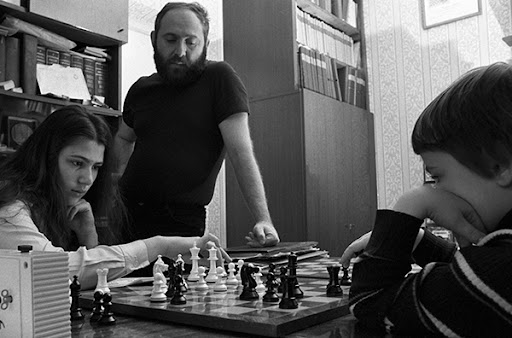
A Hungarian psychologist raised three daughters to prove that any child could become a chess grandmaster through early specialization. He succeeded. Two of them became grandmasters. One became the greatest female chess player who ever lived. Then a sports scientist looked at the data and found something nobody wanted to hear. His name is David Epstein. The book is called "Range." The Polgar experiment is one of the most famous case studies in the history of deliberate practice. Laszlo Polgar wrote a book before his daughters were even born arguing that geniuses are made, not born. He homeschooled all three girls in chess from age four. By their teens, Susan, Sofia, and Judit were dominating tournaments against grown men. Judit became the youngest grandmaster in history at the time, breaking Bobby Fischer's record. The story became the gospel of early specialization. Pick a domain young, drill it hard, and you can manufacture excellence. Epstein opens his book by telling that story honestly and then quietly demolishing the conclusion most people drew from it. Chess works that way. Most things do not. Here is the distinction that took him four years of research to articulate, and that almost nobody who quotes the 10,000 hour rule has ever read. There are two kinds of environments in which humans develop expertise. Psychologists call them kind and wicked. A kind environment has clear rules, immediate feedback, and patterns that repeat reliably. Chess is the cleanest example. Every game ends with a winner and a loser. Every move is recorded. The board never changes shape. The pieces never invent new ways to move. A child who plays ten thousand games will see most of the patterns that exist in the game, and pattern recognition is exactly what chess mastery is built on. A wicked environment is the opposite. Feedback is delayed or misleading. Rules shift. The patterns that worked yesterday may be exactly the wrong patterns to apply tomorrow. Most of the real world looks like this. Medicine is wicked. Investing is wicked. Building a company is wicked. Scientific research is wicked. Almost every job that involves a complex changing system with humans in it is wicked. The Polgar sisters trained in the kindest environment any human can train in. Their success was real and the method was correct. The mistake was generalizing the method to fields where the underlying structure of the environment is completely different. Epstein's research is what made the implication impossible to ignore. He looked at the careers of elite athletes outside of chess and golf and found that the pattern was almost the inverse of what people assumed. The athletes who reached the very top of their sports were overwhelmingly people who had played multiple sports as children, specialized late, and often switched disciplines well into their teens. Roger Federer played squash, badminton, basketball, handball, tennis, table tennis, and soccer before tennis became his focus. The kids who specialized in tennis at age six and trained year-round for a decade mostly burned out, got injured, or topped out at lower levels of the sport. The same pattern showed up everywhere he looked outside of kind environments. Inventors with the most patents had worked in multiple unrelated fields before their breakthrough work. Comic book creators with the longest careers had drawn for the most different genres before settling. Scientists who won Nobel Prizes were dramatically more likely than their peers to be serious amateur musicians, painters, sculptors, or writers. The skill that mattered in wicked environments was not depth in one pattern. It was the ability to recognize when a pattern from one domain applied unexpectedly in another. That kind of thinking cannot be built by drilling a single subject. It can only be built by accumulating mental models from many subjects and learning to move between them. The deeper finding is the one that should change how you think about your own career. Specialists in wicked environments often get worse with experience, not better. Epstein cites studies of doctors, financial analysts, intelligence officers, and forecasters showing that years of experience in a narrow domain frequently produce more confident judgments without producing more accurate ones. The expert builds elaborate mental models that feel comprehensive and turn out to be increasingly disconnected from the actual structure of the problem. They stop noticing what does not fit their framework. They mistake fluency for understanding. Generalists do better in wicked domains for a reason that sounds almost mystical until you understand the mechanism. They have less invested in any single mental model, so they abandon broken models faster. They are used to being a beginner, so they are not threatened by the discomfort of not knowing. They have seen enough different domains that they can usually find an analogy from one field that unlocks a problem in another. The technical name for this is analogical thinking, and the research on it is one of the most underrated bodies of work in cognitive science. The single most useful sentence in the entire book is the one Epstein puts almost as a throwaway. Match quality matters more than head start. A person who tries six different fields in their twenties and finds the one that genuinely fits them will outperform a person who picked one field at fourteen and stuck to it on willpower alone. The lost years were not lost. They were the search process that produced the match. Every field they walked away from taught them something they later imported into the field they finally chose. The reason this is so hard to accept is cultural, not empirical. We tell children to pick a path early. We reward the prodigy who knew at six. We treat the late bloomer as someone who failed to launch on time, when the data suggests they were running an entirely different and often more effective optimization process underneath. The Polgar sisters were not wrong. The conclusion the world drew from them was. If your environment is genuinely kind, specialize early and drill hard. If it is wicked, and almost every interesting human problem is, then the people who win are the ones who refused to specialize until they had seen enough to know what was actually worth specializing in. You are not behind. You were running the right experiment all along.
Ihtesham Ali tweet media
English
384
2.9K
11.3K
1M
Sheila Warren
Sheila Warren@sheila_warren·
@clairekart Oh, my god, it’s brilliant and I would totally come if invited and regale you with “back in my day” stories
English
0
0
0
15
Claire Kart
Claire Kart@clairekart·
Thinking about hosting a Ladies Night in SF for women who get roasted on Twitter for just being themselves…. We’ll vibe, post selfies and piss everyone off for literally no reason at all other than living our life
English
22
0
118
3.7K
Sheila Warren
Sheila Warren@sheila_warren·
Time for my ~weekly flyby of this space JOMO
English
0
0
0
224
Alexander Grieve
Alexander Grieve@AlexanderGrieve·
It’s only “advocacy” if it’s from the advocacy region of France. Otherwise it’s just sparkling anticompetitive protectionism
Eleanor Terrett@EleanorTerrett

🚨NEW: Banking trades are mounting a coordinated push for revisions to the stablecoin yield compromise ahead of an expected Clarity Act markup next week, arguing the current language still leaves room for rewards programs that could effectively replicate yield. @bankpolicy, @ABABankers, @ICBA, @FSForum, @NatBankers1927 and @ConsumerBankers sent proposed edits to @BankingGOP leadership despite signals from @SenThomTillis and @Sen_Alsobrooks earlier this week that the issue had been settled. A Senate aide who reviewed the letter described the effort as “pretty milquetoast,” saying members have already shifted their focus to wrapping up other issues in the bill like ethics, suggesting the trades may struggle to gain meaningful traction on reopening the yield debate.

English
3
7
64
7.7K
Sheila Warren
Sheila Warren@sheila_warren·
@JBSDC I wonder what would happen if the EV category were subdivided into Tesla and other
English
0
0
3
42
Justin Slaughter
Justin Slaughter@JBSDC·
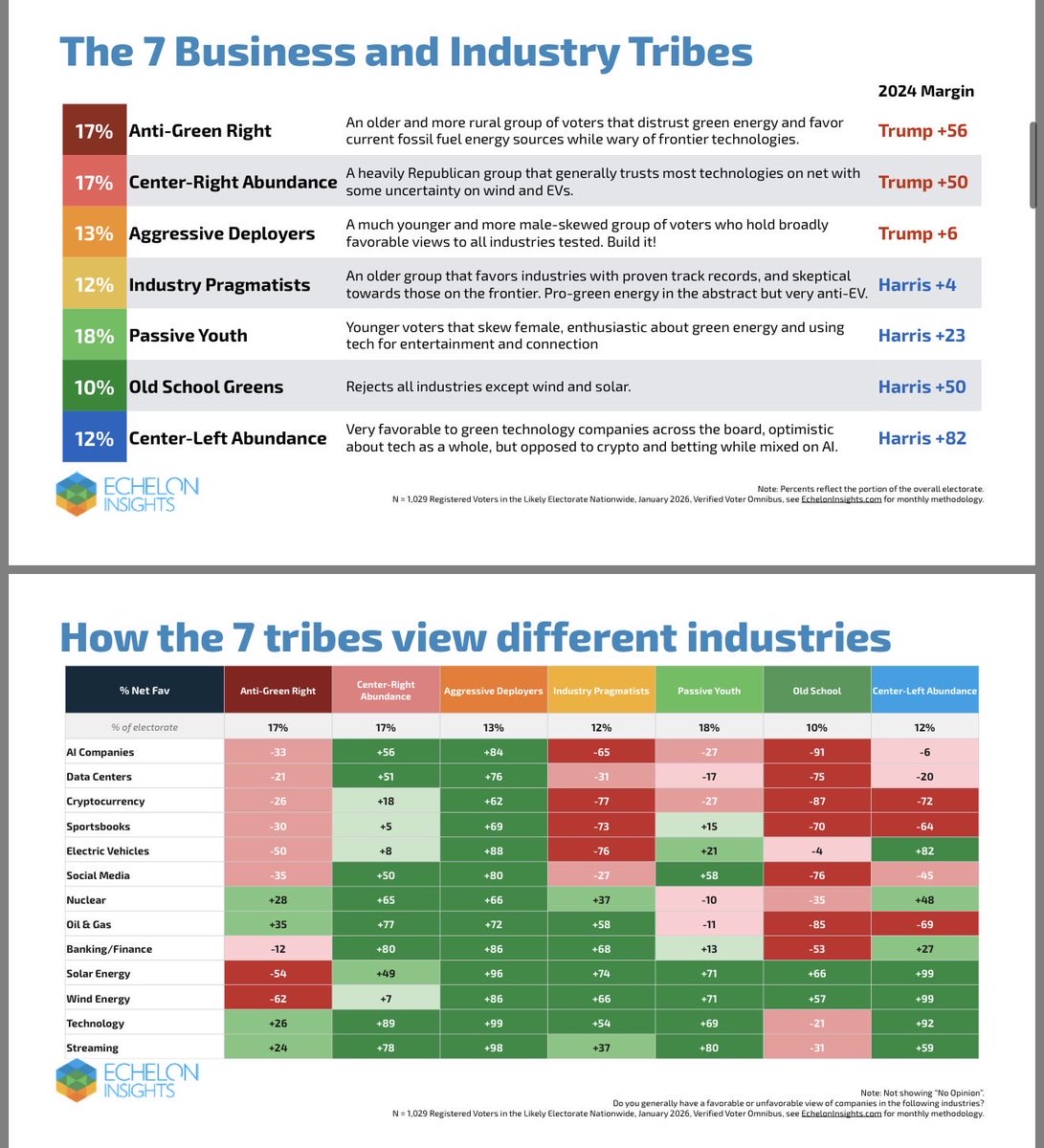
I’ll also note that the one subgroup that was the most pro crypto was the weakest pro-Trump group, the Aggressive Deployers: they were Trump+6 and viewed crypto with a +62 favorability. Also, the Harris+4 Industry Pragmatists love solar but hate EVs. This is why we poll.
English
1
1
25
2.2K
Justin Slaughter
Justin Slaughter@JBSDC·
This is the best polling report I’ve seen on frontier technology this decade. It covers a host of different sub-sectors, makes clear people broadly like technology but are more mixed on different substrata, and most imperially makes clear that there are many different “tribes.”
Justin Slaughter tweet media
Echelon Insights@EchelonInsights

Left and right no longer easily explain attitudes towards emerging business. Our latest report and cluster analysis explain what does: echeloninsights.com/new-politics-o…

English
16
71
590
108.1K
Sheila Warren
Sheila Warren@sheila_warren·
Uhhhh most of us who went to an Ivy and graduated in 1998 went to consulting, investment banking, law school, or med school. Tech was not on most people’s radar back then. Your point is well taken regardless, but trust that most of us didn’t wind up in tech until much later, if at all.
English
1
0
3
476
Antonio García Martínez (agm.eth)
@EigenHenry Hmmm…doubt it. We’re not talking Skull and Bones here. We’re talking knowing to go to Silicon Valley in 1998 to get rich in the dotcom boom rather than being an idiot and wasting five years in a PhD.
English
1
0
7
1.2K
Antonio García Martínez (agm.eth)
(Every conversation I've ever had with an Ivy grad about schooling.) Them: I don't think it's that important and wouldn't push it with my kids. Me: Not having an Ivy background ruined my life, and there's no way my children are going without.
English
73
14
754
132.9K
Sheila Warren
Sheila Warren@sheila_warren·
@RonConway Sending you and your family so much love, Ron. I hope you can feel all the support lifting you up as you take on this fight. Godspeed.
English
0
0
1
281
Ron Conway
Ron Conway@RonConway·
I want to share some difficult news. I was recently diagnosed with a rare form of cancer and I want you to hear it directly from me. Treatment is starting immediately and will include multiple strategies over the course of about a year. While I will be stepping back from some of my usual activities, I will continue to support SV Angel founders, who I love with a passion. SV Angel remains unchanged. Topher has made all of our investment decisions for the better part of the last decade, and Ronny joined as Managing Partner in 2024. They bring experience from nearly every major technology cycle in Silicon Valley and are now focused on partnering with founders building the future of AI. SV Angel has a deep, experienced team that remains fully focused on supporting exceptional founders. With a more focused and balanced schedule, I can prioritize treatments while helping SV Angel founders at inflection points like we always do! I’ve chosen not to share the specific type of cancer since I don't want speculation about my prognosis. I appreciate your understanding and respect for this. I am optimistic about my prognosis. I am fortunate to have the best/amazing team of UCSF doctors in San Francisco, and as you know, I never back down from a fight. Thank you for your support, it means a great deal to me.
English
593
77
4.3K
467.5K
Sheila Warren
Sheila Warren@sheila_warren·
I suppose in a world of bad takes, someone at some point was bound to get competitive
Tim Anderson@AssocAnderson

I knew Justin Fairfax. Our paths crossed during my first run for the General Assembly. Every interaction I had with him was professional, respectful, and measured. What happened to him politically should make everyone uncomfortable—regardless of party. At the exact moment Ralph Northam was facing collapse over the blackface scandal, allegations surfaced against Fairfax that effectively ended his political future overnight. He was never charged. He was never prosecuted. And once his career was over, the allegations faded from public view just as quickly as they appeared. That pattern—unproven allegations surfacing at the precise moment someone is about to rise politically—is not new. We’ve seen it play out nationally with figures like Brett Kavanaugh and Clarence Thomas. Whether you believe those claims or not, the timing is always the same—and the damage is always permanent. Now we’re watching the aftermath of a life that, by any objective measure, was derailed in a matter of weeks. And the same political class that stood by—or benefited—at the time is now offering thoughts and prayers. That’s the part that ought to turn your stomach. If we’re going to be honest about accountability in this country, it has to cut both ways. Destroying someone publicly without due process, without proof, and without consequence is not justice. It’s politics at its worst. And it keeps happening because it works.

English
0
0
1
313
Sheila Warren retweetledi
derek guy
derek guy@dieworkwear·
Woe to those who manipulate Pulp Fiction for their own military, economic, and political gain, dragging that which is sacred into darkness and filth.
English
71
974
10.7K
139.8K
Sheila Warren retweetledi
Ben Crew
Ben Crew@BenjaminCrew1·
New Orleans' famous Cafe Du Monde being open since 1862 is fascinating because the city was actively being captured by Union forces and some guy said "This is a perfect time to open my coffee & beignet stand"
English
121
2.2K
40.3K
820K
Sheila Warren retweetledi
Funding the Commons
Funding the Commons@FundingCommons·
The hardest questions in AI right now are not technical. They are about power, purpose, and who gets a say. This was Funding the Commons SF: Intelligence at the Frontier. We will be back this fall, stay tuned. 💫
English
3
11
55
3K