Sabitlenmiş Tweet
Shubham Baranwal 🇮🇳
3.4K posts

Shubham Baranwal 🇮🇳
@Shubhambrnw
भारत दर्शन अभिलाषी
Bengaluru, India Katılım Eylül 2015
592 Takip Edilen155 Takipçiler
Shubham Baranwal 🇮🇳 retweetledi

However, here are some words of caution; this is an Apples to Oranges comparison for specific metrics:
(a) Orders: Swiggy defines Food orders as completed orders; Zomato defines orders as all orders placed, including cancelled orders.
(b) MTUs: Swiggy counts users with at least one completed food order; Zomato counts customers who placed at least one order
(c) Restaurant partner: Swiggy counts partners with at least one delivered order. Zomato counts partners that received at least one order.
Furthermore, the debate of GOV (Swiggy) v/s NOV (Zomato) is a never-ending one.
Despite this, basis the metrics shared, I believe Zomato is a bigger & better food delivery business than Swiggy.
English
Shubham Baranwal 🇮🇳 retweetledi

In China, when you need a part or material, vendors proudly say:
“Boss, we have 100 tons ready, 10 variations in stock, can ship today.”
It’s a badge of strength, a flex showing they’re reliable valuable, and cash rich.
In India?
Even when there is stock, many vendors say:
❌“No stock.”
❌“Needs to be custom made.”
❌“15–20 days lead time.”
❌“Nahin hoga sir…”
Why?
Because the buyer’s mindset here is the opposite.
If a vendor admits he has stock, buyers smell weakness “Unke paas mal bharaa paraa hein, rate thodna hein.”
The ball is suddenly in the buyer’s court.
This mentality creates delays, annoying games, and unnecessary friction in the supply chain.
Do you agree?
Have you faced this?
How do we actually change this culture?
English
Shubham Baranwal 🇮🇳 retweetledi

We live on a planet with 1.3 billion habitable years left. We've had rockets for 69 of those years. In that time, the cost of reaching orbit dropped from $54,500 per kilogram to $2,720, and SpaceX is targeting under $100 with Starship. If they hit that number, getting to space becomes 545 times cheaper in a single lifetime.
329 orbital launches happened in 2025. Almost one a day. The space economy crossed $626 billion last year and should hit a trillion by 2034. SpaceX just filed for an IPO targeting a $2 trillion valuation, worth more than every airline on Earth combined. Starship, their fully reusable rocket (both stages fly back and land), can lift 150 tons to orbit. The entire International Space Station weighs 420 tons. Three flights could put the whole thing up there.
The engineering side of this is solved. What remains is a survival problem. Researchers published a paper in Scientific Reports calculating the natural extinction rate for humans, how often we'd get wiped out by asteroid strikes, supervolcanoes, the stuff we can't control. Less than a 1-in-14,000 chance in any given year. At that rate, we'd survive millions of years, more than enough to spread across the solar system.
Toby Ord, a philosopher at Oxford who spent a decade studying how civilizations end, puts the odds of a civilization-ending catastrophe before 2100 at 1-in-6. The threats aren't from space. Nuclear war. Viruses engineered in labs that could spread before anyone understands what hit them. AI systems are smart enough to act on goals we never gave them. All things we built ourselves.
A 2017 NASA paper made this case: we have a roughly 50-year window to lock in spacefaring infrastructure before resources run thin and energy costs make a restart nearly impossible. We're 9 years into that window. Given enough time, the math takes this to 100%. The only question that matters is whether we make it through the next few decades without blowing our shot.
Jeff (Expansão Astronauta)@Expansao_Astro
Quais são as chances de nos tornarmos uma verdadeira civilização espacial?
English

@rajivmehta19 iPhone 17e and Macbook Neo are entry level gadgets but Galaxy S26 and Tab S11 are not.
It doesn't look like a fair comparison.
English

1. Clean comparison
The “expensive #Apple ecosystem” myth needs context.
Apple #iPhone 17e ₹64,900
Apple MacBook Neo ₹69,900
Apple #iPad ₹34,900
Apple Watch SE 3 ₹25,900
Apple #AirPods 4 ₹12,900
Total: ₹2,08,500
Comparable stack from #Samsung:
Samsung Galaxy S26 ₹87,999
Samsung Galaxy Tab S11 ₹91,999
Samsung Galaxy Book 5 ₹81,990
Samsung Galaxy Watch 8 ₹25,999
Samsung #Galaxy Buds 4 ₹16,999
Total: ₹3,04,986
The #premium Apple #ecosystem is actually ~₹96k cheaper.
English
Shubham Baranwal 🇮🇳 retweetledi

Marc Andreessen ( @pmarca ) was right about software eating the world but only halfway.
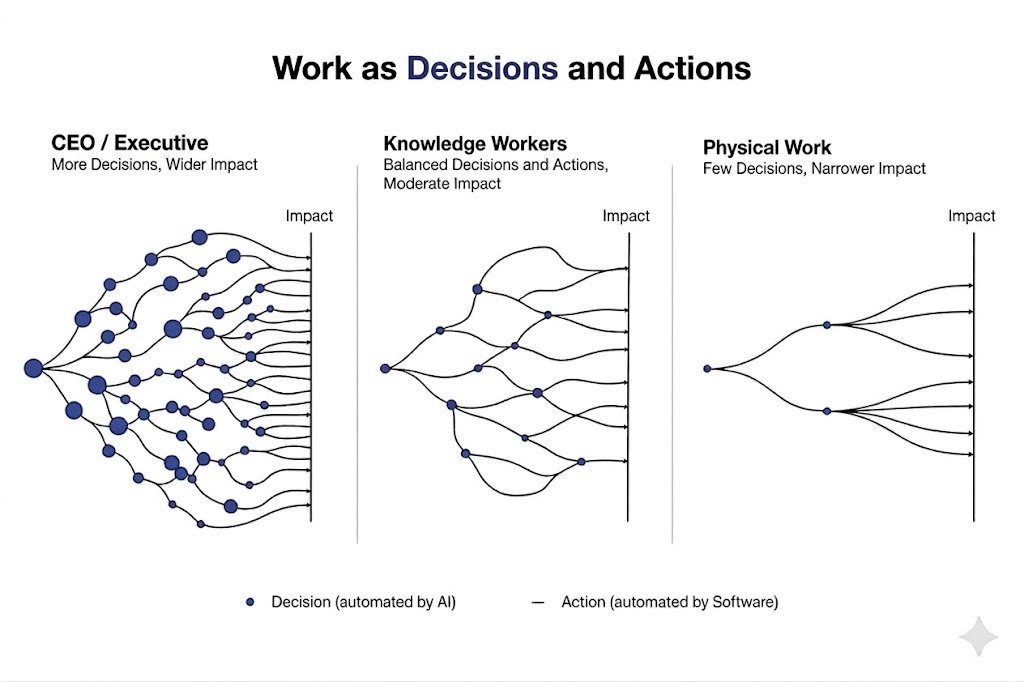
Strip any job to its atoms (surgeon, lawyer, warehouse picker, CEO, developer, therapist etc.) and you will find the same repeating primitive:
Decisions and Actions. That's it.
Every job, every workflow, every profession is just a unique permutation and combination of these two things at different frequencies and amplitudes. Creative work runs high decision cycles, low action output. Physical labor flips it. A surgeon runs both at high frequency, interleaved at speed. A CEO is almost pure decision, their actions are just emails and signatures. All work are permutation and combination of the some decisions and some actions.
Software automated the "Action" part of the work. Every SaaS, every API, every app ever built is the same thing: trigger starts a function. Functions are packaged, portable, infinitely scalable action. It was so economically violent that it felt like it had consumed everything. Borders, Blockbuster, Kodak, entire industries. But it didn't. It only ate one strand of the DNA of work.
Every product still had a human in the chair, deciding what to trigger, when, and why. Software ate action but the decision layer stayed human. Decisions require judgment, context sensitivity, ambiguity tolerance, pattern recognition across incomplete information. That needs intelligence. And intelligence wasn't available on-demand.
This is why knowledge workers felt untouchable. They weren't doing the clicking. They were deciding what to click.
AI changes this entirely. AI isn't just better software. That's the most important distinction being missed.
Software is "action on trigger". AI is "decision on demand".
Connect AI to software tools and you complete the loop for the first time. You can now build entities that can decide and act autonomously, end to end. These are not tools that assist in work. These are Entities that can do the whole work.
Marc said software would eat the world. It ate one part of the work. Now, AI is here to finish the meal.
But counterintuitively, this doesn't kill software jobs, it creates infinite demand for them. Every workflow that can now be automated needs to be built. Healthcare, legal, logistics, finance, research, each is a fractal of decisions and actions, and each is now a software problem. The total addressable market just became every human workflow that exists.
But the AI beast is feral. It hallucinates, drifts, breaks at edge cases, needs guardrails, evaluation loops, and trust builds incrementally. Someone has to tame it, wire it to real systems and make it work in production. The developers who understand they are no longer building tools but building entities will not get replaced. They will evolve into the architects of everything that does the replacing.

English

@rohanbabu Then people randomly bump each other on some random weekend event
English

There is an invisible layer that affects many friendships in Bengaluru.
That layer is called urban and civic exhaustion.
Friendships don’t fade because people don’t care. They fade because the city quietly drains the energy required to sustain them.
The traffic takes an hour out of your evening. Work spills into what used to be personal time. Weekends become recovery periods rather than social ones.
You start saying things like:
“Let’s meet soon.”
“Next week for sure.”
“Once things settle down.”
Things rarely settle down.
What earlier required a 10 minute auto ride now requires planning, coordination, and stamina. You have to build stamina to be rejected by drivers on apps, to cross under constructed sites, to take long jumps over open drainages and collect dust on your face.
Friendships slowly move from physical spaces to WhatsApp reactions and Instagram replies.
The affection is still there. The intent is still there.
But the civic friction of the city sits between people.
In cities like Bengaluru, maintaining friendships has quietly become an act of effort. And sometimes, effort is the first casualty of urban and civic exhaustion.
English
Shubham Baranwal 🇮🇳 retweetledi

indian VCs are structurally incapable of funding this list because they goodhart on short term returns. they would want to be like a tier 2 american VC, but the truth is that their systems are built around quick exits and credentialism. that is why you will find amazing indian founders all over SF here to raise from american VCs. there are exceptions, but you can count them on one hand.
English

Shubham Baranwal 🇮🇳 retweetledi

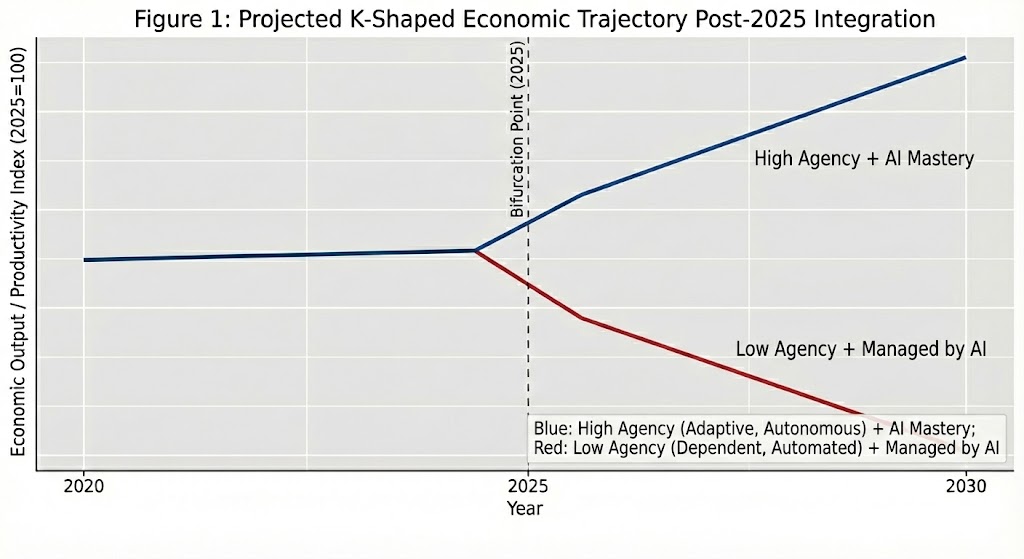
In 10 years, there will be two classes of people.
Economists call it the "K-shaped economy" - and the next 2-3 years will decide which line you're on.
• An overclass that uses AI as a lever to build wealth, automate income, and make decisions at a speed no human can compete with alone.
• And an underclass that gets managed by it.
This isn't just "coming". It's already happening.
Some mind-blowing stats:
• Workers with AI skills earn 56% more than the same job without them. That premium doubled in a single year.
• Industries adopting AI are seeing 3x the revenue growth per employee.
• Meanwhile, 90% of workers haven't taken a single hour of AI training.
• Goldman Sachs estimates 300 million jobs will be affected by AI by 2028. That's 24 months from now.
If you're reading this now and you haven't built systems with AI - haven't automated a single workflow, haven't used it to create anything that makes you money or makes you irreplaceable - you are currently on the wrong line.
That's not an insult. You have the agency to change your trajectory right now.
But six months from now, the gap will be twice as wide. And a year from now, it may not be crossable.

English
Shubham Baranwal 🇮🇳 retweetledi

We’re entering the post-scarcity era for software.
By analogy to what happened when we entered post-scarcity for food:
- There will be far fewer people writing or even understanding code (farmers)
- There will be a great variety of software (e.g. kimchi burritos)
- A lot of it will be crappy (e.g. kraft cheese)
- Marketing/branding/distribution on top of industrial processes will be the name of the game
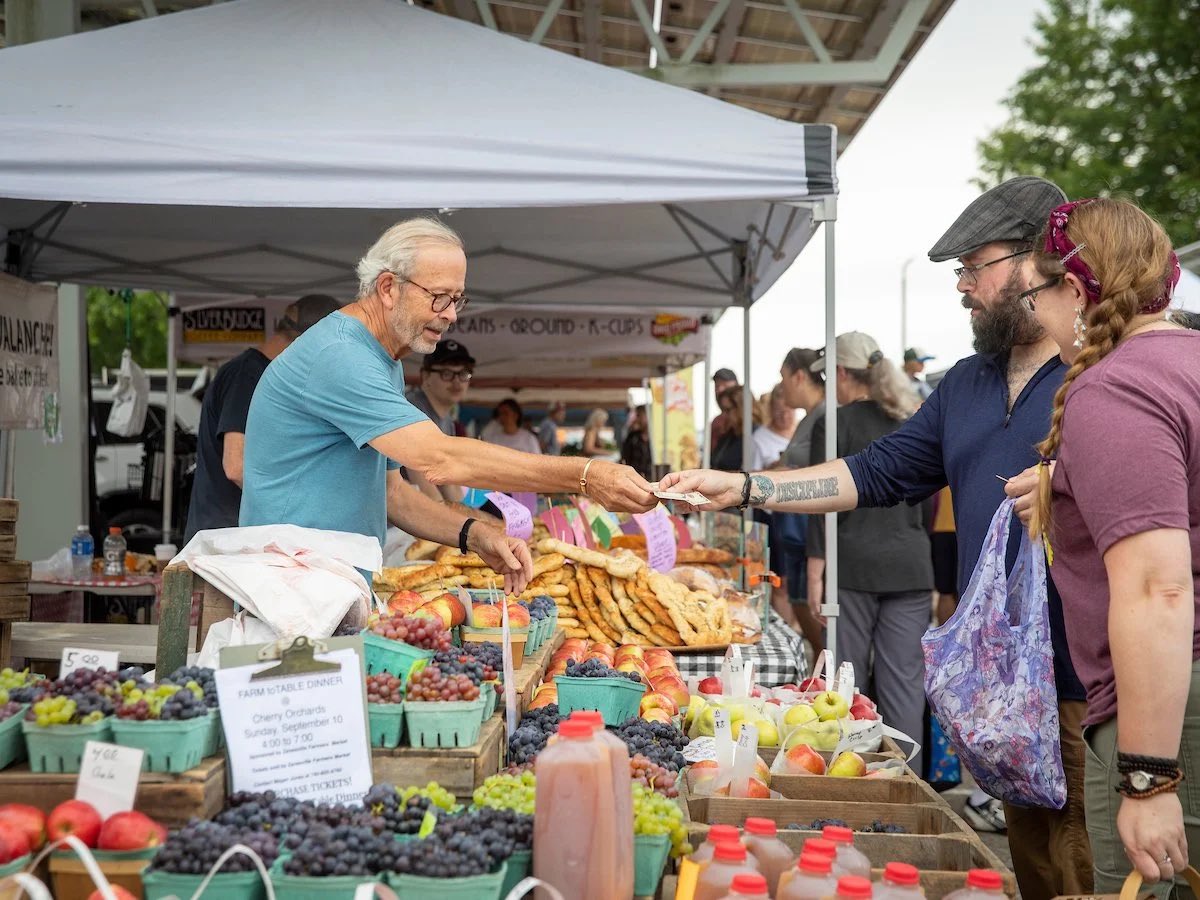
- Some people will still prefer old-school, home-grown software (farmers markets)


English
Shubham Baranwal 🇮🇳 retweetledi

The economy is going to get divided into two extremes.
We will pay premiums for Super fast experiences and mindful, slow ones.
1. Super fast experiences
- Quick commerce (Blinkit, zepto)
- Quick services (Urban company, crew, snabbit)
- Quick answers (ChatGPT, Gemini)
- Quick snacking (Swiggy bolt, ready to eat meals, protein bars, pre-mixes)
2. Slow, mindful experiences
- Meditation, Yoga, Vipasana
- Health retreats
- Food Tours
- 6 course gastronomical experiences
- Long runs/ walks/hikes
- Coaching/ Therapy
- Reading rooms/Libraries
The average experiences such as slow commerce, driving to a restaurant for a 3/5 meal, waiting for a hour for a 3/5 haircut.. will have no takers
If you are building.
Optimise for lightning fast experiences
Or meditatively slow ones.
English

@prakdadlani Where can I learn 101 of manufacturing?
I'm partially into trading and probably manufacturing would be my next lever for growth apart from growing current business.
I just don't know where to start and primarily, is it the right move or not ??
English
Shubham Baranwal 🇮🇳 retweetledi

Tagging @airtelindia, hoping this reaches the right team and gets resolved.
@Airtel_Presence @airtelnews @gopalvittal
@ViCustomerCare @DoT_India @JM_Scindia
English

🚨 Sharing a disappointing customer support experience with @airtelindia , and an unexpected contrast with @ViCustomerCare .
English