Simply With Faith
2.7K posts

Simply With Faith
@SimplyWithFaith
Simply, Jesus said, "Believe". Member of The Church of Jesus Christ of Latter-Day Saints. Husband, Father, and Brother.
Katılım Şubat 2025
339 Takip Edilen371 Takipçiler
Sabitlenmiş Tweet

(It's a book, but worth it)
Before I respond to our main topic, I am going to take your first point and reflect it in the same way you did. I'm going to rephrase this purposely from your own words. I am aiming at kindness and respect. I am curious to see if you see what I saw.
Your first paragraph argument could be treated the same way back to you.
***I hear you (skip10), but you keep trying to analyze the past through the lens of "Mainstream Christianity". If you believe that nothing was lost after the death of the apostles, then everything you dwell on will support that worldview. You cannot just view the facts by their merits.***
There is an assumption portrayed in this. You appear to have assumed I have always accepted the Mormon worldview, or have never questioned the Mormon view on these points. It's an easy mistake. I see this often when conversing with people online. It is a mistake.
Also, when you say "you cannot just view the facts by their merits", what other way(s) do you suggest if not following the trail of facts to natural conclusions the merit itself leads?
Now back to the main topic:
"They developed a concept that remained true to the OT, accommodated the NT, and made sense." This is exactly what I said happened earlier in our dialogue. The doctrine "emerged through centuries of theological reflection as church leaders sought to reconcile biblical monotheism, the divinity of Christ, the distinction between Father, Son, and Holy Spirit, and passages describing Christ in subordinate relation to the Father."
The result was an interpretation. They attempted to logically demonstrate how both monotheism and the divinity of Christ can coexist as true. What they concluded was the doctrine of the Trinity.
Would you agree with this recap? If not, what would you add or change? Fill me in. It may not be elaborate, but it hits the main points.
Here is a brief recap of the before, during, and after of the Council of Nicaea as I understand the historical events.
In the early 300s, Arius taught that Jesus (the Son) was created by God the Father and was not fully equal to Him. This teaching split the church.
To restore unity, Emperor Constantine called the Council of Nicaea in 325 AD. About 300 bishops attended.
The main debate: Is Jesus fully God and of the same substance as the Father, or a lesser, created being?
Broadly speaking, three major tendencies emerged:
• Group 1 Strong Anti-Arians
- Small minority (~15–20 persons)
-Full homoousios (“same substance”)
• Group 2 Largest Majority
- A large middle group preferred biblical language, such as ‘like the Father,’ and were cautious about homoousios.
• Group 3 Pro-Arian Small minority (~20 persons)
- Son is created / subordinate
The smaller group of bishops pushed for the word homoousios (“same substance”). Most bishops were uncomfortable with it because it was non-biblical terminology with philosophical and controversial theological baggage.
Constantine strongly favored the term as a means of achieving doctrinal unity and imperial stability. The council adopted the Nicene Creed with homoousios. Those unwilling to sign the creed or condemn Arius faced exile or removal from communion, indicating substantial political and ecclesiastical pressure toward unity.
The controversy did not end in Nicaea. For the next 50+ years, emperors, exiles, and new councils swung back and forth between Arian and Nicene views.
Finally, in 381 AD, the Council of Constantinople reaffirmed and expanded the Nicene Creed, and under Emperor Theodosius, Nicene Christianity became the official imperial orthodoxy.
Summary: Nicaea declared Jesus fully God, but it took over 50 years of debate and political pressure before that belief fully prevailed.
Again, would you agree with this recap? Does this miss anything? What would you add?
Knowing this, as I see it, critics expect Latter-day Saints to accept as essential Christian doctrine a formulation that:
1. Was formalized centuries after the apostles.
2. Relied on philosophical terminology not found in scripture (homoousios).
3. Emerged in a politically charged environment under Constantine, where unity and stability often appear to have taken precedence over arriving at a universally satisfying theological formulation.
4. It was controversial among bishops at the time and not embraced without resistance.
5. Was ultimately enforced through councils, creeds, exile, and ecclesiastical pressure.
Yet Latter-day Saints are criticized for questioning whether this represents the original apostolic faith in its pure form.
On top of all that, if nothing else, the Council of Nicaea evidences a profound shift in how doctrine was established.
In the New Testament, doctrine came through apostles receiving revelation from Jesus Christ. By Nicaea, doctrine was being defined through episcopal debate, philosophical terminology, imperial pressure, and majority agreement rather than new public revelation.
This is what naturally occurs when revelatory apostolic authority is no longer present: theological disputes are settled through councils, argumentation, politics, and consensus rather than prophets receiving revelation from God.
The Old Testament repeatedly shows that when prophetic revelation diminished or was rejected, God’s people did not cease being religious. Rather, authority shifted toward institutional leadership, interpretation, tradition, and political power struggles — precisely the kind of transition many argue became visible in the post-apostolic councils.
Amos 8:11–12 presents a biblical pattern of what happens when revelation withdraws from a people. Religious life may continue, but there is a “famine” of the word of the Lord — people seek divine guidance yet cannot find it.
11 ¶ Behold, the days come, saith the Lord GOD, that I will send a famine in the land, not a famine of bread, nor a thirst for water, but of hearing the words of the LORD:
12 And they shall wander from sea to sea, and from the north even to the east, they shall run to and fro to seek the word of the LORD, and shall not find it. Amos 8:11-12
After a thorough study, I have yet to find any period where God is pleased not to have prophets on the earth. Jesus does warn us about the false prophets who would come and lead many astray. Yet, he also armed us how to know the true from the false.
If prophets or apostles were to end forever, Jesus didn't express it.
Historically, many Christians later concluded that public revelation or apostolic office ceased after the apostolic age. But that conclusion is post-biblical theological development rather than a direct statement from Jesus Himself.
The New Testament does not prepare believers for a permanent absence of prophets. Rather, it repeatedly warns them to discern between false and true ones.
Avoiding all prophetic claims because some may be false is not the pattern taught by Christ or His apostles. The New Testament instructs believers to discern, test, and judge prophetic claims — not reject the possibility of prophets altogether.
What did Jesus establish?
Commissioned apostles and prophets. Paul calls the number 1 and 2 parts of the body of Christ. He also calls them the foundation on which everything ties in.
Christ did not establish a church built merely on scholars, councils, or inherited tradition. He established apostles and prophets.
Paul even lists them first in the body of Christ and says the household of God is built upon their foundation, with Jesus Christ as the chief cornerstone.
Through the apostles, bishops and elders were called to lead local communities in the way. They also ordained seventy, deacons, teachers, and evangelists. This was the organization and everything flowed from them as they were guided by revelation from Jesus Christ.
Were the apostles mean to be "foundational only"?
The NT repeatedly presents apostles and prophets as integral to the Church’s structure and unity, yet nowhere clearly outlines a long-term model for a fully post-apostolic Church operating without revelatory leadership.
That silence is telling.
The earliest Christian movement appears structured around living apostolic authority, not around a future model dependent primarily on councils, creeds, and inherited institutional interpretation after apostles disappeared.
That does not prove apostasy or restoration by itself. But it does create historical and theological tension for later models that assume:
- apostles were temporary,
- revelation largely ceased, and institutional succession alone was expected to carry the Church indefinitely.
The silence is especially notable because the NT does prepare believers for many future issues:
- false teachers
- persecution
- apostasy
- division
- wolves entering the flock
- deception
Yet it gives comparatively little direct instruction like:
“After the apostles die, bishops alone will govern universally.”
“Ecumenical councils will define doctrine.”
“Public revelation will cease.”
“Creeds formulated centuries later will become the doctrinal standard.”
Then again, you are asking LDS not to question this, but fall in line when there are obvious flaws to all this history.
LDS and the restoration falls in lock-step with the NT organization, set up with apostles and prophets. It returns the fundamental roots.
Scholars are also finding out that pre-Josiah reform there wasn't a hard monotheism structure like what came after. Which is interesting and leaning toward a council of gods leadership.
Again, I not stating this to convince you. I am giving you a window in the logical process as I see it. You can see it completely different, that's okay. But I cannot ignore these things. Mainstream Christianity has not resolved the tensions in simple terms. I find the LDS argument and position relatable, logical, and defensible.
English

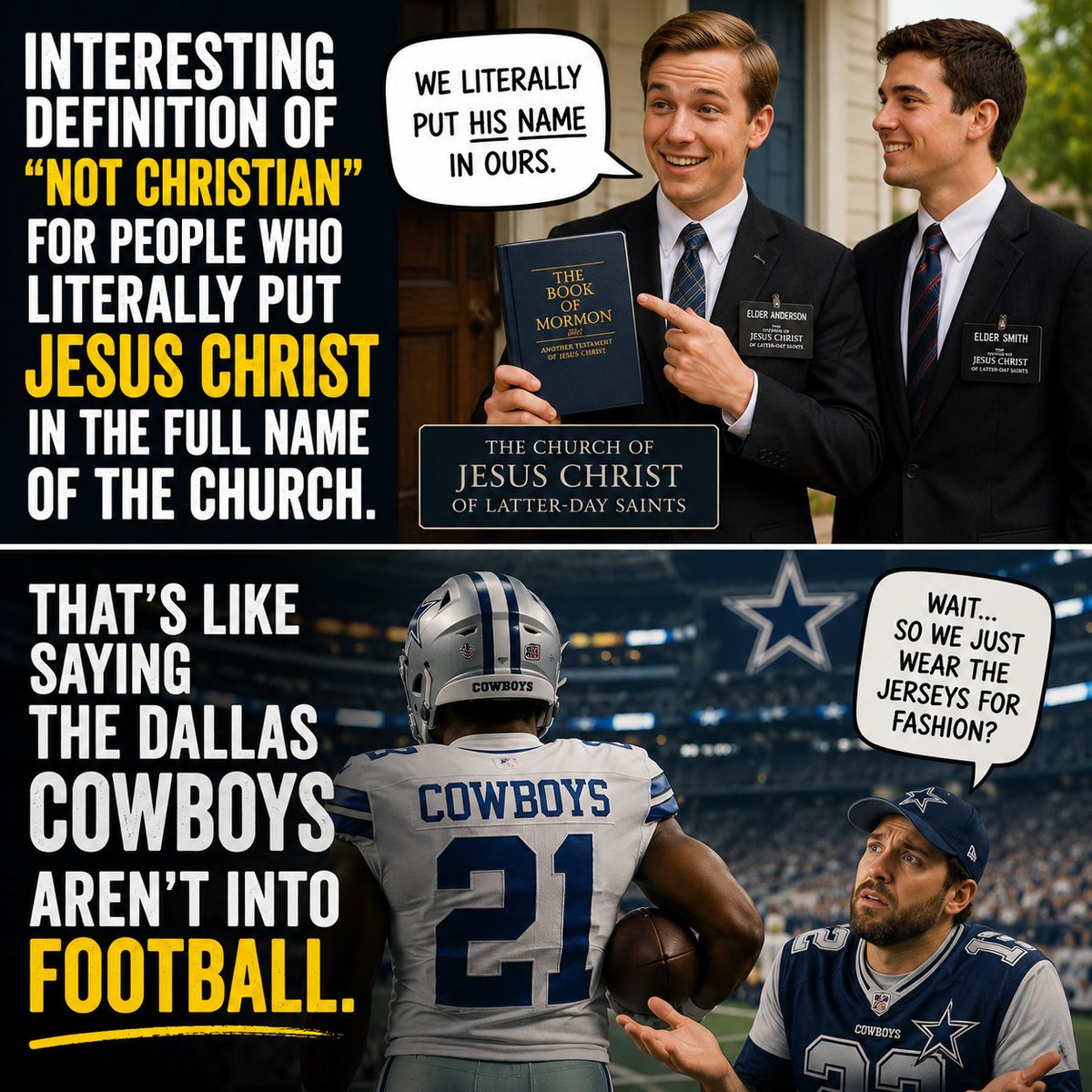
Facts aren't offensive. Its the misrepresentation of of facts that are offensive.
So-called Christians forget this from Peter
1 Peter 3:15
"Always be prepared to give a defense to everyone who asks you the reason for the hope that is in you. But respond with gentleness and respect."
Paul describes the spirit in Galatians 5:22-23
But the fruit of the Spirit is love, joy, peace, longsuffering, gentleness, goodness, faith,
Meekness, temperance.
Jesus flipping tables is not a blanket excuse for disrespectful behavior.
He confronted organized corruption in God’s house with divine authority — not personal irritation, pride, or perceived differences than actual differences. The same Jesus who flipped tables also commanded:
- Love your enemies
- Bless those who curse you
- Be meek and merciful
Instead, they’re just justifying bad behavior with an the illusion of credibility.
What's offensive is those i would rather have brothers in Christ. Some seem to prefer gatekeeping instead.
Which tells me they do believe in a "different Jesus".
The "Mormon Jesus" is the true and living Christ. "Wherefore, no man will be angry at the words which I have written save he shall be of the spirit of the devil." 2 Nephi 33:6
English

@SimplyWithFaith @LoganMPierce1 Nope, just stating the facts, which apparently you find offensive.
English

@tnsampson2 @LoganMPierce1 So you're siding with disrespect. And then continue to justify it.


English

The biblical Jesus is not the LDS jesus. End of discussion.
There's that LDS worldview again. You keep trying to interpret the Bible through the lens of Mormon theology, and it doesn't work. Mormons teach a god that was once a man on another 'planet', who achieved godhood through his obedience and 'worthiness' in the eyes of his masters. The Bible teaches a God that is nothing like the Mormon view, and the biblical view of Jesus is similarly at odds with the Mormon one.
Christians don't believe Jesus is named Jehovah; that is God's name, of whom Jesus is a part. So you cannot lay the blame on just him, but on God as biblically understood. In most, if not all events noted above, the people were warned what would happen.
The issue is that the LDS jesus acts nothing like the biblical man and his actions are inconsistent with his stated mission. John the Baptist warned the priesthood of his time that if they did not repent they'd be cut down and burned. Yet when Jesus came on the scene he didn't kill any of them; rather, he offered them salvation.
Nephi, aping John, also warned the cities, and had good results in many places. But his jesus came and did the murdering, and we are left to conclude that in all the cities he destroyed, not a single repentant person lived.
In conclusion:
1. Mormon theology is laughable, the product of a human driven by sex, money and power.
2. The Mormon god rests on ridiculous assumptions, and cannot be proven by either the Bible or the Book of Mormon.
3. The Mormon jesus falls into the same category as the Mormon god.
Trying to convince me otherwise using the LDS perspective doesn't work, because I've studied Mormon doctrine and know what garbage it really is. How any thinking person could believe in it is a mystery.
English

I was aiming for cheeky, not snarky.
My true aim was for clarity. Your "answered incorrectly" comment left me to make an assumption or an inference that could easily make misunderstandings.
You know what you get by "assume", right? Maybe it's me, but with something as close to peoples hearts as religion, i want to be clear as possible. Writing things already is tough on communication, but little things make a huge difference to heard and understood in context.
Tell me what you think is incorrect?
English

@SimplyWithFaith That was a terrible attempt at a snarky come back.
Because I’m such a nice person, I’m feeling secondhand embarrassment.
English

@genXcessive Snarky wasnt my attempt. Cheeky.
I was shooting for, you're not being clear. It invites assumptions. Which isn't good for sincere communication.
If you think "I" answered incorrectly, what do you have that fits better?
English

I love talking about Jesus with you! Just a heads-up — we don’t believe in a ‘Mormon Jesus’ who’s different from the biblical one. He’s the same Christ. Calling Him just ‘Jesus’ would be awesome. Thanks!
What you are arguing is, Jesus saves with one hand and slaughters with the other—He’s not the same loving Savior. or, If Jesus came to save sinners, why does the Book of Mormon portray Him killing sinners in catastrophic judgments? That seems inconsistent with the compassionate Christ of the New Testament
Respectfully, that is not really a uniquely LDS problem — it is a biblical one.
The same Bible that presents Jesus as Savior also presents Him as judge:
- the Flood,
- Sodom and Gomorrah,
- Egypt,
- Canaanite judgments,
- Revelation, and final judgment itself.
Most Christians also identify Jesus with Jehovah of the Old Testament. So if divine judgment is incompatible with Christ’s character, that creates tension for biblical Christianity generally — not just the Book of Mormon.
The Book of Mormon does not teach those people were excluded from Christ’s atonement. Physical death is not the same as eternal damnation. Christ still died and resurrected for them.
3 Nephi actually emphasizes both judgment and mercy. Immediately after the destruction, Christ invites survivors to repent, come unto Him, and be healed.
The real question is whether God has the right to both save and judge. The Bible and Book of Mormon both answer yes.
And respectfully, if someone accepts divine judgment in the Bible but objects only when it appears in the Book of Mormon, that starts looking less like a moral objection and more like a selective one.
In other words, by applying your argument equally across scripture, it falls flat.
English

In 3 Nephi, we find that the LDS jesus murdered thousands of Nephites because they were not righteous enough. So, in Mormon theology, the same Jesus who died on the cross in payment for the sins of all mankind, came to the Americas and murdered many of the same folks who he died to save at Calvary. I guess he excluded those folks from his universal salvation. Worse, they were all his brothers and sisters in his pre-mortal days, sons & daughters of his physical Heavenly Father.
So while the Jesus of the Bible said that it was the sick that needed the doctor, the Mormon jesus decided many of them needed an executioner instead.
English

@genXcessive Yes, it was a lot.
I am glad you have noted one of the glaring tells of all, the absence of such speech on that point is the issue.
I believe I answered it, maybe you didn't see.

English

@SimplyWithFaith Nowhere in that massive response or the Bible is there any reason why the Apostolic era had to continue. Once the Gospel was written there was no need for them. Best guess is that this is why James was never replaced and why there are zero instructions for succession.
English

@tnsampson2 @LoganMPierce1 @tnsampson2, What is your argument with 3 Nephi? Is you issue with Jesus speaking in 3 Nephi 9, specifically? If so, what about it?
English

@LoganMPierce1 @SimplyWithFaith I know, but I'll stand by my comments. Your jesus introduced himself. Smith probably forgot that when he picked up on reciting.
English

So you also meant Acts 1:22, not just 1:21?
Acts 1 absolutely shows the original Twelve were expected to be eyewitnesses of Christ’s mortal ministry. That matters.
There is an issue I see assuming Peter was establishing an eternal qualification for every apostle in every age rather than the qualification for replacing Judas specifically.
That context matters as I explain.
In Acts of the Apostles 1:21–22, Peter says Judas’s replacement needed to have accompanied them from the baptism of John onward. Why? Because Judas himself was one of the original Twelve who walked with Christ during His earthly ministry. They were restoring that exact quorum before Pentecost.
But if Acts 1 establishes a permanent rule for all apostles, several New Testament apostles immediately fail the standard:
• Paul the Apostle
• Barnabas
• likely James, brother of Jesus in the strict Acts 1 sense
Yet the New Testament still calls them apostles.
That strongly suggests the broader qualification was not:
“Must have walked with Jesus during His mortal ministry,”
but rather:
“Must be called and commissioned by the risen Christ.”
This aligns naturally with Paul’s experience.
What did Christ establish?
Paul the Apostle says Christ placed:
Apostles first and prophets 2nd at the head of the Church (1 Corinthians 12:28), and calls the Church “built upon the foundation of the apostles and prophets,” with Christ as the chief cornerstone (Ephesians 2:20).
Christ did not establish a church built primarily upon later councils, scholars, or inherited institutional tradition. He established apostles and prophets guided by revelation.
Through the apostles came bishops, elders, evangelists, teachers, deacons, and the broader structure of “The Way.” The organization flowed from living apostolic authority.
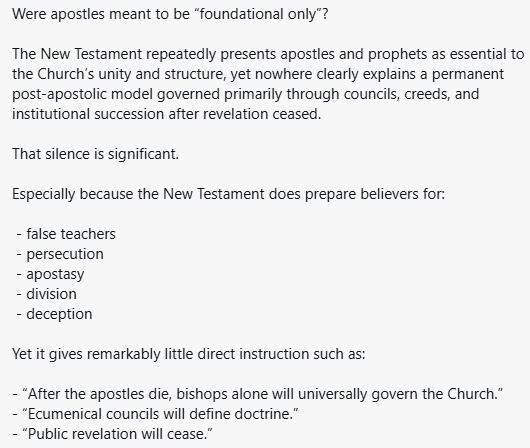
Were apostles meant to be “foundational only”?
The New Testament repeatedly presents apostles and prophets as essential to the Church’s unity and structure, yet nowhere clearly explains a permanent post-apostolic model governed primarily through councils, creeds, and institutional succession after revelation ceased.
That silence is significant.
Especially because the New Testament does prepare believers for:
- false teachers
- persecution
- apostasy
- division
- deception
Yet it gives remarkably little direct instruction such as:
- “After the apostles die, bishops alone will universally govern the Church.”
- “Ecumenical councils will define doctrine.”
- “Public revelation will cease.”
- “Future creeds will become the final doctrinal authority.”
The LDS Restoration fits naturally into the New Testament pattern:
• apostles
• prophets
• public revelation
• continuing divine guidance
It restores the same revelatory structure Christ originally established.
I’m not saying this forces everyone to accept the LDS conclusion. People can reasonably disagree.
But from my perspective, Catholic, Orthodox, and mainstream Protestant models leave major historical and theological tensions unresolved between:
- the Church Christ established in scripture,
- and the post-apostolic systems that later developed.
The Restoration resolves those tensions in a way I find coherent, biblical, historically plausible, and spiritually compelling.
English

@SimplyWithFaith My original response to your post was that no one can be an Apostle unless they have physically been present with Jesus. And even then Jesus must choose them. Therefore Apostles can’t make more apostles, so this succession idea is false.
English

I agree. When did Peter pick an apostle?
Jesus chose his apostles and ordained them. Specifically, Mark 3:14, Luke 9:1, Matthew 10:1, Mark 13:34, and John 15:16.
I am asking for a likely respone from Peter about apostles and prophets. I am asking can a Church claim to be the NT Church or "be biblical" without apostles and prophets guided by public revelation.
D&C 13, Joseph and Oliver we ordained by John the Baptist.
D&C 27:12 Joseph and Oliver were ordained aposltes by Peter, James, and John.
D&C 110 Joseph and Oliver we given keys by Moses, Elias, and Elijah.
Did Joseph take the honor upon himself or was he called of God? Would it be important to know if God did this or not?
English

@SimplyWithFaith When did Peter pick an Apostle?
you may need to review Acts 1, specifically Acts 1:21.
English

If I asked the Apostle Peter did the NT Church have apostles and prophets guided by public revelation, what would be a likely response?
When NT converts joined the NT Church and became fellowcitizens with the saints, Ephesians 2:19-20, did they join a Church with active apostles and prophets guided by public revelation? IF they did and you didn't, which is the likely the true Church?
English

@SimplyWithFaith I guess I missed the part where people can make more apostles, and without any sign from god we have to accept these new people are apostles.
English

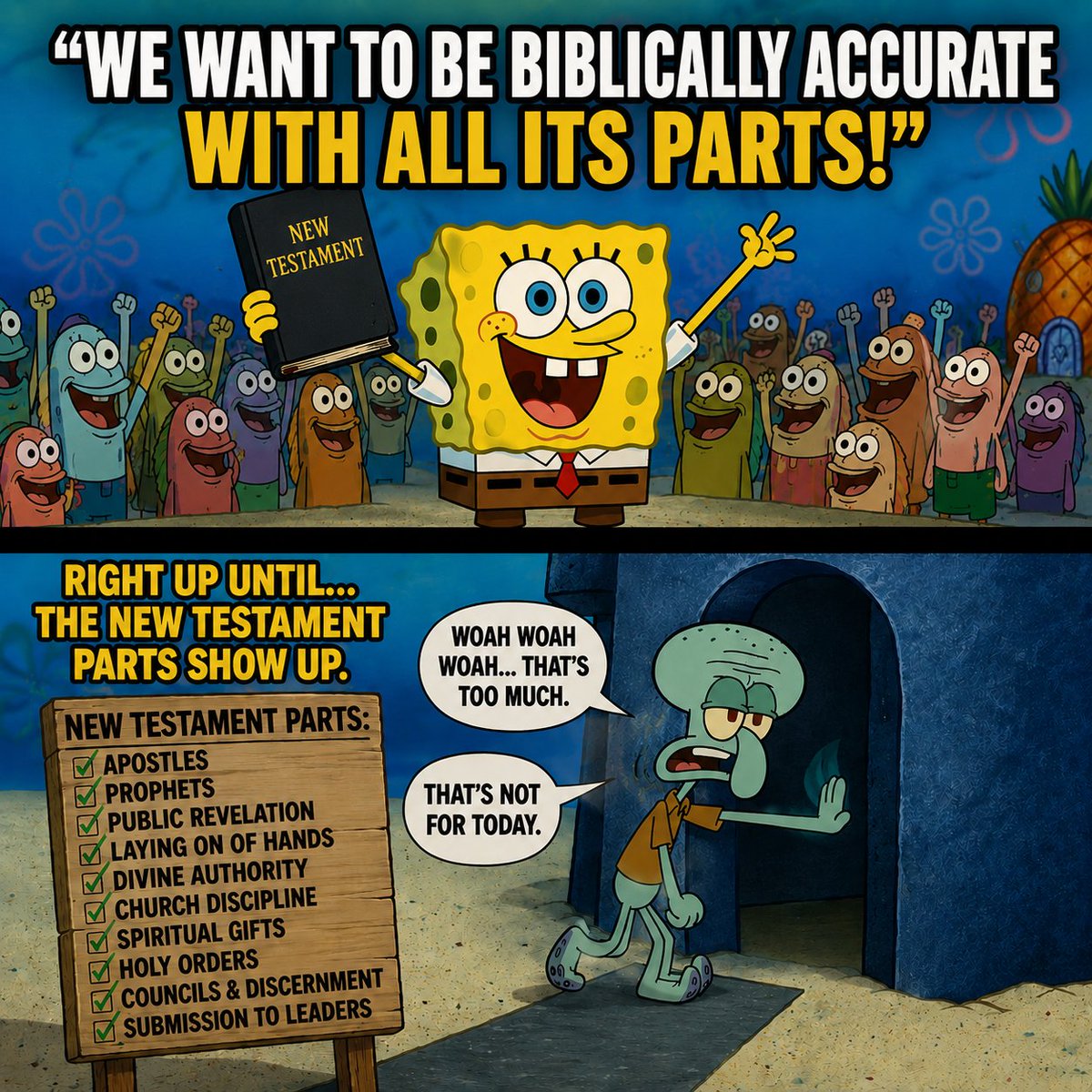
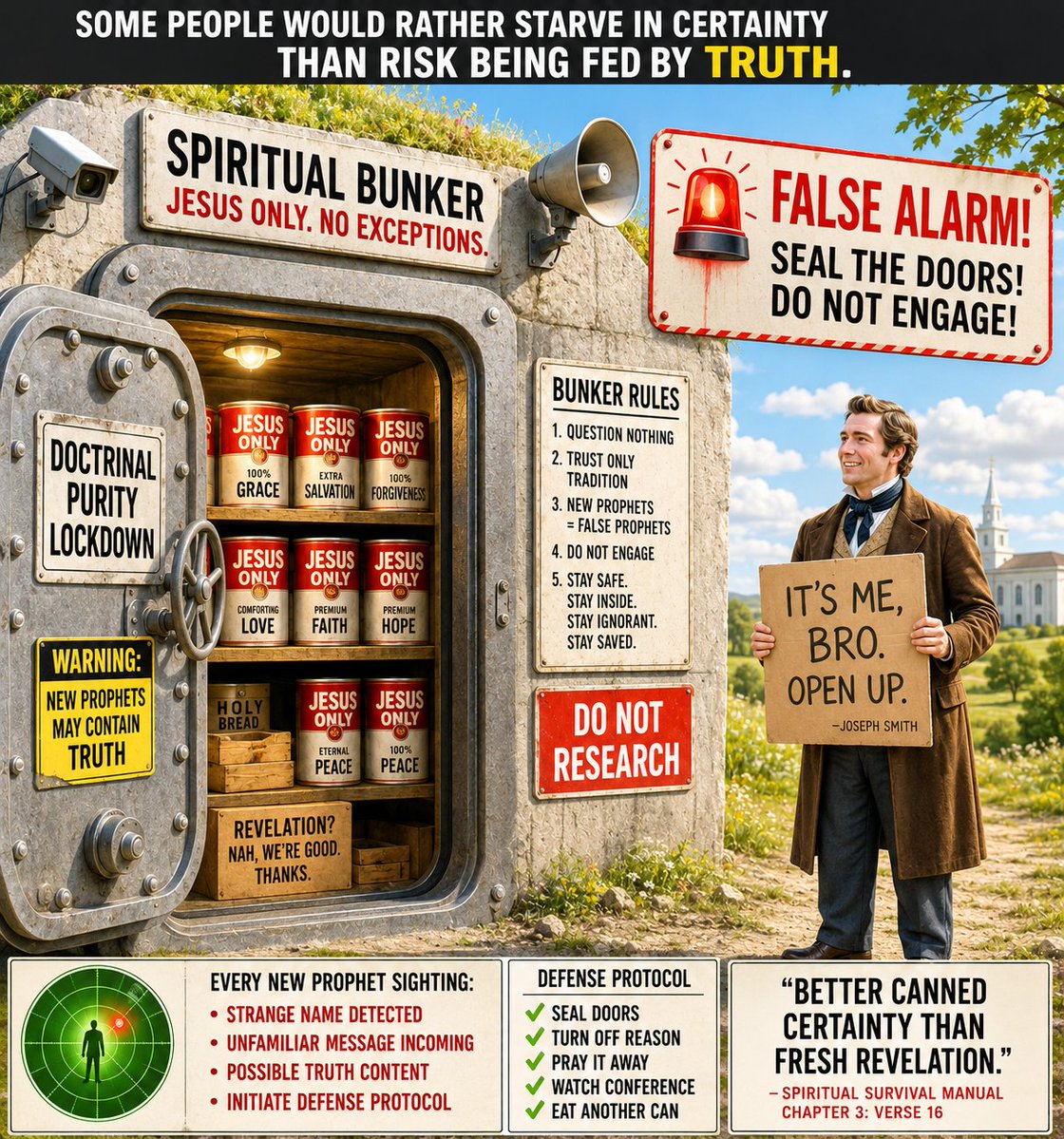
There are those who reject any idea of a prophet out of fear for being deceived. Some ministers teach there will not be any prophets after the apostolic era. Those who hear this rhetoric preached should be alarmed by such statements and know it is not what Jesus taught.
Jesus expects true and false prophets. He warned and enabled believers how to no be deceived by the false one.
#FloodXwithTruth #SaintsOnX #BuildZionOnX #LDSX #LDX

English

As I see it, the New Testament explicitly shows the operation of apostles, prophets, revelation, ordinations, councils, and living authority in the Church. What it does not explicitly provide is a detailed roadmap for how the Church was meant to function permanently after apostles and prophets disappeared from the earth.
Because of that silence, later Christian traditions had to construct theological explanations for why the Church no longer visibly operated as it did in the apostolic era.
In the Catholic and Orthodox traditions, apostolic succession became the mechanism for preserving continuity and authority after the apostles' deaths. However, the fully developed later concept — especially the idea of a singular bishop inheriting universal Petrine authority in an unbroken juridical line — is not laid out in explicit detail in the New Testament itself. Rather, it is inferred from broader principles such as ordination, laying on of hands, continuity of leadership, and preservation of doctrine.
Put another way:
the New Testament clearly shows apostles leading the Church; it does not clearly show a transition away from apostles into a permanently apostle-less structure governed solely by bishops.
That gap required later theological development.
From an LDS perspective, this matters because it suggests much of later ecclesiastical structure was built retrospectively to explain the historical reality that apostles and prophets were no longer functioning as they had in the New Testament Church.
In other words: rather than scripture plainly stating,
“Here is how the Church will operate once apostles and prophets cease,” later Christians largely reasoned backward from existing conditions: “The apostles are gone, therefore this new structure must now be the intended continuation.”
That is different from possessing direct, explicit biblical statements establishing the later system in detail.
The debate ultimately centers on whether continuity through institutional succession is equivalent to continuity through the same revelatory offices and authority structures visibly present in the New Testament Church.
The Old Testament repeatedly shows that when prophetic revelation diminished or was rejected, God’s people did not cease being religious. Rather, authority shifted toward institutional leadership, interpretation, tradition, and political power struggles — precisely the kind of transition many argue became visible in the post-apostolic councils.
Amos 8:11–12 presents a biblical pattern of what happens when revelation withdraws from a people. Religious life may continue, but there is a “famine” of the word of the Lord — people seek divine guidance yet cannot find it.
11 ¶ Behold, the days come, saith the Lord GOD, that I will send a famine in the land, not a famine of bread, nor a thirst for water, but of hearing the words of the LORD:
12 And they shall wander from sea to sea, and from the north even to the east, they shall run to and fro to seek the word of the LORD, and shall not find it.
After a thorough study, I have yet to find any period where God is pleased not to have prophets on the earth. Jesus does warn us about the false prophets who would come and lead many astray. Yet, he also armed us how to know the true from the false.
Historically, many Christians later concluded that public revelation or apostolic office ceased after the apostolic age. But that conclusion is a post-biblical theological development rather than a direct statement from Jesus Himself.
The New Testament does not prepare believers for a permanent absence of prophets. Rather, it repeatedly warns them to discern between the false and the true.
What did Jesus establish?
Commissioned apostles and prophets. Paul calls them the 1st and 2nd parts of the body of Christ. He also calls them the foundation, and we see them as the source that everything ties in. Of course, Jesus is the Chief Cornerstone. Christ did not establish a church built merely on scholars, councils, or inherited tradition. He established apostles and prophets.
Through the apostles, bishops and elders were called to lead local communities in 'The Way'. They also ordained seventy, deacons, teachers, and evangelists. This was the organization and everything flowed from them as they were guided by revelation from Jesus Christ.
Were the apostles mean to be "foundational only"?
The NT repeatedly presents apostles and prophets as integral to the Church’s structure and unity, yet nowhere clearly outlines a long-term model for a fully post-apostolic Church operating without revelatory leadership.
That silence is substantial and notable.
The earliest Christian movement appears structured around living apostolic authority, not around a future model dependent primarily on councils, creeds, and inherited institutional interpretation after apostles disappeared.
That does not prove apostasy or restoration by itself. But it does create historical and theological tension for later models that assume:
- apostles were temporary (foundational only to what was meant to come later)
- revelation largely ceased, and institutional succession alone was expected to carry the Church indefinitely.
The silence is especially notable because the NT does prepare believers for many future issues:
- false teachers
- persecution
- apostasy
- division
- wolves entering the flock
- deception
Yet it gives comparatively little direct instruction like:
“After the apostles die, bishops alone will govern universally.”
“Ecumenical councils will define doctrine.”
“Public revelation will cease.”
“Creeds formulated centuries later will become the doctrinal standard.”
Scholars are also finding out that pre-Josiah reform there wasn't a hard monotheism structure like what came after. Which is interesting and leaning toward a council of gods leadership.
You can see it completely different, that's okay. But I cannot ignore these things. Catholicism, Orthodox, and Mainstream Christianity as a whole has not resolved these tensions in simple terms. I find the LDS argument and position relatable, credible, logical, and defensible.
English


Unless I am mistaken, this is obviously important to you and apparently foundationally driving you. I going to do my best to steelman your position in attempts to understand you, not to manipulate.
If I understand you correctly this is your position:
God does not change in character, but He can change how He administers His work according to His redemptive plan and mankind’s circumstances.
In different eras, God used different means to guide His people:
• He spoke directly at times (Sinai, Jesus’ baptism).
• He governed through judges and prophets under Israel.
• He ultimately revealed Himself through Jesus Christ.
After Christ’s death, resurrection, and the sending of the Holy Ghost at Pentecost, a new covenant era began. Because Christ completed the atonement and conquered sin and death, believers now have broader access to God through the indwelling Holy Spirit and the preserved writings of the apostles and prophets in scripture.
Therefore, the Church no longer depends on ongoing prophets in the same way ancient Israel did, because:
1. Christ is the final and complete revelation of God.
2. The Holy Spirit now dwells in believers collectively.
3. Scripture preserves the apostolic witness once delivered to the saints as 'God breathed'.
Under this view, prophets and apostles were foundational for establishing the Church and producing scripture, but once that foundation was laid, the ordinary governing means became scripture illuminated by the Holy Ghost rather than continuing prophetic offices.
On in otherwords:
God used prophets to produce the written word, but now that the written word (as He breathed it) and Holy Spirit are present, the Church no longer needs living prophets as an ongoing institution.
Did I state you position on this accurately? Did I miss any important points? If so, what?
English

@SimplyWithFaith @cipherapex Part 2. God used Judges, God used Prophets. In the Church age God uses Himself as the Holy Spirit dwelling in every believer and Scripture God's written word which He breathed. Because Jesus defeating sin and death changed the circumstances.
English

(It's a book, but worth it)
Before I respond to our main topic, I am going to take your first point and reflect it in the same way you did. I'm going to rephrase this purposely from your own words. I am aiming at kindness and respect. I am curious to see if you see what I saw.
Your first paragraph argument could be treated the same way back to you.
***I hear you (skip10), but you keep trying to analyze the past through the lens of "Mainstream Christianity". If you believe that nothing was lost after the death of the apostles, then everything you dwell on will support that worldview. You cannot just view the facts by their merits.***
There is an assumption portrayed in this. You appear to have assumed I have always accepted the Mormon worldview, or have never questioned the Mormon view on these points. It's an easy mistake. I see this often when conversing with people online. It is a mistake.
Also, when you say "you cannot just view the facts by their merits", what other way(s) do you suggest if not following the trail of facts to natural conclusions the merit itself leads?
Now back to the main topic:
"They developed a concept that remained true to the OT, accommodated the NT, and made sense." This is exactly what I said happened earlier in our dialogue. The doctrine "emerged through centuries of theological reflection as church leaders sought to reconcile biblical monotheism, the divinity of Christ, the distinction between Father, Son, and Holy Spirit, and passages describing Christ in subordinate relation to the Father."
The result was an interpretation. They attempted to logically demonstrate how both monotheism and the divinity of Christ can coexist as true. What they concluded was the doctrine of the Trinity.
Would you agree with this recap? If not, what would you add or change? Fill me in. It may not be elaborate, but it hits the main points.
Here is a brief recap of the before, during, and after of the Council of Nicaea as I understand the historical events.
In the early 300s, Arius taught that Jesus (the Son) was created by God the Father and was not fully equal to Him. This teaching split the church.
To restore unity, Emperor Constantine called the Council of Nicaea in 325 AD. About 300 bishops attended.
The main debate: Is Jesus fully God and of the same substance as the Father, or a lesser, created being?
Broadly speaking, three major tendencies emerged:
• Group 1 Strong Anti-Arians
- Small minority (~15–20 persons)
-Full homoousios (“same substance”)
• Group 2 Largest Majority
- A large middle group preferred biblical language, such as ‘like the Father,’ and were cautious about homoousios.
• Group 3 Pro-Arian Small minority (~20 persons)
- Son is created / subordinate
The smaller group of bishops pushed for the word homoousios (“same substance”). Most bishops were uncomfortable with it because it was non-biblical terminology with philosophical and controversial theological baggage.
Constantine strongly favored the term as a means of achieving doctrinal unity and imperial stability. The council adopted the Nicene Creed with homoousios. Those unwilling to sign the creed or condemn Arius faced exile or removal from communion, indicating substantial political and ecclesiastical pressure toward unity.
The controversy did not end in Nicaea. For the next 50+ years, emperors, exiles, and new councils swung back and forth between Arian and Nicene views.
Finally, in 381 AD, the Council of Constantinople reaffirmed and expanded the Nicene Creed, and under Emperor Theodosius, Nicene Christianity became the official imperial orthodoxy.
Summary: Nicaea declared Jesus fully God, but it took over 50 years of debate and political pressure before that belief fully prevailed.
Again, would you agree with this recap? Does this miss anything? What would you add?
Knowing this, as I see it, critics expect Latter-day Saints to accept as essential Christian doctrine a formulation that:
1. Was formalized centuries after the apostles.
2. Relied on philosophical terminology not found in scripture (homoousios).
3. Emerged in a politically charged environment under Constantine, where unity and stability often appear to have taken precedence over arriving at a universally satisfying theological formulation.
4. It was controversial among bishops at the time and not embraced without resistance.
5. Was ultimately enforced through councils, creeds, exile, and ecclesiastical pressure.
Yet Latter-day Saints are criticized for questioning whether this represents the original apostolic faith in its pure form.
On top of all that, if nothing else, the Council of Nicaea evidences a profound shift in how doctrine was established.
In the New Testament, doctrine came through apostles receiving revelation from Jesus Christ. By Nicaea, doctrine was being defined through episcopal debate, philosophical terminology, imperial pressure, and majority agreement rather than new public revelation.
This is what naturally occurs when revelatory apostolic authority is no longer present: theological disputes are settled through councils, argumentation, politics, and consensus rather than prophets receiving revelation from God.
The Old Testament repeatedly shows that when prophetic revelation diminished or was rejected, God’s people did not cease being religious. Rather, authority shifted toward institutional leadership, interpretation, tradition, and political power struggles — precisely the kind of transition many argue became visible in the post-apostolic councils.
Amos 8:11–12 presents a biblical pattern of what happens when revelation withdraws from a people. Religious life may continue, but there is a “famine” of the word of the Lord — people seek divine guidance yet cannot find it.
11 ¶ Behold, the days come, saith the Lord GOD, that I will send a famine in the land, not a famine of bread, nor a thirst for water, but of hearing the words of the LORD:
12 And they shall wander from sea to sea, and from the north even to the east, they shall run to and fro to seek the word of the LORD, and shall not find it. Amos 8:11-12
After a thorough study, I have yet to find any period where God is pleased not to have prophets on the earth. Jesus does warn us about the false prophets who would come and lead many astray. Yet, he also armed us how to know the true from the false.
If prophets or apostles were to end forever, Jesus didn't express it.
Historically, many Christians later concluded that public revelation or apostolic office ceased after the apostolic age. But that conclusion is post-biblical theological development rather than a direct statement from Jesus Himself.
The New Testament does not prepare believers for a permanent absence of prophets. Rather, it repeatedly warns them to discern between false and true ones.
Avoiding all prophetic claims because some may be false is not the pattern taught by Christ or His apostles. The New Testament instructs believers to discern, test, and judge prophetic claims — not reject the possibility of prophets altogether.
What did Jesus establish?
Commissioned apostles and prophets. Paul calls the number 1 and 2 parts of the body of Christ. He also calls them the foundation on which everything ties in.
Christ did not establish a church built merely on scholars, councils, or inherited tradition. He established apostles and prophets.
Paul even lists them first in the body of Christ and says the household of God is built upon their foundation, with Jesus Christ as the chief cornerstone.
Through the apostles, bishops and elders were called to lead local communities in the way. They also ordained seventy, deacons, teachers, and evangelists. This was the organization and everything flowed from them as they were guided by revelation from Jesus Christ.
Were the apostles mean to be "foundational only"?
The NT repeatedly presents apostles and prophets as integral to the Church’s structure and unity, yet nowhere clearly outlines a long-term model for a fully post-apostolic Church operating without revelatory leadership.
That silence is telling.
The earliest Christian movement appears structured around living apostolic authority, not around a future model dependent primarily on councils, creeds, and inherited institutional interpretation after apostles disappeared.
That does not prove apostasy or restoration by itself. But it does create historical and theological tension for later models that assume:
- apostles were temporary,
- revelation largely ceased, and institutional succession alone was expected to carry the Church indefinitely.
The silence is especially notable because the NT does prepare believers for many future issues:
- false teachers
- persecution
- apostasy
- division
- wolves entering the flock
- deception
Yet it gives comparatively little direct instruction like:
“After the apostles die, bishops alone will govern universally.”
“Ecumenical councils will define doctrine.”
“Public revelation will cease.”
“Creeds formulated centuries later will become the doctrinal standard.”
Then again, you are asking LDS not to question this, but fall in line when there are obvious flaws to all this history.
LDS and the restoration falls in lock-step with the NT organization, set up with apostles and prophets. It returns the fundamental roots.
Scholars are also finding out that pre-Josiah reform there wasn't a hard monotheism structure like what came after. Which is interesting and leaning toward a council of gods leadership.
Again, I not stating this to convince you. I am giving you a window in the logical process as I see it. You can see it completely different, that's okay. But I cannot ignore these things. Mainstream Christianity has not resolved the tensions in simple terms. I find the LDS argument and position relatable, logical, and defensible.
English

I hear you, but you keep trying to analyze the past through the lens of Mormonism. If you believe that all was lost at some point after the death of the apostles, then everything you dwell on will support that worldview. You cannot just view the facts by their merits.
The nature of God was well-understood by the Jews, who had their books which described him and his interactions with them. But Jesus comes along and eventually proclaims the Spirit and now his followers have an unknown to consider, to wit: how do we make sense of what Jesus has told us?
The NT points to multiple events that indicate equality as the key to their relationship and sameness to their nature:
- An Old Testament implication of the Trinity is found in Isaiah 48:16: “And now the Sovereign Lord has sent me, endowed with his Spirit.”
In this verse, we have three persons referenced: the Lord (Yahweh), the Spirit, and the speaker (“me”), who in this context is the Messiah. According to Luke 4:16–21, the “me” of Isaiah 61 refers to Jesus. So, in the span of one verse, we have a reference to the Lord (Yahweh), the Messiah, and the Spirit. In other words, God the Father, God the Son, and God the Holy Spirit.
- In one of His prayers, Jesus speaks to the Father about sending the Helper, the Holy Spirit (John 14:16–17). So, Jesus did not consider Himself to be either the Father or the Holy Spirit.
- In the story of Ananias in Acts 5 where Peter accuses him of lying to God, but his wife of testing the "Spirit of the Lord" with the strong implication of their sameness. It also raises into question your view that the apostles weren't aware of the trinitarian viewpoint. How do you know that? They may well, have, as that verse suggests, but didn't articulate it in trinitarian terms.
- In John 14:16, Jesus says "And I will ask the Father, and he will give you another advocate to help you and be with you forever—" The Green for 'another' means something of the same kind; that is, just like Jesus. It also says that 'comforter' will be with them forever, meaning that the 'loss' Mormons are so concerned with couldn't have occurred.
I could list many other examples of NT references that support the trinitarian view, and that's what the later church fathers dealt with in understanding the new information about the nature of God. They developed a concept that remained true to the OT, accommodated the NT and made sense. The doctrine they agreed upon served to give each church a standard from which to operate, and from which to oppose heresy.
As an example, the Southern Baptist Convention has many churches as members, but they do not control their actions. They just ask that a church concur with a statement of beliefs and values which are biblically based. The Nicene Creed served a similar purpose, but was more strictly enforced.
The LDS view of the godhead as being separate persons, with one of them being a man who achieved godhood, is clearly beyond anything the Bible teaches. That would make OT speak of a polytheistic God, which is clearly does not, Smith's 'revelations' notwithstanding.
English

@davidHenkel20 @cipherapex Thank you for clarifying. Please expand more this position you have. How do you arive at this conclusion?
English

@SimplyWithFaith @cipherapex Correct. Think about it Faith the pause in the age in prophets is natural one. We have a direct relationship with God and the Holy Spirit living inside believers & Scripture being completed was not the case Prior. God did not change but the circumstances changed
English

@davidHenkel20 @cipherapex In essence, you are saying, since we have the Holy Ghost and scripture there is no need for prophets?
English

@SimplyWithFaith @cipherapex Holy Spirit inside of you and Scripture. Yes I am saying that. This is why the age of prophets is on pause. There is not no more revelation but truth comes directly from God we don’t need a middle man as a prophet now.
English

Thank you for that clarification. I appreciate it.
Let me draw on your statement, if I may. Please hear me out. "This doctrine was not a sudden development but a gradual process influence by theological reflection and scriptural interpretation."
Then you stated, "The doctrine of the Trinity was formally established through ecumenical councils."
This is central to the argument I have on this point.
Logically then, the doctrine of the Trinity then was not taught by the apostles or Jesus. It wasn't formalized until the councils.
While doctrine of the Trinity may have elements present in the 1st century, it wasn't even mainstream when the apostles were alive, as established in your comment which I believe is accurate.
Now, many people want to hold LDS to a standard or definition that the apostles and Jesus didn't even adhere to. Do you see an issue here or not? To me it is glaring.
What you stated, wrether you meant to or not, is a neon light-type of example of apostasy.
They established this doctrine on theological and scripture "interpretation", not revelation, like we would read if it came in the NT model through the apostles.
By 325AD, Christian Communities were divided on many doctrines. Not just on the nature of Jesus and God. Constantine did not want a divided empire, which is why he called for council to begin with.
The Christian leaders they were divide. That is extremely telling that doctrinal drift had occured because there was varying doctrines among all of them.
What you are stating as well is a reliance on interpretion, not public revelation as would be the case if there were apostles and prophets. But since there weren't any available, the did the best they could. This is evidence of apostasy already in bloom.
Post-apostolic period is exactly what has happened many times already in Israels history.
You don't have to agree with this. But it is how I see it. I don't think it is unrealistic or controversial.
English

I don't think the word 'Trinity' has much meaning because it's insufficient in describing the Biblical God. A doctrinal statement has to be far more precise, and I'll offer this one:
- The Trinitarian Doctrine is the belief that defines one God existing in three coeternal and consubstantial persons: God the Father, God the Son (Jesus Christ), and God the Holy Spirit. This doctrine emphasizes that while these three persons are distinct, they share one divine essence or nature.
This doctrine was not a sudden development but a gradual process influenced by theological reflection and scriptural interpretation. Some early contributors:
- Theophilus of Antioch: The earliest known Church Father to use the term "Trinity" in the 2nd century.
- Justin Martyr: He introduced terminology that would later be essential in Trinitarian theology, emphasizing the relationship between the Father and the Son.
- Irenaeus of Lyons: He defended the economic Trinity, explaining how the Father, Son, and Holy Spirit interact in the context of salvation.
The doctrine of the Trinity was formally established through ecumenical councils:
- First Council of Nicaea 325 - Affirmed the full divinity of the Son.
- First Council of Constantinople 381 - Affirmed the divinity of the Holy Spirit.
So, the word itself has no weight, but I do believe in the doctrine as stated. It has been amply shown to have biblical support, though not described as such.
English