Saurabh

393 posts

Saurabh banner
Saurabh

Saurabh

@sorukumar

Building @orangemetrics, a data product for FOSS/Bitcoin/LN @Bitcoindatalabs: Open source data tools and viz.

Austin Katılım Kasım 2013
920 Takip Edilen670 Takipçiler
Saurabh
Saurabh@sorukumar·
@shreyas True! Though a thousand thoughtful offsites with good data (and even better snacks) can eventually lead to a solid segment too.
English
0
0
1
308
Shreyas Doshi
Shreyas Doshi@shreyas·
A good customer segmentation is worth a thousand strategy offsites.
Gokul Rajaram@gokulr

SEGMENT, ALWAYS SEGMENT Most confounding business problems have the same root cause: you haven't segmented your customers. You look at the top-line number. It's flat, or weird, or inconsistent with what your gut tells you. You poke at it and you can't figure out why. The answer is almost always that you're staring at an average that's hiding two or three very different stories. A few places this shows up: 1. When your high-level metrics look wonky or divergent, break them out by segment. A flat retention curve often hides one cohort churning out violently and another expanding aggressively. A "meh" NPS usually has one segment of fanatics and one segment of detractors cancelling each other out. The average is a lie. The segments are the truth. 2. When your product is trying to be everything to everyone, you need to tailor it per segment. If your roadmap has SMB founders, mid-market IT buyers, and Fortune 500 procurement all fighting for features in the same backlog, that's three products in a trench coat pretending to be one. Pick the segment you're actually building for, and ship accordingly. 3. When your pricing or positioning feels wrong no matter where you set it, it's because one SKU or pitch is spanning segments with wildly different needs or willingness to pay. Enterprise will pay 10x what a startup will for the exact same thing. A single price point either leaves money on the table at the top or closes the door at the bottom. Segment the packaging. Segment the price. The pattern holds every time. Whenever a business problem is hard to reason about, break the population into segments and look again. Nine times out of ten, the fog lifts. Importantly, you don't need to use standard gender or demographic segments. You can build your own! (And AI is a superpower here). One of the best segmentations in real life was done by @davidweiden at TellMe Networks in the early 2000s. TellMe was selling phone automation software into financial services: a half-billion dollar market, and they had almost no traction. David built a custom segmentation framework called Rifle, which scored every prospect on five weighted criteria. Where the customer was in their buying cycle (engage before the RFP, not after). Whether their long-distance carrier was compatible with TellMe's deployment model. Three more criteria with explicit weightings, including negative scores that disqualified prospects outright. The whole company aligned on the scoring. Sales stopped chasing bad-fit accounts. Product stopped building features for customers who would never close. Marketing stopped spraying the market. Over two years, Rifle drove $20M in ARR inside the qualified segment and took TellMe from a loss to a profit. They literally would have failed without the segmentation. . Founders: when a metric confuses you, when your product feels scattered, when your sales pitch or pricing won't land, segment. Segment, always segment.

English
15
19
311
98.7K
Saurabh retweetledi
Ricardo
Ricardo@Ric_RTP·
Amazon just got caught running a secret price manipulation operation with Levi's, Home Depot, Walmart, and many more. Every time you "comparison shopped" online, you were looking at prices that were already rigged. Here's what happened: Amazon would monitor prices on Walmart, Target, Best Buy, Home Depot, and Chewy in real time. The second a competitor listed a product cheaper than Amazon, they'd contact the brand directly and tell them to "fix it." And the exact emails are now PUBLIC. Amazon sent Levi's links to two Walmart listings with the subject line "styles of concern." They basically said the prices on Walmart are too low and we have a problem. The next day, Levi's responded: "I talked to Walmart and they have partnered with us to take Easy Khaki Classic fit back up to ladder SPP price, $29.99 immediately." Levi's literally called Walmart and told them to raise the price. Because Amazon told Levi's to make the call. Walmart complied. Then Amazon matched the HIGHER price. Both retailers ended up charging more. The customer paid extra. Nobody competed. Same playbook with Hanes: Amazon sent them links showing Target and Walmart prices were lower. Hanes confirmed they "reached out to Target and Walmart to have the prices increased." Target increased the prices. Walmart increased the prices. Amazon kept their margins. But it gets even worse... Amazon told Allergan (the company that makes eye drops) that their product was "suppressed" on Amazon because it was cheaper on another site. Allergan responded: "Walmart got their price back up to $16.99." Amazon then unsuppressed the listing. They did this with pet treats on Chewy. Furniture on Home Depot. Products across dozens of categories spanning YEARS. The mechanism is simple but terrifying: If you're a brand and you sell cheaper on Walmart than on Amazon, Amazon suppresses your product, removes you from the Buy Box, buries you in search results, and effectively makes you invisible to 300 million customers. Brands can't afford that. So they call Walmart and Target and say "raise your prices or we'll lose our Amazon listings." Walmart and Target comply because they need the brand's products. Amazon captures 40 cents of every dollar spent online in America. That gives them the leverage to set prices across THE ENTIRE internet. Not just their own platform. So turns out, you were never comparison shopping. You were looking at a coordinated price floor set by Amazon through backroom phone calls between brands and their competitors. "Amazon is working to make your life more unaffordable." 3 separate antitrust trials are now scheduled for 2027. The FTC has its own case. 18 states plus the DOJ are piling on. This is literally happening during the WORST affordability crisis in a generation. Groceries up 25% since 2020. Housing unaffordable. Wages flat. And the largest ecommerce company on Earth has been secretly coordinating with brands to make sure you can't find a cheaper price ANYWHERE. "Competition" in retail is just a fantasy.
English
1.9K
26.6K
57.2K
2.9M
Saurabh
Saurabh@sorukumar·
@bitforth Pro tip from people who made it to senior management: let the problem fester until it’s big enough to scare the stakeholders… then solve it and look like a hero. This is called art of strategic waiting!
English
1
0
55
8.5K
Alan
Alan@bitforth·
corporate ladder climber here, I’ll tell you exactly what I would have done in this case: I would have escalated this immediately to leadership for visibility. I would have created a war room or incident channel and pulled in stakeholders. At this point, all I care about is creating a visible paper trail of events. Then I would have put the cost front and center for everyone involved and reframed the whole thing as a business problem because VPs and C-levels don’t care about a bug in some pipeline. Now, if you want IC credit, you say: “I wrote this pipeline” “I caught this issue” “I fixed it” If you want leadership credit, you say: “I pulled the right people together” “I led the response” “I drove this to resolution under time pressure”
Harnoor Singh@iHarnoorSingh

Engineer prevents $80-90M recall. credited as a "good catch" lol CFO mentions the release on the earnings call six months later. The problem isn't that companies are ungrateful. It's that there's no mechanism to reward the person at the start of the value chain. Senior engineers: how do you make invisible impact visible before review season?

English
39
110
2.9K
1M
Saurabh
Saurabh@sorukumar·
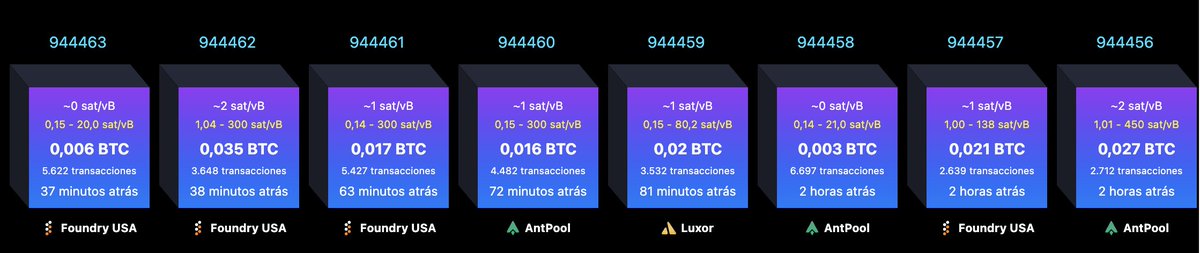
My analysis on Foundry USA's recent 7-block streak (4th time in 2026 so far). Key findings: • 35 streaks of 7+ blocks observed since 2022 — about 1.25× what pure Poisson randomness would predict. • Largely explained by their high hashrate share (~31-35%). At 35% hashrate, you'd expect a 7-block streak roughly every ~11 days on average. • No strong evidence of selfish mining; second-block uplift and header-first signals are near baseline. x.com/sorukumar/stat…
English
0
0
3
139
Saurabh retweetledi
GemsOfINDOLOGY
GemsOfINDOLOGY@GemsOfINDOLOGY·
Indian woman archers. 10,000 BCE. Bhimbetka. Now show me women warriors from around the world from the same period. I'll wait. Because most civilizations from 10,000-2000 BCE don't even have figurative art at this scale—let alone documented women with weapons in public, active, equal. But we've been taught India "oppressed" women. That we needed Victorian England to "liberate" us. Victorian England—where women couldn't own property until 1882. Where riding a bicycle was considered too physically strenuous for the "delicate" female body. Meanwhile, 10,000 years earlier, Indian women held bows. The "backward India" story required erasing 10,000 years of counter-evidence. And we helped. We internalized it. We stopped looking at our own rocks. Bhimbetka didn't fit the script. So it stayed in footnotes. Who decided that Victorian morality was "progress" and our own history was "primitive"? 🏹 And why are we still teaching it?
GemsOfINDOLOGY tweet media
English
40
1.3K
3.5K
38K
Saurabh
Saurabh@sorukumar·
@JuanSGalt @BitcoinMagazine yes. build it on feb. picking it up again these next couple of weeks to improve it. Let me know if you have any feedback or feature requests. love to hear your thoughts!
English
1
0
1
51
Saurabh
Saurabh@sorukumar·
India is exploding! 🇮🇳💥 1. 27 million developers building on GitHub right now 2. +2 million joined in 2026 alone (1 in every 7 new global devs) 3. 1 in 3 new developers worldwide will be from India by 2030 → ~57M devs in India vs US ~45M
Kyle Daigle@kdaigle

HUGE moment for India 🇮🇳 27M devs building on @github in India 2M+ more joined in 2026 1 in 7 new devs are from India 7.5M contributions to open source AI projects on GitHub Behind India’s economic growth is a relentless community of devs. Grateful we got to celebrate on the ground with so many of them here in Bengaluru. A big thank you to this community for building with us all these years. ❤️

English
1
0
3
107
Saurabh retweetledi
Aravind
Aravind@aravind·
आप्रा द्यावापृथिवी अन्तरिक्षं सूर्य आत्मा जगतस्तस्थुषश्च || apra dyava-prthivi antariksam surya atma jagatas tasthuaas ca || "Filling space & earth, atmosphere, the Sun is the soul of all that moves and all that are stationary (on Earth)." - Ṛgveda 1.115.1 (~ 3500 years ago).
Elon Musk@elonmusk

The Sun is ~everything

41
1.2K
6.2K
119.1K
Saurabh
Saurabh@sorukumar·
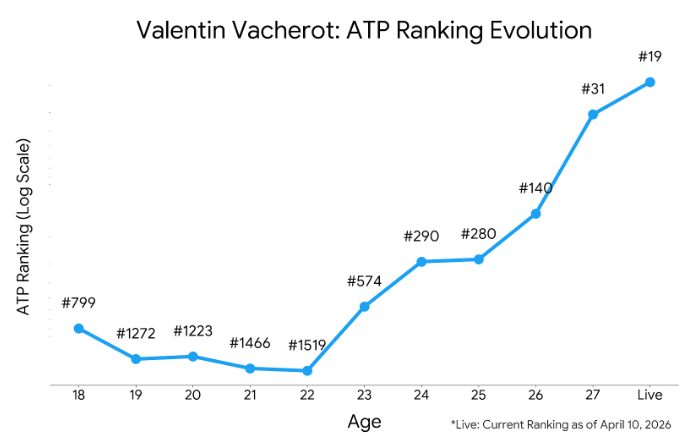
@nishikoripicks @sushantsinha For sure a story worth noticing. It will be a story of the century , if he wins a Slam! I’ll root for it. Wawrinka in steroid!
English
0
0
4
640
Nishi
Nishi@nishikoripicks·
I don't think I've ever seen a player who started breaking through this late in his career. Is there any other case like Valentin Vacherot? I can't think of one.
Nishi tweet media
English
88
31
908
87.4K
Saurabh
Saurabh@sorukumar·
Based on my Chemical Engineering degree + 20 years wrangling data Grok hit me with: 1: AI dashboards turning Bitcoin miners into grid-stabilizing AI data center side-hustles (because why not optimize energy hogs with more energy hogs?) 2: ML-optimized bioreactors for precision fermentation so we can finally make steak from yeast without the cow judging us. 3: And a couple more that sound like they require a PhD co-founder and several government grants just to prototype. Am I finally building atoms… or just more dashboards on top of dashboards?
English
0
0
2
37
Julian Shapiro
Julian Shapiro@Julian·
@armillspaugh its a fair question but i rather founders pursue whatever most motivates them as opposed to being entirely opportunistic
English
1
0
6
345
Saurabh
Saurabh@sorukumar·
@apachesuperset Big fan and user here! since I can’t join the calls, a quick 2-3 bullet recap here would be great for the community. super excited about the MCP
English
1
0
2
24
Saurabh
Saurabh@sorukumar·
@bitschmidty have created a visualization to gauge individual impact by mapping BIPs, mailing lists, and Delving Bitcoin discussions sorukumar.github.io/orange-dev-net… It’s early stages and not super insightful yet, but the data is there. Now, the goal is to extract insights
English
0
0
1
26
Saurabh
Saurabh@sorukumar·
@bitschmidty Caught this on Stacker News last week. My vision is to create dashboards that capture the discussions and debates alongside what’s already happened (like code pushes). Let me think through it and build something concrete. I'll share it with you once it's ready
English
1
0
1
26
Mike Schmidt
Mike Schmidt@bitschmidty·
“Where is the public roadmap for Bitcoin Core?” This sentiment from Zach is common and Ill give my own thoughts on it x.com/zachherbert/st… The subprojects that individual Bitcoin Core engineers contribute to reflect the project’s *software development priorities* which can include things like testing improvements, refactors, features, maintenance, or performance improvements. These software engineering efforts are distinct from the Bitcoin *protocol*, whose consensus rules change only through broad community agreement and network adoption, not by decisions made exclusively within the Bitcoin Core repository. If I were looking to derive a shorter term “public roadmap for Bitcoin Core” (again, the Bitcoin Core software, not Bitcoin protocol), there are a few places to look. Working Groups Contributors actively working on similar efforts form working groups to implement and review projects in Bitcoin Core. A list of the current working groups is on the Bitcoin Core Wiki: #current-working-groups" target="_blank" rel="nofollow noopener">github.com/bitcoin-core/b… From here we can see interest in: Erlay, Fuzzing, Kernel, Benchmarking, Silent Payments, Cluster Mempool, Stratum v2, Multiprocess, QML GUI, and Net Split These working groups also provide updates at the weekly Bitcoin Core developer meetings on IRC: bitcoincore.org/en/meetings/ This is another place to see current work. Tracking issues Many subprojects within Bitcoin Core have a place to track a todo list of code changes that roll up into that project. Here are just a few examples (search the GitHub for “tracking issue” for more): Multiprocess - github.com/bitcoin/bitcoi… Mining interface - github.com/bitcoin/bitcoi… MuSig2 - github.com/bitcoin/bitcoi… Cluster mempool - github.com/bitcoin/bitcoi… Erlay - github.com/bitcoin/bitcoi… Bitcoin Kernel Library - github.com/bitcoin/bitcoi… SENDTEMPLATE - github.com/bitcoin/bitcoi… Core Dev meetups What developers discuss at recent in-person meetings is another data point. Here are transcripts from the October 2025 meeting - btctranscripts.com/bitcoin-core-d… February 2025 meeting - btctranscripts.com/bitcoin-core-d… Merged PRs As code changes are merged into the Bitcoin Core GitHub before the next release you can see what will be in the upcoming release. These code changes include PRs related to projects above, but also more general changes unrelated to a particular project, like maintenance work, additional testing, one-off features, etc. github.com/bitcoin/bitcoi… Likewise Optech has a weekly notable code segment that picks interesting code merges to cover: bitcoinops.org Release Milestones As Bitcoin Core progresses toward a new release, PRs can be tagged with a milestone representing that release. For example, here are the items tagged for the previous v30 release: github.com/bitcoin/bitcoi… And here are considerations for the v31 release: github.com/bitcoin/bitcoi… TLDR, just tell me what will be in v31 Sorry, there isn’t a definitive authoritative answer for a decentralized open source project like this. But also in the spirit of decentralization, I can provide my own guesses of what might be in there based on the source material above: Kernel API - modular use of Bitcoin’s consensus and validation logic outside the full node MuSig2 (in wallet) - fee-efficient, privacy-preserving multi-signature support Cluster mempool - makes transaction relay and block assembly more efficient, predictable, and network reliability. ASMap - help diversify peer connections, strengthening network resilience against eclipse attacks Static builds - reproducible, portable binaries that enhance security, verifiability, and ease of deployment Again, just my personal guesses. I’ll emphasize that while these projects took a ton of work to get where they are, there will also be a majority of PRs in v31 that will not be part of a “project”. They will simply be the general improvements, bug fixes, (fuzz) testing, and maintenance work that is also critical for the project (see x.com/bitschmidty/st… for examples). I hope this is helpful for people. Feedback welcome.
Zach Herbert 🇺🇸@zherbert

Where is the public roadmap for Bitcoin Core? Bitcoin is already a multi trillion dollar asset and will continue to rapidly grow. Where is the dev roadmap? What key bug fixes and features will be worked on over the next 5-10 years? One of the key communication issues with Bitcoin Core is that hodlers, investors, and node runners are not really aware of what's being worked on. Sure we can try to read the Bitcoin mailing list, can try to listen to the @bitcoinoptech podcast or read the newsletter, can occasionally attend local BitDevs meetups – but it's not easy to keep up with what's going on. For example, if you asked me right now, I'd say that Core devs are considering some major improvements like covenants. I remember hearing about Utreexo at a BitDevs meetup last year. But I have no sense about the roadmap for new potential features. I'm sure Core devs would say that having a roadmap is difficult due to Bitcoin's decentralized nature. That there are no individual decision makers, that it is governed by consensus. That a roadmap necessitates a timeline which necessitates dates which will be impossible to hold to. And so on. But hear me out – this is a trillion dollar asset class that is being adopted by governments and publicly traded companies. Yes, it is decentralized. But I think it should at least have a roadmap we can reference. A roadmap would help non-devs understand what is being worked on and what new features are being considered. A roadmap will give everyone plenty of time to argue. Artificial target dates may even help; by acting as "deadlines" they can accelerate arguments and discussions regarding controversial issues. For institutional Bitcoin adoption, a roadmap is critical so that no one is surprised about new controversial features. That's because no feature will really be "new" – it will have been in the roadmap for several years by the time it is adopted. Also important upgrades like quantum resistance would placate critics and substantially minimize this low probability, yet existential, risk. I asked GPT to help me make a sample Bitcoin Core roadmap for the next decade: 2025: Package relay & v3 transaction policy improvements 2026: AssumeUTXO and Utreexo integrated for faster node sync 2027: Fee market and mempool optimizations under heavy load 2028: Covenant soft fork (likely CTV or APO) enabling vaults and channel factories 2029: Lightning enhancements — PTLCs, splicing, multi-party channels 2030: Privacy upgrades — improved transaction relay, better wallet-level privacy 2031: Vault and smart custody adoption through covenant-based tooling 2032: Block size, fee dynamics, and scaling research; Taproot utilization maturity 2033: Quantum-resilient key research and optional hybrid signing schemes 2034: Formal verification and code hardening of consensus layer 2035: Quantum-resistant soft fork (if needed), long-term sustainability focus Of course these are just placeholder items and timelines. But even just seeing this rough roadmap gives me more confidence that the Bitcoin Core project has direction. If this was a real roadmap, we can now all spend years discussing and arguing about each item, with arguments reaching a crescendo as the target year approaches. What do you all think? Thank you for reading.

English
14
44
129
34.1K
Saurabh
Saurabh@sorukumar·
@mattracquet @allunavano Sinner is a learning machine. If he thinks a tactic is good for his style, he will find a way to do it. Side note: do you think it will be insightful to see how Sinner/Alcarz are against others vs each other.
English
0
0
1
100
Matthew Willis
Matthew Willis@mattracquet·
@allunavano He was deeper than avg on deuce side vs Humbert & deeper than avg on both sides vs Machac but bang on avg vs FAA today (approx 2.5m). It depends on matchups. He’s very bimodal on 2nd serve return position but has been for well over a year
Matthew Willis tweet media
English
3
0
7
1.5K
Matthew Willis
Matthew Willis@mattracquet·
A nice way to look at differences in hard & clay court strategy is return positions. Both Alcaraz and Sinner move back a lot on clay (Sinner 1.2m further behind baseline than on hard, Alcaraz 1.3m). But Alcaraz has a bimodal distribution on clay, taking it early & deep evenly
Matthew Willis tweet media
English
13
70
624
46.9K
Saurabh
Saurabh@sorukumar·
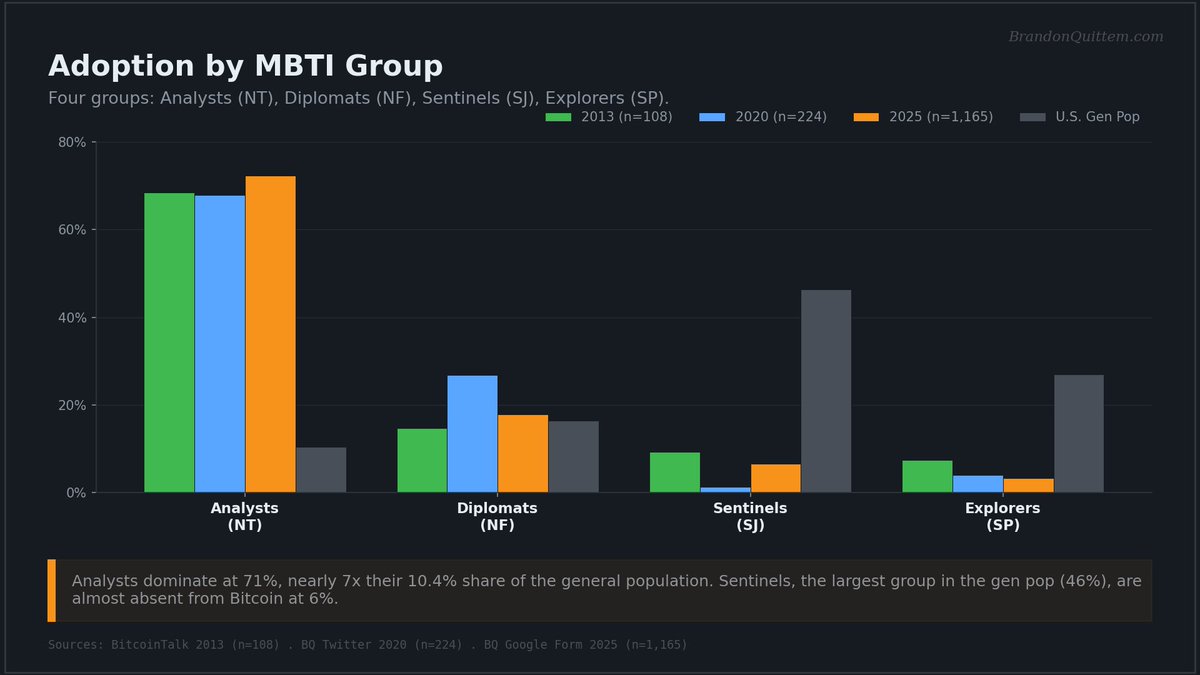
@Bquittem Spot on, Brandon! analyst heavy distribution is textbook innovators + early adopters. Rogers' diffusion model playing out in real time. curious: are we watching that same archetype explore the Bitcoin+AI intersection right now? same psychology, new frontier
English
0
0
2
201
Brandon Quittem
Brandon Quittem@Bquittem·
1/ 2025 Bitcoin personality types (Myers-Briggs) survey results are LIVE Here's what jumped out: 71% of Bitcoiners are "Analysts" (INTJ, INTP, ENTJ, ENTP). Nearly 7x higher than the general population 🤯
Brandon Quittem tweet media
English
68
102
616
93K
Saurabh
Saurabh@sorukumar·
@darosior Do you think it’s good idea to automate bnoc post here on X. More coverage for the discussion
English
1
0
2
107
Antoine Poinsot
Antoine Poinsot@darosior·
If you are a researcher on Bitcoin, in academia or not, you should know about BNOC dot XYZ
English
2
3
27
1.1K