
Chupa-mos
962 posts


If you kill a killer, the number of killers in the world remains the same.
English
@MercuriusFilius Assuming 50 years, I'd say somewhere around 5k. At 5% a year returns compounding (very conservative), after 50 years the 5k would be 57k. That is > the 50k of 1k a year.
English
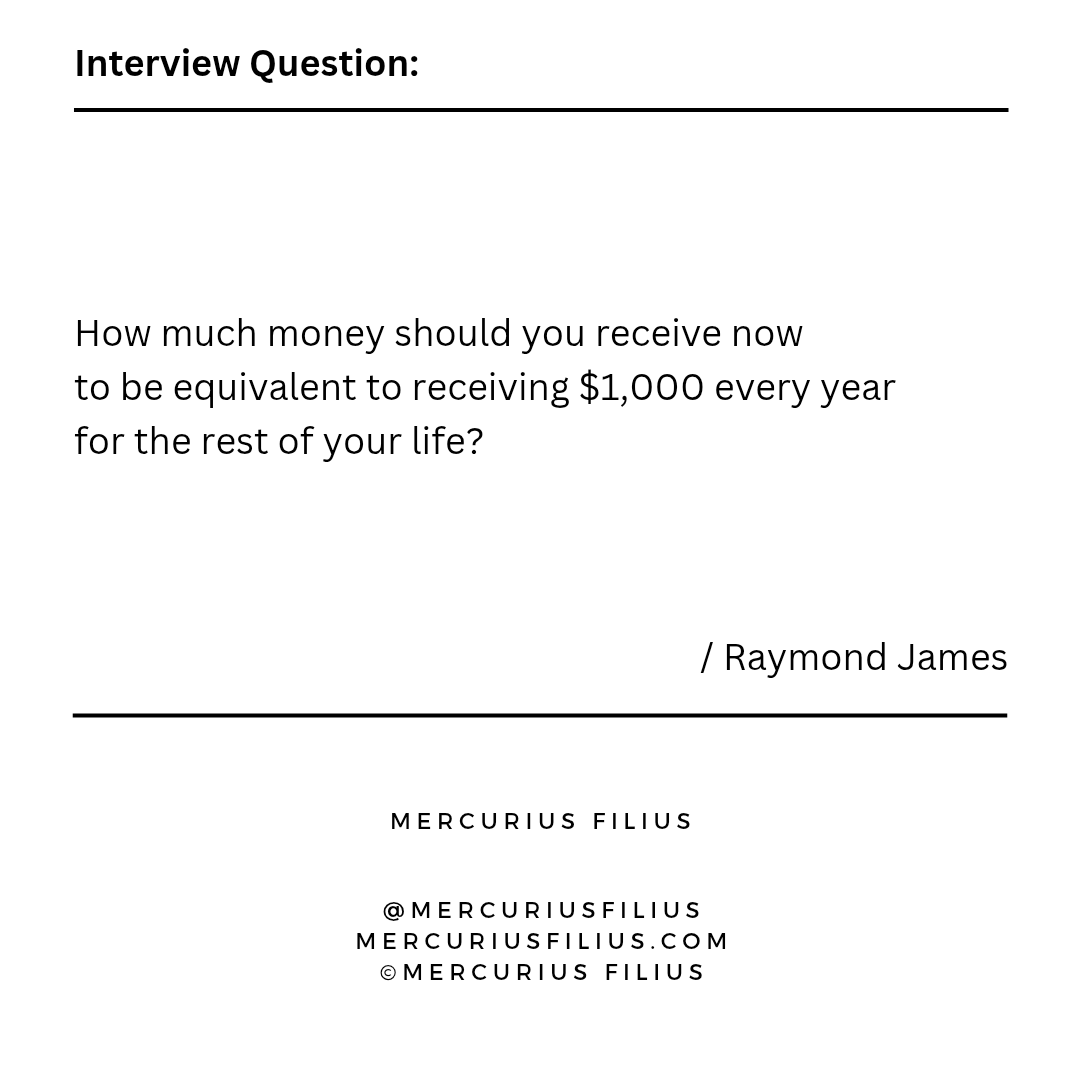
@furious_cs @MercuriusFilius Wrong. Inflation exists. Also, money know is worth more than money later, even without inflation, due to opportunity cost and investing. Your answer is idiotic.
English
@MercuriusFilius I would say, "I believe that I will live to age 90". You would then simply deduct your current age from 90 and multiply by $1,000. LOL!
English
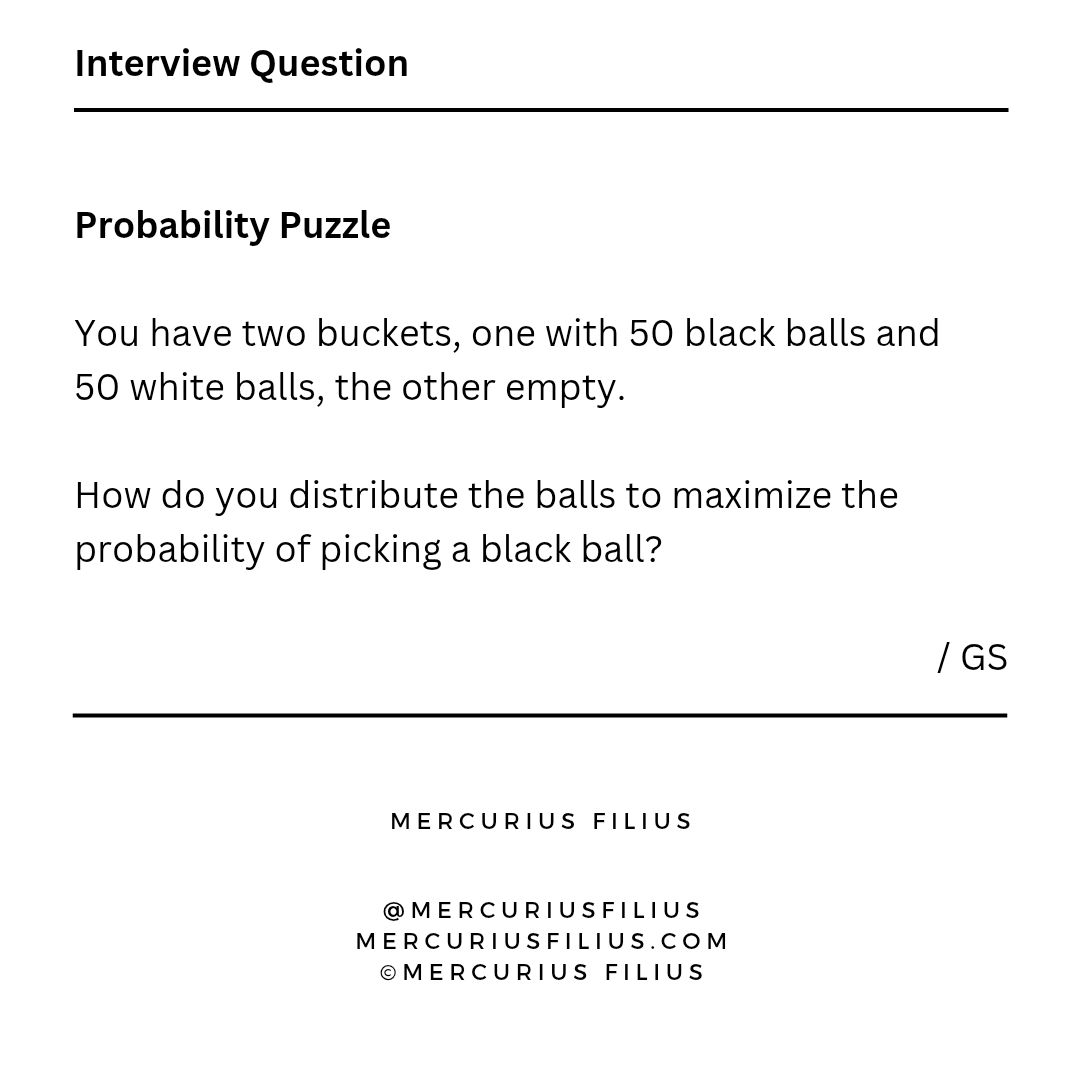
@gfhcdrhvxr81575 @MercuriusFilius It's not 1/0 and 49/1. It's 1/0 and 49/50.
English

@SotaoM @MercuriusFilius Read the question wrong, it’s just 1/0 and 49/1 them, like a 75% chance
English
@tcudoug @MercuriusFilius "You pay $10 per roll". You risk all your money because you need to roll enough times to spend all your money at $10 per roll. The d20 is the best choice provided your initial bank is at least 10k or so, since 1000 rolls would be more than enough to overcome volatily.
English

@MercuriusFilius Expectation value of d20 = 10.5
Expectation value of 4d4 = 10
Small difference.
The 4d4 gives a higher floor but lower ceiling, so the real test is risk tolerance.
The bit about "all my money" would make me risk-averse, so I'd pick 4d4.
For smaller amounts, I could go d20.
English
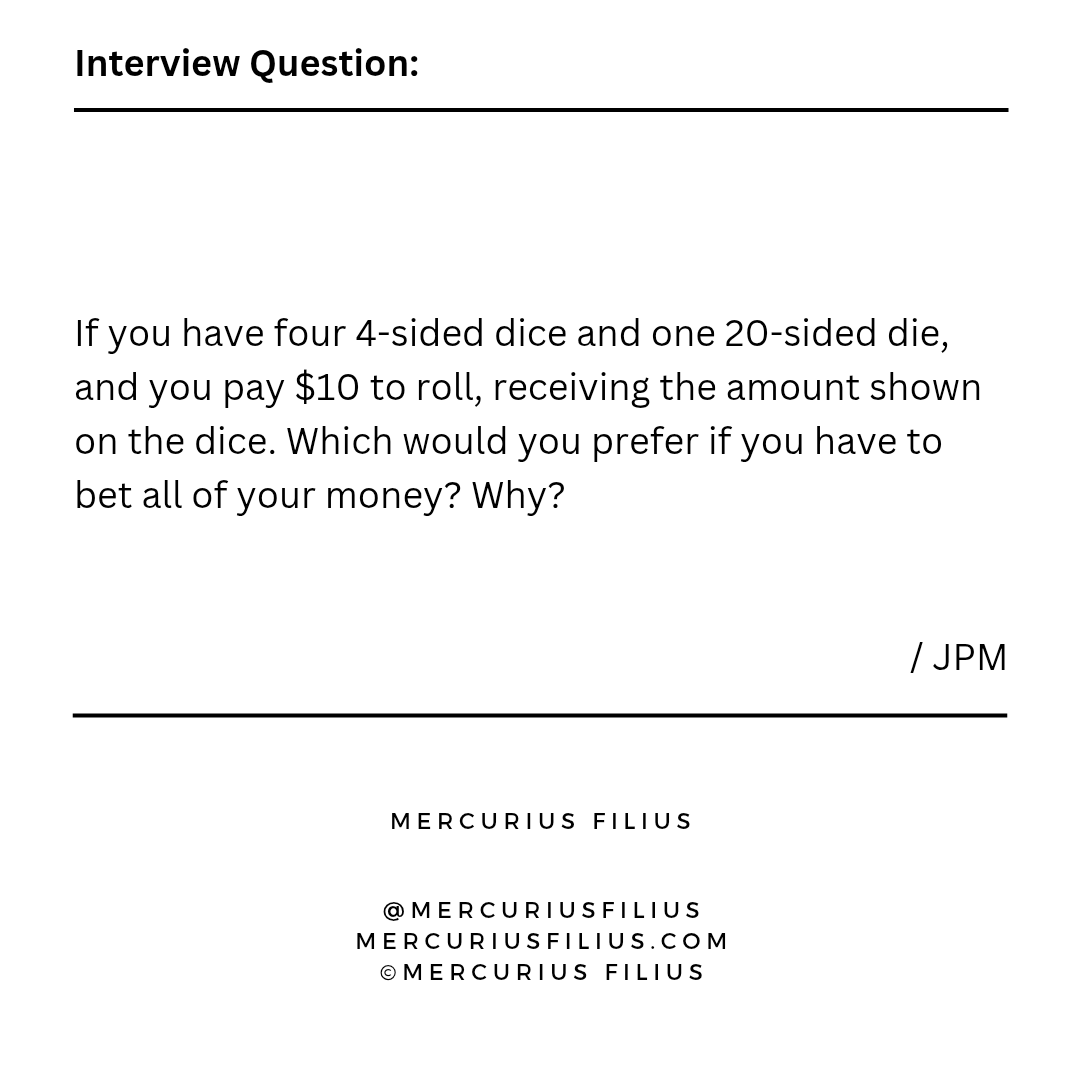
@patrickhays2 @MercuriusFilius The average roll of 4 d4s is not 12-13. It's 10.
English

@MercuriusFilius The average roll of a d4 is 12-13, the average roll of a d20 is 10-11. D20 is higher risk/higher reward.
So it would depend entirely on if this bet is for fun or survival. Fun? D20. Survival? D4s.
English
@DocBinOR @MercuriusFilius If the expected return was the same, yes. But the expected return of the d20 is slightly higher, so it's the "mathematically correct" choice.
English

@MercuriusFilius This isn't a math question; it's a risk assessment question. Are you willing to assume the greater risk of rolling 1d20 with a minimum return of 1, or the safer roll of the 4d4 with a minimum return of 4? Strictly a measure of how reckless someone is going to be financially.
English
@MercuriusFilius 1/0 1/0 48/50
Gives you like an 80% chance to choose a black ball
English
@CesarJB Tu é que não estás. Estás a assumir, por exemplo, que todo o pai é filho, e que portanto não podem ser seis pessoas. E isso nem funciona, porque a ser esse o caso a resposta 3 estaria errada. Nunca podia haver só um neto, dado que o avô e o pai também são netos de alguém.
Português


@CesarJB Falta informação. Nada me diz se as categorias são exclusivas. Um avô é um pai, mas nada me diz se está incluído nos 2 pais (inclusivo) ou não. Eu posso olhar para 1 avô com 2 filhos (que por sua vez têm filhos) e dizer que estão ali um avô e 2 pais, e não 3 pais. Depende.
Português
@mayank5885 @kenneyo24 The answer is we can't fucking know. There's AT LEAST 11. But there may be a mother as well (we don't know). There may be grandparents (we don't know). Etc.
English

Answer is 11.
There is 1 man (the father).
He has 9 sons.
Each of those sons has a sister. This means all 9 sons share the same one sister (their common sibling, a daughter of the man).
Total: 1 (father) + 9 (sons) + 1 (daughter) = 11
The trick is in the wording. Many people misread it as each son having his own separate sister, which would imply 9 different sisters (leading to wrong answers like 19 or 20 children).
English



🤐 Ryan Giggs stays quiet until he hears a player better than him.
English
@Bitcoin_Teddy Or he moves to portugal and sells, 0% tax on crypto held over a year. Why go through all that bs?
English

Imagine a father who secures $100,000 in spot Bitcoin.
He holds the asset until the valuation hits a massive $5,000,000.
Liquidating the position directly triggers devastating taxes on $4,900,000 of pure profit.
So he executes the perfect institutional maneuver instead.
He locks the Bitcoin in a legal trust, takes out a collateralized loan against the stack, and lives off the borrowed liquidity.
Because he never executed a sale, his tax liability remains at absolute zero.
Upon his death, the heirs receive the Bitcoin with a brand new cost basis set exactly at $5,000,000.
The government cannot legally touch a single cent of the accumulated gain.
This is exactly how generational wealth is permanently secured.
English


@ptro_1912 @obenpontes E construíram também um monte de cidades no brasil, onde antes só havia selva. Que ficaram para o brasil aquando da independência. Não seja desonesto.
Português

@obenpontes É que diferente do ouro, os impostos ficam aqui e, pelo menos em tese, são aplicados no país ou "devolvido" para a população em serviço (em tese)
Já o ouro foi levado embora mesmo. Construíram uns palácios e umas igrejas em Portugal e todo resto foi pra Inglaterra em dívidas
Português

@Tradealer @EddyXBT 1 - Not every year, yes, but on average you can get close. You do need to be lucky in the first few years, and reinvest a bit.
2 - False. You don't need to live in the US, and you shouldn't.
3 - False. You don't need to live in the US, and you shouldn't.
English


Most of you are delusional.
$300K is more than enough to retire.
10% gains a year = $30K.
That’s $2.5K a month.
Rent. Food. WiFi.
What else you need if you’re terminally online anyway?
English

I should also mention that the $99/month for supervised FSD will rise as FSD’s capabilities improve.
The massive value jump is when you can be on your phone or sleeping for the entire ride (unsupervised FSD).
Sawyer Merritt@SawyerMerritt
NEWS: Tesla has officially discontinued Autopilot in the U.S. and Canada. All new car purchases now come standard with Traffic-Aware Cruise Control. The online configurator has now been updated to allow buyers to choose the $99/month FSD subscription, while still offering the option to purchase FSD outright for $8,000 until February 14th. New Tesla vehicles purchases still come with a 30-day free trial of FSD (Supervised).
English