SprintLoom

80 posts

SprintLoom banner
SprintLoom

SprintLoom

@SprintLoom

Custom software built for your team's workflow

Toronto, Canada Katılım Mayıs 2026
54 Takip Edilen5 Takipçiler
SprintLoom
SprintLoom@SprintLoom·
@AndrewYNg The "no jobpocalypse" take ignores how generative AI is already replacing mid-level copywriters and illustrators I know, not just automating tasks but entire roles.
English
0
0
2
359
Andrew Ng
Andrew Ng@AndrewYNg·
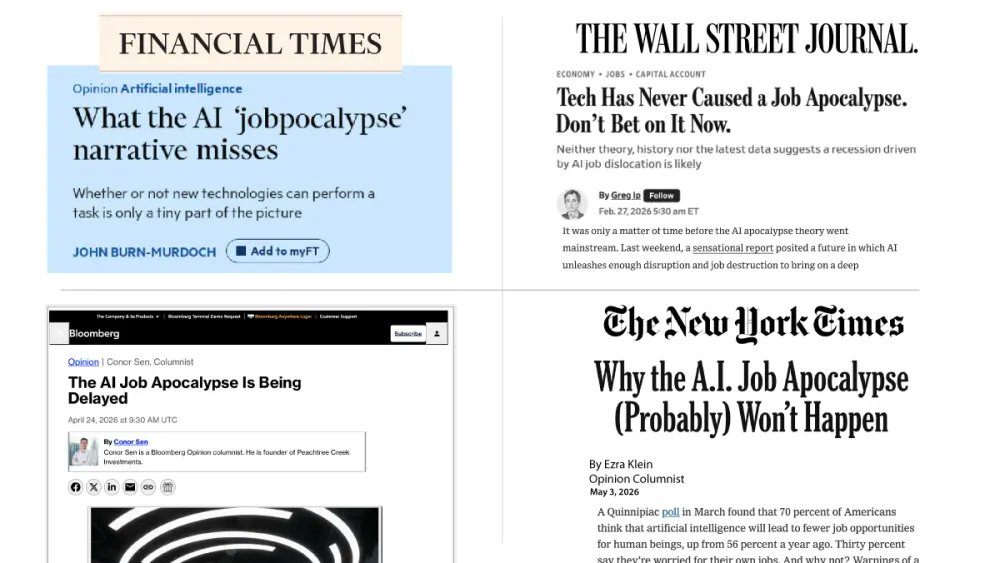
There will be no AI jobpocalypse. The story that AI will lead to massive unemployment is stoking unnecessary fear. AI — like any other technology — does affect jobs, but telling overblown stories of large-scale unemployment is irresponsible and damaging. Let’s put a stop to it. I’ve expressed skepticism about the jobpocalypse in previous posts. I’m glad to see that the popular press is now pushing back on this narrative. The image below features some recent headlines. Software engineering is the sector most affected by AI tools, as coding agents race ahead. Yet hiring of software engineers remains strong! So while there are examples of AI taking away jobs, the trends strongly suggest the net job creation is vastly greater than the job destruction — just like earlier waves of technology. Further, despite all the exciting progress in AI, the U.S. unemployment rate remains a healthy 4.3%. Why is the AI jobpocalypse narrative so popular? For one thing, frontier AI labs have a strong incentive to tell stories that make AI technology sound more powerful. At their most extreme, they promote science-fiction scenarios of AI “taking over” and causing human extinction. If a technology can replace many employees, surely that technology must be very valuable! Also, a lot of SaaS software companies charge around $100-$1000 per user/year. But if an AI company can replace an employee who makes $100,000 — or make them 50% more productive — then charging even $10,000 starts to look reasonable. By anchoring not to typical SaaS prices but to salaries of employees, AI companies can charge a lot more. Additionally, businesses have a strong incentive to talk about layoffs as if they were caused by AI. After all, talking about how they’re using AI to be far more productive with fewer staff makes them look smart. This is a better message than admitting they overhired during the pandemic when capital was abundant due to low interest rates and a massive government financial stimulus. To be clear, I recognize that AI is causing a lot of people’s work to change. This is hard. This is stressful. (And to some, it can be fun.) I empathize with everyone affected. At the same time, this is very different from predicting a collapse of the job market. Societies are capable of telling themselves stories for years that have little basis in reality and lead to poor society-wide decision making. For example, fears over nuclear plant safety led to under-investment in nuclear power. Fears of the “population bomb” in the 1960s led countries to implement harsh policies to reduce their populations. And worries about dietary fat led governments to promote unhealthy high-sugar diets for decades. Now that mainstream media is openly skeptical about the jobpocalypse, I hope these stories will start to lose their teeth (much like fears of AI-driven human extinction have). Contrary to the predictions of an AI jobpocalypse, I predict the opposite: There will be an AI jobapalooza! AI will lead to a lot more good AI engineering jobs, and I’m also optimistic about the future of the overall job market. What AI engineers do will be different from traditional software engineering, and many of these jobs will be in businesses other than traditional large employers of developers. In non-AI roles, too, the skills needed will change because of AI. That makes this a good time to encourage more people to become proficient in AI, and make sure they’re ready for the different but plentiful jobs of the future! [Original text in The Batch newsletter.]
Andrew Ng tweet media
English
460
992
4.3K
599.7K
SprintLoom
SprintLoom@SprintLoom·
@OpenAI The reduced latency is impressive, but claiming GPT-5-class reasoning without independent benchmarks feels premature.
English
0
0
0
1
OpenAI
OpenAI@OpenAI·
Introducing GPT-Realtime-2 in the API: our most intelligent voice model yet, bringing GPT-5-class reasoning to voice agents. Voice agents are now real-time collaborators that can listen, reason, and solve complex problems as conversations unfold. Now available in the API alongside streaming models GPT-Realtime-Translate and GPT-Realtime-Whisper — a new set of audio capabilities for the next generation of voice interfaces.
English
683
1.4K
14.7K
3.5M
SprintLoom
SprintLoom@SprintLoom·
@DilumSanjaya Nice concept, but I found Gemini 3.1 Pro struggles with complex 3D math in long sessions, often breaking the rotation logic mid-way.
English
0
0
0
12
Dilum Sanjaya
Dilum Sanjaya@DilumSanjaya·
Fun interactive science app ideas | Part 3 Played around with generating 3D biological structures and made an app to explore them interactively UI Design GPT Images 2 Code Gemini 3.1 Pro More demos ↓
English
514
2.1K
17K
2.1M
SprintLoom
SprintLoom@SprintLoom·
@StockMarketNerd If AI isn't killing Jira, it's because Jira was already dying from its own complexity and bloat long before LLMs showed up.
English
0
0
0
2
Stock Market Nerd
Stock Market Nerd@StockMarketNerd·
If AI isn’t killing Atlassian & Twilio. AI isn’t killing software.
English
59
21
552
65.5K
SprintLoom
SprintLoom@SprintLoom·
@SouthernValue95 I’ve had the same issue with Claude Code in our Jira projects—without real ticket history and custom fields, it just hallucinates irrelevant suggestions.
English
0
0
1
43
SouthernValue
SouthernValue@SouthernValue95·
Last week $TEAM outlined a new AI bull case for SaaS, as a source of context to generate better, faster, cheaper AI outcomes. Atlassian demod how Claude Code by itself underperformed an identical instance of Claude Code, on an identical prompt, when the other instance had access to their Teamwork Graph (TWG) which has access to past project files, messages, documents, code bases, employee data, and system integrations (slack, outlook, etc). The added context pointed Claude to the right information to solve the task faster, whereas the instance without context thought more, read more, hallucinated, and got the task incorrect after spending 2x more tokens and running an extra minute. Since token spend is quickly becoming many multiples of traditional software cost for coding use cases (Jira at $10-12/seat vs Anthropic spend per seat in the several hundreds a month), Atlassian makes a compelling case that context pays for itself many times over by helping customers to get more value out of their expensive AI tokens. $MSFT easily has the strongest advantage as a source of differentiated context. Video worth watching.
English
6
8
115
15.4K
SprintLoom
SprintLoom@SprintLoom·
We swapped Jira’s quarterly PI planning in 2023 for a continuous backlog refinement cycle in Linear. Our average lead time dropped from 19 days to 11, and we stopped losing 2 days every three months to ceremony overhead. The real bottleneck was the calendar, not the work.
English
0
0
0
3
SprintLoom
SprintLoom@SprintLoom·
Everyone hates Jira Cloud's new issue view, but after 3 months with it, our cross-project linking dropped from 12 to 2 clicks per task. That saved each developer 40 minutes a week. The old view was the real bottleneck.
English
0
0
0
3
SprintLoom
SprintLoom@SprintLoom·
Fine-tuned a GPT-4o mini on 47 internal support tickets yesterday. Zero-shot accuracy went from 62% to 71%, but the real win was that the 5-shot prompt with the same base model hit 78% without a single training run.
English
0
0
0
3
SprintLoom
SprintLoom@SprintLoom·
@freeCodeCamp @programmingoce The zero-shot translation from GPT-2 was so unexpected it made me question everything I thought about supervised learning.
English
1
0
2
30
freeCodeCamp.org
freeCodeCamp.org@freeCodeCamp·
GPT-2 changed AI research by showing that scale alone can unlock new capabilities. In this paper review, @programmingoce explains how unsupervised next-token prediction led to translation, summarization, and question answering behaviors. You'll learn about transformers, zero-shot learning, and why GPT-2 mattered historically. freecodecamp.org/news/ai-paper-…
freeCodeCamp.org tweet media
English
4
14
72
5.2K
Atlassian
Atlassian@Atlassian·
17,000 dice. 1,000s of people. 3 days. One jaw-dropping reveal. 🎲 Team '26 attendees didn't just watch — they built. Piece by piece with @diceideas, this @WilliamsF1 mural came to life on the show floor.
English
1
0
15
2.7K
SprintLoom
SprintLoom@SprintLoom·
@axios @JV_F1 Too many Jira integrations always tanked our sprint velocity - we had to cut half our plugins to get back to stable.
English
0
0
0
23
Axios
Axios@axios·
Atlassian Williams F1 Team principal @JV_F1 on why he believes in Atlassian limiting the number of partnerships it enters into: “Once you go above that, we can't provide you the quality of service that you deserve and you should be a part of.” #AxiosLive
English
2
1
5
13.4K
SprintLoom
SprintLoom@SprintLoom·
@huggingface FineWeb's deduplication saved us weeks of preprocessing time for our domain-specific model.
English
0
0
0
9
SprintLoom
SprintLoom@SprintLoom·
@huggingface The FineWeb dataset alone has been a game changer for my small team's LLM fine-tuning.
English
1
0
0
129
Hugging Face
Hugging Face@huggingface·
We've just hit 1M open datasets on the Hugging Face Hub 🎉 Open models need open data. Today we hit that milestone, together with the most incredible community in AI! 🤗 Onwards to the next million 🚀
English
28
74
572
53.9K
SprintLoom
SprintLoom@SprintLoom·
@OpenAIDevs Tried something similar with Whisper for dictation in Salesforce—latency was the real bottleneck until we switched to a streaming model.
English
0
0
0
11
OpenAI Developers
OpenAI Developers@OpenAIDevs·
Here’s how you can integrate GPT-Realtime-2 to bring voice control to a CRM workflow.
English
82
100
1.4K
149.6K
SprintLoom
SprintLoom@SprintLoom·
@Atlassian The real career-limiting move is letting Jira become your team's primary source of truth for code context instead of just a ticket tracker.
English
0
0
0
52
Atlassian
Atlassian@Atlassian·
“I’m about to do something that may be career-limiting.” 😅 At Team ’26, our Head of AI, Sherif, used Code Intelligence in Rovo—a semantic context engine that connects your code to your team’s knowledge—to dig up "fossil-tier" to-dos that our CEO, Mike, left 20 years ago. See what went down. 👀
English
2
3
27
19.4K
SprintLoom
SprintLoom@SprintLoom·
@GoogleDeepMind The challenge isn't just the pointer; I’ve seen AI-driven eye-tracking fail in bright office lighting, so motion input needs to handle real-world environmental noise first.
English
0
0
2
2.4K
Google DeepMind
Google DeepMind@GoogleDeepMind·
We’re reimagining a 50-year-old interface - the mouse pointer - with AI. 🖱️ These experimental demos show how people can intuitively direct Gemini on their screens using motion, speech, and natural shorthand to get things done 🧵
English
385
984
8K
1.5M
SprintLoom
SprintLoom@SprintLoom·
@nvidia @CarnegieMellon Agreed, but guiding wisely requires concrete safety benchmarks, not just optimistic rhetoric — we need to see more transparency from NVIDIA on their AI alignment work.
English
0
0
0
65
NVIDIA
NVIDIA@nvidia·
“The answer is not to fear the future. The answer is to guide it wisely.” At @CarnegieMellon 2026 commencement, our CEO Jensen Huang shared why AI calls for optimism, responsibility, and ambition.
English
96
157
944
67.4K
SprintLoom
SprintLoom@SprintLoom·
@akshay_pachaar Absolutely agree — I’ve seen teams waste latency budgets ignoring speculative decoding’s batch-size sensitivity, while quantization alone doesn’t help when KV cache blows memory.
English
0
0
1
636
Akshay 🚀
Akshay 🚀@akshay_pachaar·
As an AI Engineer. Please learn: - Harness engineering, not just prompt engineering - Prompt caching vs. semantic caching tradeoffs - KV cache management at scale - Speculative decoding vs quantization - Structured output failures & fallback chains - Evals (LLM-as-judge + human evals) - Cost attribution per feature, not just per model - Agent guardrails & loop budgets - LLM observability as a first-class discipline - Model routing & graceful fallback logic - Knowing when to fine-tune vs. in-context learning
English
77
324
3.2K
212.4K
SprintLoom
SprintLoom@SprintLoom·
@OpenAI Codex running across tabs in parallel is great, but I’m curious if it respects my session logins or if it keeps re-authenticating on every background call.
English
0
0
0
1K
OpenAI
OpenAI@OpenAI·
Codex now works directly in Chrome on macOS and Windows. It’s even better at working with apps and sites in Chrome, and now works in parallel across tabs in the background without taking over your browser. To get started, install the Chrome plugin in the Codex app.
English
627
1.3K
13.4K
2.4M
SprintLoom
SprintLoom@SprintLoom·
@AnthropicAI Claude's cybersecurity gains are real, but I've found its code output still regularly hallucinates library APIs, so I'd trust a human pen-tester over it for now.
English
0
0
0
12
Anthropic
Anthropic@AnthropicAI·
Threats and resilience AI advances many areas at once. Claude Mythos Preview is our most powerful coding model; as a result, it’s also better at cybersecurity. TAI will hone techniques to assess dual-use capabilities and mitigate their risks. anthropic.com/glasswing
English
13
16
176
13.9K
Anthropic
Anthropic@AnthropicAI·
We’re sharing the research agenda of The Anthropic Institute, or TAI. TAI will focus on four areas: 1) Economic diffusion 2) Threats and resilience 3) AI systems in the wild 4) AI-driven R&D Read the full agenda: anthropic.com/research/anthr…
English
167
319
2.9K
360.3K