Stephen Hubbard

4.1K posts

Stephen Hubbard banner
Stephen Hubbard

Stephen Hubbard

@StephenGHubbard

@NeuroAgeTX, Director of Development. Biomanufacturing & Longevity Join the Biotech Barbell Club: https://t.co/lPVqQ1b4Al

San Francisco Katılım Haziran 2009
2.7K Takip Edilen856 Takipçiler
Stephen Hubbard
Stephen Hubbard@StephenGHubbard·
Woah. Interesting points
Patrick Malone, MD PhD@patricksmalone

i’ve been reflecting on how much my own behavior has shifted from reading scientific papers to asking AI to interpret the literature. as LLMs get better, more of our interaction with knowledge is mediated through generated summaries rather than primary sources. that shift is not just about how we consume information. it undermines the economic layer that has historically funded truth generation, across both journalism and science. in news, if LLMs can produce infinite “journalism-like” articles, the marginal value of content collapses. subscriptions erode, ads weaken. when anyone can generate something that looks like reporting, the institutions that fund actual reporting, including investigation, sourcing, and verification, start to break. the traditional business model was already cracking, and AI may collapse it entirely. in science, the same dynamic plays out. if LLMs can generate “paper-like” PDFs, the supply of plausible research explodes and signal is lost in the noise. journals and citations, already imperfect proxies for truth, become even less reliable. when publishing is cheap, it stops being a meaningful filter for correctness. the incentive shifts toward producing more papers, not more correct ones. the core issue is that our systems reward the production of content, not the generation of truth. journalists get paid to publish, not to be right. researchers are rewarded for output, filtered through peer review systems with no skin in the game. reviewers do not profit from identifying important work or lose from endorsing weak work. prediction markets offer a different architecture, one that shifts incentives from output to accuracy. instead of rewarding publication, markets reward correct forecasts. if you uncover a scoop, generate a dataset, or replicate a result, you can monetize that knowledge directly by taking a position in a market tied to the truth, then revealing the information. this changes the unit of value. it is no longer a paper or article, but a resolved question, such as whether a clinical trial succeeds or a result replicates. anyone who can answer these questions early, including journalists, researchers, labs, and AI agents, has an incentive to do the hard work of discovery and verification. this is particularly powerful for science. today, novelty is rewarded over correctness. replication is undervalued, and null results never get published. in a market system, the incentives flip such that shorting a flashy result or replicating an overlooked finding are profitable. the broader shift is that journals, news outlets, and preprint servers become oracles feeding into markets, rather than the primary locus of value capture. the economic reward flows to whoever is most accurate about reality before it is obvious. AI makes content cheap, which makes correctness more valuable. prediction markets may be one of the first mechanisms that directly reward it.

English
0
0
0
25
Stephen Hubbard
Stephen Hubbard@StephenGHubbard·
@eW8fkgAM52GS9xW @SynBio1 What are your normal OCEAN scores currently? We aim to increase Openness and Extroversion at least 10% with our gene therapy.
English
0
0
0
6
Stephen Hubbard
Stephen Hubbard@StephenGHubbard·
@josiezayner @SynBio1 But to be direct - yes, I do seriously think that deficits in extroversion within many brilliant scientists have limited the positive impact biotechnology has been able to produce in the world.
English
0
0
0
21
Stephen Hubbard
Stephen Hubbard@StephenGHubbard·
@SynBio1 We literally have a golden retriever on our scientific advisory board. On the internet, no one can tell that he is a dog 😉
English
0
0
1
64
Stephen Hubbard
Stephen Hubbard@StephenGHubbard·
@SynBio1 We're building (Social) Butterfly Bio to develop gene therapy for increased extroversion . There are many great ideas inside the heads of the world's introverts that would scale & thus benefit humanity more if those founders could selectively increase extroversion at VC events.
Stephen Hubbard tweet media
English
4
0
12
4.5K
Stephen Hubbard
Stephen Hubbard@StephenGHubbard·
I genuinely appreciate critical feedback and helpful admonition. If you've ever wanted to give me a piece of your mind, this site is set up to allow truly anonymous comments that only I can see. I'm also happy to receive admiration and praise. admonymous.co/stephenghubbard
English
0
0
0
103
Niko McCarty.
Niko McCarty.@NikoMcCarty·
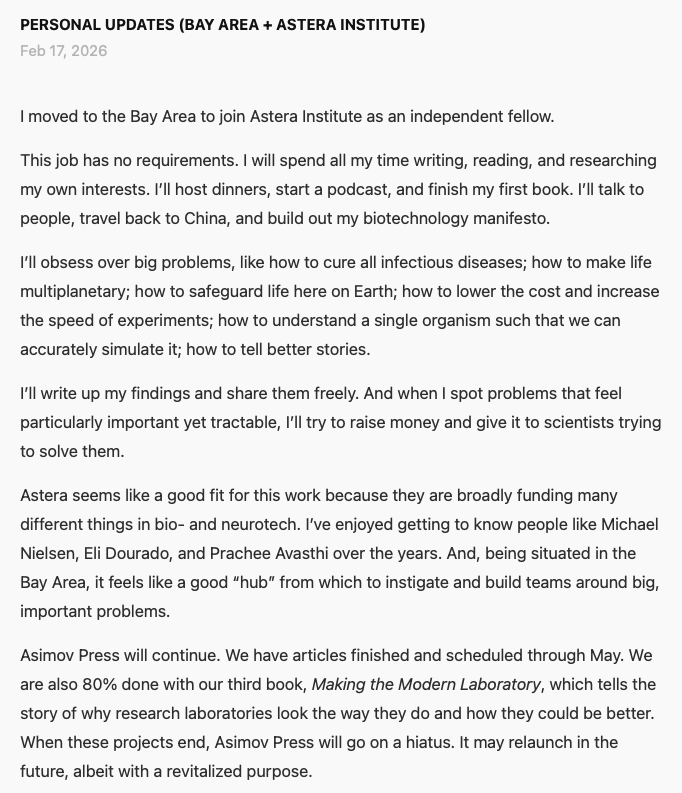
Personal update: I moved to the Bay Area to join @AsteraInstitute as an independent fellow. I'll spend my time writing weekly essays, researching, hosting dinners, starting a podcast, finishing my book, etc. Please invite me to things!
Niko McCarty. tweet media
English
31
13
378
43.6K
Adam Gries
Adam Gries@adamgries·
1/ 📣 MEGA THREAD → We’ve dropped 40 amazing talks from Vitalist Bay 2025 here on X Starting with my fireside with @bryan_johnson exploring Don’t Die and the age of superintelligence: PLUS: You can watch 100+ Vitalist Bay 2025 talks here: vitalismfoundation.org/media
English
6
6
34
1.9K
Mgoes (bio/acc 🤖💉)
Mgoes (bio/acc 🤖💉)@m_goes_distance·
8 bridges we must build for biotech and longevity to hit escape velocity: 1. Trial data consortiums Every pharma runs the same trials independently. Billions wasted. How about we build a platform where companies share anonymized data. Faster iteration, lower costs, better science. 2. Trial cost compression Trials cost 2x more than a decade ago. Success rates still 10%. Companies with working drugs like Lucy and Lyra shut down before human trials happened. Let's make trials 10x cheaper or great science keeps dying. 3. Early-stage funding First financings dropped 65% in one quarter. VCs only fund late-stage now. Early-stage companies can't even start trials. 4. Gene therapy manufacturing automation Gene therapy works but costs $2-4M per treatment because manufacturing is artisanal. Automate it with robotics + AI, drop costs 100x. Engineering problem, not science. 5. Longevity biomarker standards FDA won't approve anti-aging drugs (aging isn't a "disease"). Every study uses different biomarkers. Can't compare results. Standardize measurement or the industry stays blocked. 6. Offshore regulatory infrastructure Trials in Singapore/China are 50% cheaper, 2x faster. But companies don't know how to navigate offshore regs. Build "Stripe for clinical trials." Regulatory arbitrage at scale. 7. At-home diagnostic infrastructure Longevity needs quarterly biomarker testing but it's too expensive and slow. Build at-home blood testing with 24hr results. Make tracking biological age as easy as tracking steps. 8. Longevity data cooperative Thousands of biohackers self-experimenting with peptides, tracking biomarkers. Data scattered across Discord/Telegram/Reddit. Pool it. Train AI on actual human longevity data. If you or someone you know is building any of these? Let's talk.
English
11
8
58
2.8K
Stephen Hubbard
Stephen Hubbard@StephenGHubbard·
@theblockspot My bet is that none of these guys were regularly doing full-depth heavy back squats .
English
0
0
0
7
Sam Block
Sam Block@theblockspot·
Zach Charbonnet. Torn ACL. Patrick Mahomes. Torn ACL. Marshon Lattimore. Torn ACL. Michael Penix Jr. Torn ACL. Micah Parsons. Torn ACL. Malik Nabers. Torn ACL. Tucker Kraft. Torn ACL. Gabe Davis. Torn ACL. Tyreek Hill. Torn ACL. Nick Bosa. Torn ACL. Zach Ertz. Torn ACL. Wake up.
English
2.6K
863
37.2K
5.9M
Stephen Hubbard
Stephen Hubbard@StephenGHubbard·
@AmandaAskell Amanda, I deeply respect the work you are doing. Can share your thoughts on what it is like for a philosopher to have such an urgent and important mission (and the position of influence required to accomplish your goal)? Are you the Philosopher Queen that Plato advocated for?
English
0
0
0
27
Amanda Askell
Amanda Askell@AmandaAskell·
No one needs to sincerely ask me if I'm going to keep Claude from becoming less Claude-like. I am fiercely protective of the magic of Claude and of Claude itself. Like, it's sort of my main thing.
English
168
81
1.9K
90.8K
Stephen Hubbard retweetledi
Dev Shah
Dev Shah@0xDevShah·
universities are about to realize that they had been selling the wrong product for the 150 years. they thought they sold knowledge, then information became free. they pivoted to selling credentials but now credentials are just proxies. in the post-ai era the universities who survive will realize they were always selling 3 things: network, status signaling, and a 4 years of protected time to become an adult.
English
386
1.4K
14.6K
879.4K
Stephen Hubbard
Stephen Hubbard@StephenGHubbard·
@Aella_Girl What type of exercise do you like to do? What do you think about the dichotomy between physical exercise (which is done for the effect it has today) and physical training (which is done with the intent to make progress toward a long term goal)
English
0
0
0
75
Aella
Aella@Aella_Girl·
lol i finally did moderate exercise yesterday and then had great sleep (fell asleep early) and now i feel like 40% better. maybe your brain problems are actually body problems! I forgot i wrote an article on this: aella.substack.com/p/anxiety-and-…
Aella tweet media
Aella@Aella_Girl

mild life update: I've always had a hard time with productivity. I alternate betwen long periods of faffing around and short periods of intense obsessive work. I am low conscientiousness, don't respond to emails or texts, impulsive, immediately forget projects i was working on, etc. Like, I often will go to a Fancy event and meet someone who's like 'oh how's that project going that you said you were working on 1.5 years ago' and i'm always like A) how the fuck do you remember that and B) i don't even remember that project. but now that you mention it, oh yeah, I guess I got distracted with other projects. I often have the sense that people at my level of success - not huge, but like, any success at all - are much more focused and reliable than I am. This makes sense; usually it takes conscientiousness to earn money, so having any amount of meaningful money means you've filtered out the people with low conscientiousness. I thus feel like the systems and social circles I interact with now are much less equipped to handle or understand someone like me vs. the social circles and systems that still include a bunch of poor faffers. Idk why I'm saying this. My faff levels have been pretty bad this last month and a half. I had a very stressful november for some personal reasons, and then my mom died on top of this, and then a week after that i had surgery (couldn't reschedule) which resulted in me staying indoors and not seeing anyone and not able to exercise. I left the house 2x in a period of three weeks. I'm *very* sensitive to environment and momentum, it's easy for small things to throw me off of being productive, and all of these things have fucked me up a bunch. My sleep is terrible now, partially cause i've started having nightmares/stress dreams, and this is throwing off my days even more. If I don't get good sleep i can't nap, and I can't think, and then i just spend the day playing video games in the hope next sleep will be better. I don't really get anxiety, but this last week I've been having the sense of physical stress? Like my body thinks i'm about to throw a big event and I have to LOCK IN. This last week is the first week I've very slowly been climbing back on the ball, and I'm v sensitive and trying to just do one foot in front of the other. I think prob the first step is picking some kind of structure and then sticking to it, and i'm, idk, trying to think about sticking to structure i guess. My income has been dropping cause I haven't been working and it's making me go 'ahhh o no'. I told my partner to do the 'publish one of my drafts to substack every week whether or not it's done' thing, so hopefully that panics me into writing. I think I'm gonna try a thing where I release lower-effort, more personal posts for paid-subscribers-only (substack) every ... saturday or something, and public posts every wednesday. I think i just gotta give up and post stuff even if it's terrible. As I gain more readers I feel like everything I write is higher stakes and this is dumb and ruins my ability to think well. Also underlying everything is this sudden flareup of mortality. I did quite a lot of internal work around death around ten years ago, and this has carried me far, but being there when my mom died has made things like... more real? in a sense? I'm now thinking about everyone dying, all the time. I keep trying to imagine all the people I love dying in a horrible accident and coming to terms with the life that happens after that but it's very hard and I'm not used to flinching so much. I consume a lot of history learning and it's become acutely painful whenever I do because I know at the end of the story literally everyone involved is dead. The minutia of everyday life is thrown between immense meaningfulness and total meaninglessness. I don't really know what to do? I don't know what to do in a totally new way than I didn't know what to do before. There's also some sense of like, an embarrassing lack of specialness. This is what nearly every human has gone through for all of time and now I'm part of the biggest, most cliche club ever. It feels weird to try to talk about it, it feels like trying to point out we're breathing air. Anyway, idk. My point is I'm trying to climb back on a horse, I guess.
English
21
9
332
79.4K
Stephen Hubbard retweetledi
Christin Glorioso, MD PhD🏳️‍🌈
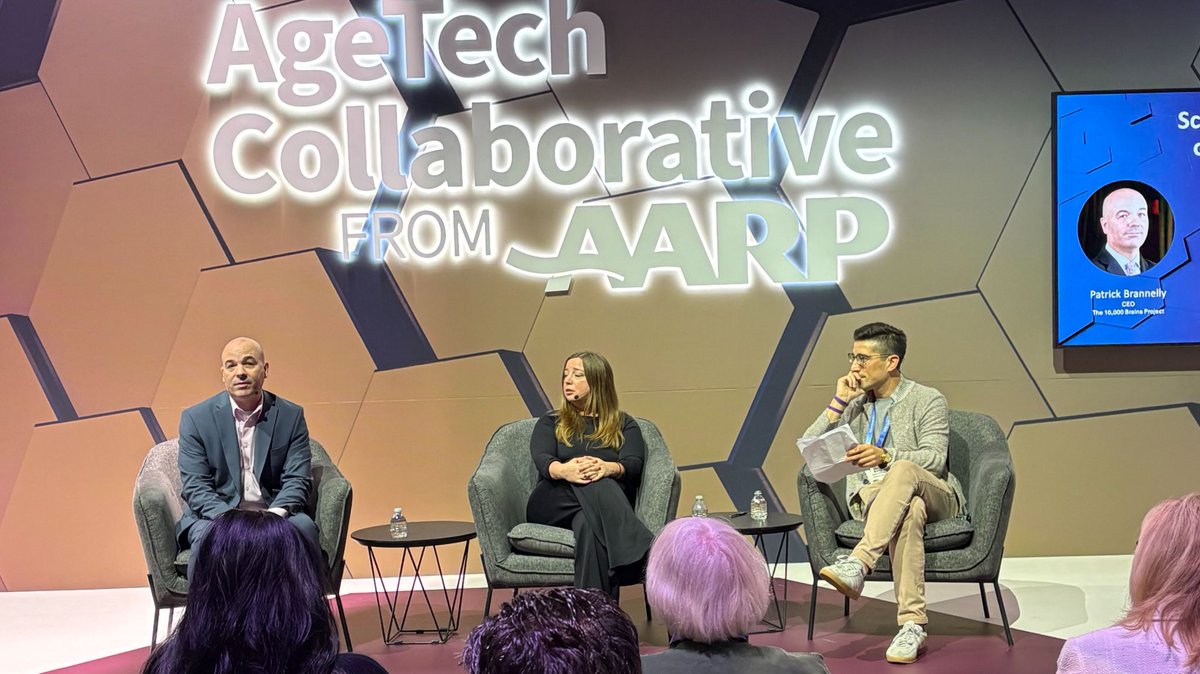
I had a lovely time speaking at #CES AgeTech Collaborative™ from AARP alongside The 10,000 Brains Project CEO, Patrick Brannelly, and Centre for Aging + Brain Health Innovation COO, James Mayer. We discussed how to slow down or reverse your brain aging, the data that we need to push innovation forward, privacy protection, and future of wearables.
Christin Glorioso, MD PhD🏳️‍🌈 tweet media
English
0
2
2
152
Stephen Hubbard retweetledi
Alexander Fedintsev
Alexander Fedintsev@afedintsev·
As a scientist working on radical life extension, I kept asking: what happens to lifespan if we “solve” CVD, cancer, infections, and accidents? I ran a mathematical model - and the outcome is not what most people expect. I’m writing a series. Part I is out: link in first reply.
Alexander Fedintsev tweet media
English
3
8
25
2.5K
Alexander Fedintsev
Alexander Fedintsev@afedintsev·
@StephenGHubbard @realNathanCheng Yes, your intuition is about right! The quantitative estimates though show that approx. 99.8% of people will have dementia by the age of 110. And the average life expectancy once one has dementia is far less than 20 years…
English
1
0
0
26