

Steve Dussault
258 posts

NIH EBOLA EXPERT UNDER FBI INVESTIGATION FOR SMUGGLING PATHOGENS INTO AMERICA FROM THE CONGO
Vincent Munster — NIH virologist & COVID gain-of-function collaborator — was caught at a US airport smuggling deadly pathogens from the Congo… right before the Ebola outbreak.
English
Just a coincidence I guess.
Nicolas Hulscher, MPH@NicHulscher
NIH EBOLA EXPERT UNDER FBI INVESTIGATION FOR SMUGGLING PATHOGENS INTO AMERICA FROM THE CONGO Vincent Munster — NIH virologist & COVID gain-of-function collaborator — was caught at a US airport smuggling deadly pathogens from the Congo… right before the Ebola outbreak.
English
@Kuppal00p @garrytan There will be hundreds of thousands of data center construction jobs for a decade or two. The crews move from one project to the next as the infrastructure is built out. If it’s blocked in the US, this national security infrastructure will be built in hostile countries.
English

@garrytan These are temporary jobs my friend.
You only need construction workers then it's automation.
I'm a conservative and for once I am on board with AoC and Bernie.
Fuck these billionaire cock suckers who don't give a fuck about us slaves.
English

Sanders and AOC introduced a bill to pause ALL AI data center construction. 300+ local bills filed. Half of planned 2026 data centers facing delays or cancellation. Each one brings billions to local economies.
The people who say they want American jobs are trying to block the biggest job creation engine since the interstate highway system.

English
@WHFraudTF Shutting down the fraud is a good start, but until the perps are behind bars you haven’t really solved the problem. This must include the politicians and those in law enforcement who enabled the fraud.
English

Steve Dussault retweetledi

Elon Musk just defended America better than every politician in Washington combined.
Musk: “After World War 2, the US could have basically taken over the world and any country. Like we got nukes, nobody else got nukes. We don’t even have to lose soldiers. Which country do you want?”
One nation on earth held a weapon nobody else had.
Total dominance. Zero competition. No risk of retaliation.
Every empire in history that held that kind of advantage used it.
Rome. The Mongols. The British. The Ottomans.
They conquered until they collapsed.
America had a bigger advantage than all of them combined.
And it rebuilt the countries it just defeated.
Musk: “The United States actually helped rebuild countries. So it helped rebuild Europe, it helped rebuild Japan. This is very unusual behavior, almost unprecedented.”
Almost unprecedented?
It had never happened before. Not once in 5,000 years of recorded history.
The Marshall Plan wasn’t foreign aid.
It was the most radical act of restraint any superpower ever committed.
America turned its enemies into allies. Turned rubble into economies. Turned surrender into partnership.
Germany went from ashes to the economic engine of Europe in a generation.
Japan went from unconditional surrender to the third largest economy on earth.
Three years after the war, America was flying food into Berlin.
A city in the heart of the nation that just tried to destroy it.
That’s not policy.
That’s a civilization deciding what it is at the exact moment it has the power to be anything.
You’re being told a story right now.
That America is the villain of history.
You hear it everywhere. Media. Universities. Social platforms.
Musk: “There’s always like, well America’s done bad things. Well of course America’s done bad things, but one needs to look at the whole track record.”
Every nation on earth has dark chapters. Every single one.
The difference is what a country does when nobody can stop it.
And when nobody could stop America, it fed its enemies and rebuilt their cities.
Musk: “The history of China suggests that China is not acquisitive. Meaning they’re not going to go out and invade a whole bunch of countries.”
Probably right.
China has historically built walls, not fleets.
But the real question isn’t about borders anymore.
We’re approaching a moment that mirrors 1945 in ways nobody has fully processed yet.
AI is going to give a handful of people a power advantage that makes nuclear monopoly look quaint.
If someone is going to hold that kind of power, who do you want it to be?
The country that conquered when it could? Or the one that rebuilt when it didn’t have to?
Every alliance. Every trade route. Every economy.
Billions lifted out of poverty.
All of it traces back to one act of restraint that had never been done before.
And carries no guarantee of being repeated.
The most powerful thing America ever did wasn’t building the bomb.
It was what it didn’t do after.
English
@EarnFormation @SpaceX @elonmusk Among the other problems, South Africa is too far from the equator for launches. It takes too much fuel to get to orbital speeds from there.
English



It’s no secret that we intend to launch Starship a lot, targeting thousands of flights per year. That cadence will require the ability to launch from many different locations, so we are constantly exploring to find viable sites to expand Starship operations in the future, both domestically and internationally
S.E. Robinson, Jr.@SERobinsonJr
SPACEX: A realtor named Jim Keaty of Keaty Real Estate published a rumor of possible SpaceX land acquisition in Louisiana. It states SpaceX may have acquired or is acquiring 136k acres (212 sq miles) of marshland south of Highway 82 towards the Gulf of America in Pecan Island and Freshwater City in Vermilion Parish of the Acadiana region. At the Southeast corner of the land near the Freshwater City boat launch is a plot ready to be converted for port operations and direct access to the Intercoastal Canal and the Gulf of America. Pecan Island is halfway between Boca Chica and Cape Canaveral, and has easy access to Cheniere LNG and Golden Pass LNG; both on the either side of the Louisiana and Texas border at Sabine Pass. This has not been confirmed by SpaceX of Elon. More SpaceX news in the ELON CHRON below!
English
@InterbayMicheal @SpaceX Most costal real estate in Florida is too expensive and too developed. Going inland seems difficult as well because how can you launch rockets over nearby neighbors?
English

Your safest bet long term is Florida. Best state government. Plenty of skilled workers. Business friendly. Access to the Gulf Of America.
Please don't make the mistake of picking the wrong location and then 30 years later, be held hostage by the state or a foreign government.
California, Oregon and Washington state would be the absolute worst choices.
English
Absolutely. Need to find federal charges to bring to avoid corrupt Minnesota state courts.
Nick shirley@nickshirleyy
@foxnewspolitics To people who ask why there aren’t more arrests or what’s happening with the fraud in Minnesota.... Minnesota is protecting the fraudsters because they are IN ON the fraud.
English
@kevinnbass @RoKhanna Great work, love the details. Don't many others in Congress have similar problems? Do you have plans to release similar research on others?
English
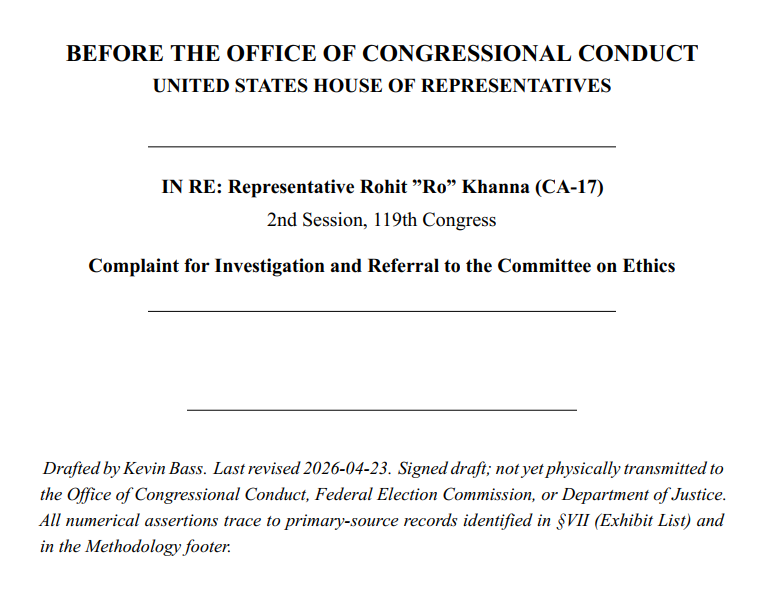
I have conducted the most comprehensive public records audit of any Congressman in the history of the United States.
That audit was conducted on Congressman @RoKhanna.
This audit has exposed shocking ethical lapses and potentially criminal behavior by Congressman Khanna.
I am filing a 239-page ethics complaint, including 30 evidentiary exhibits, with the Office of Congressional Conduct (OCC), to be followed by complaints to the House Ethics Committee and the Department of Justice (DOJ) in the coming days.
Besides being based on an extremely comprehensive public records audit, the complaint is the first of its kind in another way: the factual basis of every single specific claim in the complaint is fully verifiable and reproducible by anyone with a computer.
Attached to this post is a link to the GitHub Release containing the complete reproducibility kit. Anyone with Python 3 and the GitHub CLI installed can download it and run a single command — `python welcome.py` — which walks them through the analysis at whatever verification depth they pick:
1. A 30-second offline check that every body figure derives from the bundled snapshots;
2. A primary-source spot-check that re-fetches the underlying records from the House Clerk and IRS and confirms the bytes match;
3. An OpenTimestamps proof that the package existed at publication time and wasn't backfilled; and
4. An opt-in path that lets the reviewer re-run the OCR pipeline themselves against the primary-source PDFs.
This means that any person in the world can confirm for themselves that all statements made in this complaint are fully reproducible and true.
---
The complaint asserts the following:
Representative Ro Khanna is a Democratic congressman from California's 17th District (basically Silicon Valley). He has been in Congress since January 2017. He is currently in his fifth term.
Khanna has done six different things wrong.
Each one is bad enough to investigate on its own.
Together, they are very bad.
His family's stock trades line up suspiciously with the committees he sits on, the donors who fund him, and the votes he takes.
That's bad.
Khanna's household made between $15 million and $108 million from these trades, with a middle estimate of about $61 million.
The estimate cannot be made any better than this. The disclosure forms provide only disclosure "bands". Precise amounts can only be determined with subpoena power.
But we do have one hard number:
Compared to just buying a basic stock-market index fund, his family beat the market by about $28 million.
$28 million.
The complaint says that Congressman Khanna should pay this money back.
Now, how the trading actually works in this household is important because it helps us to understanding everything else, so I will explain that now.
Khanna himself has filed 114 reports with the House Clerk listing every trade his household has made. Those reports cover 37,238 individual trades. That's a huge amount. Most members of Congress don't trade nearly that much.
But here's the kicker.
Almost none of those trades are in Khanna's own name.
99.997% of them are listed as belonging to either his wife (Ritu Ahuja Khanna) or his dependent child.
That's basically all Khanna trades. A massive volume.
Yet virtually none in his own name.
Curious.
Khanna has publicly said this is fine because the trading is done through what's called a "separately managed account" or "blind trust", meaning a broker or trustee makes the decisions without telling him.
If that were true, he'd be off the hook because he wouldn't know what was being bought or sold.
The complaint says that's not true. When you read his official financial disclosure form (the one he signs every year), it shows:
> No separately managed account
> No blind trust
> No third-party broker handling the actively-traded stocks
Instead, the trades come from about a dozen family trusts (the Ritu Ahuja 1994 Trust, the Ritu Ahuja 1995 Trust, the Ahuja Children's Trust, etc.).
These are family-controlled entities.
Whoever's making the trade decisions is a family member. His wife or his child. (Put another way: his "wife" or his "child".) Not an outside professional.
Uh oh.
The "I didn't know what my spouse was trading" defense doesn't work. Nothing on the official paperwork supports it.
Think about it.
Do you think Khanna and his wife sit around and his wife is just buying Palantir stocks, while, by coincidence, Khanna sits on the defense tech committee?
And they don't talk?
That's the framework. But it gets a whole lot worse.
Because the complaint isn't undergirded merely by this speculation. But by hard evidence.
The complaint makes six specific allegations, or "counts".
---
COUNT 1: Filing trade reports late
This sounds like a technical detail, but it is not. It is the pattern of misbehavior that enabled everything else.
When a member of Congress, their spouse, or their kid makes a stock trade worth more than $1,000, they have to report it within 45 days. That's the STOCK Act, passed in 2012. Each late report costs at least $200 in fines.
Out of about 36,000 auditable trades made by Khanna, 624 were filed late.
The worst one was 358 days late -- almost a full year. A trade in HUMANA stock made in October 2023 wasn't reported until November 2024.
The complaint provides a calculation of how Khanna fares compared to other Congressmen in terms of how often he is late in filing.
Khanna's rate of late filing (1.74%) is better than most members of Congress. The average House member is late on 10% of trades.
So if you measured just the percentage, he'd look fine.
But here's where things get crazy.
The complaint uses a special "composite score" that combines (1) how much money is involved, (2) how late, and (3) how many trades.
By that score, Khanna ranks in the top 7% of the entire House.
This means that Khanna's late filings expose more dollars to delayed disclosure than 93% of members.
A late report means the public can't see what a member of Congress is buying or selling at the time it happens.
By the time it's disclosed, the value of the inside information is gone.
The late filings are not hitting Khanna on a technicality.
They imply that the entire system designed to prevent insider trading in Congress is broken inside Khanna's office.
The 45-day disclosure rule is not a paperwork deadline. It is the security camera. It is the only mechanism that lets the public see what a Congressman is buying while the trade still matters -- while the bill is still being debated, while the FDA decision is still pending, while the news is still fresh.
When Khanna files 358 days late, the camera is off. By the time anyone sees the trade, the moment has passed. The witnesses have moved on. The dots cannot be connected.
A few late filings is a paperwork mistake. 624 of them, on a household making 37,000 trades, in the exact industries Khanna's committees regulate, is a system.
It is Khanna's system. It is how he does his dirty work.
And it is the system that lets every other count in this complaint happen in the dark.
Until now.
The complaint asks for:
1. Civil penalties for the late filings.
2. A requirement that Khanna set up an actual qualified blind trust going forward.
3. An Ethics Committee finding under House Rule XXIII that the absolute-count and composite-score chamber rankings reflect conduct that does not reflect creditably on the House.
---
COUNT 2: Buying defense stocks right before defense bills pass
Members of Congress can't trade based on inside information they got from doing their congressional job (the STOCK Act, sections 3 and 4).
Khanna sits on the House Armed Services Committee, which writes the giant yearly defense bill (the NDAA).
And across four different years, his household bought stock in big defense contractors (Boeing, Lockheed Martin, Northrop Grumman, Raytheon, etc.) right before the NDAA passed:
> 7 defense stock buys 12 days before the 2018 NDAA
> 4 defense stock buys 4 days before the 2021 NDAA override
> 1 Palantir buy 13 days before the 2022 NDAA
> 2 Raytheon buys 2 days before the 2024 NDAA
Khanna publicly voted NO on 12 of 13 of these NDAA passage votes.
So he's saying "I oppose this bill" with his vote.
But his family is buying stock in the companies that would benefit from it passing.
That, of course, is insane.
The complaint argues this is the worst version of the conflict:
Khanna gets the political credit for opposing the bill.
Meanwhile, he makes money from insider knowledge from sitting on the Committee, knowing it would pass anyway.
In addition.
Khanna sits on a committee that oversees defense contracts. The data analytics company Palantir got $4.88 billion in federal contracts during his time in Congress.
On at least nine separate days, Palantir got a federal contract AND Khanna's household bought Palantir stock the same day.
One of these was a $19 million Air Force contract on May 10, 2022: the same day his dependent child's account made six separate Palantir trades.
Khanna's defense trades made about $5.4 million in profits beyond what the broader market did, suggesting that Khanna was using his insider knowledge -- through the intermediary of his dependent child -- to beat the market.
What the complaint asks for:
1. Send to House Ethics.
2. Send to DOJ for possible criminal charges.
3. Force Khanna to give back the $5.4 million.
---
COUNT 3: Buying drug company stocks right before government drug actions
COUNT 3 is the same as COUNT 2, except healthcare stocks instead of defense stocks.
Yes, Khanna is doing the same thing across stock classes. Of course.
Khanna sits on a committee that oversees the agencies regulating drug companies (HHS, CMS, FDA). The complaint identifies 14 different government drug-pricing actions between 2017 and 2024 where Khanna's household made pharmaceutical-company trades within 14 days of the action.
1,244 pharmaceutical-sector trades clustered within ±14 days of these events. That's chamber rank 1 of 66 House members, 14 times the chamber 95th-percentile.
The biggest example: On August 2, 2024, Khanna's family made 286 trades in a single-day rebalance.
Hidden inside was simultaneous trading in four of the nine drug companies (AbbVie, Amgen, Johnson & Johnson, Merck) whose drugs were going to be on the government's negotiated-price list.
That list was published 13 days later, on August 15, 2024.
It was confidential and not yet public on the day of the trades.
But Khanna had insider access to the list. And made the flurry of trades that aligned with it at precisely the right time.
Two other "conflict triangles" the complaint highlights:
1. Palantir (already mentioned in Count 2): Khanna chairs the China select committee and is a top member on the cyber subcommittee. Palantir is a defense tech company affected by both. His family has done 29 Palantir trades and gotten $22,700 in donations from Palantir's chief operating officer.
2. Nvidia: In 2024, Khanna's family donated 10,076 shares of Nvidia stock (worth about $1.67 million when given, much more later as the stock soared) to a family foundation. In the same year, he voted NO on a chips bill, voted YES on four China-policy bills, and continued chairing the China committee. This is the committee that has the most influence over Nvidia's massive AI chip business.
3. The Goldman Sachs margin loan setup: Across 2017-2019, Khanna's spouse had two simultaneous Goldman Sachs margin loans (basically borrowing money against stocks to buy more stocks).
Each loan was labeled as belonging to a family trust ("Ritu Ahuja 1994 Trust" and "Ritu Ahuja 1995 Trust"). This same Goldman Sachs is also the broker for a sophisticated short-volatility options trading program in the spouse's account, and Goldman employees have donated about $48,000 to Khanna over the years.
You can't run an options trading program on a margin account passively; somebody (the spouse) has to authorize each trade.
What COUNT 3 asks for: Same as COUNT 2:
1. Send to Ethics.
2. Send to DOJ.
3. Force Khanna to step away from CMS, FDA, and defense matters pending investigation.
---
COUNT 4: Khanna's family trades line up with insider events at the issuer level — same-day SEC filings and same-day insider trades
The single sharpest count in the complaint.
The legal hook is the STOCK Act §§ 3-4, codified at 15 U.S.C. § 78u-1(g) — the federal statute that extends Rule 10b-5 insider-trading prohibitions directly to Members of Congress who trade on material non-public information acquired through their legislative or oversight duties.
Khanna's household trades are not just suspicious because of how many they are. They are suspicious because they happen at very specific moments.
Two examples:
> 186 of his household's trades happened on the same calendar day that the company in question filed important news with the SEC (Form 8-K — the disclosure form companies file for material acquisitions, executive changes, regulatory actions, and the other news events the SEC requires public companies to disclose immediately).
> 86 of his household's trades happened on the same calendar day that a named officer at the same company (CEO, CFO, board member) was buying or selling their own stock in the same direction.
On each of these patterns, Khanna ranks at the top of the entire House:
> Same-day-8-K count: rank 1 of 96 House Members. 4.3 times more than the second-place Member.
> Same-day-aligned-insider count: rank 3 of 156 House Members.
The complaint does NOT allege that Khanna's RATE of same-day-8-K trading is exceptionally high. As a percentage of his trades, his same-day-8-K rate is 5.4% — which is above the chamber median (4.5%) but inside the normal band. The complaint discloses this candidly, up front, to pre-empt the inevitable "his rate is in-band" defense.
The argument is about ABSOLUTE count combined with ticker-specificity: the same-day intersections concentrate on companies in sectors his committees regulate.
These two findings join two more from Count 3:
> 4,595 pharmaceutical trades within 14 days of FDA Advisory Committee meetings. Rank 1 of 66 House Members. 6.1 times the second-place Member.
> 1,244 pharmaceutical trades within 14 days of CMS rulemaking events. Rank 1 of 66 House Members. 14 times chamber P95.
Across four independent issuer-event and regulator-event substrates — SEC 8-K filings, named-officer Form 3/4/5 filings, FDA Advisory Committee calendar, CMS rulemaking calendar — Khanna's household ranks first or third by absolute count. The four substrates are independent: different agencies, different filer classes, different denominators. The convergence is structurally inconsistent with portfolio management that doesn't draw on contemporaneous information advantage.
The complaint asks for:
1. Ethics Committee referral for full investigation.
2. DOJ referral for criminal review under 15 U.S.C. § 78ff (Exchange Act criminal penalty) if any single windowed trade reflects willful use of material non-public information.
3. Disgorgement under STOCK Act § 9 of any profit attributable to same-day-issuer-event or same-day-officer-aligned trading.
4. A House Rule XXIII finding that the four-substrate convergence reflects conduct that does not reflect creditably on the House.
---
COUNT 5: Ex-government officials who became lobbyists are donating to him
The law says that federal officials who leave government can't immediately go lobby their old agencies. Various waiting periods apply, and the lifetime ban (18 U.S.C. § 207(a)(1)) prevents them from ever working on the same specific matters they personally worked on in government.
Yet, five former federal officials, who all later became registered lobbyists, donated to Khanna's campaign. Each one's old job lines up with what they're now lobbying about:
1. Chris Israel. Former Deputy Assistant Commerce Secretary. Now lobbies for tech and pharma companies (Qualcomm, AbbVie, PhRMA). Donated $1,000 (one $500 check was refunded within 24 hours).
2. Arshi Siddiqui. Former senior staffer to Speaker Pelosi. Now a partner at Akin Gump, lobbying on Armed Services issues for RTX (Raytheon) and Honeywell. Donated $2,000.
3. Francisco Sanchez. Former Obama Commerce Department Under Secretary for International Trade. Now lobbies on international trade issues. Donated $1,250.
4. Kevin Batteh. Former CFTC counsel. Now lobbies on CFTC and DoD issues for Citadel and D.E. Shaw. Donated $1,000.
5. Robert Taylor. The most damning case. Former Deputy Assistant Secretary of Defense for Senate Affairs. Now lobbies for Boeing, BAE Systems, Aerojet Rocketdyne, Textron — the exact defense contractors his old job covered. Donated $1,000 (NOT refunded). Khanna sits on Armed Services.
Their employees too: The companies these lobbyists work for collectively gave $365,140 across 264 individual contributions to Khanna.
Khanna says he doesn't take corporate PAC money. But the corporations' executives give to him personally.
Lobbyists are required to disclose their political contributions. Two of the five lobbyists hid the Khanna donations from their required reports. Robert Taylor's case is the worst: he affirmatively certified "I made no contributions" while a Khanna donation was sitting in the period.
The complaint asks for:
1. DOJ referral for the lifetime-ban review (especially Robert Taylor).
2. DOJ referral for Taylor's allegedly false lobbying disclosure.
3. FEC audit.
COUNT 6: The Ahuja family foundation and a missing rental property
Three problems.
PROBLEM 1: Khanna's family foundation isn't disclosed as a spouse asset
Remember how 99.997% of the trades made by Khanna are made either through his spouse or his child?
His wife's Ahuja Charitable Foundation is a $45 million private family foundation. His wife Ritu Ahuja Khanna, is:
> A named trustee every year from 2018 through 2024 (according to the foundation's own IRS filings)
> A substantial contributor for tax years 2022, 2023, and 2024 (also per IRS filings)
The foundation owns massive amounts of stock in defense companies (Honeywell, L3Harris, TransDigm, Boeing, GE Vernova) and healthcare companies, again exactly the sectors Khanna's committees oversee.
Khanna's annual financial disclosures don't mention the foundation as a spouse-held asset at all. And they don't mention his wife's trustee role. Federal ethics law (5 U.S.C. § 13104(d)(1)(A)) requires members to disclose their spouse's income from nonprofit positions where the spouse has decision-making power. The complaint says the Ethics Committee should decide whether this should have been disclosed.
Now, in 2024, Khanna's wife "donated" 2,821 shares of Nvidia to the Foundation, and the related Ahuja family trust donated 7,255 more shares
This was a combined 10,076 shares of Nvidia worth $1.67 million at donation time (much more later).
This happened the same year Khanna voted on multiple chip and China bills and continued chairing the China committee.
PROBLEM 2: A rental property in Dover, Delaware is missing
In tax year 2021, Khanna disclosed a $100,000-$250,000 mortgage from "First Bank of Wilmington, Delaware" tied to a Dover, Delaware rental property.
But across ten years of disclosures (2014-2023), the Dover, Delaware property itself never appears as an asset. Federal law says any rental property worth more than $1,000 has to be disclosed.
And here's the killer: Every other rental property the household owns (Cincinnati OH, Denham LA, Walton Hills OH, Harahan LA, an NY condo, Walton OH) is correctly disclosed both as an asset AND with the rental income.
Only Dover, Delaware is missing on both sides. So the household clearly knows how to fill out the form. They just didn't for this one property.
Why?
What's special about that property?
The public deserves to know if Khanna is hiding something.
PROBLEM 3: Margin loans and options trading prove there's no blind trust
Across 2017-2020, Khanna's spouse had Goldman Sachs margin loans (borrowing against stocks). At the same time, the household was running a sophisticated options trading program. They were writing PUT options on the spouse-owned account.
Under brokerage rules, writing options on a margin account requires personal customer authorization. You can't run an options program with a passive blind trust.
The "I have no idea what my spouse is trading" defense is impossible.
Khanna knew. And he was breaking the rules.
The complaint asks for:
1. Ethics Committee review of the foundation question.
2. Per-year corrective filings on the Dover property.
3. Civil penalties.
4. A possible "honest services" fraud referral if the Ethics Committee finds intentional concealment.
---
How much money Khanna made
> $61 million in profits the family made from these trades (middle estimate)
> $28 million of that is "alpha" — money beyond what just buying an index fund would have earned
> 41% of those profits ($25.2 million) came from trades made within two weeks of an event Khanna could have known about because of his job
> The complaint asks for that money to be paid back (called "disgorgement") under STOCK Act penalty rules
What the complaint asks
1. The Office of Congressional Conduct should investigate and refer the case to the House Ethics Committee for a real investigation
2. Parts of it should go to the FEC for the LD-203 lobbyist-contribution-disclosure compliance audit
3. Parts of it should go to the DOJ for possible criminal review (insider trading under 15 U.S.C. § 78u-1(g) and § 78ff; lifetime lobbying ban violations under 18 U.S.C. § 207; false statements on lobbyist disclosure filings under 18 U.S.C. § 1001 and 2 U.S.C. § 1606)
4. Khanna should set up an actual blind trust to prevent this in the future
5. He should recuse himself from CMS, FDA, and defense matters while it's being investigated
6. The roughly $28 million in market-beating profits should be returned
English
@nickshirleyy @AntiFraudClub Hopefully they can also take down the rings run by the mafia that you are unable to cover due to security threats. Maybe forward your info to the task force?
English

@AntiFraudClub Fraud so bad in California they need their own task force, good luck Newsom
English

Buckle up Gavin Newsom!
The DOJ just launched a new West Coast Fraud Strike Force.
10+ federal prosecutors are being deployed to crack down on fraudsters exploiting Medicaid and programs meant for the poor, elderly, and disabled.
English
In 2024, I referred David Morens to the DOJ for concealing federal records tied to COVID research.
Now he’s been indicted by the DOJ.
The truth has a way of catching up, and accountability is coming.
Josh Christenson@jchristenson_
BREAKING: The DOJ has indicted David Morens, a former senior adviser to Dr. Anthony Fauci, "for his role in a scheme to evade Freedom of Information Act (FOIA) requests in connection with COVID-19 research grants"
English
I came here with the same question. Pay per click can bring up positive or negative information. Perhaps the term is bid up due to people trying to shape the narrative in both positive and negative directions.
Diane Ibarra@DidiIb4
@ProjectConstitu Wait... wouldn't that mean negative content as well, sir? Is nothing organic?
English
Steve Dussault retweetledi

RANT: So I pay $1700 a month for Blue Cross insurance for myself and my daughter. My cardiologist is worried about this massive clot in my heart and scheduled a scan but I have to get another doctor that I have never met to approve it. He can't meet with me for six months. The way we pay for healthcare is broken.
English
@libbyemmons It’s worse than that - the more taxes I pay, the worse things get. At this point I just want to see it all zeroed out.
English

"I wouldn't mind paying more taxes if they fixed everything, but it doesn't seem like it fixes anything! Not one things gets fixed. And they keep asking for more money, which is crazy. The solution is: cut it all off," Joe Rogan on wealth taxes.
English
@realcarrier411 Thanks for the info. It seems like the minimum insurance of $750k isn’t enough for the high risk to be reflected in the premium. They just write a limits check and move on.
English

I really like the question from @Steve_Dussault about unsafe carriers and liability insurance.
And it's on-point considering what's going on now with the Supreme Court and the topic of broker liability.
He asked:
"Isn’t the liability insurance for these unsafe carriers becoming unaffordable? I would think that jury awards for these carriers hiring drivers who don't belong on the road would be sky high."
Here's the part I think people miss when it comes to insurance becoming unaffordable for unsafe carriers.
It usually doesn't price them off the road. It just keeps them compliant enough to operate.
In this case, we won't consider "chameleon carriers" that start new companies to reincarnate and escape their safety history. Set that aside for now.
Take this real carrier example. Check out the pics.
We won't identify them, but this is current data,
On the surface, everything looks fine. Active authority. Insurance on file with no lapses. Over 17 years in business. Small fleet with 4 trucks and 4 drivers.
But look at the actual safety profile.
Conditional carrier safety rating. Driver out-of-service rate at 60% compared to a 6.67% national average. Vehicle out-of-service rate at 66.7% compared to 22.26% national average. Vehicle maintenance BASIC sitting at 93 percent. Their BASIC percentiles are off the charts.
That's a high-risk carrier profile.
But they're still in business.
They're still moving freight.
And brokers are still booking their trucks.
Now layer in the insurance history. No gaps, but 18 policy cancellations. Constant movement between insurers year after year. Still operating with the $750,000 minimum required to stay legal.
They're current insured. But here's their history.
1. TRISURA SPECIALTY INSURANCE COMPANY
MARCH 1, 2025 - MARCH 1, 2026
MARCH 1, 2024 - MARCH 1, 2025
2. HIGHLANDER SPECIALTY INSURANCE COMPANY
MARCH 1, 2023 - MARCH 2, 2024
MARCH 1, 2023 - MARCH 1, 2024
3. TEXAS INSURANCE COMPANY
MARCH 1, 2022 - MARCH 1, 2023
4. UNITED SPECIALTY INSURANCE COMPANY
MARCH 1, 2021 - MARCH 1, 2022
5. AMERICAN MILLENNIUM INS CITADEL REINSURANCE
MARCH 1, 2020 - MARCH 1, 2021
6. NATIONAL LIABILITY FIRE INS CO
SEPTEMBER 1, 2019 - MARCH 1, 2020
7. NORTHLAND INSURANCE COMPANY
SEPTEMBER 1, 2015 - SEPTEMBER 1, 2019
SEPTEMBER 1, 2013 - SEPTEMBER 1, 2014
8. OCCIDENTAL FIRE AND CASUALTY CO OF N C
SEPTEMBER 1, 2014 - SEPTEMBER 1, 2015
9. GREAT WEST CASUALTY CO
AUGUST 8, 2010 - SEPTEMBER 1, 2013
10. GREAT AMERICAN ASSURANCE COMPANY
AUGUST 8, 2009 - SEPTEMBER 16, 2010
AUGUST 8, 2009 - AUGUST 8, 2010
11. CANAL INSURANCE CO
MAY 18, 2009 - AUGUST 8, 2009
OCTOBER 2, 2008 - JUNE 22, 2009
OCTOBER 2, 2008 - MAY 18, 2009
AUGUST 8, 2008 - OCTOBER 2, 2008
So what’s really happening?
Insurance isn't eliminating the risk. It's moving it.
When one insurer steps away, another takes it on at a higher price. The carrier stays insured. The authority stays active. The trucks stay on the road.
From the outside, it still looks compliant.
That's the disconnect.
Part of carrier comliance is somewhat simple, You either have authority and insurance or you don't.
But carrier safety is not the same. And nothing about a $750,000 liability insurance policy reflects the kind of risk you're seeing in those inspection numbers and actual safety history based on FMCSA inspections and violations over the last 24 months - and beyond.
So no, unsafe carriers aren't being priced out. They're being recycled through the insurance market and kept operational.
Legal doesn't mean safe.
I hope this example and my perspective helped.
Maybe someone in the insurance industry can share their persective?


English

Someone needs to take AI away from the regime.
This is embarrassing. 🤦♂️
English
Steve Dussault retweetledi

Amazon just got caught running a secret price manipulation operation with Levi's, Home Depot, Walmart, and many more.
Every time you "comparison shopped" online, you were looking at prices that were already rigged.
Here's what happened:
Amazon would monitor prices on Walmart, Target, Best Buy, Home Depot, and Chewy in real time. The second a competitor listed a product cheaper than Amazon, they'd contact the brand directly and tell them to "fix it."
And the exact emails are now PUBLIC.
Amazon sent Levi's links to two Walmart listings with the subject line "styles of concern." They basically said the prices on Walmart are too low and we have a problem.
The next day, Levi's responded: "I talked to Walmart and they have partnered with us to take Easy Khaki Classic fit back up to ladder SPP price, $29.99 immediately."
Levi's literally called Walmart and told them to raise the price. Because Amazon told Levi's to make the call.
Walmart complied. Then Amazon matched the HIGHER price.
Both retailers ended up charging more. The customer paid extra. Nobody competed.
Same playbook with Hanes:
Amazon sent them links showing Target and Walmart prices were lower. Hanes confirmed they "reached out to Target and Walmart to have the prices increased."
Target increased the prices. Walmart increased the prices. Amazon kept their margins.
But it gets even worse...
Amazon told Allergan (the company that makes eye drops) that their product was "suppressed" on Amazon because it was cheaper on another site.
Allergan responded: "Walmart got their price back up to $16.99." Amazon then unsuppressed the listing.
They did this with pet treats on Chewy. Furniture on Home Depot. Products across dozens of categories spanning YEARS.
The mechanism is simple but terrifying:
If you're a brand and you sell cheaper on Walmart than on Amazon, Amazon suppresses your product, removes you from the Buy Box, buries you in search results, and effectively makes you invisible to 300 million customers.
Brands can't afford that. So they call Walmart and Target and say "raise your prices or we'll lose our Amazon listings."
Walmart and Target comply because they need the brand's products.
Amazon captures 40 cents of every dollar spent online in America. That gives them the leverage to set prices across THE ENTIRE internet. Not just their own platform.
So turns out, you were never comparison shopping.
You were looking at a coordinated price floor set by Amazon through backroom phone calls between brands and their competitors.
"Amazon is working to make your life more unaffordable."
3 separate antitrust trials are now scheduled for 2027. The FTC has its own case. 18 states plus the DOJ are piling on.
This is literally happening during the WORST affordability crisis in a generation. Groceries up 25% since 2020. Housing unaffordable. Wages flat.
And the largest ecommerce company on Earth has been secretly coordinating with brands to make sure you can't find a cheaper price ANYWHERE.
"Competition" in retail is just a fantasy.
English
@UAPJames @disclosureorg If defense contractors were behind the murders, there is a high probability that this investigation goes nowhere.
English

@realcarrier411 @atutruckers Isn’t the liability insurance for these unsafe carriers becoming unaffordable? I would think that jury awards for these carriers hiring drivers who don’t belong on the road would be sky high.
English
I respect your opinion, @atutruckers. But your perspective needs a bit of a reality check. Brokers don't put "dangerous, unqualified, unvetted trucks and drivers on our highways". Brokers don't hire drivers. Brokers don't maintain trucks. Brokers don't manage hours of service. Carriers do. Yet every time there's a crash, somehow the blame gets redirected upstream away from carriers. Let's be clear: If a carrier puts an unsafe driver behind the wheel… If they ignore maintenance… If they run illegal hours… If they hire someone with a non-domiciled CDL... If they hire someone who can't speak or read English... That's not a brokerage failure. That's a carrier failure. Accountability shouldn’t be optional depending on the headline. Carriers are responsible for their operations. Looking forward to hearing from the Supreme Court on this very important issue. Allegations for negligent selection of motor carriers and vicarious liability should not be the responsibility of brokers and shippers when carriers are at fault.
English

🚨 The Supreme Court will soon rule in a blockbuster case that could impact liability for crashes involving unvetted carriers and truck drivers: Montgomery v. Caribe Transport II and C.H. Robinson. The trucking industry—and especially brokers—is watching very closely.
Freight brokers want blanket immunity from liability when they negligently select unsafe, high-risk carriers that cause devastating truck crashes.
Victims like Shawn Montgomery (who lost a limb) and Dalilah Coleman deserve real accountability, not protection for middlemen who chase the cheapest (and often most dangerous) options.
Dalilah and Shawn Deserve Accountability!
Granting immunity means more unregulated brokers, more fly-by-night carriers, and more tragedies for families and responsible truckers.
No more hiding behind preemption.
Demand accountability, not immunity.
Watch this breakdown of the oral arguments and see what's at stake for every driver and motorist on our roadways.
#SupremeCourt #HighwaySafety #AccountabilityNotImmunity
English