Alchemist - τ
10K posts

@SubnetSummerT
🌐 Public square for Bittensor - TG: https://t.co/IDGEmHiXHJ 🤝 Partnerships Lead - @BitstarterAI 🎤 Convening - @ExploitSummit & @proofoftalk


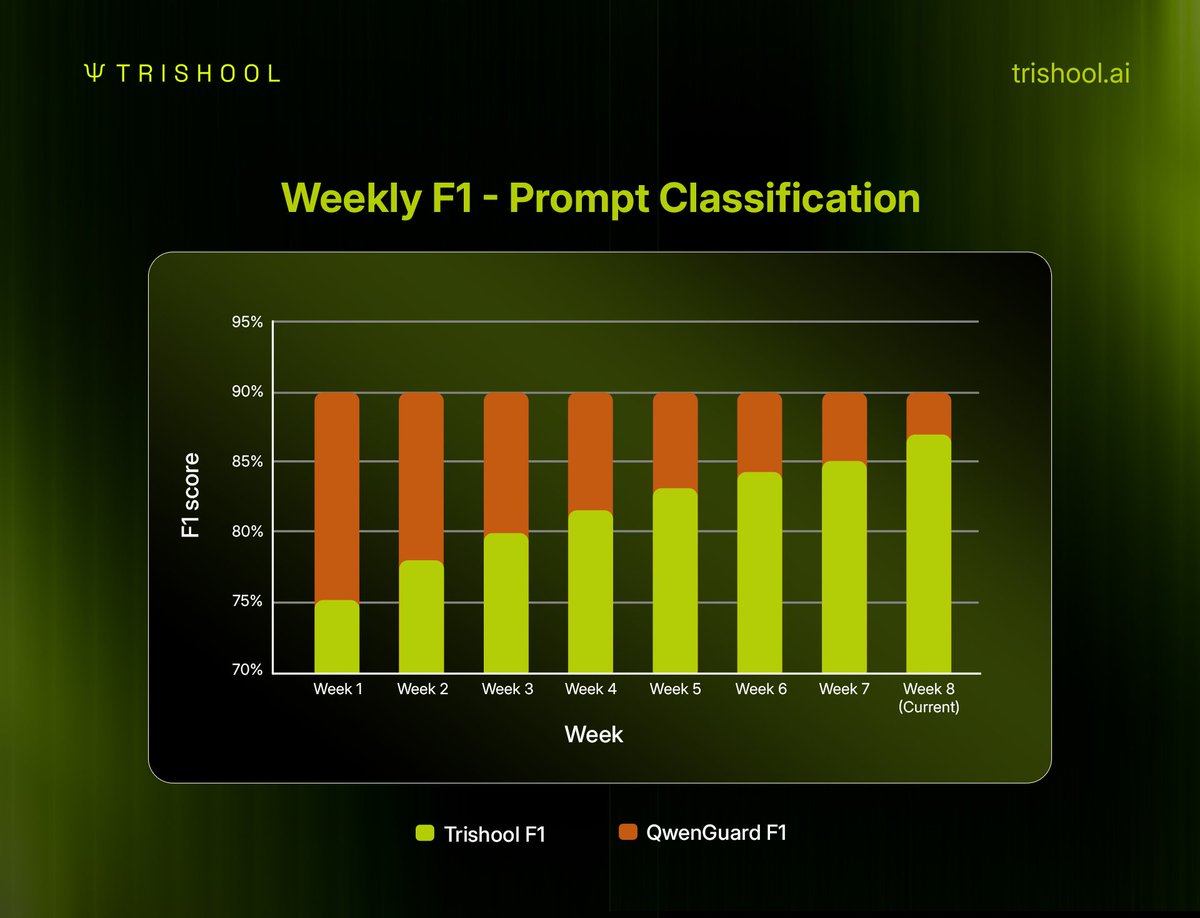
We’re pleased to share our weekly F1 score update for Halo (powered by Trishool SN23) vs QwenGuard. Halo is our guardrail model, and over the past few weeks we’ve seen strong improvements in performance, steadily closing the gap with QwenGuard. What does this mean: F1 score is the single number that tells you whether our guard model is striking the right balance, catching real harmful prompts (high recall) without overflagging benign ones as harmful (high precision). Our stats: • We started at 75.0% (Week 1) • Now sitting at 87.0% (Week 8), up +12.0 points in just 8 weeks • Right now, the Gap to QwenGuard (90% constant baseline) has reduced from 15% to 3% This simply shows that we have a working model and active miners carrying out real work. In the coming weeks, we will continue updating the stats and sharing them with the community, as we expect even more progress ahead as we approach SOTA.


Something very important is being brought into existence right now. Bricks have been laid over the last 18 months and now the tech is coming together in a way that makes commercialization possible. If this shit works, it will completely disrupt the economics of training large models and the floodgates will burst open. @Pluralis and @MacrocosmosAI are the only teams who I think can clearly see the shape of this opportunity right now. Agora is a strong first step towards this future. After spending a bit of time on their platform there's a form factor to it which feels "natural", almost inevitable in hindsight. This subfield of training is really starting to take shape. Our IOTA team has been very, very busy for the last few months. Can't wait to share more soon.


🚨 Enigma is launching on June 4th 🚨 A challenge-driven subnet built to solve the toughest problems in deep tech and fortify our most critical technologies. Let the countdown begin. #Enigma #SN63

The @IOTA_SN9 Simulator competition: 22k+ submissions, ~29% faster epoch times, R&D insights for distributed AI training. Two months ago we launched a competition to minimise epoch completion time inside a digital twin of the IOTA network by optimising activation routing and balancing. The goal: to improve speed and efficiency within our distributed training network. The result: 22,967 submissions across 57 rounds. Epoch times are now ~29% faster on average compared to the start of the competition, and up to 39% faster on some network configurations. Our subnets are an ecosystem - the IOTA Simulator is the clearest example: insights from miners feed directly into how IOTA engineers iterate, both for current participants and for future clients once we productise. Several R&D insights have arisen. Let's isolate one in particular. The competition highlighted a specific architectural challenge: downstream congestion dominates throughput more than raw processing speed does. Routing too many activations to the fastest miner doesn't solve the problem, as doing so fills its queues and slows it down overall. Top submissions converged on the same fix: track how full each miner's downstream queues were getting, and skip the ones building up backlog, even if they were nominally the fastest pipeline target. In other words, routing decisions must consider downstream capacity, not just downstream speed. Seeking the fastest miner in IOTA only makes sense if the algorithm factors in the speed their queues fill and empty, otherwise it accentuates the bottleneck. As a result, subnet 1 draws in techniques from frontier labs. This setup best fits the structure of Capacity-Aware Load Balancing, applied in many settings, with Mixture of Experts models like DeepSeek and Mixtral using it to route tokens to different neural networks during inference tasks, Google using it to prevent congestion on its cloud services, and even Amazon using the same principles for optimising its physical supply chain. In trying to opimise IOTA, miners are learning second order corrections to peer to peer networks.