Dr M V Srinivas retweetledi

Vitamin C is more than just "immune support"
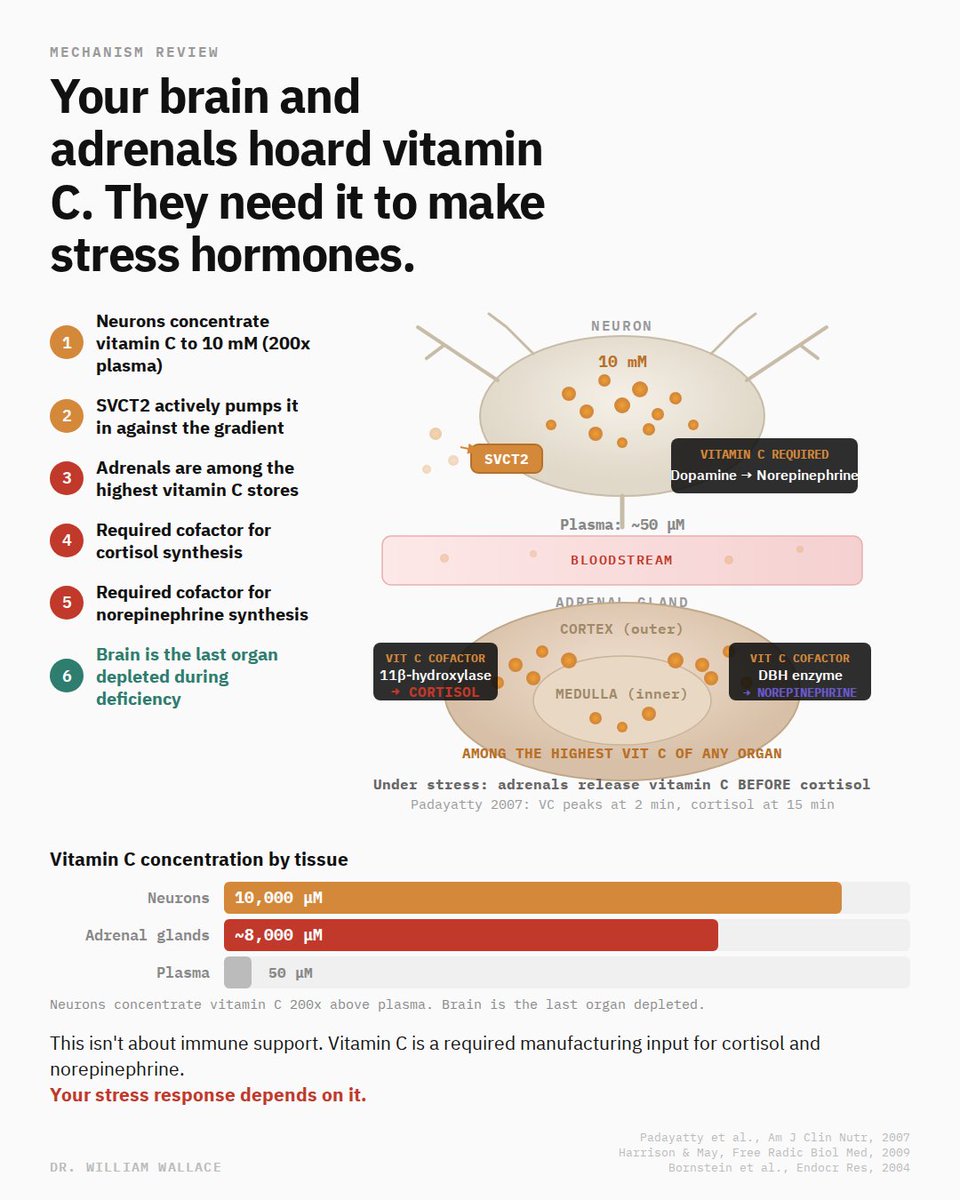
Neurons accumulate vitamin C to approximately 10 mM intracellularly, roughly 200 times the concentration found in plasma. This gradient is maintained by SVCT2, a sodium-dependent transporter expressed almost exclusively in neurons in vivo. The brain is also the last organ to be depleted during deficiency. In guinea pigs (which, like humans, cannot synthesize vitamin C), the brain retained 24% of its vitamin C stores after 14 days of zero intake, while the adrenal glands dropped to 4% and the spleen to 3%. The body prioritizes the brain above everything else.
The adrenal glands are the other major site of accumulation. Vitamin C is a required cofactor for two enzymes central to the stress response: 11β-hydroxylase, which catalyzes the final step of cortisol synthesis in the adrenal cortex, and dopamine β-hydroxylase, which converts dopamine to norepinephrine in the adrenal medulla.
Padayatty et al. (2007) measured this directly in 26 human patients. After ACTH administration, adrenal vein vitamin C concentration surged from 39 to 162 μmol/L within 2 minutes, while cortisol did not peak until 15 minutes. The adrenals released vitamin C before they released cortisol.
This sequence suggests ascorbate must be mobilized for steroidogenesis to proceed.
This doesn't mean mega-dosing vitamin C will improve your stress response. Most of this work describes what happens during deficiency or acute demand, not supplementation above adequate intake. But it does reframe what vitamin C actually does in your body: it's not primarily an antioxidant or immune molecule. It's a required manufacturing input for cortisol and catecholamines, concentrated exactly where those hormones are made.
Harrison & May, Free Radic Biol Med, 2009. Padayatty et al., Am J Clin Nutr, 2007.
Bornstein et al., Endocrine Research, 2004.
English