Superalgos

2.5K posts

Superalgos banner
Superalgos

Superalgos

@Superalgos

Open-source trading bots platform with a social trading network crowdsourcing superpowers for retail traders. Decentralized, permissionless, incentivized.


Open-Source Cyberspace Katılım Nisan 2018
281 Takip Edilen1.9K Takipçiler
Superalgos
Superalgos@Superalgos·
@lopp That said, without investment you wouldn't really know which ideas are truly good, as the ultimate way to test them is to fund them.
English
0
0
0
225
Jameson Lopp
Jameson Lopp@lopp·
One of the more disappointing realizations I've had over the years is that good ideas aren't necessarily good investments.
English
33
10
231
13.4K
Lunaticoin ⚡
Lunaticoin ⚡@lunaticoin·
Estoy seguro que quien me envió esta oferta irresistible por Linkedin escucha el podcast. 100%
Lunaticoin ⚡ tweet media
Español
31
6
170
12K
Matt
Matt@tradermatt·
bitcoin not dropping is giving me blue balls i know it wants to but not yet
English
11
0
59
4K
James Scaur 👾
James Scaur 👾@gringokiwi·
@JoshRainerGold @Howlingmutant0 One of my clearest memories as a child is watching a group of chickens fight each other to get at some sheep brains scattered over grass. After they'd finished they began ganging up on one of their own. They had to be kicked away multiple times to stop. Vicious creatures
English
2
0
14
1.3K
Superalgos
Superalgos@Superalgos·
@EvanWritesOnX Evan, what role do you think Bitcoin will end up having in the de-dollarized system? Is the FIC naturally adopting it as one more of the multiple rails that will integrate the post-dollar system, intermediation remaining the main business model around it?
English
0
0
0
28
Evan
Evan@EvanWritesOnX·
There is a widespread assumption in both mainstream and alternative media that de-dollarization represents a threat to American power and, by extension, to the Western financial system that has operated under dollar hegemony since Bretton Woods. The BRICS narrative, the central bank gold accumulation trend, the rise of bilateral currency swap agreements, and the growing use of the yuan in trade settlement are all presented as evidence that the dollar's dominance is eroding and that this erosion is bad news for the entities that have profited most from that dominance. People who read it like this confuse the interests of the American state with the interests of the Transnational Private Sector. These are not the same thing, and the divergence between them is precisely where the rationale lives. The dollar system, as it has functioned since 1944, served a dual purpose. It gave the United States extraordinary monetary privilege, the ability to run persistent deficits, borrow in its own currency, and project financial power globally. But it also gave the TPS something equally valuable: a single, liquid, universally accepted medium through which capital could move across borders with minimal friction. The dollar was not just America's currency. It was also the operating currency rail for the TPS. The problem, from the TPS perspective, is that this operating rail has become increasingly unreliable. Not because the dollar is losing value in any terminal sense, but because the state that issues it has begun using it as a weapon in ways that create unpredictable disruptions to capital flow. The weaponization of the dollar through sanctions, asset freezes, and SWIFT exclusions, which accelerated dramatically after 2022 with the Russian reserve seizure and has now reached almost farcical levels with the simultaneous imposition and suspension of sanctions on Russia and Iran during the same conflict, has introduced a form of political risk into the dollar system that the TPS cannot hedge against through conventional financial instruments. You cannot buy an option against a US president deciding to freeze your country's reserves on a Tuesday and unfreeze them on a Thursday because oil prices are inconvenient. This is the main trigger for de-dollarization, and it is important to understand that the TPS recognized this problem before the BRICS did. BlackRock's Aladdin platform, which monitors $25 trillion in global assets, has been incorporating geopolitical scenario analysis including sanctions risk and reserve currency diversification into its models for years. The major international banks have been building yuan clearing capacity, rupee settlement infrastructure, and digital currency interoperability frameworks not because China told them to, but because their institutional clients, sovereign wealth funds, central banks, multinational corporations, demanded it. The TPS does not wait for governments to build a new system. It builds the system and then lets governments announce it. The transition away from a single reserve currency does not reduce TPS extraction capacity. It increases it. Under dollar hegemony, the TPS operated through one dominant channel. Every cross-border transaction, every commodity trade, every sovereign debt issuance ultimately cleared through a dollar-denominated system with a relatively fixed set of intermediaries. The fees, spreads, and information advantages were substantial but structurally capped by the system's homogeneity. There was one set of rails and everyone rode them. A multi-currency world creates multiple sets of rails. Each new settlement currency, whether the yuan, the rupee, a BRICS basket instrument, or a central bank digital currency, requires its own clearing infrastructure, its own swap lines, its own derivative markets, its own legal frameworks, and its own risk analytics. Every single one of these layers represents an extraction opportunity for the financial institutions that build and operate them. Consider what happens when a Japanese manufacturer wants to buy Iranian oil in yuan, settle the transaction through a new BRICS payment mechanism, hedge the currency exposure through a derivative contract, and insure the shipment through a non-Western underwriter. Every node in that chain requires financial intermediation. Every node generates fees. Every node requires risk analytics (which Aladdin or its competitors will provide). Every node creates information asymmetry that benefits the institutions with the broadest cross-system visibility. The TPS does not lose from de-dollarization because the TPS does not depend on the dollar. It depends on intermediation. And a fragmented multi-currency system requires more intermediation, not less. That's why I still maintain the view that TPS will get stronger in a multipolar world. More currencies mean more foreign exchange transactions. More settlement systems mean more clearing fees. More regulatory frameworks mean more compliance services. More complexity means more demand for the risk analytics platforms that help institutions navigate that complexity. The dollar's decline as a reserve monopoly is, from the TPS perspective, analogous to the breakup of a single telecommunications monopoly into multiple competing carriers. The end user might see it as disruption. The companies that build and operate the network infrastructure see it as a multiplication of revenue opportunities. This is why you can observe what appears to be a paradox: the same Western financial institutions that were built on dollar hegemony are actively facilitating the infrastructure of its replacement. They are not doing this out of disloyalty to the American state. They are doing it because their incentive structure is aligned with financial complexity, not with any particular currency. The dollar was a convenient vehicle. When the vehicle becomes unreliable because the state that operates it keeps swerving into geopolitical ditches, the TPS simply builds more vehicles and collects tolls on all of them. The American state loses from de-dollarization because it loses the exorbitant privilege of issuing the world's reserve currency, the ability to run deficits that would sink any other country, the capacity to impose financial sanctions with global reach. These are genuine losses of sovereign power and they will have real consequences for American fiscal sustainability and geopolitical leverage. But the TPS, which is headquartered in New York and London but is domiciled nowhere and everywhere simultaneously, does not lose. It repositions. BlackRock does not need the dollar to be the world's reserve currency. It needs to manage assets denominated in whatever the world's reserve currencies are, plural. JPMorgan does not need SWIFT to be the only payment rail. It needs to operate clearing infrastructure on whatever payment rails exist. Goldman Sachs does not need oil to be priced in dollars. It needs to trade whatever instruments oil is priced in and collect the spread. The entities that built the dollar system are the same entities building the post-dollar system. They are not being disrupted. They are diversifying. When central banks buy gold and reduce their dollar holdings, the gold trades through bullion banks that are owned and operated by Western financial institutions. When China settles trade in yuan, the swap lines and clearing mechanisms involve Western correspondent banks at key nodes. The expertise, the infrastructure, the client relationships, and the analytical platforms do not evaporate because the currency label changes. De-dollarization is not a threat to the TPS. It's simply a migration. And the TPS has been pre-positioned for it because unlike the state, it operates on infinite-game logic. States defend currencies because currencies are instruments of sovereignty. The TPS defends intermediation because intermediation is the instrument of extraction. As long as capital needs to cross a border, settle a trade, hedge an exposure, or price a risk, the TPS has a revenue model. The people who frame de-dollarization as the decline of Western financial power are confusing the state with the system. The state is losing leverage. The system is gaining optionality. And the system, not the state, is where power resides.
English
41
34
233
32.8K
Superalgos
Superalgos@Superalgos·
@EvanWritesOnX How deep have you gone into de Bitcoin rabbit hole, Evan? Technically.
English
0
0
0
698
Evan
Evan@EvanWritesOnX·
Many asked me why Bitcoin hasn’t gone parabolic like Gold in this recent run. The answer is simple. Gold has gone parabolic because states are scared of the dollar system and are buying the asset that states have trusted for 5,000 years. That is infinite-game survival logic at scale, price-insensitive and persistent. Bitcoin is not following because the buyers who would make it behave like gold; sovereigns and central banks, are not yet there in size. Bitcoin is still primarily held and traded under finite-game logic; profit extraction, momentum trading, ETF arbitrage, corporate treasury optimization. The problem with finite-game actors is that they exit. They hedge. They rotate. They don’t create durable structural floors. This adversely insulates Bitcoin from being adopted by states that can treat it like gold. They prefer to test that assumption during peace time, not geopolitical uncertainty. It’s really important to understand that Bitcoin is housed under speculative players for now precisely because of this. The infinite-game actors (like states that care about legitimacy) will not choose Bitcoin because they believe in it ideologically. They will accumulate it because the existing TPS financial architecture is visibly degrading and sovereign actors need non-confiscatable, non-weaponizable reserve assets outside Western control. Bitcoin is the only digital asset with the decentralization properties that make it resistant to the same dollar-weaponization risk that is already driving gold accumulation. But as of now, it’s nothing but centralized under TPS speculators. The question is not if but when, at what price, and under what forcing conditions.
English
19
19
156
21.5K
Julio Moreno
Julio Moreno@jjcmoreno·
@bitcoindata21 Because it didn't reach full euphoria in Nov 2021, but reached full capitulation in 2022.
English
2
0
8
1.3K
quantdata21
quantdata21@bitcoindata21·
If bitcoin didn't reach full euphoria (red line), why should it reach full capitulation at 45-50k (green line)?
quantdata21 tweet media
English
55
29
298
20K
On-Chain College
On-Chain College@OnChainCollege·
The lack of Bitcoin realized losses by Long-Term Holders now versus the last bear market is very telling. A capitulation from LTHs may still be on the horizon for Bitcoin.
On-Chain College tweet media
English
32
17
184
23.9K
Eric Balchunas
Eric Balchunas@EricBalchunas·
@Scaramucci "gets what's coming to it" geez, seems personal for them. This tracks tho, I've noticed that bitcoin has a special ability to annoy the crap out of anyone with High Priest-ism. And these two economists fit the bill. Some haters are good to have imo
English
8
4
153
18.5K
Anthony Scaramucci
Anthony Scaramucci@Scaramucci·
The two Democrats are clueless when is comes to crypto. They will keep the Republicans in power if they don’t learn about and embrace this technology.
Anthony Scaramucci tweet media
English
106
52
527
53.6K
Superalgos
Superalgos@Superalgos·
@lopp Wait until de UAP files come out
English
0
0
0
187
Superalgos
Superalgos@Superalgos·
@SeekingTheValue @LaEstafaFiat No. Gustavo entiende (y defiende) bitcoin, pero sabe que el mercado aún no lo entiende. Asimetría de información. Lee de nuevo bajo esa luz.
Español
0
0
2
89
Seeking the Value
Seeking the Value@SeekingTheValue·
@LaEstafaFiat Adapta su mensaje, tejido milimetricamente, para que pase lo que pase siempre gane, si cae a 0, el te advirtió de que para el mercado solo era un activo meramente especulativo, si se va a 1M$, siempre te advirtió de que lo tuvieras. Deshonesto y oportunista imo
Español
3
0
7
989
Superalgos
Superalgos@Superalgos·
@lopp A beautiful irony, indeed
English
0
0
1
31
Jameson Lopp
Jameson Lopp@lopp·
One of the most amusing replies that commonly shows up on controversial posts is "nobody cares what you think!" How anyone can take the time to type that out without realizing the irony?
English
15
3
59
6.7K
Superalgos
Superalgos@Superalgos·
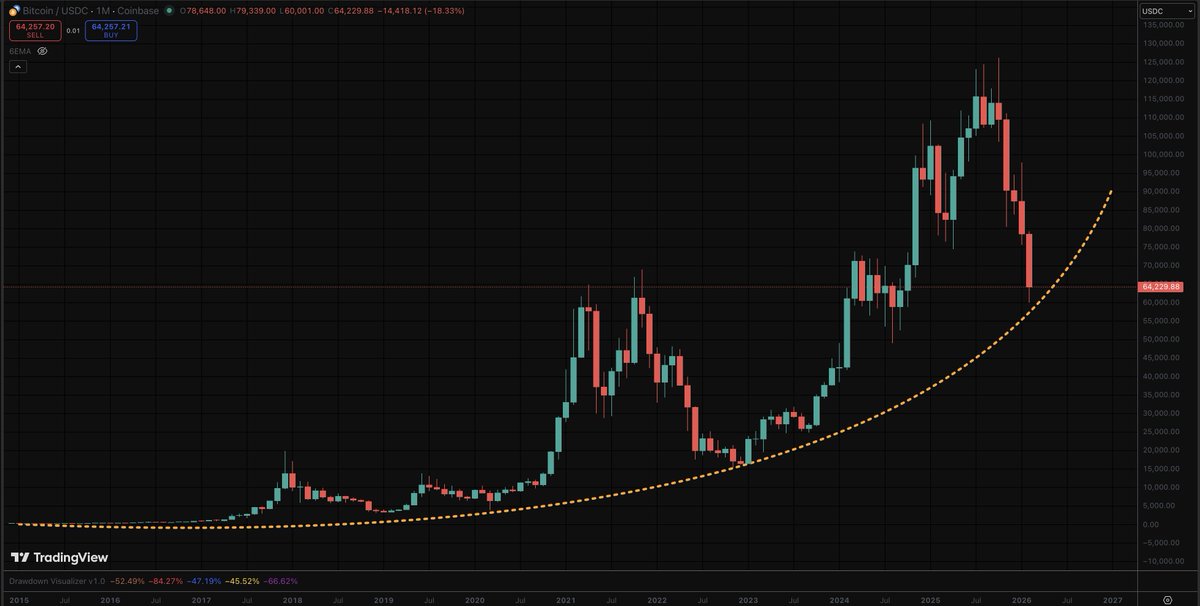
For the critics of Bitcoin as a store of value, the refutation lies in a single chart: we store the value at the bottom, not the top. JAN 2015: $110 MAR 2020: $3,800 NOV 2022: $15,400 FEB 2026: $60,000 +54,900% increase (550X) since 2015 +1,450% (15X) since 2020
Superalgos tweet media
English
0
0
1
74
Izabella Kaminska
Izabella Kaminska@izakaminska·
I just tried to do the “if you put twopence in the bank” explanation with her about how savings work to determine if she would prefer a “savings” bank account or a spending one. As an example I said for a savings option you give the bank £100 and in a year you would have maybe £105. And she laughed in my face and said: “If I want £200 I will be 57 by that point!” Not sure maths is her strong point unless she is predicting major deflationary forces 😂
English
5
0
14
3.5K
Izabella Kaminska
Izabella Kaminska@izakaminska·
Looking to get my 8 year old her first bank account for collection of pocket money. Does anyone have any recommendations and/or definite avoids? Ideally a system that doesn’t enslave her to debt peonage for the rest of her life?
English
35
0
17
17.7K