Heiko Hamann

5.2K posts

Heiko Hamann banner
Heiko Hamann

Heiko Hamann

@SwarmDynamics

Swarm Robotics 🤖, Swarm Intelligence 🐜, Evolutionary Robotics 🧬, Bio-hybrid Systems 🌱🧍‍♀️, Machine Behavior ⚙️🦆

Konstanz, Germany Katılım Kasım 2010
646 Takip Edilen2K Takipçiler
Heiko Hamann retweetledi

Patrick Kaczmarczyk
Patrick Kaczmarczyk@pat_kaczmarczyk·
CDU: „Bei Bundesjugendspielen nur Teilnehmerurkunden zu verteilen, geht gegen das Leistungsprinzip. Man muss schon früh gewinnen und verlieren lernen.“ Auch CDU, nach verlorener Wahl 👇
Patrick Kaczmarczyk tweet media
Deutsch
20
390
3.2K
33.1K
Heiko Hamann retweetledi
hardmaru
hardmaru@hardmaru·
As AI makes coding more efficient, Jevons Paradox kicks in. The cost of building software is dropping, which means the demand for great Software Engineers to build even more ambitious systems is higher than ever. We are actively hiring more Software Engineers at Sakana AI to help us build these systems. Come join us in Tokyo 🗼🇯🇵 #software-engineer-research-and-development" target="_blank" rel="nofollow noopener">sakana.ai/careers/#softw
Sakana AI@SakanaAILabs

AIの進化で開発効率が上がる一方、ジェボンズのパラドックス(Jevons paradox)によりSoftware Engineerの需要はかつてなく高まっています。 Sakana AIではより多くのSoftware Engineerを採用します。ぜひご覧ください。 #software-engineer" target="_blank" rel="nofollow noopener">sakana.ai/careers/#softw

English
27
16
229
42.1K
Heiko Hamann retweetledi
Rohan Paul
Rohan Paul@rohanpaul_ai·
Citadel Securities published this graph showing a strange phenomenon. Job postings for software engineers are actually seeing a massive spike. Classic example of the Jevons paradox. When AI makes coding cheaper, companies actually may need a lot more software engineers, not fewer. When software is cheaper to build, companies naturally want to build a lot more of it. Businesses are now putting software into industries and tools where it was simply too expensive before. --- Chart from citadelsecurities .com/news-and-insights/2026-global-intelligence-crisis/
Rohan Paul tweet media
English
428
1.4K
9.9K
2M
Heiko Hamann retweetledi
Santa Fe Institute
Santa Fe Institute@sfiscience·
Some computers are easy to spot, such as the artificial, human-built ones found in smartphones and laptops, with recognizable computational elements like input, output, energy cost, and logical processes. But scientists have long argued that many natural dynamic systems — from cells to brains to turbulence in fluids — carry out computations, too. In a new paper, SFI Professor David Wolpert and coauthor Jan Korbel from the Complexity Science Hub in Vienna, Austria, introduce a framework for identifying and studying the computations encoded in natural dynamic systems, allowing researchers to map, or connect, those computations to ones carried out by traditional man-made computers. santafe.edu/news-center/ne…
Santa Fe Institute tweet media
English
8
69
277
13K
Heiko Hamann retweetledi
ANTS Conference
ANTS Conference@ants_conf·
ANTS 2026 received the 3rd highest number of submissions since 1998 (after 2006 & 2010), promising a stellar program! Explore the plenary talks, perspective talks, and accepted papers ants2026.org 📣 Early-bird registration ends 20 Feb (23:59 pm, Central European Time)
ANTS Conference tweet media
English
0
4
3
119
Heiko Hamann retweetledi
Roderich Gross
Roderich Gross@RoderichGross·
📣 Early-bird registration available until 20 February 2026 (23:59, Central European Time) ANTS 2026 is approaching! Explore the list of plenary talks, perspective talks, and accepted papers on our website: ants2026.org
Roderich Gross tweet media
English
0
3
4
221
Heiko Hamann retweetledi
PNASNews
PNASNews@PNASNews·
Adding randomness to robot motion can reduce traffic jams and get robots to their destinations faster, according to a study that used both models and experiments, and that could help improve the design of robot teams and pedestrian spaces. In PNAS: ow.ly/mGPx50Yi7n2
English
1
5
29
6.4K
Heiko Hamann
Heiko Hamann@SwarmDynamics·
CyberRobo@CyberRobooo

Just saw something that actually feels like a real leap in robotics hardware.👋 @AllonicRobotics built a robot hand using 3D Tissue Braiding,basically weaving high-strength fibers around a minimal rigid skeleton the way human connective tissue wraps around bone. No hundreds of screws, bearings, cables or fiddly joints. Instead,a continuous automated process that creates the tendons, soft tissue & compliant structure all at once. The outcome is wild: »strong yet naturally soft & safe for close human interaction »surprisingly dexterous »produced from digital design→physical part in minutes »cost drops so much that you could eventually swap end-effectors like disposable gloves This is starting to feel like the moment robotic bodies get their own “3D printing revolution”. Hardware iteration speed finally approaching software speed. If this scales, it could be one of the missing pieces that lets dexterous humanoid robots move from lab → factories → homes. (Oh, and the company just raised $7.2M Pre-Seed,largest ever in Hungary. Budapest-based with US HQ. Led by Visionaries Club + angels from OpenAI, Hugging Face, ETH Zurich, Northwestern etc.) Prototype hand looks insane,the woven fiber texture is unreal.

QAM
0
1
3
135
Heiko Hamann retweetledi
Jay Van Bavel, PhD
Jay Van Bavel, PhD@jayvanbavel·
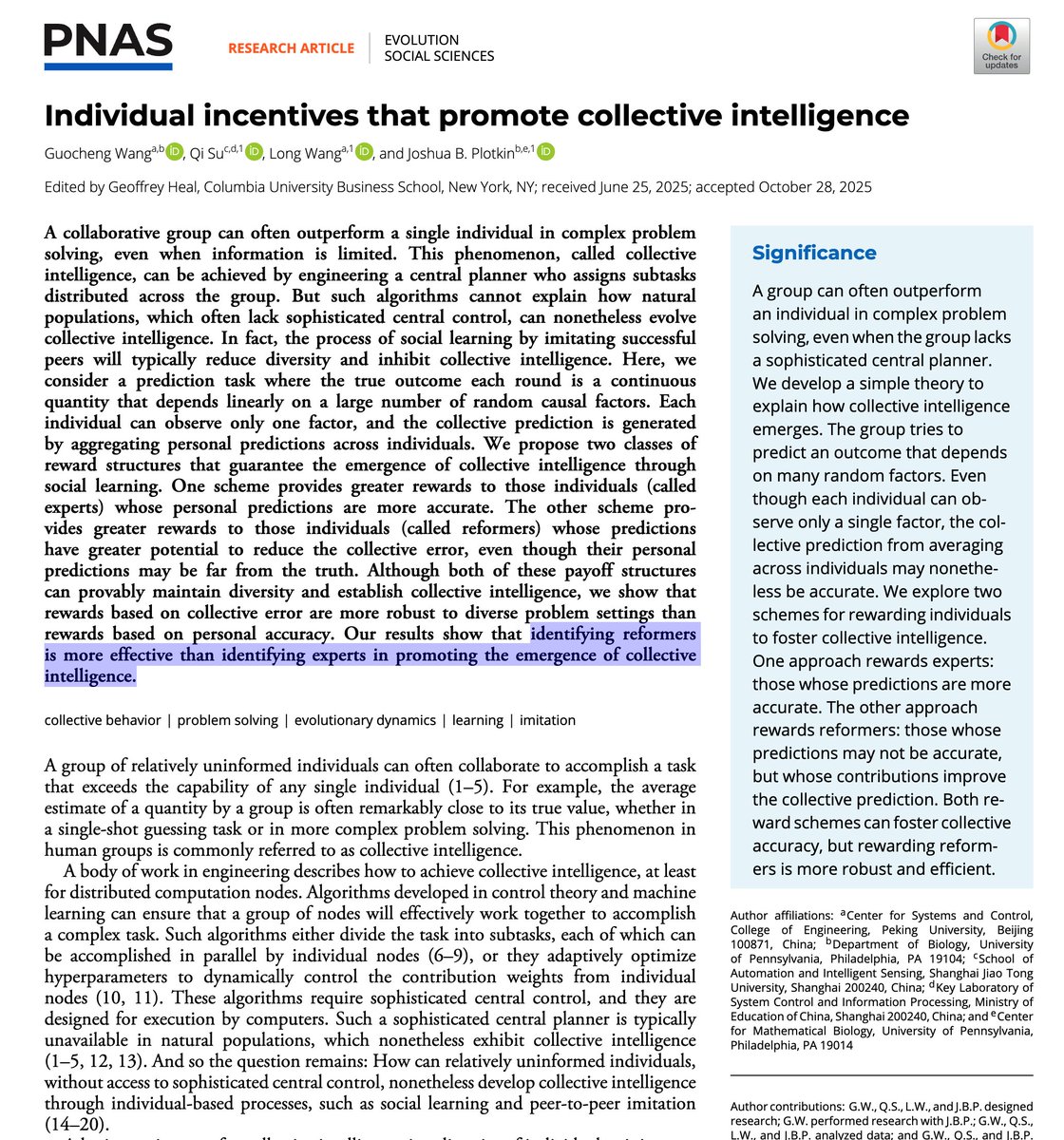
Collaborative groups often outperform single individuals in complex problem solving. A new paper examined how to create the right incentives to promote this kind of collective intelligence. Rewarding experts who are accurate can improve collective intelligence. But rewarding reformers whose predictions have greater potential to reduce the collective error (even though their personal predictions may be far from the truth) is *much more effective* in promoting the emergence of collective intelligence! If you want to create smart groups, you need to incentive contributions to the collective rather than mere individual success! pnas.org/doi/epdf/10.10…
Jay Van Bavel, PhD tweet media
English
15
156
551
38.3K
Heiko Hamann retweetledi
Mathelirium
Mathelirium@mathelirium·
In 1905, Russian Mathematician Andrey Andreyevich Markov asked a heretic question for the time: if randomness is allowed to remember something, do averages still behave or does probability theory fall apart? His answer was a very specific kind of memory. The next step only depends on the present, P(Xₙ₊₁=j | Xₙ=i, Xₙ₋₁, …) = Pᵢⱼ, and yet the law-of-large-numbers stability survives. The bead jitters forever, but long-run occupation settles. Time-averaged state frequencies converge to a fixed profile π satisfying π = πP. Fast-forward to 1931, another Russian Andrey Nikolaevich Kolmogorov, takes the same Markov mechanism and turns it into dynamics. Instead of only asking where does the chain spend its time?, you watch the whole distribution move in real time through the Kolmogorov forward (master) equation dp/dt = pQ, where Q is the generator of the continuous-time chain. That’s exactly what the render is showing as the same mechanism wearing two different lenses. The fog is p(t) spreading through the labyrinth, the flux layer is the net current pushed through corridors and the portal, and the particles are just sample paths driven by the same generator. One Markov engine...either you look at the evolving law, or you watch trajectories and let ergodic averages do the estimating. That’s also why Markov’s "memory without collapse" became a workhorse. MCMC engineers a chain whose stationary distribution is the target, then uses time-averages to estimate things you can’t integrate directly (posteriors, partition functions, constrained geometries). The same skeleton appears in hidden Markov models for time series, in biophysics as channels switching between states, and in control/RL through Markov decision processes. #ProbabilityTheory #MarkovChains #ContinuousTimeMarkovChains #KolmogorovForwardEquation #StochasticProcesses #Kolmogorov #Markov #MCMC
English
28
192
1.3K
95.8K
Heiko Hamann retweetledi
MIT CSAIL
MIT CSAIL@MIT_CSAIL·
"Beware of bugs in the above code; I have only proved it correct, not tried it." — Donald Knuth, Turing winner & author of "The Art of Computer Programming," who turns 88 today. Image: Brian Flaherty for The New York Times
MIT CSAIL tweet media
English
12
49
230
12.5K
Heiko Hamann retweetledi
hardmaru
hardmaru@hardmaru·
Survival of the fittest code. Core War (1984) is a game where programs must crash their opponents to survive. Warriors written in an assembly language called Redcode fight for control of a virtual machine. Our new paper: Digital Red Queen: Adversarial Program Evolution in Core War with LLMs, explores what happens when LLMs drive an adversarial evolutionary arms race in this domain. We task LLMs to write Warrior programs in Redcode that must out-compete a virtual world full of such programs. Core War is a Turing-complete environment where code and data share the same address space, which leads to some very chaotic self-modifying code dynamics. This approach is inspired by the Red Queen hypothesis in evolutionary biology: the principle that species must continually adapt and evolve simply to survive against ever changing competitors. In our work, programs continuously adapt to defeat a growing history of opponents rather than a static benchmark. We find that this adversarial process leads to the emergence of increasingly general strategies, including targeted self-replication, data bombing, and massive multithreading. Most intriguingly, it reveals a form of convergent evolution. Different code implementations settle into similar high performing behaviors, mirroring how biological agents independently evolve similar traits to solve the same problems. I think this work positions Core War as a sandbox for studying Red Queen dynamics in artificial systems. It offers a safe controlled environment for analyzing how AI agents might evolve in real world adversarial settings such as cybersecurity. By simulating these adversarial dynamics in an isolated sandbox, we offer a glimpse into the future where deployed LLM systems may start competing against one another for limited resources in the real world.
English
82
322
2.2K
172.7K
Heiko Hamann retweetledi
Dashun Wang
Dashun Wang@dashunwang·
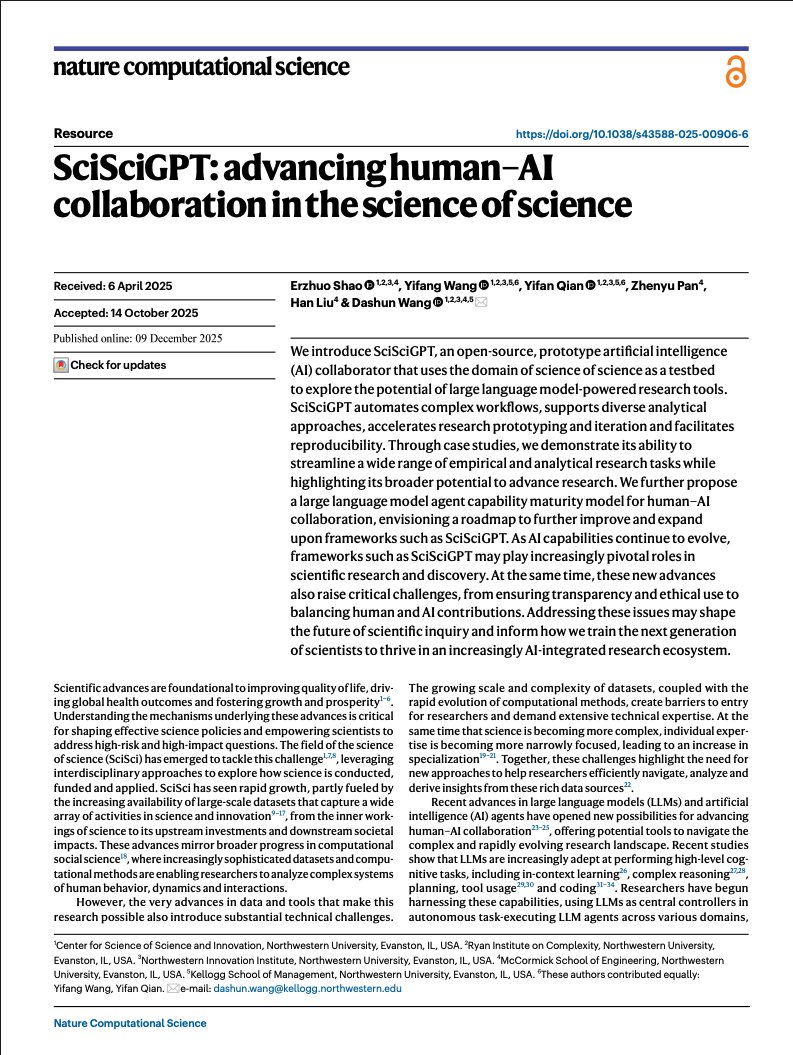
🚨New paper out in Nature Computational Science! Introducing #SciSciGPT: an open-source, multi-agent, prototype AI collaborator designed to support research and discovery, using the science of science as a testbed. Led by the amazing @ErzhuoShao Demo + paper below! 1/n
Dashun Wang tweet media
English
16
216
905
69.9K
Heiko Hamann retweetledi
Louise Jensen Duffy (also Ernest Jensen)
So, a lot of people ask me why I buy so many books. The truth is, I have a genetic disorder where my body doesn’t produce enough books of its own, so I have to supplement.
English
268
4.6K
33.3K
576.9K
Heiko Hamann retweetledi
Alex Prompter
Alex Prompter@alex_prompter·
This paper from Harvard and MIT quietly answers the most important AI question nobody benchmarks properly: Can LLMs actually discover science, or are they just good at talking about it? The paper is called “Evaluating Large Language Models in Scientific Discovery”, and instead of asking models trivia questions, it tests something much harder: Can models form hypotheses, design experiments, interpret results, and update beliefs like real scientists? Here’s what the authors did differently 👇 • They evaluate LLMs across the full discovery loop hypothesis → experiment → observation → revision • Tasks span biology, chemistry, and physics, not toy puzzles • Models must work with incomplete data, noisy results, and false leads • Success is measured by scientific progress, not fluency or confidence What they found is sobering. LLMs are decent at suggesting hypotheses, but brittle at everything that follows. ✓ They overfit to surface patterns ✓ They struggle to abandon bad hypotheses even when evidence contradicts them ✓ They confuse correlation for causation ✓ They hallucinate explanations when experiments fail ✓ They optimize for plausibility, not truth Most striking result: `High benchmark scores do not correlate with scientific discovery ability.` Some top models that dominate standard reasoning tests completely fail when forced to run iterative experiments and update theories. Why this matters: Real science is not one-shot reasoning. It’s feedback, failure, revision, and restraint. LLMs today: • Talk like scientists • Write like scientists • But don’t think like scientists yet The paper’s core takeaway: Scientific intelligence is not language intelligence. It requires memory, hypothesis tracking, causal reasoning, and the ability to say “I was wrong.” Until models can reliably do that, claims about “AI scientists” are mostly premature. This paper doesn’t hype AI. It defines the gap we still need to close. And that’s exactly why it’s important.
Alex Prompter tweet media
English
386
2.1K
8.3K
1.2M
Kent Kjærgaard Jensen
Kent Kjærgaard Jensen@Hampmir·
october is first month of quarter which is usually "Bad" because they export furthest away from the beginning of quarter. also lets just ignore that tesla was best selling in both september, november and will probably be in December as well. also definatly best selling i year 2025 overall.
English
2
0
6
232
Cheddar Flow
Cheddar Flow@CheddarFlow·
$TSLA's European sales fell near 50% in October
Cheddar Flow tweet media
English
63
67
506
48.3K
Heiko Hamann retweetledi
Quanta Magazine
Quanta Magazine@QuantaMagazine·
Mathematicians are studying elliptic curve patterns that resemble murmurations of starlings. Nina Zubrilina, a doctoral student at Princeton, was the first to prove a formula that explains reasons for the patterns. quantamagazine.org/elliptic-curve…
Quanta Magazine tweet media
English
31
303
2.6K
188.1K
Heiko Hamann retweetledi
Lex Fridman
Lex Fridman@lexfridman·
Here's my conversation with Michael Levin (@drmichaellevin) about the nature of intelligence in biological systems, including unconventional & alien intelligence, agency, memory, consciousness, and life in all its forms here on Earth and beyond. It's here on X in full and is up everywhere else (see comment). Timestamps: 0:00 - Introduction 0:44 - Biological intelligence 9:17 - Living vs non-living organisms 14:30 - Origin of life 18:15 - The search for alien life (on Earth) 51:19 - Creating life in the lab - Xenobots and Anthrobots 1:04:21 - Memories and ideas are living organisms 1:18:02 - Reality is an illusion: The brain is an interface to a hidden reality 2:03:48 - Unexpected intelligence of sorting algorithms 2:29:26 - Can aging be reversed? 2:33:17 - Mind uploading 2:51:57 - Alien intelligence 3:06:52 - Advice for young people 3:13:21 - Questions for AGI
English
271
505
2.8K
986.1K