thenimblemm
3K posts

thenimblemm
@THenkinet
Solo Quant | AI-Augmented | Nimble Market-Maker | Crypto & Prediction


Respect to @bennpeifert for the level of transparency. Few would write this thread publicly. Worth reading in full for anyone managing derivatives risk. The key passage for allocators is the one about adding risk during the drawdown. Benn's framing: from a portfolio management perspective you want to cautiously, prudently add more risk when positions get more attractive. Academically defensible in a stable regime. Operationally devastating when the regime shifts under you. Four months of -7% to -9% in a row is what happens when a "more attractive" position is actually a regime breakdown the model has not absorbed yet. The mean-reverting prior fails because the mean has moved. Two structural points on how D2 is built differently. One: epoch-based architecture. Each epoch closes and locks. New capital, new sizing, new conviction. No accumulating exposure to a thesis that has not paid because "it should have." LPs re-up or leave based on the closed epoch. We cannot double down on a losing trade across months, no matter how attractive it looks. Structural, not discretionary. Two: investor concentration. 1,200+ deposit positions across our vaults, no single LP above 10%. No anchor investor pushing for a higher-risk share class. The QVR thread is honest that their anchor investor wanted increased risk precisely as the regime turned. We do not have that pressure vector by design. We do not claim a crystal ball. We built the hard way: no VC, no token deal, no anchor LP dictating sizing. Investors self-selected for conviction and patience. That selection is the strongest risk control we have, and it does not appear on any factsheet. The lesson is structural again. Risk management is not just a Greeks book. It is the cap table, the lockup architecture, the LP composition, and the discipline of letting epochs close. fade D2 at your own risk

Castle Labs published a thoughtful piece on the vaultification of finance. We agree with most of it. Vaults are eating allocation. Infrastructure is consolidating. The institutional rail onchain is being built right now. One question is missing from the cover slide. Risk is a four letter word. Who carries it. The case for vaults is genuinely strong. ERC 4626 standardized the share accounting. Curators standardized the allocation logic. Audits standardized the security baseline. For a depositor this is real progress. Then the question the architecture does not answer. When the trade breaks, who carries the loss. In TradFi, a leveraged trade carries three balance sheets. Equity is wiped first. A lender prices the credit. An operator runs the operation. Three sets of consequences. In most onchain vaults the answer is one balance sheet. The depositor. The curator economics are the cleanest illustration. Most curators earn fees for routing capital. They do not deposit meaningful alongside. This is not bad faith. It is just the contract. It is also the contract behind the Resolv pattern. March 2026. Resolv wstUSR exploit. Morpho Public Allocator routed fresh USDC into the impaired markets hours after the failure. Curators including @gauntlet_xyz were documented in the @chaoslabs post mortem with combined exposure above 54 million. Auto allocation kept optimizing for utilization while the attacker drained the system. This is not a Morpho problem. It is a model problem. Stream Finance, November 2025. Recursive loop across Morpho, Euler, Silo, Gearbox. 160 million of real deposits became 500 million of deployed capital. xUSD went from 1.26 to 0.16 in a day. 300 million of bad debt. Caleb disappeared. @diogenes is doing podcasts with @Bankless. Same pattern. Different rail. Five questions an allocator should ask before depositing into any curated vault. 1) Is the vault anything more than @OpenZeppelin contracts plugged into @FireblocksHQ or @FordefiHQ custody? 2) Who mints the asset you are depositing, and what is the balance sheet behind that mint? 3) Does the curator have asset management skill, and have they ever made money outside the capital their VCs handed them? 4) Does the curator have their own capital in the vault? 5) Who executes the trade and manages the risk when the CEO is on a podcast or at a conference? If any answer is unclear, you are the skin in the game. Castle Labs named @Morpho @upshift_fi @veda_labs @SteakhouseFi @SentoraHQ @pendle_fi @ipor_io. Each is doing genuinely useful work on the infrastructure layer. Share accounting, curator interfaces, vault isolation, yield tokenization, lending aggregation. None of them are the strategy. They are the rail the strategy runs on with basic risk management. The vault that carries the loss is not the vault that wrote the audit. It is the vault that took the position. @XtineFang put it well. "The next generation of trading infrastructure should only be built by those who have actually traded. Traders who understand market microstructure, risk, and execution — not just engineers optimizing for theoretical elegance." This is how we have built D2. We are the strategy, not just the rail ( even ours has @HyperliquidX coreWriters). We trade derivatives. We carry the position. We post the PnL onchain, every epoch. We deposit our own capital alongside on selected mandates. 29 consecutive green months on the flagship lineage. 2.6 Sharpe. Negative 0.4 percent worst monthly drawdown. Fully auditable. Fade @HyperliquidX and D2 at your own risk.


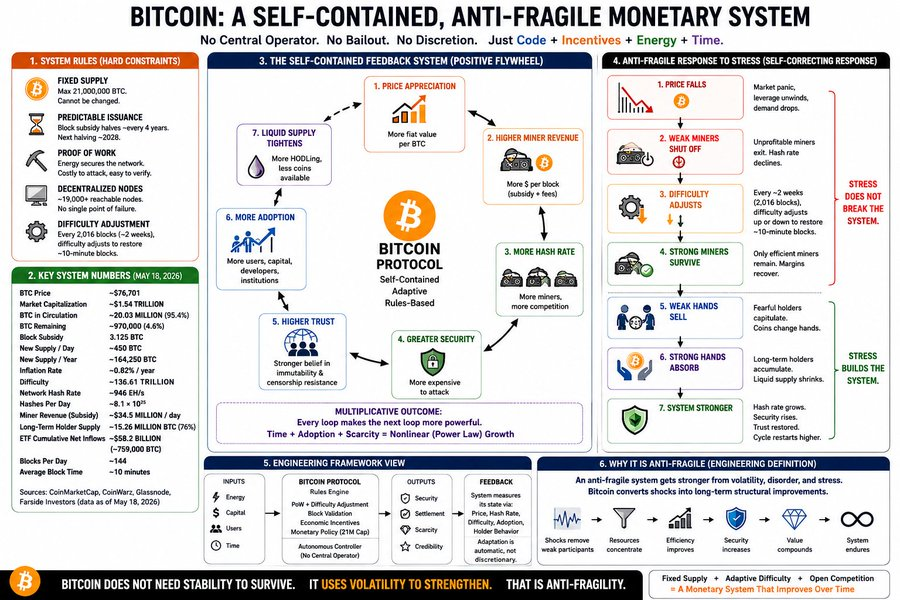
We've been mapping BTC against macro + on-chain for 90 days. The setup right now is the cleanest structural floor read we've seen since August 2024. Here's the exact 8-step playbook we run: 1. Macro layer one — Fed paused at 3.50-3.75% with 4 dissenters in April. Most dissent since 1992. That's the max-hawkish bar. Cuts now > pause forever. 2. Macro layer two — DXY at 99.4, 6-week high. Every BTC bottom in 2023-24 came within 14 days of a DXY local top. Gold liquidity squeeze at $4,600 is the same signal: cash being raised to deploy. 3. Exchange Reserve Balance: 2.69M BTC. Eight-year low. Only 5.6% of supply on exchanges. -170k BTC over 6 months. Sellers don't have inventory. 4. SOPR Trend Signal at 1.0008. The max pain pivot zone. Recovered from <0.98 in February. Historically the recross of 1.0 from below = bear-to-recovery handoff. 5. STH-SOPR at 1.0037. Short-term holders went from -7.85% realized loss in January to breakeven now. Capitulation cohort already exited. 6. Funding rate: averaged +0.005% per 8h over 30d. No leverage stacked. The OI rebuild after May 18 was spot-driven. 7. W-R Delta: whales +27k BTC over 30d while retail bid evaporates. Largest 30d whale accumulation since November. 8. Reserve Risk in the green band. Conviction-weighted LTH supply rebuilding. Dormant supply 5y+ at 33.14% — record high. The pattern: macro is loosening, leverage is gone, supply is in cold storage. This is not what a top looks like. This is what a structural floor looks like. We don't trade vibes. We trade the stack. Right now the stack is loaded long. Full dashboard → app.alphractal.com


A huge hedge fund allocator messaged one of my guests (@MacroAlf) saying he watched Odds on Open. I am blown away by the power of media.