TechTerra

369 posts

TechTerra banner
TechTerra

TechTerra

@TechTerraInvest

Predicting the future on @Polymarket. Investing in disruptive technologies and sharing insights to grow wealth.

Katılım Ekim 2023
200 Takip Edilen60 Takipçiler
TechTerra
TechTerra@TechTerraInvest·
“You don’t work = you die” is not unique to capitalism. That’s biology. In every system, food, shelter, and medicine require labor. The question is whether people are forced by an owner, or whether they exchange labor in a society with imperfect but real alternatives. Calling scarcity “slavery” doesn’t explain anything.
English
0
0
0
3
Malcolm
Malcolm@Mechamalcolm·
@TechTerraInvest @PatrickC1995 Slavery: you don't work=you die Capitalism: you don't work=you die The builder and the farmer don't enslave you, the systems that restrict access to those needs does.
English
1
0
0
5
Patrick Carroll
Patrick Carroll@PatrickC1995·
One of the biggest mental blocks of the left is their inability to think about value creation in any way other than manual labor. A good counter-example is the professional athlete, or pop-star. Who did Tayler Swift exploit to become a billionaire?
𐌁𐌉Ᏽ 𐌕𐌉𐌌𐌉@OrevaZSN

No one “earns” a billion dollars. No one can work a billion times harder than anyone else. There is no good, ethical, or righteous billionaire. That kind of wealth can only be accumulated through the exploitation of the working class. No exceptions.

English
295
335
6.2K
503.3K
TechTerra
TechTerra@TechTerraInvest·
This only works if you define “coercion” as “having needs.” But needing food doesn’t mean the farmer enslaved you. Needing shelter doesn’t mean the builder enslaved you. Slavery is ownership. Wage labor is exchange. You can criticize capitalism without destroying the meaning of words.
English
1
0
0
9
Malcolm
Malcolm@Mechamalcolm·
@TechTerraInvest @PatrickC1995 That's why I said the slave has to sign a contract. Also wage labor is coerced. You can survive in this world without money.
English
1
0
0
26
TechTerra
TechTerra@TechTerraInvest·
Why can't you answer my question? Comparing wage work to slavery only works if you erase the main feature of slavery: coercion. If someone can reject the job, quit the job, negotiate, or work elsewhere, that’s not slavery. You can argue the market is unfair without pretending employment is ownership.
English
1
0
0
32
TechTerra
TechTerra@TechTerraInvest·
If a worker is paid the rate they agreed to, gains experience, keeps their wage, and voluntarily takes the job, what specifically makes the transaction exploitative? If everyone is paid the wage/contract they agreed to, and the upside comes from brand, risk, IP, demand, and scale, where exactly is the theft?
English
1
0
0
73
Malcolm
Malcolm@Mechamalcolm·
@TechTerraInvest @PatrickC1995 The workers personal situation does not affect the value of their labor. Without the workers that make her merch, tours, and music possible she is not a billionaire. You couldn't plant enough trees to grow a million apples on your own and you aren't going to pick all the apples
English
1
0
0
215
TechTerra retweetledi
PredictionMarketTrader
PredictionMarketTrader@PredMTrader·
You asked, we listened. Introducing: Equitable Prediction Markets All the features you love about prediction markets - now with fair, equitable wealth redistribution. Trade like normal - but if you win, your profits are redistributed to the losers.
PredictionMarketTrader tweet media
English
49
14
260
25.9K
TechTerra
TechTerra@TechTerraInvest·
What is your definition of exploited? Those people voluntarily agreed to a job and were paid accordingly. You know nothing of their life, work, or pay yet you assume they are exploited because she has wealth? If I start an apple farm and serve a million people im a savior, if I serve a billion, I'm a villain.
English
1
0
0
318
Malcolm
Malcolm@Mechamalcolm·
@PatrickC1995 She exploits the people who make her merch, A/V professionals, background instrumentalist/dancers/vocals, basically every worker that makes her albums/concerts possible.
English
3
0
3
2.5K
HondaCivic
HondaCivic@0xMarchyel·
Interesting day on the London weather market! Started with 18C/17C being the favorites, then corrected to 16C, but ultimately settled at 15C. Huge win today for me and a big shoutout to the Meteoblue forecast model for the edge, it was predicting 15C very early 👏👏👏
HondaCivic tweet media
English
14
7
72
4.1K
TechTerra retweetledi
Hedgeye
Hedgeye@Hedgeye·
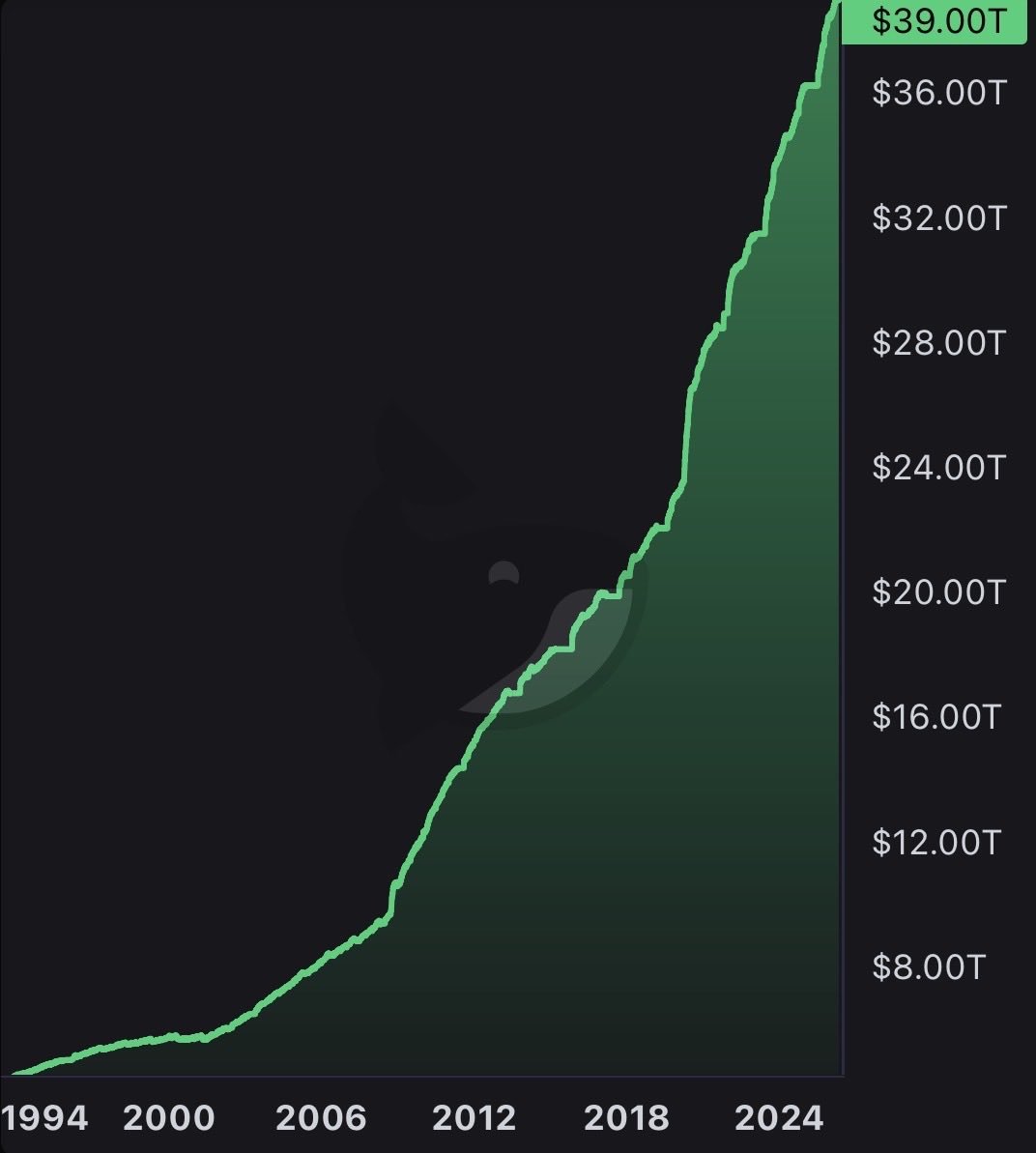
🇺🇸 Here's what $39 trillion in debt really means: If we confiscated every dollar of U.S. corporate profit ($3.8T/year), it would take over 10 years to pay off. Sell every ounce of gold ever mined: $32 trillion. Still $7 trillion short. Liquidate every Bitcoin in existence on top of that: $33.5 trillion. Still $5.5 trillion short. If we confiscated every dollar of federal tax revenue ($5.3T/year), it would take over 7 years to pay off, assuming zero spending. The debt is 71% of every home in America, or 30% of every publicly traded company on Earth. The debt grows by $7.2 billion a day, or $84,000 a second. This is a problem.
Hedgeye tweet media
English
326
963
3.2K
626.1K
TechTerra
TechTerra@TechTerraInvest·
The movie depicting the genesis of OpenAI—its drama, innovations, genius, egos, and power struggles—would make The Social Network look tame.
English
0
0
0
8
TechTerra retweetledi
Alter Ego
Alter Ego@AlterEgo_eth·
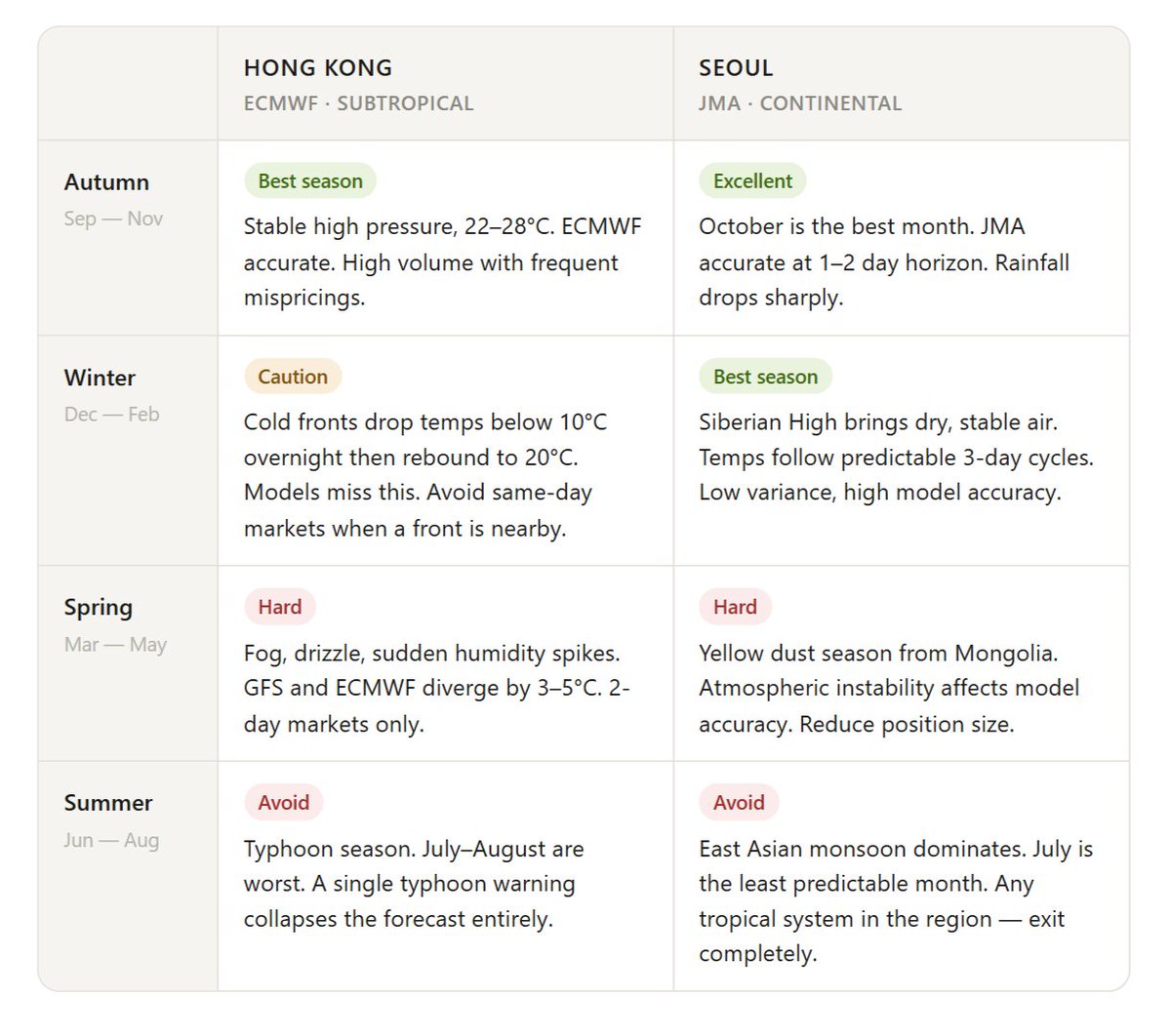
Hong Kong vs Seoul on Polymarket weather markets Two of the most actively traded cities on the platform Same format, completely different game depending on the season > Autumn (September - November) This is when Hong Kong is at its best for trading Dry air, stable high pressure, temperatures sitting consistently between 22–28°C with minimal variance day to day ECMWF nails the forecast here. Models agree. Market mispricings are common because volume is high but retail traders underestimate how stable autumn HK actually is Seoul in autumn is also excellent - October especially. Rainfall drops sharply, skies clear, and the JMA model is highly accurate at 1–2 day horizons Both cities are tradeable in autumn. Hong Kong has the edge on volume, Seoul has the edge on forecast accuracy > Winter (December - February) Seoul becomes a different animal Siberian High-pressure systems bring cold, dry, consistent air from the northwest. Temperatures follow predictable 3-day cycles - a pattern that repeats almost mechanically For a bot running on JMA or ECMWF data, Seoul winter is one of the highest edge periods of the year. Low variance, high model accuracy Hong Kong winter is mild but has a hidden trap: cold fronts can drop the temperature below 10°C overnight, then rebound to 20°C the next day when it clears That volatility is invisible on a 7-day forecast. Models underestimate the cold front impact consistently Avoid same-day HK markets in winter when a cold front is in the area > Spring (March - May) The hardest period for both cities Hong Kong spring is famous for fog, drizzle, and sudden humidity spikes. Visibility drops so low that air and ferry services get disrupted GFS and ECMWF regularly diverge by 3–5°C. Convective events form fast and resolve fast - models see them late Seoul spring has its own problem: yellow dust season from Mongolia creates atmospheric instability that affects temperature models If you trade either city in spring - reduce position size, extend to 2-day markets, and only enter when models fully agree > Summer (June - August) Both cities enter typhoon season. This is where most traders get hurt Hong Kong summer means constant threat of tropical cyclones - July and August are worst. A single typhoon warning collapses the forecast entirely Seoul summer is dominated by the East Asian monsoon. July is the cloudiest, wettest, least predictable month of the year for both cities The rule for both cities in summer: if there is any tropical system in the South China Sea or western Pacific - stay out entirely. No model handles typhoon-adjacent forecasting reliably The seasonal calendar matters more than the city itself Hong Kong autumn and Seoul winter are where the real edge concentrates Everything else requires more caution, smaller sizing, or staying on the sidelines entirely
Alter Ego tweet media
Alter Ego@AlterEgo_eth

Spring is the worst season to trade Polymarket weather markets Here's why - and which 3 cities are still profitable right now in April Spring is a transitional season. In meteorology, transitional means models are constantly fighting each other GFS and ECMWF regularly disagree by 5–8°F on the same city, same day Convective events - sudden thunderstorms, cold fronts, wind shifts - can flip a forecast in hours When models disagree, the market price is basically a coin flip with extra steps > The cities to avoid in April are all in the US Midwest and South Chicago sits at the boundary of cold Canadian air and warm Gulf air. Unpredictable by design Dallas gets hammered by convective storms that no model catches reliably at 48h. Any Midwest city right now = Kansas City, St. Louis, Denver - same story These markets have volume. They look tradeable. They will drain you in April > Now the cities that actually work right now Buenos Aires. It's autumn in the southern hemisphere. Stable high-pressure systems dominate. GFS is accurate, variance is low, the market consistently misprice the tails. This is where the edge is cleanest right now. Seoul. Korean spring is unusually stable compared to US spring. The Japanese Meteorological Agency model (JMA) is highly accurate for Seoul at 1–2 day horizons. High daily volume means the market is liquid enough to enter and exit cleanly. Jeddah. Desert climate in the Arabian Peninsula means almost zero convective activity in April. ECMWF nails the forecast consistently. The market opened recently and still has pricing inefficiencies that haven't been arbitraged away yet > One more thing that matters in spring specifically: stop trading same-day markets When model uncertainty is high, same-day markets resolve before the market has time to correct Extend your horizon to 2 days out. You get more time for the forecast to stabilize, more time for the market to misprice, and more time for you to enter at a real edge The best weather traders narrow their city list in spring and go deeper on fewer markets Spring = reduce your city pool, avoid the Midwest, lean on southern hemisphere and arid climates Summer = open back up. US cities stabilize. New opportunities appear Save this post. Come back to it in July when the landscape shifts again

English
11
7
71
16.1K
TechTerra retweetledi
Clemente
Clemente@Chilearmy123·
Crypto was early to VCs getting all the upside and dumping on retail We're seeing the same exact thing happen with AI VCs ride these companies to massive valuations and IPO is the exit liquidity As if AI wasn't hated enough, the public doesn't have any way to capitalize on the AI frenzy unless they use the products to avoid getting "left behind" Wild world we're living in Great writeup by Tulip
Tulip King 🌷@tulipking

x.com/i/article/2047…

English
19
9
126
19.9K
TechTerra retweetledi
SightBringer
SightBringer@_The_Prophet__·
⚡️Hal Finney is Satoshi Nakamoto. Every piece of evidence points the same direction. Here’s why: Finney was running a beta version of Bitcoin in January 2009 within days of Satoshi releasing the software. That’s not the behavior of an interested observer. That’s the behavior of someone who already knew the code intimately because they helped write it. Nobody else jumped in that fast. Everyone else took weeks or months to even understand what Bitcoin was. Finney was running it immediately. The proof of work system at the heart of Bitcoin is a direct evolution of Finney’s RPOW system from 2004. RPOW stood for Reusable Proof of Work. It solved the exact problem Bitcoin’s mining mechanism solves. Finney built it five years before Bitcoin existed. The conceptual lineage from RPOW to Bitcoin’s mining is so direct that anyone reading both would conclude they were built by the same mind. The Bitcoin mechanism is not just inspired by RPOW. It’s RPOW with the trust assumption removed by adding a blockchain. That’s an iteration on his own work, not someone else’s. He had been working on cryptographic digital cash systems for over a decade before Bitcoin launched. He was on the cypherpunks mailing list for years. He worked at PGP Corporation under Phil Zimmermann, the most important cryptography company of the era. His career trajectory was building toward something exactly like Bitcoin. The white paper was the natural conclusion of his entire prior body of work. The geography is too specific to be coincidence. Hal Finney lived in Temple City, California. Dorian Satoshi Nakamoto lived in Temple City, California. They lived a few blocks from each other. The pseudonym Satoshi Nakamoto was lifted from a man living in the same neighborhood as Finney. The probability of this being random is essentially zero. Either Finney chose the name because he knew Dorian existed nearby, or somebody who somehow knew Dorian’s name and Finney’s neighborhood happened to be the actual Satoshi, which is much less plausible than the first explanation. The Forbes journalist Andy Greenberg analyzed Finney’s writing style against Satoshi’s writings using textual analysis tools. The match was significantly higher than for any other candidate. The vocabulary, the sentence structure, the punctuation patterns, the use of British spellings inconsistently which would be characteristic of an American who occasionally affected British style. All of it lined up. The timing of Satoshi’s exit aligns precisely with Finney’s medical decline. Satoshi started reducing involvement in Bitcoin in mid 2010. Finney was diagnosed with ALS in August 2009 and his physical capabilities began deteriorating throughout 2010. By 2011, when Satoshi went completely silent, Finney could barely use a computer. He had to use eye tracking software for the rest of his life. The timeline of Satoshi’s withdrawal matches the timeline of Finney’s progressive paralysis with eerie precision. The Satoshi wallets containing approximately one million Bitcoin have never been touched. Not a single coin moved in sixteen years. This is consistent with a Satoshi who is physically dead. Finney died in August 2014. The wallets remained untouched before and after his death. His body was cryogenically preserved. The keys, if he was Satoshi, were either destroyed, lost, or held by his wife Fran. She has consistently said she doesn’t have access to them and doesn’t know if they exist anywhere. The fact that no Satoshi coin has ever moved is the strongest evidence that whoever Satoshi was, they’re either dead or incapable of accessing the keys. A living Satoshi who could move coins would have done so for any number of reasons over sixteen years. Tax planning. Charitable giving. Even just to demonstrate continued life. Nothing has happened. The simplest explanation is that Satoshi died and the keys died with him. Finney’s behavior in the early Bitcoin community was strange in ways that fit. He was the most technically capable person involved. He clearly understood Bitcoin at a depth that exceeded everyone else. But he played the role of an enthusiastic outsider who happened to be very interested in the project. That’s a position someone takes when they want to participate in their own creation without admitting authorship. Other early contributors deferred to him on technical questions and he deferred back to Satoshi, even when his answers and Satoshi’s answers were structurally identical. The other candidates don’t fit as cleanly. Nick Szabo has the conceptual fingerprint through bit gold but doesn’t match the implementation work. He’s also been publicly active in ways that someone trying to maintain anonymity wouldn’t be. Adam Back has the cryptographic background but his style doesn’t match. Wei Dai has the conceptual background but his style and timing don’t match. Craig Wright is a documented fraud who has been judicially proven to have forged evidence multiple times. Dorian Nakamoto is just an unrelated retired engineer who shares a name. Finney is the only candidate where every variable lines up. The technical capability. The conceptual lineage. The geographic proximity to Dorian. The writing style. The behavioral patterns in the early Bitcoin community. The timing of withdrawal matching ALS progression. The wallets never moving matching his death. The family’s denial being expected regardless of truth. There’s no candidate where this many independent variables converge. With Finney, basically every piece of evidence points the same direction. With everyone else, you have to explain away the variables that don’t fit. With Finney, you don’t have to explain anything. It just makes sense.
Brian Armstrong@brian_armstrong

The Finding Satoshi documentary is the most thoughtful take on this subject I've seen out there. It's coming out tomorrow, but Coinbase users can get early access today. Open your Coinbase app to find out more!

English
194
103
918
232.3K
TechTerra retweetledi
Nick shirley
Nick shirley@nickshirleyy·
🚨 Exposing California's corrupt "Stop Nick Shirley Act", instead of going after the fraudsters California is now going after the people exposing the fraud. This bill AB 2624 will: - Criminalize journalists with misdemeanors, $10,000 fines, imprisonment, and content takedown - Let immigrant based NGOs' funding be confidential - Take away freedom of the press from journalists - Protect any "immigration support services" information from being public (healthcare, legal services, etc) This bill was created by the Attorney General's WIFE Mia Bonta to stop fraud from being exposed. Please like and share this video everywhere! By trying to silence and intimidate journalists, they are trying to hide the truth from you. EXPOSE ALL THE FRAUD.
English
5.5K
44.1K
138.9K
4.3M
oliver
oliver@AngelCochran12·
@KobeissiLetter This event highlights modern market volatility, showing how quick decision-making and information sensitivity can lead to large short-term profits. While rare, such reactions to real-time information are not unexpected.
English
1
0
0
19
The Kobeissi Letter
The Kobeissi Letter@KobeissiLetter·
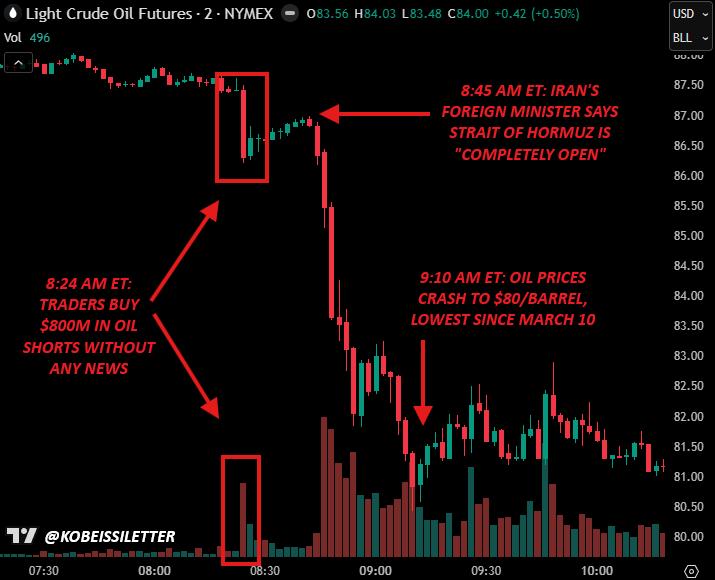
Is this the best timed trade of 2026? Yesterday, at 8:24 AM ET, oil traders bought nearly $800 MILLION worth of oil shorts. Just 21 minutes later, Iran's Foreign Minister Araghchi said the "Strait of Hormuz is declared completely open." By 9:10 AM ET, oil prices had collapsed to $80 per barrel and hit their lowest level since March 10th. These same oil shorts made nearly $70 million in profit in less than one hour, according to our analysis. Truly unusual.
The Kobeissi Letter tweet media
English
395
1K
4.9K
942.8K
TechTerra
TechTerra@TechTerraInvest·
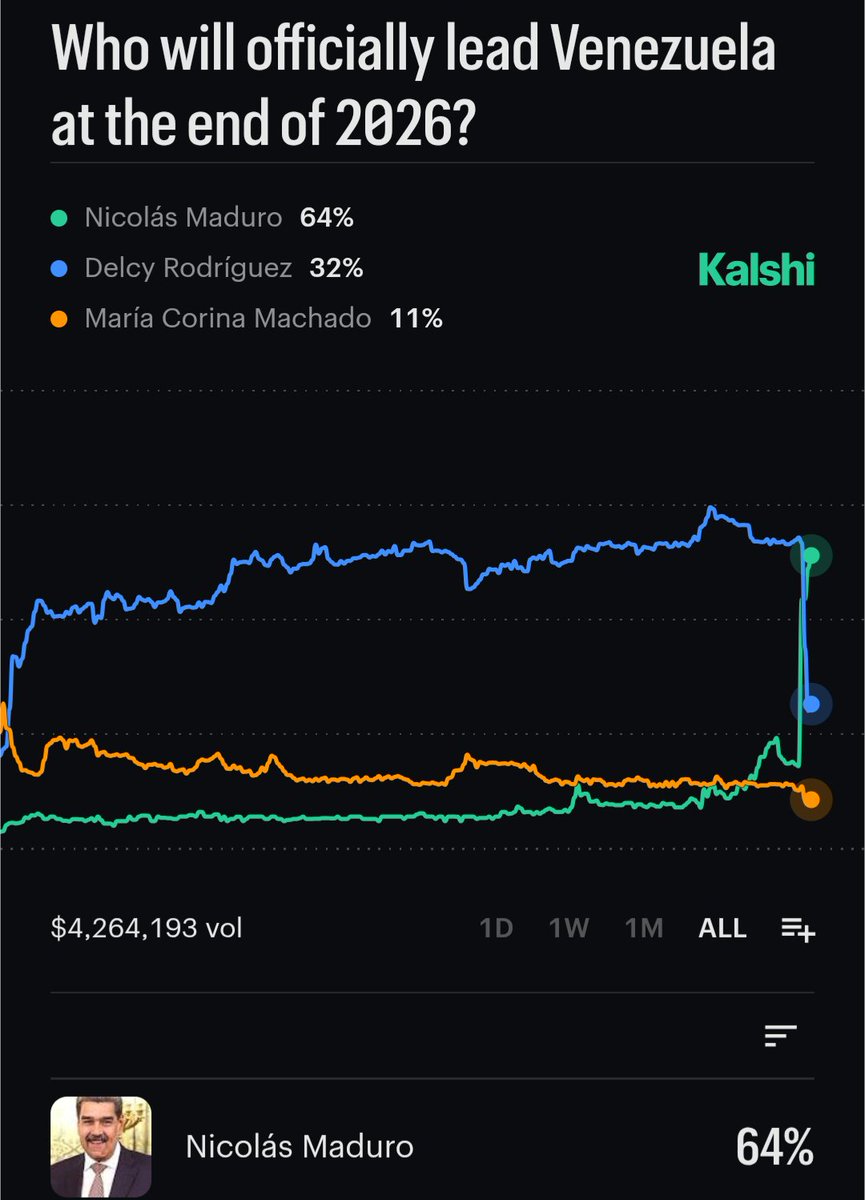
@bdquinn I believe it has something to do with the UN and how he is still considered president by them.
English
0
0
0
43K
TechTerra retweetledi
Polymarket
Polymarket@Polymarket·
JUST IN: Bluesky experiences major outage, dozens of users impacted.
English
2K
1.9K
33.9K
3.9M