

Aryan D
246 posts

Aryan D
@Th1Thinker
My diary | Learning from 5 senses | Buiding the 6th | Will be writing random ideas | Appreciative of critical ideas
Bengaluru Katılım Haziran 2022
166 Takip Edilen7 Takipçiler


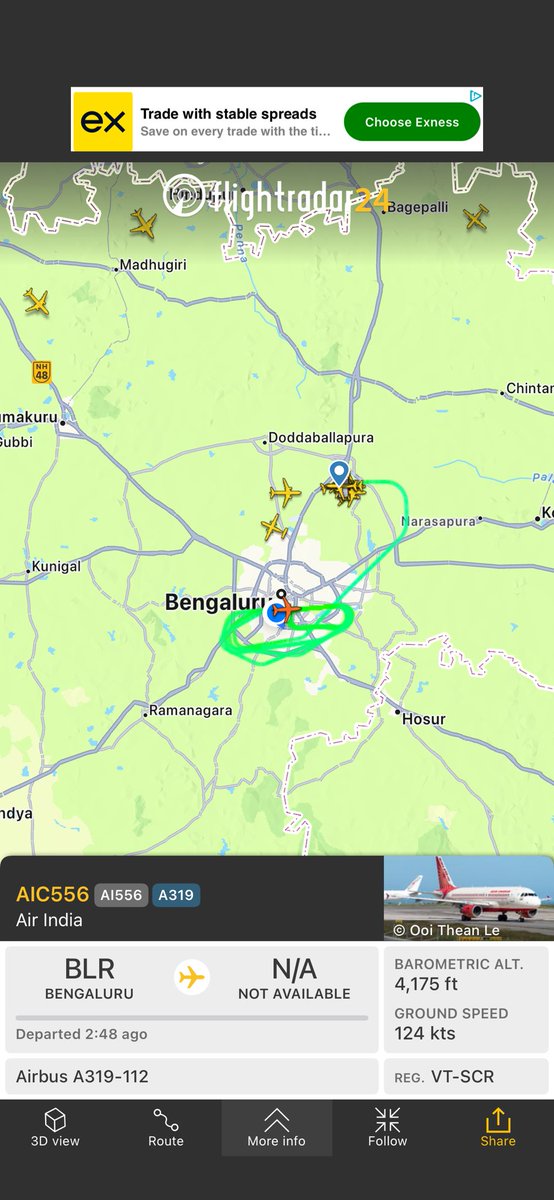
Flight AI556 from Bengaluru
fr24.com/AIC556/3864c665 @Vinamralongani weren’t AI 319’s supposed to be phased out?
English
@albinder @letsblinkit how about adding newspapers to the portfolio? I can place a recurring order of newspaper and milk in the morning to get started.
English
@letsblinkit @albinder thought of adding newspaper in the shopping list along with groceries in the morning?
English
English

@contrarianEPS The biggest challenge would be to generate income if index fund is the best strategy. Either pick a conservative BAF and go with SWP payout or any dividend yield fund
English

what if you quit ur job to become full time investor only to realise that sip in index fund is the best strategy.
English
@Iamsamirarora thoughts on N500, N500 M50 index funds? Are you planning one from Helios?
English
Aryan D retweetledi

Here are problems with these calculations.
It assumes
1. Perfect behavior by the investor.
2. Fixed inflation-adjusted withdrawal from the portfolio.
3. Linear rate of growth of portfolio and inflation.
In the real world -
1. Investors don’t stick to the plan - No investor runs the fixed assumed asset allocation throughout retirement. Many times, investors don’t even understand assumed portfolio management in the retirement corpus calculations.
2. Excess withdrawal risk - Retirees don’t withdraw a fixed inflation-adjusted amount from their corpus assumed in retirement corpus calculations. Retirees aren’t even aware of the withdrawal their portfolio can support. There is always the risk of excess withdrawal that the portfolio can not sustain.
3. Sequence of return risk - All such calculations assume linear growth of portfolio and inflation throughout retirement. Neither portfolio grows at an assumed average rate nor inflation grows at a linear rate. Negative portfolio returns at the early stages of retirement could cut down the life of the retirement portfolio. Withdrawals during bear markets can deplete the portfolio rapidly. Markets may recover subsequently, but there would be a smaller base to benefit from.
4. Investors underestimate their expenses - 30, 40 or 45 years is a long time. We don’t know what the world will look like 20-30 years hence, what all things would be part of our necessary expenses.
- You may upgrade the house during retirement or spend a significant amount on renovation of the existing house.
- Perhaps you would move to a richer neighborhood and that would increase your lifestyle expenses.
- Your friends getting richer also adds to your lifestyle expenditure.
- Expenses may reduce with age but there could be unexpected big expenses.
- You may have to support your kids or close relatives/friends during retirement.
- Your kids could be settled abroad and visiting them even once in a year could be a big drain on your portfolio.
- Geriatric care could be expensive.
- Investors who don't actively track their expenses underestimate their expenses.
5. Longevity Risk - Practically all retirement corpus calculations in India assume life expectancy of 85 or 90. Many of us could live till 95, some of us may even touch 100.
6. Cognitive decline - Many of us will face the cognitive decline in the later part of retirement, which severely affects portfolio management and financial decision making skills. The death of the spouse who manages money also exposes the surviving spouse to serious financial mistakes.
There are too many unknowns in retirement planning. If you want to make allowance for all these unknowns in FIRE or retirement corpus calculations, it is safer to
assume that the post-tax real return from retirement corpus in retirement would be closer to inflation you would face.
In which case the retirement or FIRE corpus would be annual expense in the first year of retirement*years in retirement.
30X is not a FIRE corpus at age 40 or 45. It is a good enough corpus to leave the highly stressful job that is crushing your soul and do something of your own or change your profession though.
- Quoted from my own article in freefincal.
Gurjot Ahluwalia@gurjota
Mr. Neil Borate, just because someone has a research paper on a subject it doesn't mean that person is correct. Till 1920s-1930s, doctors and physicians promoted cigarette smoking in the US saying it could cure irritated throats. Anyway, let's come to the maths on retirement planning. According to your published article in Mint, a person retiring at 40 years of age with a life expectancy of 90 years requires 50x annual expenses as the retirement corpus. Now, let me share my maths on how the same person can retire with just 60% of the corpus i.e. 30x of annual expenses and would still be left with a considerable corpus after their demise. The following approach has been used in the above calculations: 1. Person will utilize savings bank capital and interest for the first 6 years of retirement and gradually run it down to 0 and let the equity corpus compound 2. From year 7 onwards, the person will do a SWP from equity corpus to cover the annual expenses for entire lifetime Now the next question will be, why have I assumed Index ETF CAGR of 10% for 50 years? This can be argued in two ways, 1. I have also assumed inflation at 7% for the next 50 years which is higher than the inflation rate for the past 20 years 2. The alpha generated by equities over inflation in the past 20 years has been 9% (refer chart below), which is much higher than the 3% alpha assumed in my calculation above I hope this is conservative enough for you and Mr. @ravisaraogi In the past 20 years, Nifty50 has a 9% CAGR alpha over India's consumer price inflation Inflation data is taken from cpi.mospi.gov.in/Inflation_Curr… Taxation The interest will be around 7 lakhs in first couple of years so it's non-taxable. Plus investments can be divided amongst family members for tax efficiency, same rule applies for equity plus it has much lower rate of taxation Here's a month on month chart covering 50 years of retirement for the 40 year old having 20 lakhs annual expenses as per my example. Guess what? He still has 100 crores left to give back to family and society!
English
@flipkartsupport Please stop copy pasting of responses. Absolutely poor service.
English

@Th1Thinker We've just replied to your DM. Please do check. fkrt.it/c5ZBmZNN
English
@flipkartsupport @Flipkart Ordered a product on 27th, supposed to be delivered on 3rd. Getting out of delivery updates everyday but never the 'delivery'. Customer support has no clue. Giving responses like a bot - may not be aware about what escalation means. Trying my luck here.
English
@flipkartsupport No concrete solution over DM. I need a priority intervention by someone from you to track and ensure successful delivery of the package, not same old responses.
English
@Th1Thinker We have replied to you via DM about the concern raised. Please do check. fkrt.it/c5ZBmZNN
English
@Th1Thinker I'm really sorry for this experience. We acknowledge your concern about the order. We kindly ask you to provide the order ID via DM. We want to sort this out for you, please reach us via DM to keep your details safe. Awaiting your response. (1/2) fkrt.it/c5ZBmZNN
English
@Lingeshan @T_Investor_ @IndianTechGuide Gujarat is the second biggest customer base for BSNL after Kerala. :)
English

@T_Investor_ @IndianTechGuide Very much. Both the dual Sims and everyone in our area/company. Bsnl 3G itself has been very satisfying. 🙌 Its the BJP gujju mafia who wanted to support jio by ruining other networks. That's why bsnl was purposefully not given upgrades and support.
English

🚨 BSNL is set to launch 4G services across the country in October, 2024.

English
@Trendulkar We are looking quite disorganised after the second goal. Need to gather back for the last 5.
English

@India_AllSports @23_rahulr @SunielVShetty @bhogleharsha @anandmahindra @joybhattacharj When is the next scheduled today?
English

Just get a feel for what has happened:
Yui Susako of Japan is reigning Olympic Champion, 4-time Olympic Champion, has NEVER lost an international bout
Our Vinesh BEATS HER | What a win, what an athlete
#Wrestling #Paris2024 #Paris2024withIAS

English
