

The Don’t Pass Line
2.1K posts


Market sentiment: “I’m guessing he’s gonna swerve first.” $NVDA vs $TLT

English
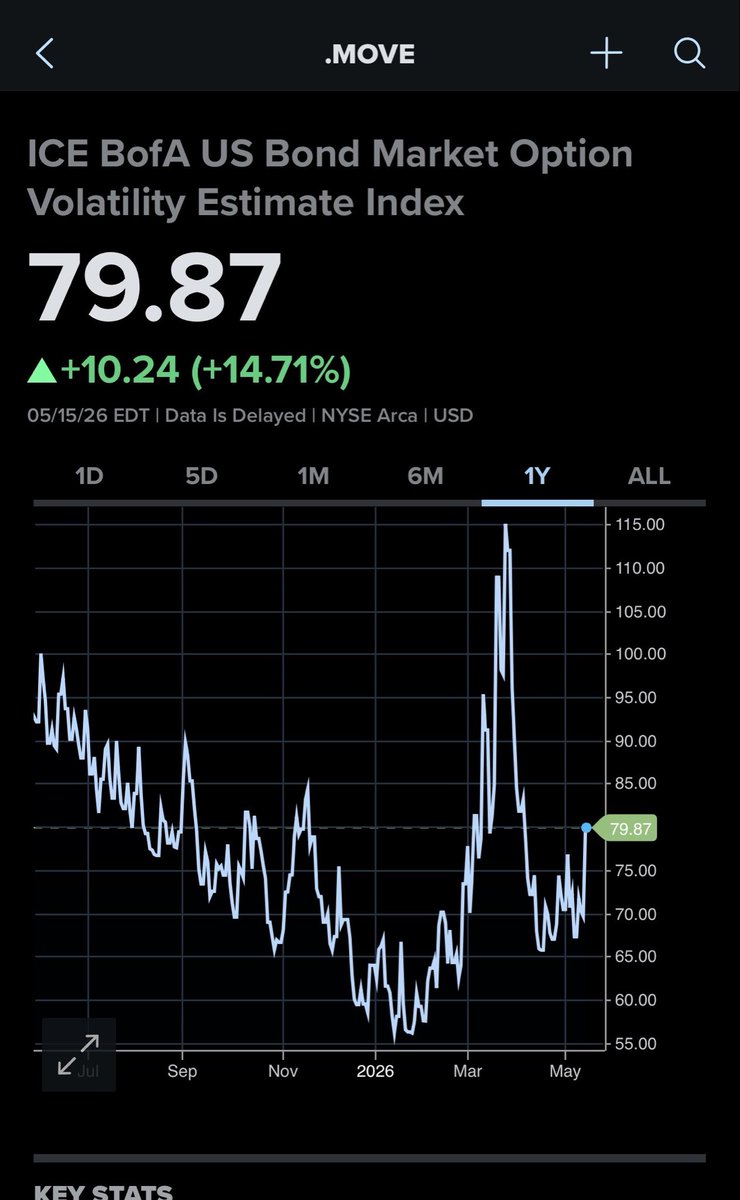
Food for thought if you don’t believe bond volatility matters for stocks. This chart shows what happens when the MOVE index breaks out by 50% or more in a 3 month period (last Friday jumped 14%). $TLT $SPY

English
@NoLimitGains This is a synthetic stock long with only a few mild non-earnings related catalysts in the next month. I’ll pass.
English

Someone just paid $112M for $SBUX calls.
This wasn't a series of small trades.
It was a single, MASSIVE options contract.
For the $75 calls that expire on June 18.
The stock is currently trading at $106.67.
They bought 35,341 contracts in one shot.
Open interest for that strike was only 69 contracts.
This is a brand new position, and it's gigantic.
The volume-to-open-interest ratio is over 512x.
A trader just made an enormous bet that SBUX is going to run much, MUCH higher in the next 32 days.

English
The Vix can (and has just recently) risen alongside the market. Agree it is useful for predicting short term moves in the market. Big moves in the MOVE index are referenced here for a reason, which is that it is a better predictor of macro regime change. The author is setting an explicit target for the S&P during a potential inflection point where value may start to matter again, prolonging that goalpost for a long time.
English

@TheDontPassLine @DrJStrategy People have been very wrong on the correlation between higher rates and the QQQ for several year now as the QQQ has had massive performance in the face of long rates staying stubbornly higher than the last decade.
English

Food for thought.
Ignore the Bear Porn
The S&P just tagged 7,500 with bottom‑up targets pointing toward 8,250, and the doomer industrial complex still insists we’re one headline away from financial extinction. They traded a modest 10% pullback like it was the dress rehearsal for 2008, then quietly disappeared when the market delivered one of the fastest V‑shaped recoveries in history and went on to make fresh highs.
The story never changes, only the excuse list does.
In a single quarter, they sold investors a “private credit crisis,” declared software structurally doomed by AI, and promoted a Middle East war narrative built around a catastrophically shut Strait of Hormuz. Reality? Credit bent but didn’t break, software is adapting instead of evaporating, the strait is open, and risk assets shook off the scare far faster than the pundit class could draft their next bearish thread.
The market processed the shock, repriced, and moved on; the doomers simply moved the goalposts.
Meanwhile, fundamentals have the audacity to keep improving. Earnings march higher, and bottom‑up targets now point to an equity market that is not priced for fantasy but for solid, compounding cash flows.
A long‑overdue digital‑asset clarity act is finally on the books, yet much of Wall Street still dismisses Bitcoin as a “scam,” recycling a decade‑old insult because they can’t be bothered to update their priors. It is less analysis than superstition, dressed up in finance jargon.
Layer on geopolitics, and the gap between narrative and reality widens. President Trump and his team gets no credit for brokering de‑escalation and energy‑security arrangements that help keep the global system functioning, even as another terrorist is being taken off the board in Africa in real time.
The same commentators who obsess over tail risks refuse to acknowledge when those tails are actively being managed, hedged, or neutralized. Stability is treated as an accident; instability is always assumed to be permanent.
This is the core tell of the modern doomer: they are never graded on outcomes, only on how scary they sounded at the time. They were wrong on the “collapse” of private credit, wrong on AI instantly vaporizing software economics, wrong on a sustained oil chokehold from Hormuz, and they will be just as wrong if their new fetish is a reflexive 20% crash because of a Warsh taking over the Fed. They do not rethink; they rebrand.
What passes for “prudence” in this crowd is really just performative pessimistic “bear porn” for an audience that confuses anxiety with insight. They sell dread, one crisis costume at a time, while price action and cash flows quietly keep contradicting the script.
The job of serious investors is not to react to the fear merchants; it is to notice that the world is messy, risks are real, and yet, somehow, 7,500 on the S&P is telling you the doom machine is not the one in charge.
S&P 500 Target for 2027 10,000. Ignore the Bear Porn.
Have a nice weekend.

English
The recent move toward China resuming and expanding purchases of U.S. oil adds a direct trade channel effect that supports both oil prices and the USD at the same time. Higher U.S. energy exports to China tighten global crude balances (supporting oil), while also increasing demand for dollars to settle trade and reinforcing the dollar’s role in energy transactions amid geopolitical fragmentation. This keeps oil elevated on supply–demand tightening and keeps the dollar strong on trade settlement flows and safe-haven reach.
English

@rickjeff78 Agree here. Retail wise, most “oil experts” are permabears just hoping something will work for them. You can spot them easy bec they are rooting for more escalation based on their positioning.
The cascade from USO/UCO will be 2020 esq
English


@biancoresearch With respect to Jevon, the worst unemployment of his lifetime was briefly 11%. This is what Claude estimates under peak AI adoption at a long term level. Hard to reconcile this with his original idea.

English

The fear over AI is palpable.
So, it's time for my optimistic take ....
Why the AI doom-and-gloom story is missing the bigger picture
A lot of people hear “AI” and immediately think one of two things: it’s just Google search on steroids, or it’s a magic machine coming for everyone’s job. Both miss the bigger picture.
A job is not one single task; it’s a bundle of tasks supported by a massive, fragmented software stack. Email, spreadsheets, presentations, Slack, CRM platforms, and, in finance, a Bloomberg Terminal, FactSet, and market data feeds. For millions of jobs, the cost of software to provide basic tools for these tasks can run to $1,000 a month, and more for complicated roles.
Much of the modern workday is consumed by the friction of this stack: moving data between systems, cleaning spreadsheets, searching for files, and summarizing meetings.
AI is emerging as the new interface for enterprise software. Think about the iPhone. It collapsed cameras, GPS devices, and music players into one simple, powerful device. AI is doing something similar for workplace software, turning 10 clunky programs that don't talk to each other into a single conversational prompt.
Just as we stopped buying standalone cameras and tape recorders once the smartphone came around, companies will happily pay for an AI layer. It will be far cheaper and eliminate the bloated costs of that fragmented software stack that requires you to perform endless, mundane tasks because these programs do not talk to each other.
The immediate fear is that if AI lets three people do the work of five, companies will fire two people. But that ignores economic history.
When the electronic spreadsheet was invented, the cost of calculations plummeted. But accounting jobs didn't vanish; demand for complex financial modeling exploded. Accounting clerks became financial analysts, a more in-demand role.
Jevons Paradox suggests that making a resource more efficient actually increases total demand for it. By absorbing the drudgery, AI allows the employee to focus on judgment and strategy—making the human element more valuable, not less. In this framework, demand for high-output workers doesn't shrink; it explodes.
Does this justify the mind-numbing capital expenditure currently pouring into AI infrastructure? If AI fulfills this promise of enterprise-wide productivity, the investment isn't just justified—it’s a bargain. That said, we are clearly near the peak of a hype cycle, just like the internet was in 1999.
But remember: the dot-com crash did not mean the internet was a bust. It simply meant the hype outpaced the infrastructure. After the wreckage cleared, the optimistic predictions about connectivity and productivity were not only fulfilled—they were exceeded.
The same path can lie ahead for AI. And instead of the fear that AI will replace workers, it's the joy of replacing soulless busywork, making jobs more fulfilling... and more profitable for employers.
The Economist@TheEconomist
The jobs apocalypse is not yet here. But if governments wait for conclusive evidence before creating a safety-net, it will be too late. Register for free to understand why econ.st/3PHF3N8
English

POV: Looking at our portfolios on Monday!
Bookmark this.

The Kobeissi Letter@KobeissiLetter
BREAKING: The US and China have agreed to lower tariffs on some unspecified products to promote bilateral trade, per China’s Commerce Ministry. The statement confirmed China’s plan to purchase US planes and it said China would address US concerns on agricultural imports.
English
@Tony_Schultz_ @DrJStrategy Should also note the effect is more pronounced on long duration assets like tech / $QQQ but this is anecdotal.
English
@TheDontPassLine @DrJStrategy Up 18% this week yet S&P didnt react at all. It remains 50% higher than February yet the index is considerably higher. Just not sure bond volatility alone has great predictive power. Do you have some backtested data verifying the effectiveness of the correlation?
English
@Tony_Schultz_ @DrJStrategy Almost entirely on Fridays when the market dropped. It accelerates as the MOVE does. Here you go!

English
@ColesTrades This is oil bullish, bond bearish. Bonds broke support already, so unless we decide not to sell oil to China, not likely.
English

THE S&P 500 WILL SET RECORD HIGHS ON MONDAY
The Kobeissi Letter@KobeissiLetter
BREAKING: The US and China have agreed to lower tariffs on some unspecified products to promote bilateral trade, per China’s Commerce Ministry. The statement confirmed China’s plan to purchase US planes and it said China would address US concerns on agricultural imports.
English

@Tony_Schultz_ @DrJStrategy Yes, 50% on the move is roughly equal to a 10% drawdown in the S&P (also the intraday total drawdown) so one could argue it affects markets on a 5:1 basis. Also where it starts from matters. A 50% jump in the MOVE when interest rates are near zero matters less than now.
English
@TheDontPassLine @DrJStrategy It looks like it went parabolic in April yet not much really happened
English
@DrJStrategy Yes, but it can be evaluated on a technical basis like anything else and just broke out on a technical basis (daily chart).
English

@NickSchmidt Absolutely, but context is also important. This is the only chart I care about now. Very, very high predictive value.
English

75% of stocks follow the trend of the general market so in an uptrend if you're treating every pullback like the top you're statistically working against yourself every day
English
@NotA_Bull Wait for a diamond breakout (up or down) for oil next week before deciding. Up: $USO Down: $TLT . Normal stocks I’d sit out for awhile.
English
I have $4,500 to buy the dip.
Which stocks should I buy?
English
@401ktrade @WealthMechanic1 @Jake__Wujastyk $SNOW is one-sided, reflexive, crowded, and convex. Earnings and ROE matter when interest rates pick up. A few stocks bounce on down days (based on technicals) but that’s quite different from persistent relative strength when the stock is already too crowded. Long term it’s fine.
English

@WealthMechanic1 @Jake__Wujastyk $ADBE $PATH $SNOW
QME

Look at what is green this morning when the market is finally down big.
Those are your next leaders.
English
@JollyTime1991 @RevShark A lot of patience after breaking long term support.
English

@RevShark The only thing that is "no question" is that with a little more patience, $TLT long-dated calls will be the most profitable trade in the entire market.
You're welcome.
x.com/JollyTime1991/…
JollyTimeRecords@JollyTime1991
#SPX $SPY $QQQ $IWM #RTY #NQ #Nasdaq $ES #S&P #dow ATTN $TLT fans: $TLT & #US10yr bonds move inversely- and they both LOVE to fill gaps. Their final gaps are ~equidistant from here. If/when they BOTH fill, I'm backin up the truck for long-dated calls, adding at each target.
English

That $TLT chart is horrendous. There is no question that it is a major problem.
English
@DrJStrategy The market has been pricing in this eventually happening since the Iran war started. Peace is a sell the news event because the instrument of that peace is selling oil to china, a bond selloff trigger.
English
Food for thought.
A New Peace Dividend and the Case for Higher Multiples
A new, if fragile, global peace dividend is starting to emerge. With Xi and Trump endorsing a three‑year framework of “constructive strategic stability,” the world’s two largest powers are explicitly trying to shift from open‑ended brinkmanship to managed rivalry, lowering the risk of sudden shocks across trade, technology and security flashpoints. That doesn’t resolve structural tensions over Taiwan or advanced chips, but it does aim to keep competition bounded and differences “manageable,” which is exactly how you engineer a gentler geopolitical backdrop for the real economy.
For markets, that shift matters because it begins to normalize the geopolitical environment that has been distorting risk premia since the trade war and pandemic era. A clearer three‑year horizon with fewer tariff salvos, sanctions surprises, or confrontation scares supports more confident capex, smoother supply‑chain planning, and better earnings visibility for globally exposed firms. In that sense, a peace dividend of sorts is on the way: as perceived geopolitical risk recedes, equity risk premia can compress and valuations can drift higher, echoing, albeit on a smaller scale, the multiple expansion that followed the end of the Cold War in the 1990s. No bubble a global re- rating. Ignore the Doomers.
Rapid Response 47@RapidResponse47
.@POTUS tours the gardens with President Xi at Zhongnanhai
English