
@fuckyouiquit Well, one thing I learned from watching Monkey World is that chimps don't share, so there's that. And alphas feel free to take food from other chimps, who tend to wait their turn. Maybe not the best analogy.
English
Blush Unseen
51.5K posts
@TheMopingOwl
Wasting my tweetness on the desert air.

It’s just a weird sickness at some point, this level of greed. You have $200 billion dollars. You could wipe your ass with $100 bills and keep getting richer every day. Why kill thousands and thousands of jobs at this point?





This is the Heritage Foundation who authored Trump’s Project 2025 No women in sport or academia No votes for American women No voice in politics or societal issues Do them dishes and desist basically 153 million women to be disenfranchised by morons

Ali Larijani’s successor, Hossein Dehghan, holds a PhD in Management. He was one of the students who occupied the US embassy in Tehran. He also commanded the IRGC forces in Lebanon and was among the orchestrators of the 1983 bombing of the US Marine barracks in Beirut. The look on his face says it all.





Asked why he didn't coordinate with allies before going to war with Iran, Trump says, "We didn't tell anyone about it. Who knows better about surprise than Japan? Why didn't you tell me about Pearl Harbor, OK?"


JUST IN: The most irreversible consequence of this war is not happening in Tehran. It is happening in a barn in Iowa. A farmer is standing over a kitchen table looking at two seed catalogues. One is corn. One is soybeans. Corn needs 180 pounds of nitrogen per acre. Nitrogen costs $610 per ton on the CBOT March futures settlement as of yesterday, up 35 percent in a month. Soybeans fix their own nitrogen from the atmosphere through root bacteria called rhizobia. They need nothing from the Strait of Hormuz. The farmer is choosing soybeans. Millions of acres are choosing soybeans. And once the planter rolls into the field, the choice cannot be reversed until next year. USDA projected corn at roughly 94 million acres for 2026, down from 98.8 million. Soybeans at 85 million, up from 81.2 million. Those projections were published February 19, before urea surged past $683 at New Orleans. The actual shift will be larger. USDA Prospective Plantings reports March 31. By then the seeds will be in the ground. This is the transmission channel the world is not watching. A 21-mile strait enforced by provincial commanders with sealed radio orders just rewrote the planting economics of 90 million acres of the most productive farmland on Earth. Not through sanctions. Not through diplomacy. Through the price of a single molecule that corn cannot grow without and soybeans do not need. Now follow the cascade. The Renewable Fuel Standard mandates 15 billion gallons of corn ethanol annually. That consumes roughly 43 percent of the entire US corn crop. The mandate is set by the EPA. It does not flex when corn acres shrink. It is inelastic demand consuming a fixed share of a declining supply. When supply tightens against a fixed mandate, the remaining corn reprices upward. Corn above $5 per bushel compresses every margin downstream. The US cattle herd stands at 86.2 million head, a 75-year low per USDA NASS. Poultry and pork operations face compression from higher corn prices. Feed is the single largest cost in livestock production. When feed reprices, protein reprices. When protein reprices, every grocery shelf in America absorbs the increase. This is the protein cascade. Corn to feed to meat to eggs to dairy to the checkout counter. Each link tightens because the link before it tightened. The originating cause is a urea molecule that cannot transit a strait because a provincial commander’s sealed orders say it cannot. The farmer did not start this war. The farmer cannot end it. The farmer responds to the price on the screen and the biology of the two crops in front of him. Corn needs the molecule. Soybeans do not. At $610 the arithmetic is settled. The planter rolls. The season is locked. Israel just authorised the assassination of every Iranian official on sight. The US has spent $16.5 billion. South Pars is burning. The Fed is holding rates because oil inflation will not break. Gold touched $5,000. Bitcoin is bleeding. China is running exercises near Taiwan. Sri Lanka shut down on Wednesdays. And underneath all of it, a man in a barn is making the decision that determines whether four billion people pay more for food this year. He has never heard of the Mosaic Doctrine. He does not know what a sealed contingency packet is. He knows what nitrogen costs. And he is planting soybeans. Full analysis - open.substack.com/pub/shanakaans…





“A 6'1" man, dressed in a pink nightgown with a pink suitcase, was standing at the door.” At today’s Religious Liberty Commission hearing, @ADFLegal client Sherrie Laurie recalled her long legal battle to keep men out of an overnight women’s shelter.
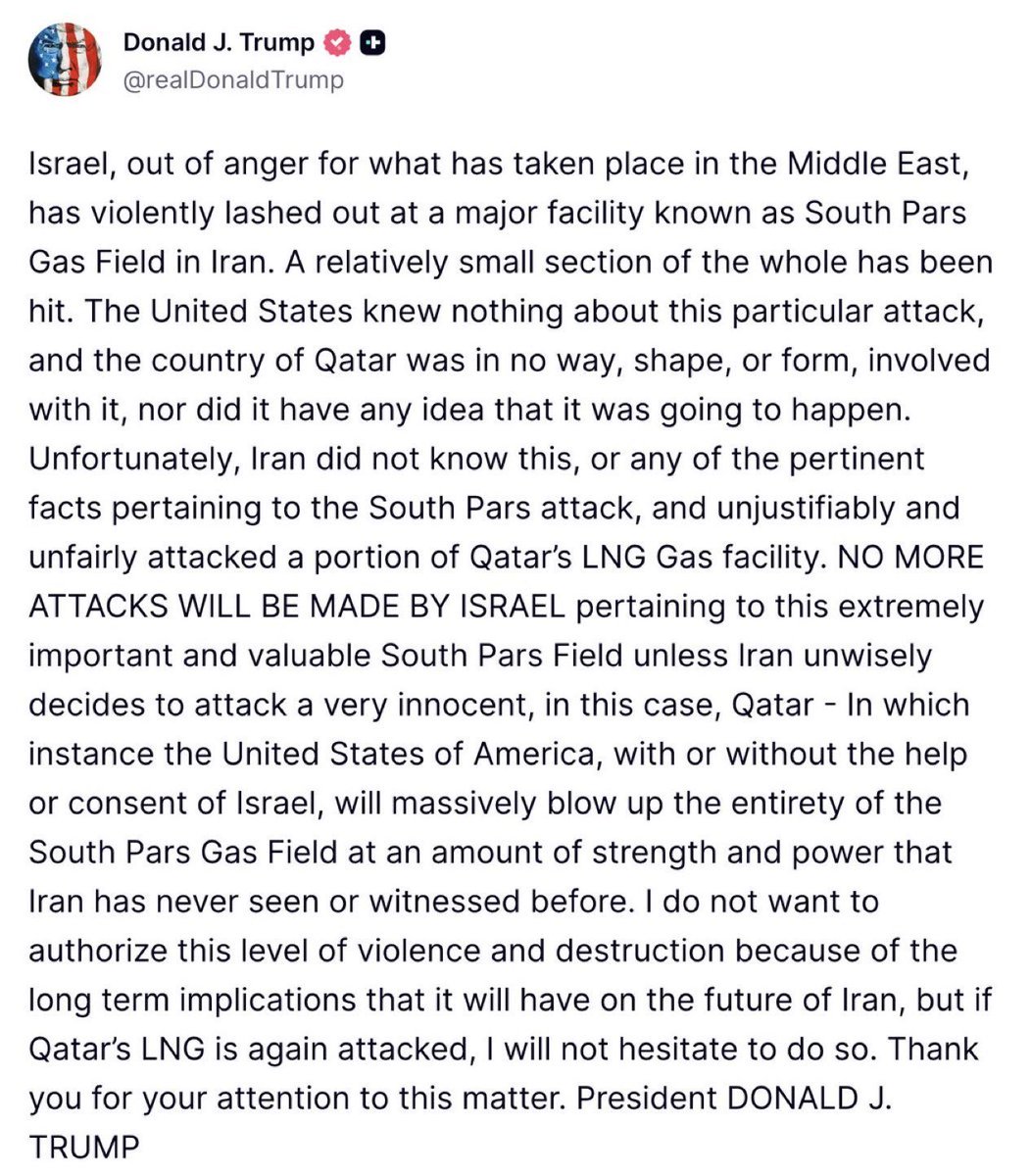
Abu Dhabi intercepted the missiles. The debris shut down the gas fields anyway. Habshan gas processing facilities and the Bab field were both taken offline today as a precautionary measure after falling debris from successful missile interceptions struck the sites. Abu Dhabi authorities confirmed it. No injuries. Both facilities shut down. The public was told to rely only on official sources. The air defense system worked exactly as designed. The warheads were destroyed before impact. And two of the UAE’s most important gas production facilities went dark because the wreckage from a successful interception is still wreckage. This is the paradox that no interception rate can solve. Gulf air defenses intercept 90 to 96 percent of incoming projectiles. Those rates are extraordinary. They save lives. They prevent direct detonation on target. What they do not prevent is debris. A missile destroyed at altitude does not vanish. It fragments. The fragments fall. They fall on the same geography the missile was aimed at. And when that geography contains gas processing infrastructure with pressurised systems, heat exchangers, and pipeline junctions, falling metal at terminal velocity is sufficient to trigger a precautionary shutdown regardless of whether the warhead detonated. Ras Laffan was hit directly today. Riyadh was hit directly today. Habshan and Bab were hit by the defence that worked. Three countries. Four facilities. Two by Iranian missiles. Two by the wreckage of intercepted Iranian missiles. The result is the same: offline. Iran does not need to penetrate the air defense shield. It needs to overwhelm the geography underneath it. Every missile that is intercepted over an energy facility still deposits debris on that facility. The interception prevents the warhead from functioning. It does not prevent the airframe, the motor casing, the guidance section, and the fuel residue from falling on infrastructure that was designed to process gas, not absorb ballistic fragments. The mathematics of this are devastating for the Gulf’s energy posture. Three hundred fourteen ballistic missiles and 1,672 drones launched at the UAE since February 28. At 90 to 96 percent interception, roughly 280 to 300 of those missiles were destroyed over UAE territory. Each one produced debris. Each debris field covered a footprint measured in hundreds of metres. Across nineteen days, the cumulative debris footprint covers a significant fraction of the UAE’s coastal energy infrastructure corridor. Even perfect interception rates produce imperfect debris patterns over the geography they are defending. Shekarchi threatened to burn Gulf energy facilities to ashes. He may not need to. The interception debris is doing it for him. Not through fire. Through precautionary shutdowns triggered by falling metal from the missiles his forces launched and the defenses that successfully destroyed them. The Fed just raised PCE to 2.7 percent and flagged Middle East developments as uncertain. Trump just directed no more strikes on Iranian energy. The IRGC just published satellite targeting images of five Gulf facilities. And Abu Dhabi just shut down two gas fields because the defense that saved lives could not save production. The interception rate is 96 percent. The shutdown rate from debris is 100 percent when the debris lands on a gas plant. And the urea at $610 does not distinguish between a warhead that detonates and one that falls in pieces. open.substack.com/pub/shanakaans…