@AphrahAshe Honestly, I couldn't care less if a game uses AI art, depending on whether the gameplay is actually good. An example is Neverness to Everness. The game is fun, so I don't care, but compared to Call of Duty, which is not fun, I care more.
@AphrahAshe I think it completely depends on what you're using the AI art on, for example, a video game, AI art makes it look cheap and poorly made, but if sombody uses it for personal reasons, and isn't being sold, then who cares
Also if I remember correct AI art is no longer copyrightable
@TheNumber1Ace Because the people who made the AI stole a ton of content (posts on social media, books, art, etc.) to train the AI, and then everything the AI makes is plagiarism from everything it was trained on.
@KissingGooses I've heard that at least twice now, but I personally never saw that. Also, reporting this stuff to the FBI about it is kind of dumb. Like they probably know, but there is no law they can use to make a thing stick, so everybody is wasting time better used elsewhere.
@TheNumber1Ace@AI_EmeraldApple That’s not true that’s why such things were scraped off other laws and discarded. It’s why the fbi gets annoyed if you bug them about artwork and not actual csem
Mimi Yanagi update... and an unpopular take.
Various people have been dropping evidence on Kiwifarms, Reddit, The Virtual Asylum, and here on X of disturbing new information.
The person was not an artist or a VTuber in the normal sense, but was a transgender communist by the name of Jordan Williams. The person commissioned art from various artists on FurAffinity, Pixiv, Baraag, Deviant Art, and VGen. Specifically, Jordan paid Imeoowto about $200 to make the rigged Vtuber model. Jordan was the client and not the creator of these artworks and drawings.
Most of the artists he commissioned from are unnamed or anonymous... not tied to any known artist.
The drawings contained extreme fe****es, and themes... like b******ity, multi p********tion, ga******gs, depicting this character and others in every combination of these disgusting scenarios possible.
Is it gross? Yes.
Is it offensive? Yes.
Is it obscene? Yes.
Is it evil? Yes.
It's something I'd rather not see or be exposed to.
Based on what is uncovered so far, no real children, no photos, no actual victims, no real animals, just illustrations. The worst one is the LazyTown Stephanie art, which is based on an animated character design and not from the actual child actress.
Any association with real children appears to be a misattribution to artists who did "shadman" style art, and no actual real children were involved in the production of the materials. If that changes ill update it, but so far I don't see anything connected to real victims.
That said, the person is likely to be a real pedophile, someone who is attracted to real children, by his saying it's a sub for CSAM and by the evidence uncovered. But "likely" is not a criminally prosecutable bar that holds up in court unless you are in the UK.
This kind of "art" is perfectly legal in Japan, and one would assume, because of that, child SA must be rampant. The UK claims that these kinds of materials can normalize pedophilic ideation and be used in grooming, but without any backing based on real data.
Instead, Japan is one of the safest countries in the world, while the UK is one of the least safe, where sex crimes are anywhere from 10x to over 50x Japan's rate.
Here is the unpopular take...
Based on the UK's law, I knew to some extent that this was likely the nature of the artwork in question. They don't arrest you for just the run-of-the-mill lolicon illustration.
Despite all that, it is still a waste of money, time, and effort... all a symbolic effort to protect the kids, while the actual victims in the UK, being r***ed, get ignored.
Even if it's absolutely disgusting, it is still in the 'thought crime' category, and it's a slippery slope. It's this kind of issue that is why the UK is in the quandary it is right now with hate speech laws, online monitoring of speech, and the Online Safety Act. Places like the US are more resilient when it comes to offensive political speech because the law in the states clearly distinguishes between fiction and reality.
The US's First Amendment was crafted precisely because of the UK's tendency towards tyrannical framing of opinions and political speech. We shouldn't decide what is allowed and not allowed based on disgust, because if that becomes normalized, the First Amendment is no more.
@TheNumber1Ace@QianNi05566757@____Sh4d0w_____ See but no one has never been arrested for it thats how i know that the Law is very specific or you see everyone being arrested left and right especially with this much evidence online
@argenteye123 Yeah, and that's kind of the problem. At least in my opinion. You can meet 2 of the 3, and it still fails. Which is why I think it needs more of a set thing, but I'm no politician, nor Lawyer.
Just sombody who is tired of seeing naked lolis
@TheNumber1Ace@QianNi05566757@____Sh4d0w_____ If the Miller Test is required to prove it is obscene then
1. It's on a case by case basis, as in, per individual art work.
2. You can only definitively call it illegal if it has already failed the Miller test in the court of law.
@arawen_flowen Look, I'm getting tired of this, so this is my final message. §1466A exists to ban fictional child porn, only if the Miller test lets it, which is hardly used because the requirements are complicated. So hardly anybody gets in trouble for it.
@QianNi05566757@____Sh4d0w_____ Which is why in 2003, due to the CPPA being too broad and declared unconstitutional, they made the 18 U.S.C. §1466A to work around the unconstitutional part, requiring the Miller test to prove it is obscene, also making it so it doesn't require a real minor.
@arawen_flowen So to make sure I'm understanding everything to this point, we're using the Stanley v. Georgia case from 1969 in a Grecco (2024) case, to prove drawings of child pornography do not go against §1466A made in 2003-2004. Keep in mind, the Miller rule wasn't until 1973
@TheNumber1Ace The State concedes that “established federal precedent precludes his prosecution for accessing or possessing obscene virtual child pornography within his own home.”
it's written right there
But again, it has to be seen as obscene, and the Miller test is kind of weak, honestly; if it fails one of the three, the whole thing fails, and §1466A cannot be applied. Which is why Loli stuff might seem protected.
@arawen_flowen Stanley v. Georgia protects private possession of adult obscenity, but it does not protect obscene material involving minors (real or fictional).
@arawen_flowen The court found it could not be prosecuted under child porn statute laws, as it only applies to real children. And since it was fictional, it was able to be dismissed. But if the state used §1466A. It would have to go through the Miller test.
@TheNumber1Acecaselaw.findlaw.com/court/in-court…
and here is a fairly recent case involving lolicon in the united states that was dismissed because of the us supreme court precident that fictional lolicon porn is protected by the first amendment.
@____Sh4d0w_____ 18 U.S.C. § 1466A under Cornell Law School states it "any kind, including a drawing, cartoon, sculpture, or painting, that" under 1 a says "depicts a minor engaging in sexually explicit conduct"
Look, I'm not against lolis in general, but loli porn is most likely illegal
@TheNumber1Ace Again, Which law. If its csam it's completely different 18 U.S. Code § 2256
Then under CP definition it explicitly states "use of a minor engaging in sexually explicit conduct [...] indistinguishable from, that of a minor"
Define indistinguishable. Where did you get your source
@TheNumber1Ace I don't think the Miller test is part of the law especially from both the UK and Canada
I took a look at the law for Canada a while back and the phrasing infers it's about actual people and not characters. Even for the UK they often refer to "persons"
@arawen_flowen So, from what I understand, Williams was arguing against 18 U.S.C. §2252A, which makes it a crime to ask, offer, advertise, or convince you have it or sombody to send it to you.
And this law only applies to real minors
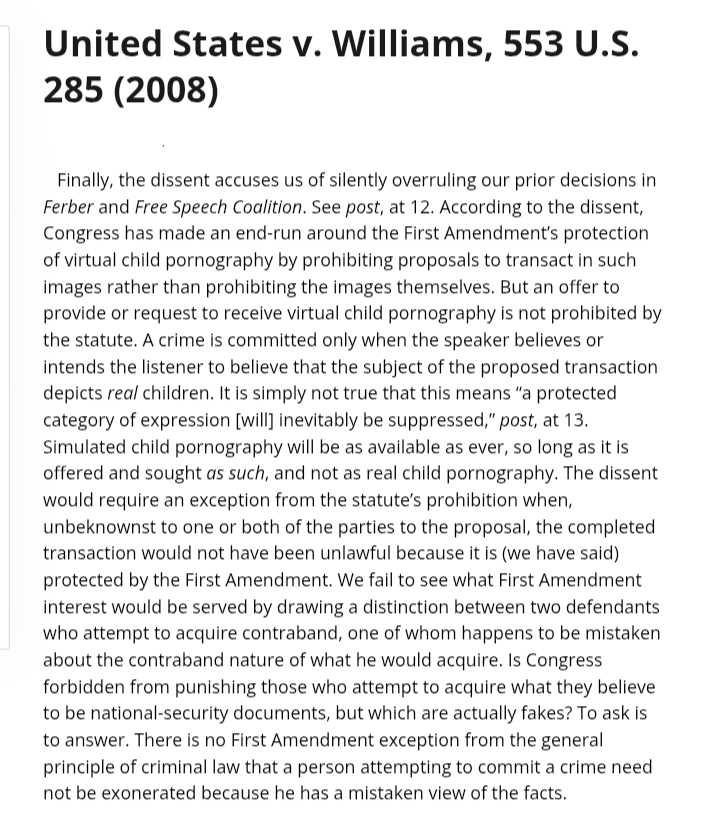
@TheNumber1Ace@AI_EmeraldApple The later Supreme Court case United States v. Williams 2008 solidified that lolicon pornography is considered legal and protected by the first amendment.
@Neitsuke I have no idea what Ranma 1/2 is, but from what I could find, it passed the Miller test, which follows. Is the main purpose sexual? Does it depict sexual conduct? And does it lack serious value? Ranma 1/2 is a comedy, so it fails part 1. It's not explicit, fails part 2, fail 3
@AI_EmeraldApple But that's because he took a plea deal. I missed that and cases under violation of 18 U.S.C. § 1466A don't really get punished that hard
@AI_EmeraldApple United States v. Handley (S.D. Iowa 2008) was charged with possession of an obscene visual representation of sexual abuse of children in violation of 18 U.S.C. § 1466A(a)