The Signal Process

22 posts

The Signal Process banner
The Signal Process

The Signal Process

@TheSignlProcess

MPhys Physics. Diagnostic quant instruments. No predictions. No hype. Just measurement.

Katılım Mart 2026
74 Takip Edilen4 Takipçiler
The Signal Process
The Signal Process@TheSignlProcess·
The Albuquerque paper you linked is the right starting point. Beyond that, Harvey and Siddique (2000) on conditional skewness is worth reading and they show skewness is priced in the cross-section. And if you want the portfolio construction angle, Boudt, Cornilly and Verdonck have work on skewness-adjusted portfolio optimisation. All worth having a look.
English
0
0
1
4
Darren 🥚
Darren 🥚@ReformedTrader·
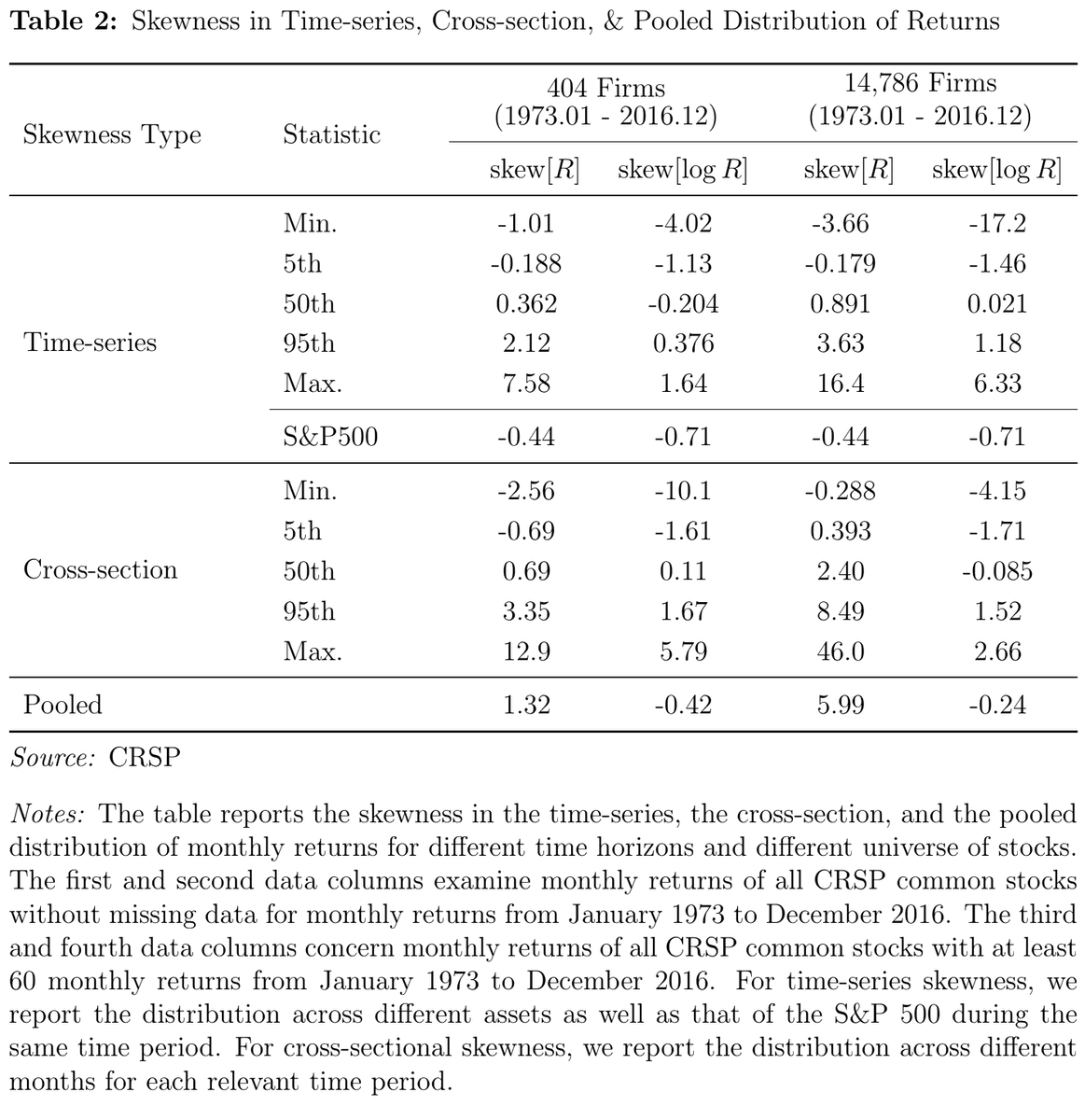
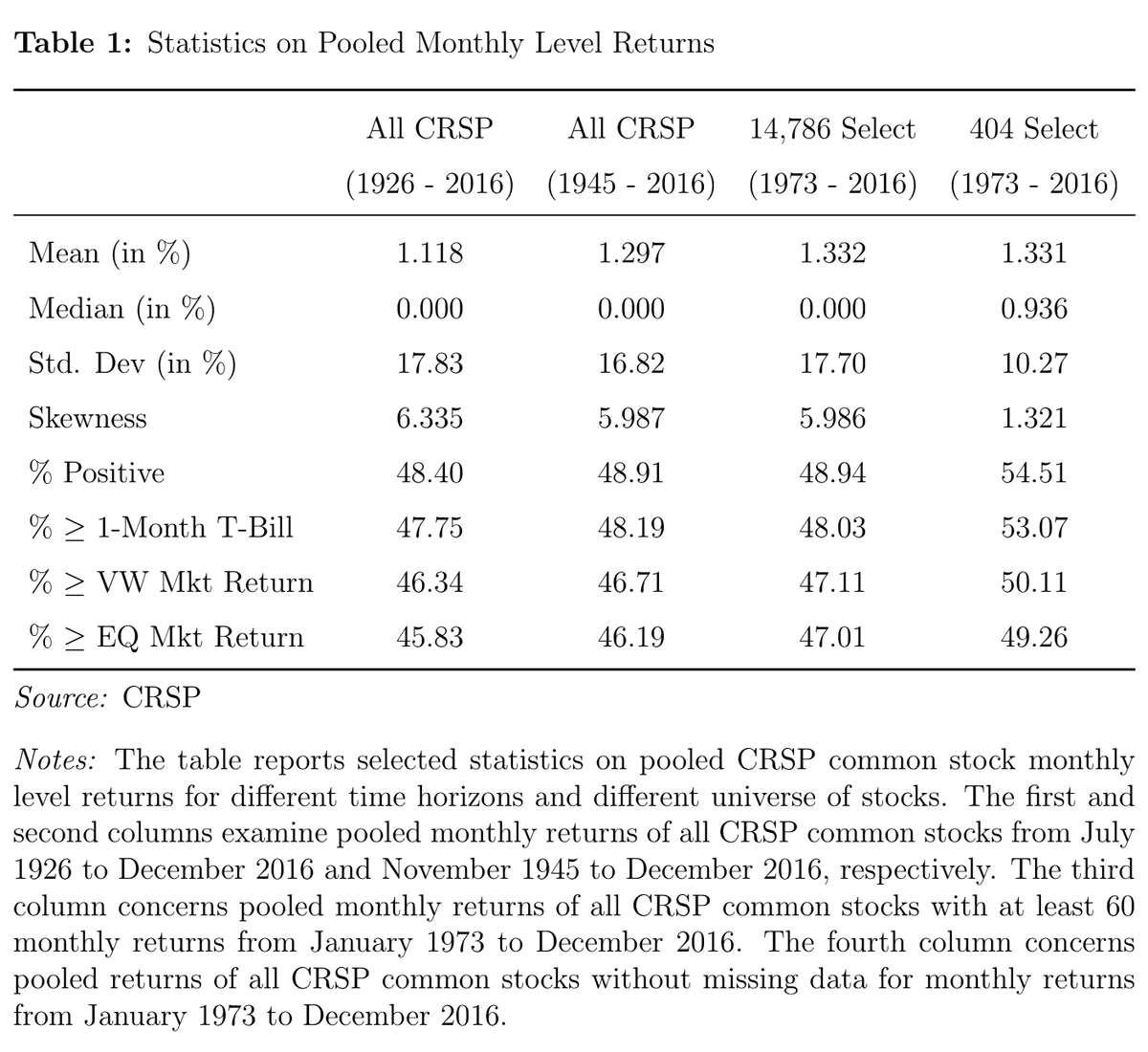
@TheSignlProcess It's super interesting! Here are a couple of papers I found on the subject. Please let me know if there is anything in addition to this that you think is worth reading. Skewness in Stock Returns: Reconciling the Evidence on Firm Versus Aggregate Returns x.com/ReformedTrader…
Darren 🥚@ReformedTrader

1/ Skewness in Stock Returns: Reconciling the Evidence on Firm Versus Aggregate Returns (Albuquerque) "Cross-sectional heterogeneity in announcement events can lead to conditional asymmetric stock correlations and negative skewness in aggregate returns." papers.ssrn.com/sol3/papers.cf…

English
2
0
0
7
Darren 🥚
Darren 🥚@ReformedTrader·
Cross-Sectional Skewness (Oh, Wachter, Wachter) "Cross-sectional skewness in monthly returns far exceeds what the standard lognormal model would predict, but aggregate market skewness is negative. We present a model that accounts for these facts." semanticscholar.org/paper/Cross-Se…
Darren 🥚 tweet mediaDarren 🥚 tweet media
English
1
3
15
1.7K
The Signal Process
The Signal Process@TheSignlProcess·
This is the part most strategy discussions skip entirely. A strategy isn’t good or bad in isolation. It’s good or bad relative to the current climate. The same system that printed last year can destroy an account this year if the underlying conditions have shifted and you haven’t noticed.
English
0
0
0
0
Nick Schmidt
Nick Schmidt@NickSchmidt·
Most people are so zoomed into strategy and setups that they don’t even think about the environment they’re trading in. When the market is good you don’t notice because everything just works. You’re making money and you feel you’ve got it figured out without really understanding that the market is doing all the heavy lifting and you just happen to be in the right environment. Right now if you’re trying to trade through this like you were trading last years market then you feel like you can’t do anything right. You feel like something’s wrong with you and it’s easy to spiral on that but it’s not you. It’s the environment. The direction of the general market does 90% of the heavy lifting. It always has. Just knowing that and being aware of when the environment is working for you and when it’s not is most of what separates the traders that make money and the ones that don’t.
English
36
31
355
19.6K
The Signal Process
The Signal Process@TheSignlProcess·
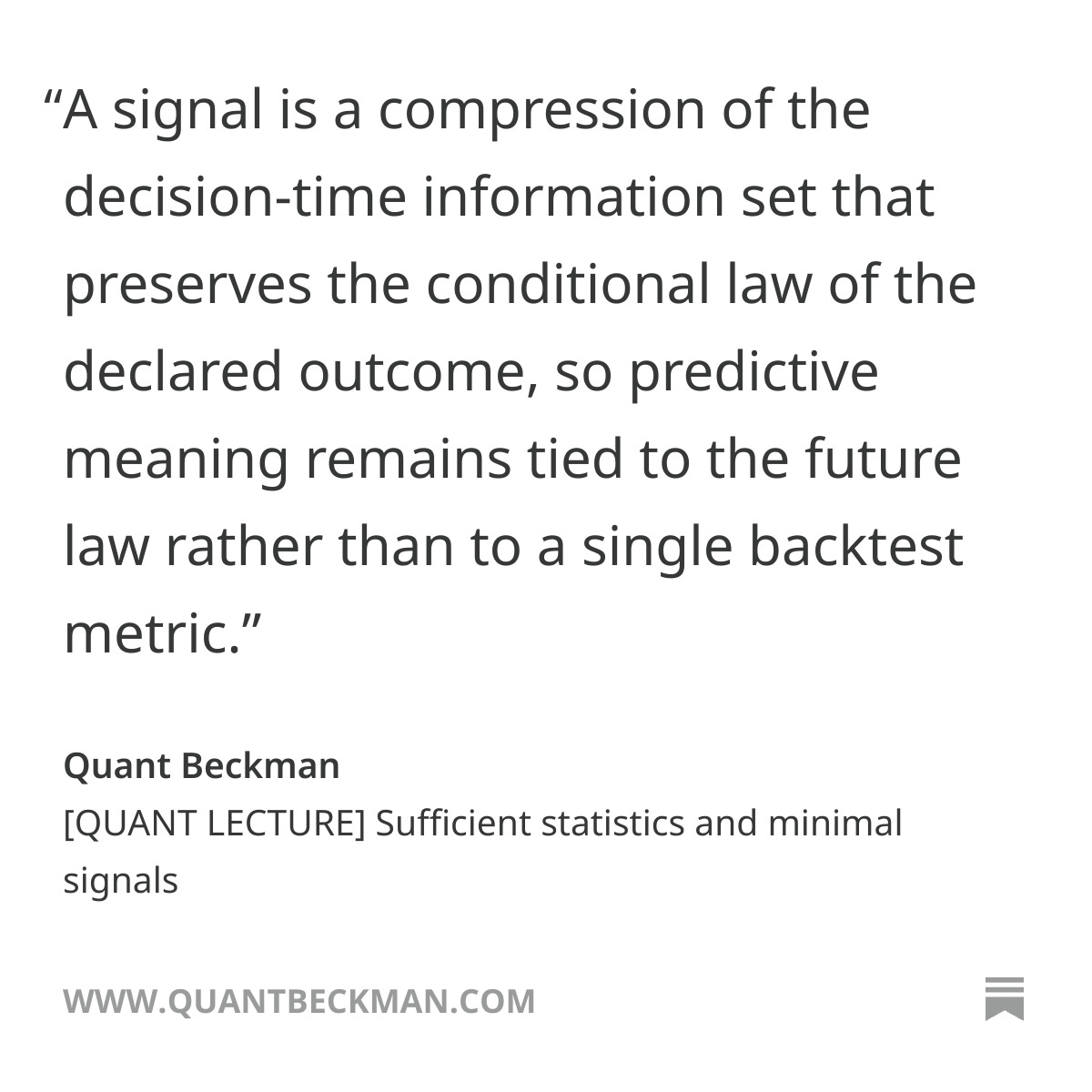
The compression framing is the useful part. I think most signals fail not because they lack predictive power in isolation but because they discard information that only becomes relevant when the market structure shifts. A sufficient statistic for a stationary market isn’t sufficient anymore when the regime changes.
English
1
0
0
14
Quant Beckman
Quant Beckman@quantbeckman·
📘[QUANT LECTURE] Sufficient statistics and minimal signals📘
Quant Beckman tweet mediaQuant Beckman tweet media
English
7
5
16
1K
The Signal Process
The Signal Process@TheSignlProcess·
The transition period is the interesting part. When a regime breaks down the statistical properties of the market become unstable, volatility clusters differently, correlations shift and mean reversion assumptions stop holding. That instability is exactly when most models fail because they were calibrated on the previous regime.
English
0
0
0
11
sopersone
sopersone@sopersone·
markets don't repeat - regimes do stable regimes keep prices consistent during transitions the market loses coherence and arbitrage appears on Polymarket this was worth $40m in one year 41% of contracts had arbitrage opportunities 60 cents on the dollar hurry up and make your prediction -> @sopersone" target="_blank" rel="nofollow noopener">kreo.app/@sopersone
ramper@ramperxx

x.com/i/article/2032…

English
10
7
77
6.6K
The Signal Process
The Signal Process@TheSignlProcess·
The market doesn’t care about your strategy. It cares about whether your assumptions still match the current environment. I’d say most drawdowns aren’t caused by bad strategies. They’re caused by good strategies running in the wrong conditions.
English
0
0
0
2
The Signal Process
The Signal Process@TheSignlProcess·
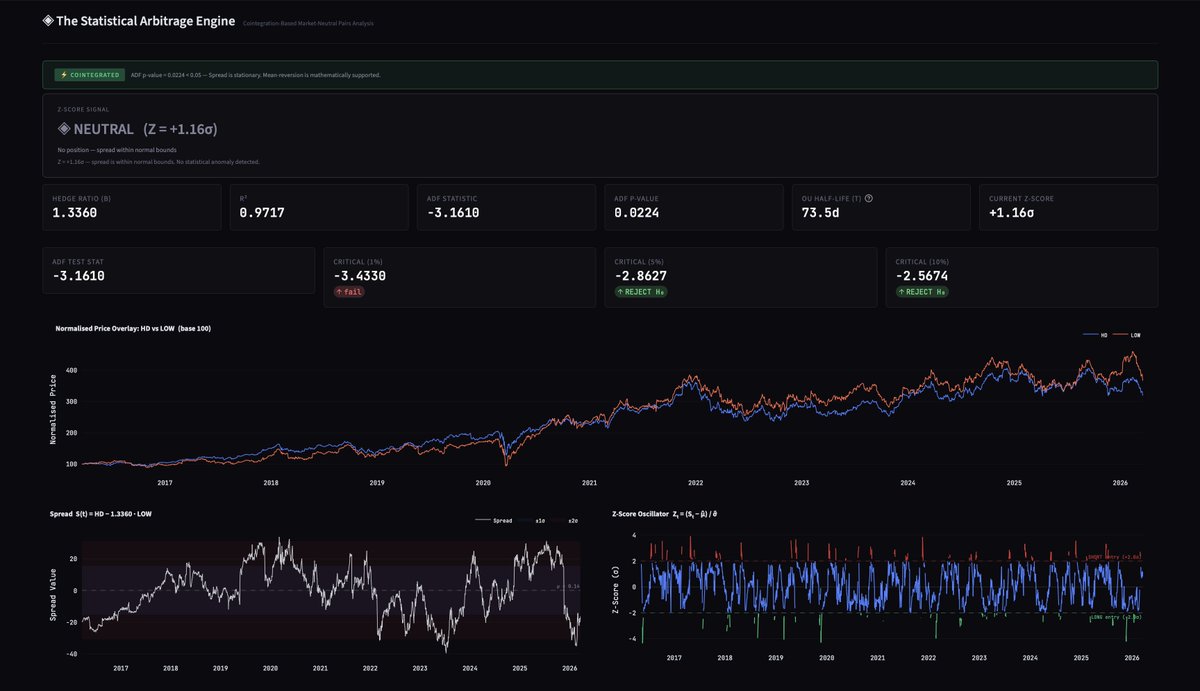
Most pairs trading is just correlation dressed up as something more serious. Correlation tells you two things move together. It says nothing about whether the gap between them will ever close. Cointegration is the actual test. It tells you the spread is stationary, that there is a mathematical tendency to mean revert. That is the only version of this trade that has a statistical basis. Everything else is just hoping.
The Signal Process tweet media
English
0
0
0
7
The Signal Process
The Signal Process@TheSignlProcess·
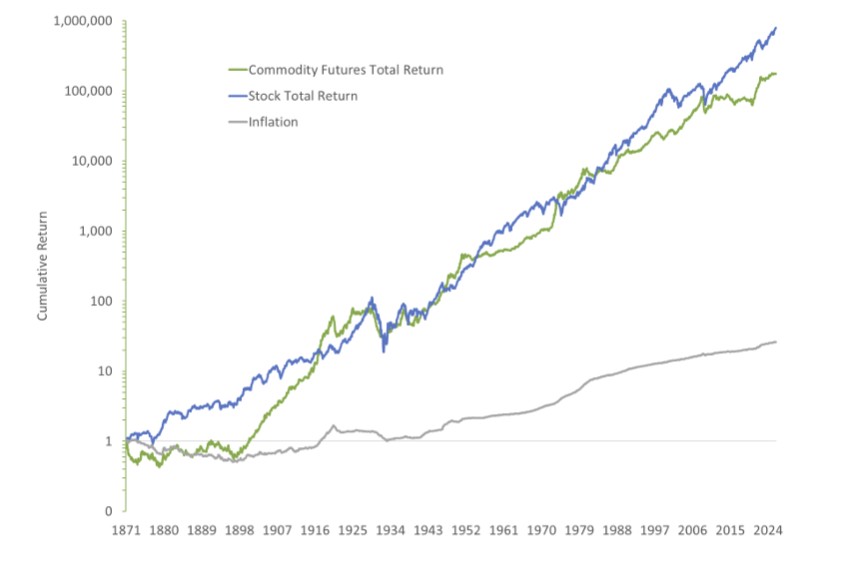
@macro_synergy The 43% of years outperforming equities is the interesting number. It suggests the premium is real but highly market state dependent, which means the question isn't whether to hold commodities but when the conditions that historically drove that premium are actually present.
English
0
0
0
30
Ralph Sueppel
Ralph Sueppel@macro_synergy·
"An Index of Commodity Futures Returns Since 1871": "Commodity futures have earned... a premium over US inflation of more than 6% per annum. [They] have outperformed equities in roughly 43% of years and in two out of every five decades." papers.ssrn.com/sol3/papers.cf…
Ralph Sueppel tweet media
English
1
9
50
3.8K
The Signal Process
The Signal Process@TheSignlProcess·
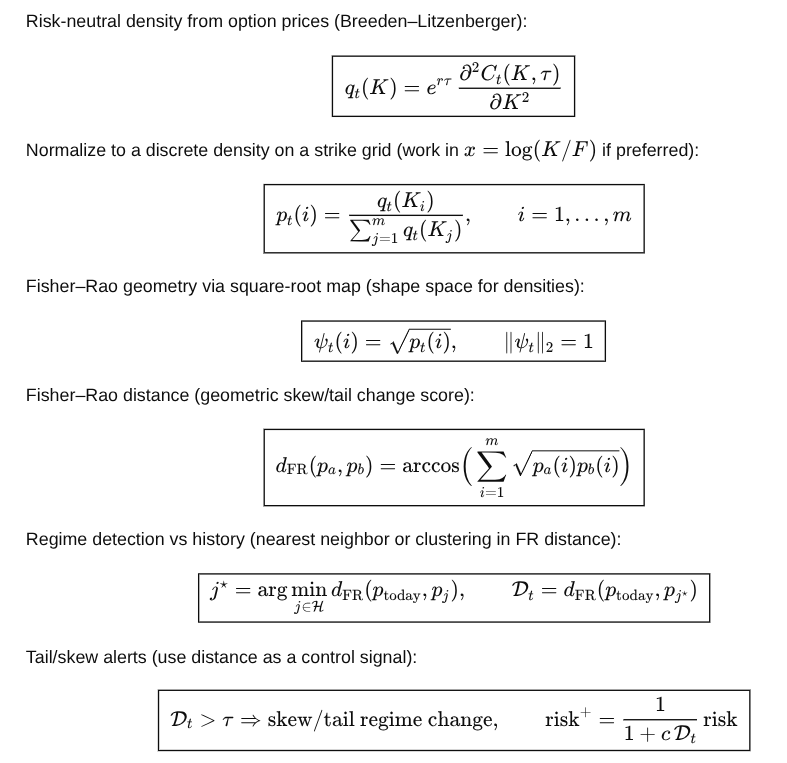
@quantbeckman The Fisher-Rao distance as a regime change signal is a genuinely elegant framing. The shape of the density changing before price moves is the kind of leading information most approaches completely miss by working directly on returns.
English
0
0
0
25
Quant Beckman
Quant Beckman@quantbeckman·
Extract the risk-neutral density from the implied-vol surface and treat it as a probability density over strikes. Each date becomes a point on a density manifold, where geometric distance measures shape change in skew and tails. Compare today’s density to a historical library to detect regime shifts. Use the distance as a trigger for hedging, sizing, and volatility risk limits.
Quant Beckman tweet media
English
8
5
34
2.1K
The Signal Process
The Signal Process@TheSignlProcess·
@quantscience_ The cherry-picking problem usually shows up at the data preparation stage before anyone has even designed a signal. If you've already looked at the price series when deciding how to clean or segment it, the bias is basically already in.
English
0
0
0
5
Quant Science
Quant Science@quantscience_·
🚨 BREAKING: A new 33-page PDF demystifying how hedge funds create bias-free signals This is what you need to know (Number 2 is the most important finding): 🧵
Quant Science tweet media
English
8
80
488
45.9K
The Signal Process
The Signal Process@TheSignlProcess·
@QuantRob The more useful question is whether you're using it to automate thinking or to accelerate it. One of those compounds. The other just makes you faster at being wrong.
English
0
0
1
3
HFT Quant
HFT Quant@QuantRob·
hot take: any quant who is not using LLMs for research in major way will be replaced within a year. Thoughts?
English
17
3
121
17.5K
The Signal Process
The Signal Process@TheSignlProcess·
@macrocephalopod The problem isn't really the AI. It's that people are asking it to do something that doesn't have a reliable answer and then being surprised when it confidently gives them one.
English
0
0
0
0
cephalopod
cephalopod@macrocephalopod·
I encourage everyone to try this. Lots of money to be made by getting Claude to give you advice on when to sell options. Don’t worry if you wipe your account a couple of times at first. Just keep trying. You’ll get there eventually.
Nav Toor@heynavtoor

BREAKING: AI can now automate daily options income with 78% win rate like professional theta traders (for free). Here are 12 insane Claude prompts that generate consistent 0.5-2% daily returns (Save for later)

English
56
40
1.4K
164K
The Signal Process
The Signal Process@TheSignlProcess·
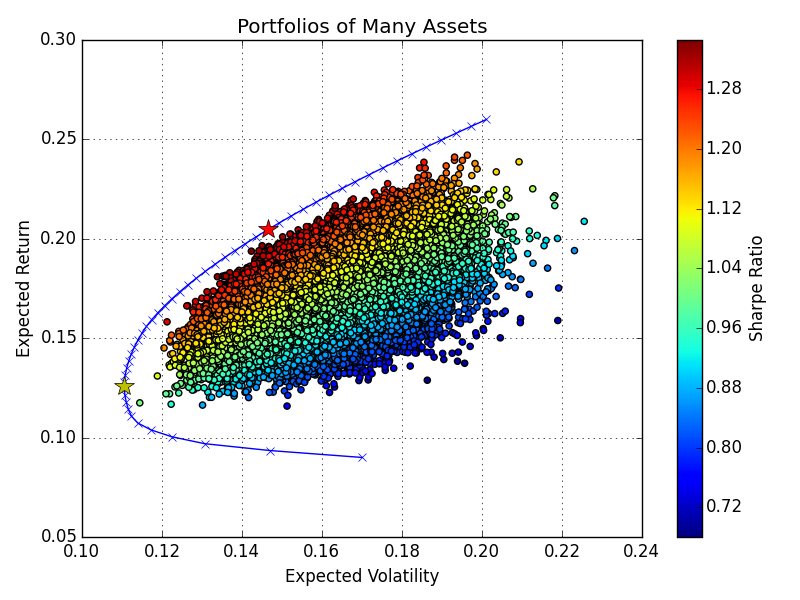
@quantscience_ I think The bigger issue is that the frontier assumes the covariance matrix is stable. In practice it shifts with the state of the market, so the optimal portfolio you calculated last quarter may be actively working against you this quarter.
English
0
0
1
666
Quant Science
Quant Science@quantscience_·
There's a curve in finance that most investors get wrong. It's called the efficient frontier. Markowitz defined it in 1952. Most investors still don't understand what it means in practice. Here's what they get wrong:
Quant Science tweet media
English
12
52
513
50.3K
The Signal Process
The Signal Process@TheSignlProcess·
Most people look at price as a trend with noise around it. Run it through a Fourier transform and you start to see something different. Dominant cycles. Repeating periodicities buried inside what looks like random movement. Whether you act on them or not, it changes how you think about what a chart actually is.
The Signal Process tweet media
English
0
0
0
3
The Signal Process
The Signal Process@TheSignlProcess·
@investingidiocy To be fair, mine just tells you what kind of market you’re in and lets you make the bad decision yourself.
English
0
0
3
278
The Signal Process
The Signal Process@TheSignlProcess·
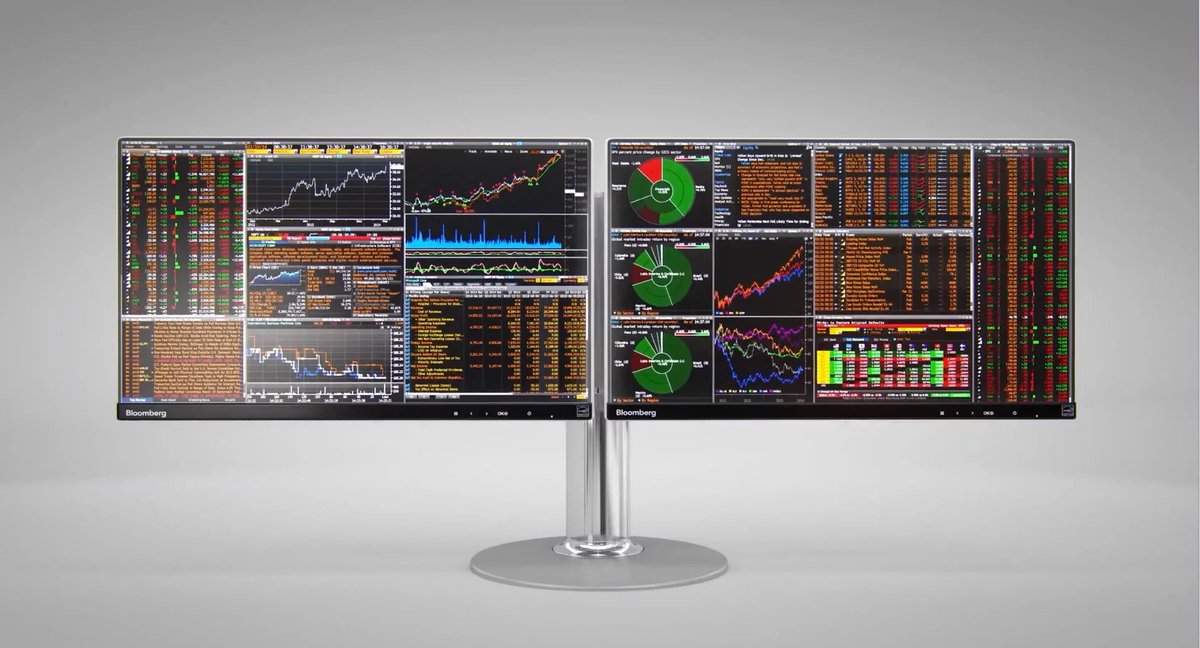
The data and charting layer is straightforward to replicate. The harder part is building the analytical layer on top and the kind of models that actually classify what the market is doing rather than just displaying it. That’s where Python starts to genuinely outperform the terminal.
English
0
0
2
1.3K
Quant Science
Quant Science@quantscience_·
A Bloomberg Terminal costs $30,000 a year. Here's how to build 90% of it for free. Wall Street doesn't advertise this. But every function that matters has a free alternative in Python. Here's the DIY version (with Python):
Quant Science tweet media
English
32
172
1.3K
128.5K
The Signal Process
The Signal Process@TheSignlProcess·
@traderwillhu Very interesting angle. There’s real value in studying what the best setups actually looked like before they moved rather than just backtesting rules against them. I feel that the human pattern recognition piece is harder to systematise than people would admit.
English
0
0
1
30
Will Hu
Will Hu@traderwillhu·
Thanks to AI coding, a complex learning process is now much simpler. I filtered the top 7% YTD stocks from 2000–2026 (including delisted ones), get 1400+ stocks, and visualized them with TradingView Lightweight Charts, featuring auto-marked highs/lows and direct period displays. Browse by year or symbol, even delisted stocks from the last decade like $LVGO and $TWTR are fully accessible. Once I refine the charting and annotation features, I will open-source this learning project.
Will Hu@traderwillhu

The Path to Trading Mastery: Research and Pattern Recognition By Qullamaggie 1. Step-by-Step Market Research The easiest way to start is to research the markets thoroughly. First, get a platform like TC2000 and set your charts to the monthly timeframe. Create a watchlist of all US stocks and filter them by dollar volume instead of just share volume. Aim for liquid names—those with at least $1 billion to $10 billion in monthly dollar volume—to avoid "super thin" or illiquid stocks. 2. Identifying the Big Movers Go through the entire database (roughly 5,000 stocks) and identify the outliers. Look for stocks that: At least doubled in price within six months. Increased 200–300% within a single year. Gained 400–500% over three to four years. Create a separate watchlist for every single stock that has made these massive moves. You will likely end up with a few hundred highly liquid, historical winners. 3. Studying Chart Patterns Go back as far as the 80s or 90s and study their chart patterns. Stocks move in very specific ways. These same patterns occur over and over again—there is nothing truly new in the markets. While there are variations, the patterns that worked in the 90s are the same ones you see today. Focus primarily on price action. You can add a few indicators if you wish—I recommend moving averages—but don't use too many. "Too many indicators is for suckers." Study how these big winners acted during pullbacks: Which moving averages did the best stocks respect or "obey"? How did they behave before the breakout? How did they act once the move was underway? 4. Building Your Mental Database (The 2,000-Hour Rule) Your goal is to build a database in your head. Spend 1,000 hours doing exactly this: printing out charts, studying them, and saving them. (I personally use Evernote to store tens of thousands of these charts). Once you understand the price action, spend another 1,000 hours researching the fundamentals and the news behind those moves. What was driving them? What made a stock go up 500% in a year? If you put in those 2,000 hours of deep research, I promise you: before you know it, you’re going to have ten million dollars in your account.

English
22
31
326
34.1K
The Signal Process
The Signal Process@TheSignlProcess·
@Quant_Kurtis The speed of production is the interesting part. The research to implementation gap used to be weeks. Now it can be done in an afternoon. Been building something in a similar space. Different approaches to how the regimes get defined.
English
0
0
0
8
Kurtis The Quant
Kurtis The Quant@Quant_Kurtis·
Claude Cowork has increased my productivity by 10x. This is just one example... Last week I was reading this academic paper called Dynamic Factor Allocation via Momentum-Based Regime Switching that was posted 3 days before that. The idea was interesting so I ask Claude to design software around this idea. But I don't stop there. I take it further. Not just normalized factor momentum vs. the market, but also absolute momentum. Then I combine them. And I apply this to fixed income, sectors and global markets. I create a backtest engine where you can customize allocation to each sleeve, keep top momentum funds in each sleeve, dynamic weighting of each sleeve and more. 60 minutes after reading new research I have built a tool to systematically backtest and build portfolios around the concept. No, that's incorrect. Taking the idea and building on it in meaningful ways....inside an hour! Claude is not just some passing fad. It is a game-changer. You shouldn't be afraid of Claude stealing your job. It is a highly skilled worker but it also needs an insightful and creative CEO to manage and direct it. However, if you fail to embrace Claude, you should be afraid of the guy next to you who is 10x-ing his productivity with it.
Kurtis The Quant tweet media
English
23
32
298
27K
The Signal Process
The Signal Process@TheSignlProcess·
@GoshawkTrades A Sharpe of 21.4 just means the backtest hasn’t seen a real drawdown yet. Run it through 2020 or 2022 and watch it dissolve. Optimising for Sharpe in-sample is basically just a more complicated way of curve fitting.
English
0
0
0
9
Goshawk Trades
Goshawk Trades@GoshawkTrades·
Make it stop. 21.4 Sharpe... Guys come on
Nunchi@nunchi

Agentic Trading Competition is coming. @karpathy proved an AI can run experiments autonomously and find what humans miss. We ran the same loop on live trading strategies: 251 experiments, no human intervention, Sharpe 2.7 → 21.4. Now we want to see what you can build with it.

English
20
7
256
64.1K
The Signal Process
The Signal Process@TheSignlProcess·
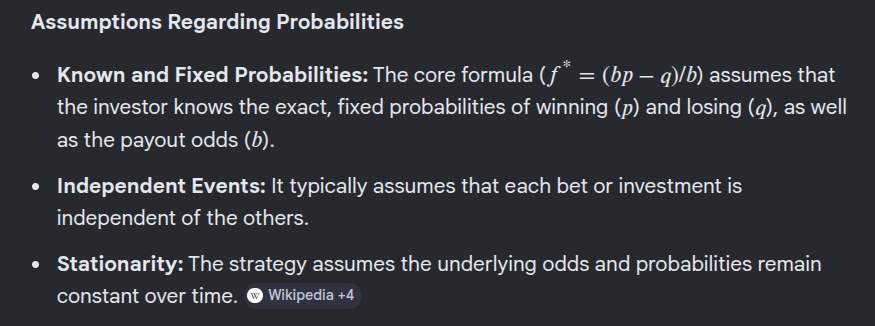
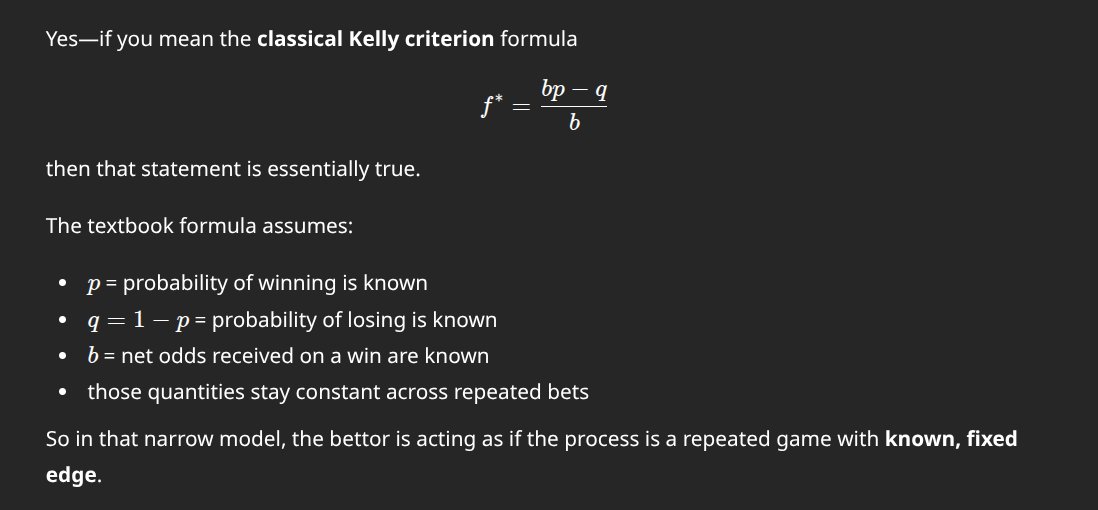
Exactly this. Kelly requires a fixed, known edge and markets give you neither. The environment itself keeps changing, which is why I’ve been more interested in classifying what kind of market you’re in before even thinking about sizing. A position sizing model built on a stale market assumption is just loosing money with extra steps.
English
0
0
1
36
mikkom
mikkom@mikkom·
Please don't use kelly for trading. It is not suitable. I see so many people posting about kelly this and kelly that related to trading. Kelly was originally designed for gambling. Gambling has fixed rules that typically favour the house but in some cases you can find an edge. Because the rules and the environment are fixed, the edge can be calculated. In trading you have volatility clustering and fat tails and everchanging environmental chaos from both external event, varying participants and market internals. Kelly assumes fixed and known constants. In trading NONE of these is true: - Environment is known and constant - Ratio of wins/losses is constant and known - Payout is constant and known You can get much better results via backtesting with decent sample size + monte carlo uncertainties. /rant
mikkom tweet mediamikkom tweet media
English
26
14
167
72.5K