Tim Vanderhook

41 posts

Tim Vanderhook

Tim Vanderhook

@TimVHook

Founder/CEO | Viant (NASDAQ:DSP), Founder | Xumo

Katılım Mayıs 2009
109 Takip Edilen185 Takipçiler
Tim Vanderhook
Tim Vanderhook@TimVHook·
@HatesAdtech @101Programmatic It’s reminding me of when photoshop came out and everyone commented that images were ‘photoshopped’. In a few years we will look back and laugh when AI gen content is normal course.
English
1
0
1
27
Gareth Hates AdTech
Gareth Hates AdTech@HatesAdtech·
AI slop as a category is a fascinating one, and I think a little too loose. There's a ton of procedurally generated content today -- summary websites, overviews, etc. For a data-driven industry, we seem awfully vulnerable to subjective descriptions that appeal to emotions rather than objective descriptions that correlate to outcomes. I think perfectly reasonable to demand an estimation of things like grade level, emotional content, copyright status, other contextual signals to determine whether or not you want to buy something, and author name is just one of those signals. An author named Claude is still an author, and just by virtue of being AI does not mean it is slop.
English
1
0
1
50
Vlad Chubakov (@Programmatic 101)
The thing is that AI slop can have pretty strong metrics (viewability, ad density, etc.), which makes it harder to detect. Legacy verification tools are also not very good at identifying it.
Trishla Ostwal@trishlaostwal

NEWS: AI slop is fooling the ad verification tools built to catch it. AI sites are beating real publishers on the metrics advertisers trust and now make up to 2.4% of open web programmatic spend, with TAG's CEO saying billions of dollars could be at stake. adweek.it/4pFOomc

English
2
0
3
855
Joe
Joe@ProgrammaticJoe·
@cvanderhook @AdtechGod @EricTilbury_RTB @Cassin75 @TimVHook In 2013 agencies laughed at the notion; MySpace provided any meaningful advantage for Adelphic in id mapping. time inc subscriber data was coo. Google didn’t kill MySpace, social communities and digital culture shifted to Facebook. Leaving you with an already dead & useless O&O
English
1
0
1
99
ADWEEK
ADWEEK@Adweek·
Penry Price, a longtime ad industry executive who previously held top roles at @LinkedIn and @Google, is joining @TheTradeDesk's board. His appointment follows a wave of high-profile departures, including several C-suite leaders and multiple board members. Price joins as investor pressure grows, with the stock down nearly 73% year over year and roughly $60 billion in market value wiped out since its late-2024 peak. Read more 👉 adweek.it/4vsxetK
ADWEEK tweet media
English
1
0
0
1.9K
Alex Patrascu
Alex Patrascu@maxescu·
Seedance 2.0 is still pretty insane. Prompt below:
English
5
3
45
3.8K
Tim Vanderhook
Tim Vanderhook@TimVHook·
@bindureddy We see the same value for having a topology layer and model routing in advertising. Your product is on the money.
English
0
0
0
24
Bindu Reddy
Bindu Reddy@bindureddy·
🚨 Create Your Own Custom Coding Agent - Mix Fable 5, GPT 5.6 sol and Grok 4.5! Our newest feature allows you to mix and match your favorite LLMs and create your custom coding agent Create your favorite cocktail such as - Fable 5 for hard coding - 5.6 sol for backend - Opus 4.8 for frontend - Grok 4.5 for easy coding You can also only choose cheap LLMs for a cost optimized experience. Your use custom agent in API, chat or our agent platform
English
119
131
1.8K
7.8M
The All-In Podcast
The All-In Podcast@theallinpod·
How Martin Scorsese Uses AI: Prototyping Set Ideas By Bringing His Thoughts to Life @bfl_ai CEO @robrombach explains to @Jason: Jason: “You sat in a room with Marty Scorsese and showed him your tools, what was his reaction?” Rombach: “He clearly has a vision in his head of a scene or scenery where maybe a new movie will be shot, and he's trying to explore that. We basically looked at the scenery of a village in Eastern Europe somewhere, and he was describing it. We saw some outputs, we iterated on the outputs. Getting the mental picture of something out of your head and communicating it in a visual way by making these images, or a series of images, just makes it easier to communicate and convey an idea of what is actually in your head. I think that's one of the very interesting and powerful ways to use this technology.” Jason: “Is to get the inspiration, to get the vision, out of his head onto an image?” Rombach: “Yeah, language ultimately is a little bit of a lossy communication medium, right? It's also interpreted in different ways, but then visual information is so rich. An image or video, there's so much signal in it, and it's just another way of communicating. And I think that's one of the beautiful things that this technology ultimately enables.” ------------------------------ Thanks to our partners for making this possible! Most advertisers have never heard of the platform with an $11B annual run rate in ad spend. @AppLovin Ads — 1B+ daily active users, full-screen video ads watched for a median of 35 seconds, and businesses are profitably spending hundreds of thousands of dollars a day on it. Advertiser access is in closed beta. The window is open at applovin.com/ALLIN Positioned at the nexus of technology and the capital markets, @Nasdaq provides premier platforms and services for global capital markets and beyond with unmatched technology, insights and markets expertise. nasdaq.com
English
3
8
83
51.3K
Tim Vanderhook
Tim Vanderhook@TimVHook·
@miramurati My favorite line is "shaped by the people they serve." Domain expertise of humans will be the lasting value for all of us in the long run.
English
0
0
1
15
Mira Murati
Mira Murati@miramurati·
Today we share the worldview behind our mission. Human values don't average out. Local knowledge can't be centralized. The good future has many AIs, raised in different places, shaped by the people they serve, disagreeing with each other the way we do. thinkingmachines.ai/blog/the-futur…
English
150
527
4.5K
1.2M
Mira Murati
Mira Murati@miramurati·
A year ago we set out to empower humanity with a focus on multimodal AI, custom models, and open science. We previewed interaction models that collaborate the way people do. Tinker lets anyone train their own open weights models. We published our research on Connectionism.
Mira Murati@miramurati

Thinking Machines Lab exists to empower humanity through advancing collaborative general intelligence. We're building multimodal AI that works with how you naturally interact with the world - through conversation, through sight, through the messy way we collaborate. We're excited that in the next couple months we’ll be able to share our first product, which will include a significant open source component and be useful for researchers and startups developing custom models. Soon, we’ll also share our best science to help the research community better understand frontier AI systems. To accelerate our progress, we’re happy to confirm that we’ve raised $2B led by a16z with participation from NVIDIA, Accel, ServiceNow, CISCO, AMD, Jane Street and more who share our mission. We’re always looking for extraordinary talent that learns by doing, turning research into useful things. We believe AI should serve as an extension of individual agency and, in the spirit of freedom, be distributed as widely and equitably as possible.  We hope this vision resonates with those who share our commitment to advancing the field. If so, join us. thinkingmachines.paperform.co

English
59
110
1.8K
395.7K
Joe Zappa
Joe Zappa@joe_zappa·
I'm doing a new pod! The Adtech Marketing Podcast launched today. It'll range from big-picture discussions of media, marketing, and politics to how to make a marketing budget. Occasional guests (eg adtech marketing leaders) but mostly ME and my team. First ep is out now.
English
2
2
27
1K
Tim Vanderhook
Tim Vanderhook@TimVHook·
@paulg Another reason why HR shouldn't be making decisions for the whole organization.
English
0
0
0
17
Paul Graham
Paul Graham@paulg·
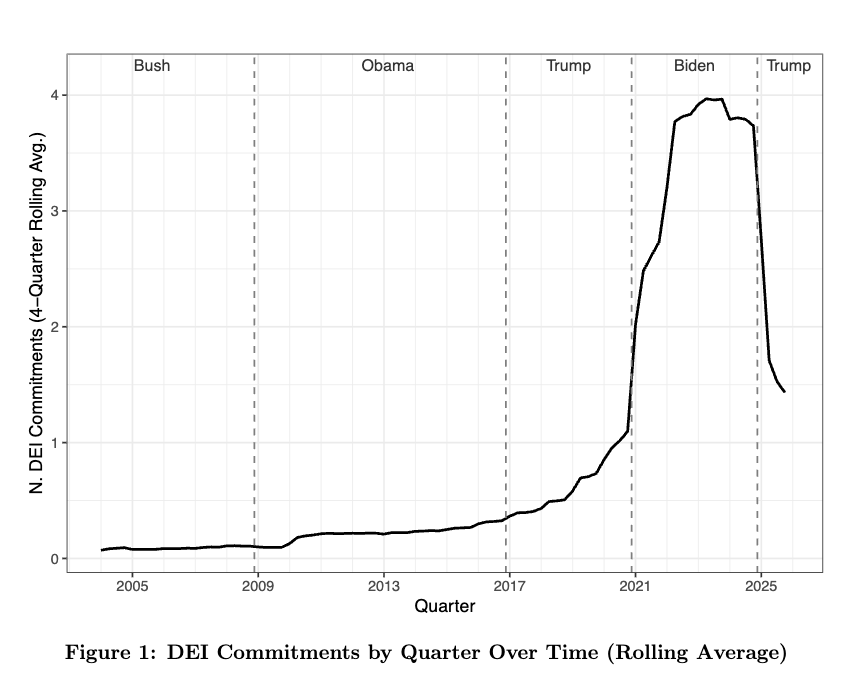
The rise and fall of wokeness: DEI commitments in corporate securities disclosures filed with the SEC. To me this seems a trailing indicator; most other measures of wokeness take off well before 2019 and peak in 2020 or 2021. But the shape! That's what a moral fashion looks like.
Paul Graham tweet media
English
307
802
7.8K
1.2M
Tim Vanderhook
Tim Vanderhook@TimVHook·
This is an excellent take. One distinction, the smaller the company, the easier it is to adopt AI in advertising. In early tests of our autonomous ad product, the AI outperformed human traders on cost efficiency of transactions by 67%. This is going to be a huge unlock as adoption scales to larger org's.
English
0
0
0
48
Eric Seufert
Eric Seufert@eric_seufert·
I joined @tbpn last week to discuss The Prosperous Society, my four-part podcast series on the political economy of artificial intelligence. AI is fundamentally an economic technology. In The Prosperous Society, I argue that AI, as applied to digital advertising, will shift the binding constraint on commerce from production to distribution by enabling ever more precise matches between idiosyncratic consumer preferences and the products that best serve them. I believe this will produce remarkable benefits for consumers and society broadly: a greater diversity of products, broader participation in the advertising economy, higher consumer satisfaction, and more powerful pathways for self-discovery and self-expression.
English
5
3
45
13K
Tim Vanderhook
Tim Vanderhook@TimVHook·
@nikesharora @satyanadella I agree with everything you are saying on AIaaS. We are about to see a transformation where companies will offer AI that performs those services autonomously. AI-as-a-Service will enable companies to do what was once unimaginable.
English
0
0
0
22
Nikesh Arora
Nikesh Arora@nikesharora·
I love @satyanadella his ability to put technology transformations in simple terms is par none. In this instance I think it's important to understand the distinction in consumer, horizontal multi-tenant AIaaS and Enterprise which tends to be deep and vertical. 1. Consumer - this is not new news, the consumer has always been part of the product. Be it search (Bing or Google), social media (think TikTok, Snap, and of course FB), even unassuming products like Maps have always retained the knowledge learnt from customers, customers suspecting or unsuspecting have always had the choice. Use the product and share your prompts, location or preferences and that will be used to build a better product. So why is that surprising if it happens in AI, the model complex will continue to use consumer usage to train fundamental multiple modalities. This is the biggest technological event of our lifetime :). 2. Horizontal AIaaS (AI capability that doesn't need to be too enterprise specific - can be tuned, but is a 80% common use case) - Think coding, legal, many current SaaS categories - most likely agentic development for prosumers. All of this behavior is being used to train the model complex to get better at all these. The large swath of small medium size businesses will be fertile training grounds for such applications. They cannot deal with isolated apps and custom deployments. 3. Enterprise deployments - this is where I am not sure the reverse information paradox applies. There is an existing model of isolated single tenant public cloud deployments, deployments where our data, code and connectivity are both isolated and in the hands of the enterprise. This is the deployment we have for our development from all frontier models. All our grounding data, prompts, internal tribal knowledge is sequestered. This is important because this is where enterprise IP will reside. It will be a large task to capture, collate, interpret this data. Equally complex to maintain, evolve and make effective an enterprise AI architecture. But that is what we all will need to sign up for. This is not a cloud vs on prem debate, they can both be equally secured. On prem is probably more unwieldy at the moment given the fast pace of development.
Satya Nadella@satyanadella

x.com/i/article/2076…

English
58
85
925
266K
Tim Vanderhook
Tim Vanderhook@TimVHook·
@aripap @RichieHyden @viant_tech @keithepetri 🤣 A free portal where publishers see the signals and scoring on inventory they send our DSP. QPS, HHID coverage, IRIS ID coverage, how we grade their supply for quality, etc. Nothing for sale.
English
1
0
7
275
Richie Hyden
Richie Hyden@RichieHyden·
Today we launched Viant Publisher Solutions! The future of advertising will not be won by those who simply optimize transactions more efficiently. It will be won by those who create stronger connections. For too long, our industry has focused on optimizing bids, auctions, supply paths, and yield. Those efficiencies matter, but the next phase of growth will come from creating stronger connections across the ecosystem and aligning around shared outcomes. As advertisers demand greater accountability and publishers seek stronger monetization opportunities, the answer is not more complexity. It is greater transparency, stronger identity, richer content intelligence, deeper attention signals, and more direct collaboration between buyers and sellers. When publishers have visibility into the signals that drive advertiser performance, they can make their inventory more valuable. When advertisers have access to more addressable, signal-rich supply, they can drive better business outcomes. Everyone wins. That is the vision behind Viant Publisher Solutions. By bringing together SupplyIQ, Direct Access, Household ID, and IRIS_ID, we are helping create a marketplace where advertiser success and publisher success are directly connected. Just as importantly, we believe the structure of that marketplace matters. If the goal is to create more direct, transparent, and mutually beneficial relationships between buyers and sellers, incentives must be aligned accordingly. That belief is reflected in one of the core principles behind Direct Access: publishers should not have to pay a toll to create a more direct connection with advertiser demand. We made a deliberate decision not to charge publishers fees for participating because we do not believe adding costs to access demand is aligned with the future of a more efficient and transparent marketplace. When publishers improve signal quality and advertisers achieve better outcomes, value is created for everyone through stronger performance and stronger partnerships. As the industry continues to evolve, we believe stronger connections between advertisers, publishers, content, identity, and attention will be critical to the future of the open web, and we are excited to help drive that future forward. businesswire.com/news/home/2026…
Richie Hyden tweet media
English
2
1
15
2.4K
Tim Vanderhook
Tim Vanderhook@TimVHook·
@oliviaakory Imagine what their revenue would have been if they were all in the office…
GIF
English
0
0
1
30
Olivia Kory
Olivia Kory@oliviaakory·
In the remote v office debate, no one talking about how Grüns just proved you can build a unicorn fully remote.
English
8
1
27
5.9K
Chris Vanderhook
Chris Vanderhook@cvanderhook·
Viant $DSP jumps 16% after smashing Q4 expectations! Revenue up 22% to $110M, adj. EBITDA surges 45% to $25M. Real AI-powered ad tech is winning big. 🚀 #ViantTech #EarningsBeat
Chris Vanderhook tweet media
English
11
2
51
2.7K
Tim Vanderhook
Tim Vanderhook@TimVHook·
@aakashgupta You just described how Google is a Monopoly and the quality of the product doesn’t matter when you monopolized distribution! Turns out it is impossible to beat a monopoly!!
English
0
0
0
38
Aakash Gupta
Aakash Gupta@aakashgupta·
Sam Altman just admitted defeat in an image generation war he didn’t know he was fighting. GPT Image 1.5 was scheduled for January. OpenAI pulled it forward by a full month because their internal dashboards showed something terrifying: Gemini’s weekly download share climbed from 29% to 33% in a single week. That’s the kind of trajectory that compounds into market position collapse. The timing tells you everything. December 1st: Altman sends “code red” memo. December 11th: GPT-5.2 ships. December 16th: GPT Image 1.5 ships. Three major releases in 15 days after months of nothing. This isn’t a product roadmap. This is a company in crisis mode, burning through its bench depth to stop the bleeding. Here’s what most people don’t understand about the image generation market: it’s not about quality. It never was. Nano Banana went viral in September because people could share their AI-generated Thanksgiving dinner with fake celebrity guests. They could turn their pets into Ghibli characters. Google turned image generation from a utility into a social behavior. OpenAI had no answer for three months. Look at the engagement data. Gemini users now spend 120% more time in the app compared to March. ChatGPT users saw time spent decline 10% since July. The product works fine. The distribution is the problem. Google has something OpenAI can never replicate: Android. Twice as many US users access Gemini directly through the operating system versus downloading the standalone app. Billions of devices with AI image generation baked into the home screen. OpenAI has to convince people to download an app. Google just turns on a feature. The LMArena benchmarks show GPT Image 1.5 leading text-to-image by 29 points. Sounds impressive until you see image editing: it’s ahead of Nano Banana Pro by exactly 3 points. In blind user testing, the gap between these models is essentially noise. OpenAI won on a technicality while Google won on cultural adoption. The 20% API price cut reveals the strategy shift. OpenAI knows it can’t win the consumer market on quality alone, so it’s pivoting hard to enterprise. The pitch: better logo preservation, consistent brand elements across edits, full product catalog generation from a single source image. This is a “please buy our enterprise tier” play, not a consumer play. The financial math gets brutal from here. OpenAI is burning $22 billion this year against $13 billion in revenue. $1.69 spent for every $1 earned. Cumulative cash burn through 2029: $115 billion. Revenue needed to justify this: $200 billion by 2030. The entire business model assumes ChatGPT dominance persists for five more years. Sensor Tower data says market share dropped 3 points in four months. The Disney deal tells you where OpenAI sees the escape hatch. $1 billion equity investment in exchange for 200+ character licenses starting in 2026. OpenAI gets exclusive rights to generate Baby Yoda images. Disney gets shares in a company valued at $500 billion on the assumption it remains the market leader. Both parties are betting that licensed IP becomes the moat around AI image generation. Google doesn’t need licensing deals to grow. It has distribution. It has Android. It has Search. It has YouTube integration. It has Workspace. OpenAI has to buy cultural relevance one IP deal at a time while Google distributes to billions for free. This release isn’t OpenAI maintaining leadership. This is OpenAI discovering that first-mover advantage has a half-life, and theirs is decaying faster than their burn rate can sustain. The real question isn’t whether GPT Image 1.5 is technically superior. On specific benchmarks, it probably is. The question is whether technical superiority matters when your competitor’s distribution advantage grows by 30% quarter-over-quarter while yours grows by 6%. At $22 billion in annual spend, OpenAI is paying roughly $60 million per day to find out.
OpenAI@OpenAI

Introducing ChatGPT Images, powered by our flagship new image generation model. - Stronger instruction following - Precise editing - Detail preservation - 4x faster than before Rolling out today in ChatGPT for all users, and in the API as GPT Image 1.5.

English
68
43
565
122.2K
Tim Vanderhook
Tim Vanderhook@TimVHook·
@jacob_posel @TaylorHoliday I still can’t figure out what would be different or unique based on what you mentioned above. Is this a CRM only for the social channel? Doesn’t seem possible via the Open Web with the descriptions you gave.
English
0
0
0
48
Jacob Posel
Jacob Posel@jacob_posel·
Well you know the kind of conversations that happen during a sales process, and you know the kind of services we deliver, so it doesn’t take much imagination to draw the dots. I don’t know where blood type comes in. Experiences, preferences, goals, what’s worked, what hasn’t, brand dna all are things you might discuss that are important.
English
1
0
0
429
Jacob Posel
Jacob Posel@jacob_posel·
We built a CRM It tracks the entire sales journey (and beyond). Every conversation, every document. Why? Because a customers expectations and needs are essential context for service delivery. When a deal is closed, they become a client in the agency platform. That means every person who is responsible for execution truly understands the entire customer context. What was promised, why it matters, and how success is defined. Nothing lost through misinterpretation or disconnected handoffs. Every data point anchored by expected outcomes. Quantitative married to qualitative. Sales and service, inextricably linked. This is what a true AI native business looks like.
Jacob Posel tweet media
English
4
0
14
2.8K
AdTechGod
AdTechGod@AdtechGod·
Has anyone figured out what Apple Intelligence is yet?
English
7
0
4
563
Tim Vanderhook
Tim Vanderhook@TimVHook·
Here is why: one consumer visiting Google and searching used to mean 1 to 2 ‘clicks’ to per search. NOW, one prompt in an LLM produces ‘25 simultaneous search clicks’ and thus everyone is seeing inflated numbers but bots make it easy. Same volume from a consumer perspective but the LLM executes 25 times the search referrals. Really quite simple.
English
0
0
1
22
Tom | Findable
Tom | Findable@findable_tools·
@neilpatel Wild that AI traffic is already the #1 source at 9.2%. Makes me think I’m on the right track with my project. The compounding effect here is going to be huge.
English
1
0
0
272
Neil Patel
Neil Patel@neilpatel·
Here are the top converting digital marketing channels. You know many of them, but the highest-converting ones are ignored by many companies. They may not drive the volume, but every bit adds up.
Neil Patel tweet media
English
35
43
203
19.1K
Tim Vanderhook
Tim Vanderhook@TimVHook·
@AdtechGod I want a robot SO SO BAD! Mainly for two items: washing dishes and accessing ViantAI without a keyboard. Can’t wait for @Tesla_Optimus
English
1
0
3
39
AdTechGod
AdTechGod@AdtechGod·
It’s crazy to think that my grandchildren may be in a relationship with a robot.
English
5
0
6
895
Tim Vanderhook
Tim Vanderhook@TimVHook·
What I think you should do is stick with your current setup for now. Side by side you should run an additional test using us. Load in whatever data you want. I will pay for half the media up to 50k and match any budget up to that amount. Then you can look at the results side by side. You should only allow your current setup to use retargeting and exclude it from Viant. That way, we have one hand tied behind our back against your current provider. Viant will demolish whatever setup you have in place. Our data feeding the models will outperform whatever you are doing. Would you stop having FOFO and let’s go! How many ad platforms have offered you $50k to test?
English
1
0
0
53
Eric Tilbury - Programmatic
Eric Tilbury - Programmatic@EricTilbury_RTB·
I find it really cool you remember our conversation from a few months ago, founder mode to the fullest 👍🏼 . To clarify, the horror story I mentioned was not about me but one of my incoming clients, and it is a recurring issue I have heard before. Regarding our services, we do offer a managed service solution (you caught me 😊 ) to activate our data, so we are not JUST curators. But, we do not buy out of The Trade Desk, we have our own bidder. Our curation works really well with SSP integration. We can push our data to any DSP without sacrificing our ability to adapt to their supported features, and SSPs pass us bid requests in real time, which we process in milliseconds in our system. Within that millisecond timeframe we score each request against our clients’ custom models, and if it is a strong match, we assign a PMP ID and push the bid request to the client’s line item. Our models internally are updated every five minutes to ensure maximum freshness. On the DSP side, our managed service requires bidder integration for the same functionality we get on the SSP side, which many DSPs do not support. I am not sure if Viant does, but I think what you are building is definitely cool, and there is definite potential for synergy. Our solution is really built for incrementality and I know Viant is all about driving real outcomes. Integrating our custom data solution into Viant’s DSP could create a powerful offering. That’s why I said before if we had the potential to possibly integrate as a data provider in Viant, I think together we could do a lot of good.
English
1
0
1
61
Eric Tilbury - Programmatic
Eric Tilbury - Programmatic@EricTilbury_RTB·
Public service announcement, as I’ve seen others get burned: never enable auto-accept deals in your DSP. Bad actors may send you “deals” to piggyback on your media spend if you don’t regularly review the deals you buy against.
English
4
0
1
538