Chris Vanderhook
337 posts

Chris Vanderhook
@cvanderhook
Co-Founder & COO @ Viant. Co-Founder @ XUMO. Steward of Myspace. Family & Baseball for fun.


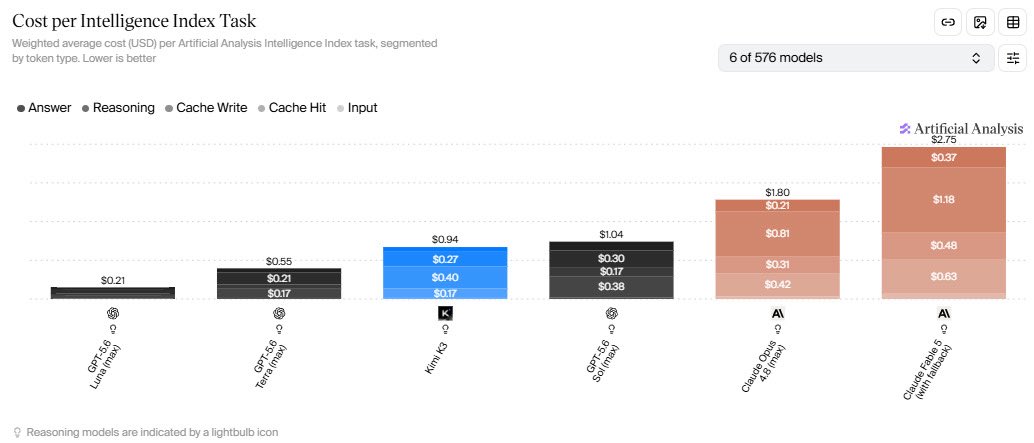
Kimi K3 may be an important inflection point for AI. Potentially negative for Anthropic and OpenAI while being net positive for essentially every other company in the world. I mean that very literally. Although the real “Sputnik moment” would be an open-source frontier model that was also token efficient unlike Kimi K3 which is 50-70% more expensive to run than GPT 5.6 per Artificial Analysis. Rationale: A world where there are only 2-3 dominant frontier labs with 90% inference margins is net negative for every other layer while being awesome for those 2-3 labs. Those labs would become monopsonies for power, data centers, semiconductors and hyperscalers and would obviously vertically integrate over time into all those layers while also completely subsuming the application/software layers. Anything that lowers margins and increases competition at the model layer is good for every other AI layer: power, semiconductors, hyperscalers, neoclouds and yes even software. This is why Jensen is so supportive of open-source. An open-source model requires the *exact* same amount of compute to run as a closed frontier model of similar size and architecture. Kimi K3 is roughly the same price as GPT 5.6 Terra on a per token basis, which actually suggests that it is less computationally efficient as I am sure that GPT 5.6 is priced to a higher margin than K3. And given that K3 is a token wastrel, i.e. token inefficient, it is significantly more expensive per task than GPT 5.6 and Grok 4.5, which are much more token efficient. Cost per token and token efficiency (i.e. intelligence density per token) are the drivers of intelligence per unit of cost. The winning AI companies will be those that offer the most intelligence per $ over time. Lower margin % at the model layer = more margin $ at every part of the infrastructure layer and is a godsend for software. This can happen either through open-source models like K3 at the frontier *or* having a vertically integrated model company like Meta, SpaceX or Google at the frontier. Both outcomes result in a lower margin % at the model layer as vertically integrated model companies don’t really care where the margin $ come from. This is why it was so painful for OpenAI and Anthropic when Google was right there with them from a model competitiveness perspective and why Grok 4.5 and Muse 1.1 were just as important as Kimi K3. The reason Kimi K3 is only *potentially* negative for Anthropic and OpenAI is 1) the @ericvishria point that the Claude and ChatGPT products and harnesses may be more important than their models today and 2) the hypothesis that they have much more advanced model checkpoints internally that are already being used for RSI. In the latter scenario, reaching RSI even a few months ahead of other labs might be enough to cement a permanent lead. Time will tell on both points. And likely fairly quickly. Caveat would be that since Kimi K3 is not token efficient and thereby actually more expensive than ChatGPT 5.6, we may need to see a more token efficient open-source model at the frontier or see Grok 5/Composer 4/Muse 2 at multiple points on the Pareto frontier for this potential risk to Anthropic and OpenAI to play out. And I am sure they will both vertically integrate as quickly as possible while continuing the product/harness strength they have shown over the last 8 months.


Why are all of the tech bros wearing mandarin shirts? I missed the memo.


A few thoughts on what we will see in AI structurally for the foreseeable future: * Frontier intelligence continues unabated and pushes the industry forward continuously. The top labs will continue to buy the best and the most data, build the most compute, be at the forefront of improved training breakthroughs, and so on. A few different approaches stratify the market on pricing and capability, but overall competitive pressure brings down pricing on a per task basis. That said, we just ask more from the models over time - as one thing gets cheaper, we just use more - so frontier spend and use remains robust. * Open weights rapidly absorbs frontier breakthroughs (and drives other breakthrough directions given the constraints), offering both lower cost intelligence and the ability to be post trained for specific workflows and domains. This creates a healthy counter balance to the frontier as you can run models “at cost” on a hyperscaler at any time, and tune models just for your tasks. * The Applied AI layer has a huge opportunity to combine frontier intelligence with open or cheap closed models to orchestrate workflows in any given domain. Due to evals, deep domain context, being trusted with enterprise data and workflows, this layer can maximize performance and cost combination. The applied AI layer will also often have their own RLed models especially for high volume, predictable tasks in their systems. * Individual enterprises will generally focus on their enterprise context, making sure they can get any AI system the right data and information to work with, in a continuously improving way. Some will go off and train their own models for specific areas of work (large banks, pharma, etc.) where they can get real alpha from doing so given the many tradeoffs, but most will spend energy on making sure they can get all of the gains from AI breakthroughs on their data and workflows. Net net: even though some of this gets framed as zero sum, there’s just a ton of opportunity for all layers of the stack and approaches.

Mark Zuckerberg explains the 405B teacher-model flywheel that could make one giant AI the wrong end state "People are gonna wanna do inference directly on the 405 because it's, you know, by our estimates, it's gonna be about 50% cheaper, I think, than GPT-4o to do that directly." "Because it's open weights, the ability to take the model and distill it down to whatever size that you want, to use it for synthetic data generation, to use it as a teacher model." "Our vision is that there should be lots of different models. I think every startup out there, every enterprise, governments, they all kind of wanna have their own custom models." "Right now, as open source basically closes the gap, I think you're just gonna see this wide proliferation of models where people now have the incentive to basically customize and build and train exactly the right size model for what they're doing, train their data into it." "They're gonna have the tools to do it because of a lot of the partner integrations that the companies like Amazon are doing with AWS or Databricks or different folks like that who are building these whole suites of services for distilling and fine-tuning open models." The counterintuitive edge is that the 405B model may be most valuable as raw material, not an endpoint. The open model compresses into the right size, absorbs proprietary data, and turns one frontier release into thousands of company-specific systems. Distribution of intelligence beats centralization. - Mark Zuckerberg (@finkd), CEO of Meta, with @rowancheung


Comcast is breaking up with NBCU. Why did it ever buy it in the first place? Business Insider’s Peter Kafka on the Comcast split, and why the dream of content plus pipes keeps failing. theverge.com/podcast/962994…


The mega bull case for AI infrastructure would be *if* market share shifted away from certain frontier labs with 90%+ inference margins toward cheaper models, whether open-source or closed. It would increase the ROI on AI spend for end customers by increasing intelligence per dollar, which would drive incremental token demand. Margin dollars would effectively get redistributed from the frontier labs to AI infrastructure providers. The infra winners would be those with the lowest per token cost and the winners at the model layer would be those with the highest token efficiency. There are many reasons Jensen is so focused on open source, but this is likely the most important one as I think he is probably less worried about a monopsony these days. Lower margin % at the model layer = more margin $ at the infra layer all else equal. With SpaceX and Meta being vertically integrated and possessing the #3 and #4 models respectively it is more possible than ever. Note that Grok 4.5 is ahead of Fable for some useful tasks at a much lower cost, so ranking them #3 is conservative. This is not happening yet. Cheap, mostly open source tokens are likely the majority of volume today but the majority of economic value is still accruing to the most intelligent models. Might change though. We will see.


Got ZDR? 🚀 The currency of AI is trust. Since launching Agentforce Trust Layer with Zero Data Retention (ZDR) on June 12, 2023, we’ve drawn a hard line with our model suppliers: Your data is YOUR data — it is NOT our product or their product. 🛡️ We have never used customer data to train AI models. Ever. Learn more: salesforce.com/ca/artificial-… #Trust #Agentforce #ZDR #Salesforce