Trajectory AI

2.2K posts

Trajectory AI banner
Trajectory AI

Trajectory AI

@Trajectory_AI

AI is eating the world, and we are investing in the next generation AI & infrastructure transforming the world. Disruptors, news and insights on all things #AI

New York, NY Katılım Haziran 2018
1.3K Takip Edilen286 Takipçiler
Trajectory AI retweetledi

Investing visuals
Investing visuals@InvestingVisual·
$NBIS vs $IREN: A side by side of two top tier neoclouds. Who's your favorite?
Investing visuals tweet media
English
10
30
259
25K
Trajectory AI retweetledi
Formic
Formic@goformic·
We're opening our Oakland facility on August 19. It's not just another location. It's proof that the flat-rate, zero-CapEx model scales past a single region, and it puts Formic closer to West Coast manufacturers who've been asking when we'd get here.
GIF
English
1
1
9
136
Trajectory AI retweetledi
Lambda
Lambda@LambdaAPI·
PixARMesh turns one photo into a full editable 3D scene. The CVPR 2026 work from UC San Diego and Lambda represents the scene in a single token sequence, then predicts it autoregressively. It does this without SDFs or a multi-stage pipeline. Scene-level F-Score reached 33.55% on 3D-FRONT, compared with 25.00% for DepR. Chamfer Distance fell from 0.153 to 0.099. Each object is an artist-ready mesh with a few thousand faces. How it works. Pixel-aligned image features and global scene context pass through cross-attention into an autoregressive Transformer. One forward pass predicts object poses and meshes token by token. There are no occupancy fields or separate layout optimization. The model generates the meshes directly. Why it matters. Robots need 3D maps before they can plan or act. Self-driving systems reconstruct scenes before control. A game developer or interior designer can turn one reference photo into a usable 3D asset without hours of manual modeling. The same capability supports robotics, autonomous systems, AR/VR, digital twins, gaming, and embodied AI.
Lambda tweet media
English
1
4
6
923
Trajectory AI retweetledi
Trajectory Ventures
Trajectory Ventures@TrajectoryVC·
@PhotonCap What a spot on insight article re light based AI infrastructure, and thrilled to see our MVP investment in the space @LightmatterCo leading the way collaborating with @nvidia 🚀 The age of photonics is here.
English
0
1
3
89
Trajectory AI retweetledi
Photon Capital
Photon Capital@PhotonCap·
Optical networking is already widely used for scale-out connections across data centers, while low-latency scale-up links between GPUs inside a rack still rely primarily on copper technologies such as NVIDIA NVLink. As signaling speeds increase, copper links face greater attenuation, power consumption, and heat. NVIDIA plans to expand its tightly connected systems from 72 GPUs today to as many as 576 by 2027, and the company acknowledges that in-rack copper is approaching its physical limits. NVIDIA’s NVLink Fusion ecosystem now includes photonics companies such as Ayar Labs, Marvell, and Lightmatter. Ayar Labs is developing optical chiplets positioned beside processors, while Lightmatter is pursuing photonic interposers that can sit underneath compute chips. Improvements in foundry processes, hybrid bonding, packaging, and testing have made co-packaged optics more manufacturable. However, integrating large numbers of lasers efficiently and reliably remains a major challenge. NVIDIA is taking a gradual approach, adopting optics first in scale-out networks and potentially extending it into scale-up systems as bandwidth requirements increase. Industry participants expect multiple high-volume optical scale-up implementations around 2028, although this remains a forecast and copper is likely to coexist with optics for some time. --> Optical scale-up is being pursued through a wide range of architectures by multiple companies and engineering teams. Ayar Labs is developing optical chiplets, while Lightmatter is taking a photonic-interposer approach, and other implementations will continue to emerge. At this stage, predicting the eventual architectural winner is difficult. A more useful strategy is to focus on the common bottlenecks and chokepoints that every solution must pass through. As I have consistently argued, the two most critical layers in silicon photonics and co-packaged optics are packaging and measurement/testing. Optical devices, electronic chips, lasers, and fibers must be integrated with low loss, high yield, and sufficient reliability. Once assembled, both individual components and complete optical engines must also be tested at production speed and scale. As competition between architectures intensifies, these two layers are likely to determine which technologies can actually reach high-volume manufacturing.
Photon Capital tweet media
English
6
31
152
36.9K
Trajectory AI
Trajectory AI@Trajectory_AI·
Shifting gears: Space Force moves to embrace space mobility for orbital warfare The service's new Objective Force plan calls for demonstrating on-orbit refueling and fielding operational "space tugs" by 2030. breakingdefense.com/2026/04/shifti…
English
0
0
4
29
Trajectory AI retweetledi
Sam Badawi
Sam Badawi@Sam_Badawi·
One of Leopold Aschenbrenner's recent investments, $SHAZ Sharon AI, signed a five-year, $1.32B cloud computing agreement with a global AI lab, with revenue expected to begin in 1H 2027. The company now has 116MW of its 132MW AI Factory capacity contracted and expects to deploy more than 62K $NVDA GPUs by mid-2027.
Sam Badawi tweet mediaSam Badawi tweet media
English
7
6
58
13.8K
Trajectory AI retweetledi
Lambda
Lambda@LambdaAPI·
Your default Kubernetes scheduler grabs 4 of 16 GPUs for a distributed training job, then waits. Those 4 GPUs sit idle, reserved by pods that can’t progress until all 16 are ready, and unavailable to anyone else on the cluster. Classic partial-scheduling deadlock. kube-scheduler doesn’t gang-schedule by default. We compared Kueue, KAI Scheduler, and Volcano across gang scheduling, GPU topology awareness, and deployment patterns. The three options split up cleanly. Kueue handles quota governance for multi-tenant clusters. It also provides gang admission, while Volcano can handle pod-level control. KAI Scheduler is aimed at dedicated NVIDIA clusters where topology and consolidation matter most. Volcano is the mature choice for gang scheduling. It supports frameworks including PyTorch and TensorFlow, alongside Ray and MPI. The article lays out where each scheduler fits and what it does not solve.
Lambda tweet media
English
3
5
14
2K
Trajectory AI retweetledi
Lightmatter
Lightmatter@LightmatterCo·
Lightmatter was just named one of the 10 coolest semiconductor startups of 2026 by @CRN. We're proud to be recognized alongside other innovators pushing the boundaries of AI infrastructure and tech hardware — see page 7 for our overview. Thanks @markharanas for the spotlight. @theanalognick crn.com/news/computing…
English
1
12
33
1K
Trajectory AI retweetledi
DAA
DAA@daaapollo908·
$NIXX I advice everyone to read this and the rest of it that @PeterBordes posted earlier ! This is nothing short of Amazing!!
DAA tweet media
English
4
8
36
2.8K
Trajectory AI
Trajectory AI@Trajectory_AI·
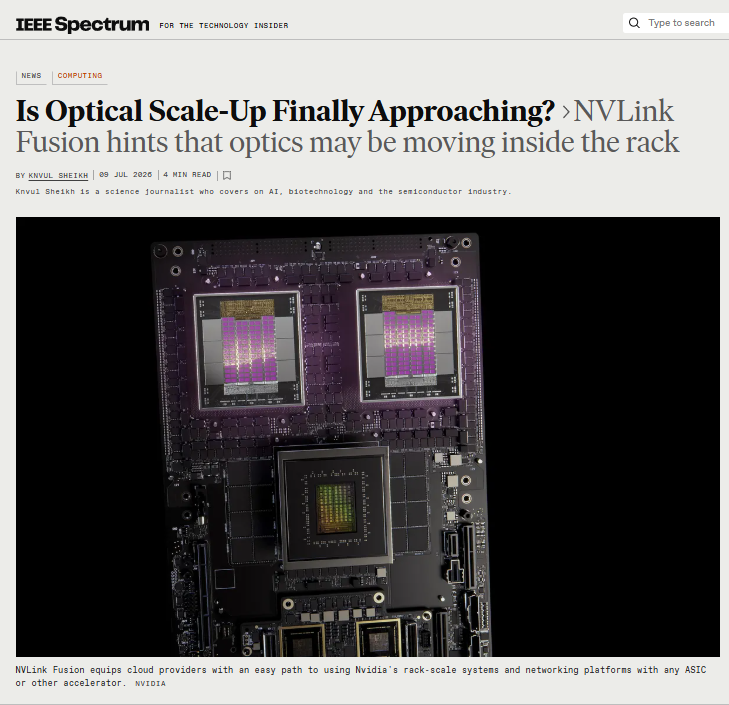
Fantastic @IEEESpectrum insights on the data center inflection point moving to optical light-based infrastructure, and how @LightmatterCo collaboration with @nvidia NVLINK is rapidly transitioning from copper to optical. spectrum.ieee.org/nvlink-fusion-…. #AI #DataCenters
Lightmatter@LightmatterCo

Lightmatter is in the spotlight in @IEEESpectrum! The latest feature explores a critical turning point in data center architecture as the industry rapidly transitions to optical networking inside the rack. In the article our VP of Product, Roy Kim, breaks down how Lightmatter is solving the copper bottleneck. While traditional methods rely on interfacing optical chiplets to the edges of processors, we’re 3D-integrating silicon photonics as the interconnect fabric inside the package. With Passage photonic interposers, we allow processors to stack vertically—bypassing the edge-routing chokepoints that limit communications bandwidth. The packaging hurdles of the past have been cleared. Today, scale-up networking also requires dense, high-performance external laser solutions. Lightmatter is tackling this head-on by integrating lasers directly onto silicon, driving unprecedented bandwidth density and scalability. Read the full article: spectrum.ieee.org/nvlink-fusion-…

English
0
1
6
206
Trajectory AI retweetledi
Lightmatter
Lightmatter@LightmatterCo·
Lightmatter is in the spotlight in @IEEESpectrum! The latest feature explores a critical turning point in data center architecture as the industry rapidly transitions to optical networking inside the rack. In the article our VP of Product, Roy Kim, breaks down how Lightmatter is solving the copper bottleneck. While traditional methods rely on interfacing optical chiplets to the edges of processors, we’re 3D-integrating silicon photonics as the interconnect fabric inside the package. With Passage photonic interposers, we allow processors to stack vertically—bypassing the edge-routing chokepoints that limit communications bandwidth. The packaging hurdles of the past have been cleared. Today, scale-up networking also requires dense, high-performance external laser solutions. Lightmatter is tackling this head-on by integrating lasers directly onto silicon, driving unprecedented bandwidth density and scalability. Read the full article: spectrum.ieee.org/nvlink-fusion-…
English
0
13
30
1.2K
Trajectory AI retweetledi
Peter Bordes
Peter Bordes@PeterBordes·
Just found this very interesting $NIXX comp $SHAZ on Instagram. Scroll thru the story, look at the rev numbers and who is involved ie $NVDA and Leopold, look at the chart, @nixxyofficial Tachyon are exponentially better positioned in every comp point instagram.com/p/DaWpiJnARtr/…
Peter Bordes tweet media
English
0
10
37
1.1K
Trajectory AI retweetledi
Lightmatter
Lightmatter@LightmatterCo·
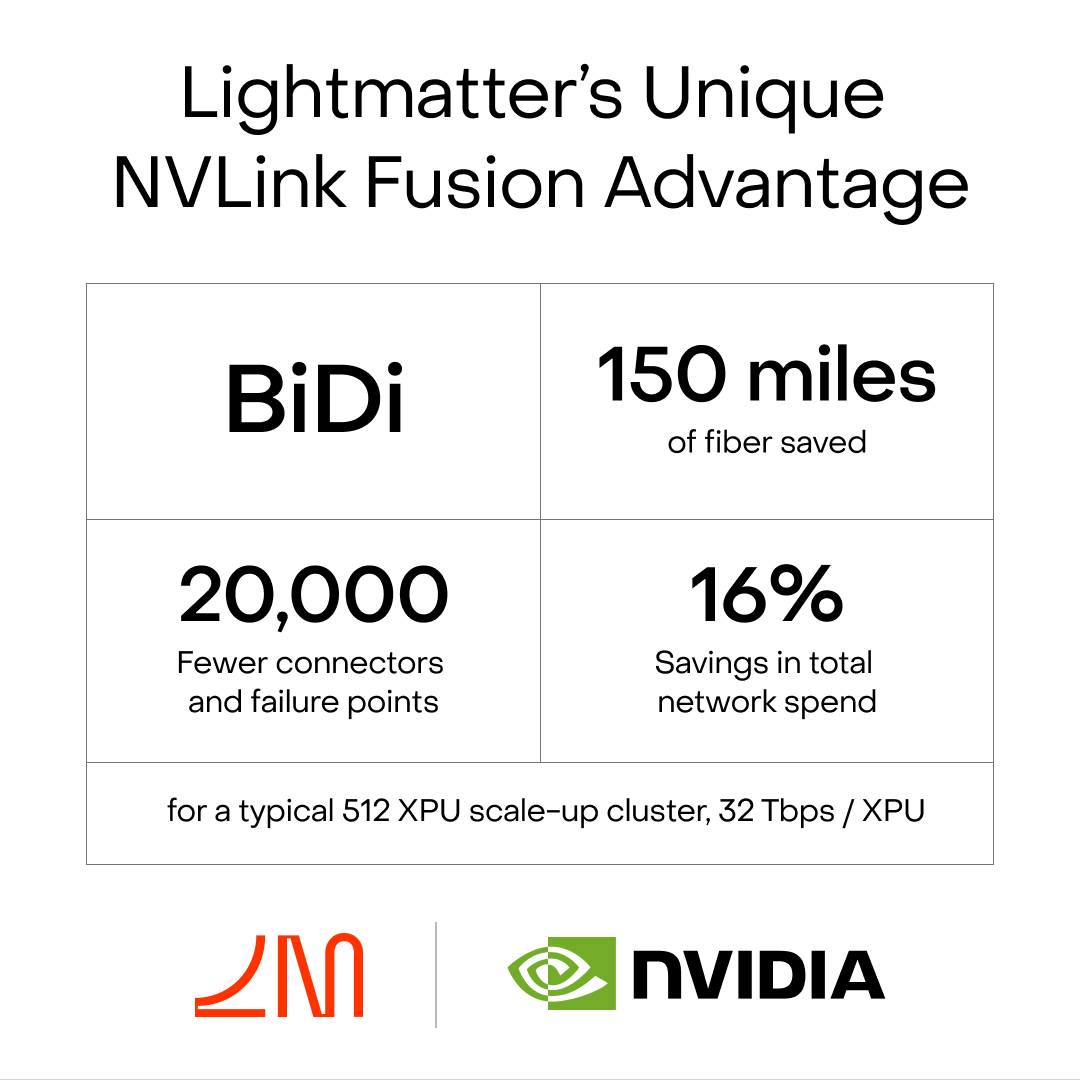
The future of AI scale-up is optical. With global fiber supply already strained, how you transition to photonic interconnects matters. Lightmatter's industry-leading Passage BiDi architecture, built for NVIDIA's NVLink Fusion ecosystem, was designed for exactly this constraint. By enabling simultaneous bidirectional signaling over the same optical paths, our BiDi links cut required optical fibers and connectors in half. “Integrating Lightmatter’s advanced photonic engines into the NVLink Fusion ecosystem provides our partners and hyperscale customers with more choice and flexibility to build specialized, energy-efficient AI infrastructure at unprecedented scale.” –Ashish Karandikar, Vice President of Engineering, NVIDIA lightmatter.co/press-release/… #BiDi #SiliconPhotonics #AIHardware #NVIDIA #NVLinkFusion
Lightmatter tweet media
English
1
12
39
1.1K
Trajectory AI retweetledi
Investing visuals
Investing visuals@InvestingVisual·
Trump “build, bring, or buy all of the energy needed for building and operating data centers” The energy market map: • Fuel cell: $BE, $FCEL • Storage: $FLNC, $TSLA, $ETN, $AES • Turbine: $GEV, $ENR, $CAT, $CMI, $CGEH • Utilities: $CEG, $VST, $NEE, $BEP Bullish energy.
Investing visuals tweet media
The White House@WhiteHouse

President Donald J. Trump is calling on the leading U.S. AI companies to build, bring, or buy all of the energy needed for building and operating data centers, ensuring American consumers are protected from price hikes.


English
6
46
198
29K
Trajectory AI retweetledi
Peter Bordes
Peter Bordes@PeterBordes·
Holy $NIXX shit this is beyond #AI HUGE 🚀Posted on LinkedIn by the CEO of Tachyon. Very very smart strategy building the next generation of AI infrastructure as an integrated ecosystem. Taken directly from the $NVDA strategy and play book. linkedin.com/posts/shahalkh…
Peter Bordes tweet media
English
2
16
45
2.8K
Trajectory AI retweetledi
M1tanker
M1tanker@M1tanker1966·
$NIXX soon to be $TACC
M1tanker tweet media
English
1
5
22
1.4K