

𝔾𝔸𝔹𝔹𝕐✞🎩
2.2K posts

𝔾𝔸𝔹𝔹𝕐✞🎩
@UIlorah
AI/ML||Flare Believer🙂|| Join me bring the connection between Crypto and AI closer✨
Home Katılım Ekim 2023
331 Takip Edilen315 Takipçiler

@UIlorah Happy weekend chap, it is on pause for now. Comms will come in the coming days.
English
Flare Confidential Compute (FCC) is built for retail and institutions alike.
Flare ☀️@FlareNetworks
Institutions care about what happens around the transaction. Who was allowed to act. What code ran. How keys were protected. What proof exists. Flare Confidential Compute (FCC) is built for that.
English
𝔾𝔸𝔹𝔹𝕐✞🎩 retweetledi

Earlier today, the FAssets system was automatically paused following a security alert triggered by our monitoring partner, Hypernative.
The pause was triggered as designed under existing configurations. Subsequent review, including analysis by Hypernative, confirmed that no risk materialized for FAssets and it was safe to unpause. No vulnerabilities were identified in the FAssets or FXRP contracts, and no user funds were affected.
Following governance approval, the system has been safely unpaused and is now fully operational.
English

Nano Banana is FREE.
Claude AI is FREE.
Perplexity AI is FREE.
DeepSeek is FREE.
Recraft V3 is FREE.
NotebookLM is FREE.
Kling 3.0 is FREE (daily credits).
Voicebox is FREE (offline).
n8n is FREE (open-source).
OpenClaw is FREE (local agents).
Windsurf is FREE (AI coding).
LM Studio is FREE.
DaVinci Resolve is FREE.
OBS Studio is FREE.
Figma is FREE.
Notion is FREE.
Cloudflare is FREE.
Vercel is FREE (hosting).
Systeme io is FREE.
Beehiiv is FREE (starter).
Tavily is FREE (research).
Stripe is FREE (to set up).
GitHub is FREE.
Gumroad is FREE.
Discord is FREE.
Start Your Business Today.
The internet is your free university.
Start building today.
English

FDC uses FLR.
FAssets use FLR.
FSA uses FLR.
FCC uses FLR.
More usage → more $FLR consumed.
The flywheel is usage-driven.
And it's kicking into high gear.
Flare ☀️@FlareNetworks
FDC uses FLR. FAssets use FLR. FSA uses FLR. FCC uses FLR. More usage → more FLR consumed. The flywheel is usage-driven. And it's kicking into high gear.
English
@0x_boyalone @PerleLabs Good thread 🧵
As I am someone that's into ai, Data is the most important part in artificial intelligence 👏🏽
English

$50/week reply guy needed!
engage with this post.
Don3x@don3x_1
can you accept $50 weekly as a reply guy? more info soon.
English

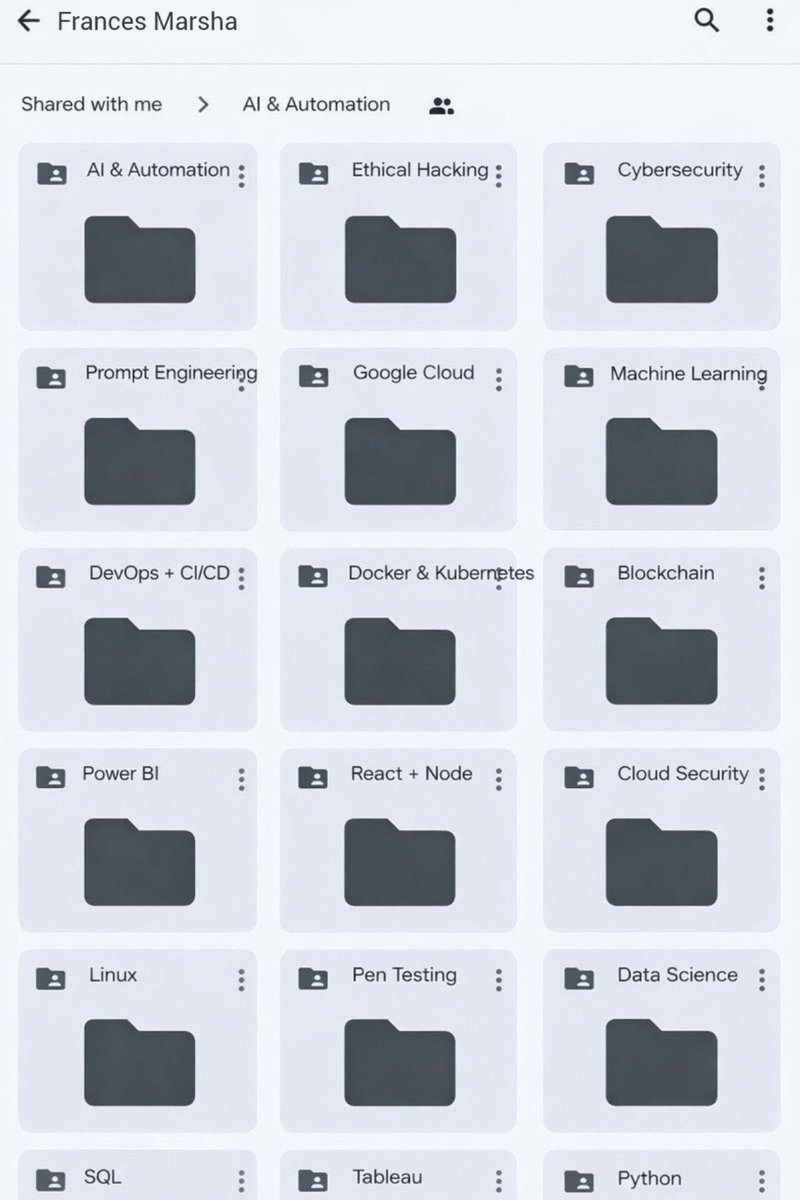
🚨 119𝐆𝐁+ 𝐆𝐎𝐎𝐆𝐋𝐄 𝐃𝐑𝐈𝐕𝐄 — 𝐀𝐋𝐋 𝐏𝐀𝐈𝐃 𝐂𝐎𝐔𝐑𝐒𝐄𝐒 🚨
𝐌𝐢𝐬𝐬𝐞𝐝 𝐢𝐭 𝐥𝐚𝐬𝐭 𝐭𝐢𝐦𝐞? 𝐈’𝐦 𝐝𝐫𝐨𝐩𝐩𝐢𝐧𝐠 𝐢𝐭 𝐚𝐠𝐚𝐢𝐧. 👌
This vault helped agencies close $9K+ clients using proven systems.
Inside the Drive:
📁 AI & Automation
📁 Ethical Hacking
📁 Cybersecurity
📁 Prompt Engineering
📁 Google Cloud
📁 Machine Learning
📁 DevOps + CI/CD
📁 Docker & Kubernetes
📁 Blockchain
📁 Power BI
📁 React + Node
📁 Cloud Security
📁 Linux
📁 Pen Testing
📁 Data Analytics
📁 Data Science
📁 Big Data
📁 SQL
📁 Tableau
📁 Python
📁 AWS
📁 Java
Everything organized. Everything premium. 119GB+ value.
Get it:
✔ Follow me [MusT]
✔ Like & RT+bookmark
✔ Comment “ NEED ” To Get Auto DM.
⚠️ No follow = No Access ⚠️
English

ARMchain is hiring Ambassador!!
Possible reward: $200 monthly
The team is looking for passionate contributors worldwide to help grow the ARMchain quantum-secure blockchain.
Are you one? Tap in:
• Follow, like & tag frens
• Fill the form: docs.google.com/forms/d/e/1FAI…

English
𝔾𝔸𝔹𝔹𝕐✞🎩 retweetledi


English

English
𝔾𝔸𝔹𝔹𝕐✞🎩 retweetledi
Last call — almost 24 hours left.
Explain stXRP in one standalone tweet.
Best explainers win a custom @Ledger wallets.
(Feel free to reply here with a link to your tweet or tag @FlareNetworks + @Firelightfiso so we don’t miss it.)

English

BREAKING NEWS 🔥🔥
OneAsset @OneAsset_io has officially opened an application for beta access to 500 testers. Early birds get priority in Cohort 1.
OneAsset is building a compliant infrastructure for tokenizing commercial real estate investment onchain and making it accessible to everyone globally.
✅ First cohort gets priority access
✅ Rewards for verified testers
✅ Synthetic environment testing
Apply in here👇🏿
tally.so/r/b57XB6
OneAsset@OneAsset_io
The gates are opening. 🚨 BETA ONBOARDING IS LIVE We’re opening controlled Beta access to 500 testers. Early birds get priority in Cohort 1. ✅ First cohort gets priority access ✅ Rewards for verified testers ✅ Synthetic environment testing Join the whitelist: tally.so/r/b57XB6
English
𝔾𝔸𝔹𝔹𝕐✞🎩 retweetledi
Strong analysis.
What matters here is observable risk.
FXRP’s design moves backing from assumption → onchain enforcement, while the vault layer adds constrained, transparent execution.
For builders targeting XRPL users, this is the kind of infrastructure that makes real DeFi products viable on @FlareNetworks.
Flare Devs@FlareDevHub
Builders: a new partner analysis from @ClearstarLabs breaks down the FXRP vault stack (Upshift + Flare) as an infrastructure case study. If you’re building for XRPL users, the key point is this: Non-native assets introduce a representation layer between the source chain and the DeFi execution environment. In many designs, that layer can fail discontinuously, which means downstream protocols can’t rely on gradual risk controls. FXRP is a collateral-backed representation of XRP where backing is enforced onchain: agents must maintain required collateral levels, and if they don’t, the protocol can liquidate or penalize them according to defined rules. This makes the backing status continuously observable onchain instead of assumed. Finally, the vault layer can be framed as constrained execution: strategy steps are explicit, permissions and risk limits are defined, exit paths are specified, and predefined safety controls trigger when thresholds are hit. 📰 Read more here: clearstar.xyz/partners/partn…
English