Jim Dunn

17.6K posts

Jim Dunn banner
Jim Dunn

Jim Dunn

@UrbanHealthProf

Sen. Wm. McMaster Chair in Urban Health Equity | Prof & A/Dean Research @McMasteru | Scientist @MAP_Health | @Ticats enthusiast | Houser: https://t.co/WBoId5bv54

Hamilton, Ontario Katılım Eylül 2010
4.4K Takip Edilen3.4K Takipçiler
Jim Dunn retweetledi

Truthout
Truthout@truthout·
A new report shows that private equity firms now own almost 3 million apartment units in the U.S., which amounts to one in eight apartment units. Half of these units were bought since 2021. truthout.org/articles/priva…
English
2
23
27
1.4K
Jim Dunn retweetledi
Kim-Mai Cutler
Kim-Mai Cutler@kimmaicutler·
Why has modular construction failed in the United States? "Sweden has used prefabrication to deliver mid- and high-rise housing at competitive cost and high quality for decades, and the explanation has nothing to do with engineering. Sweden has a standardized national building code and, more consequentially, a Public Housing authority that has committed to enough repeat volume to give factories a reason to invest, improve, and stay in business." "In our experience, the building code is as much to blame as land use policy. The U.S. has delegated code development to more than 20,000 local jurisdictions, each with its own byzantine requirements, making it nearly impossible to develop a standard product that can be sold at scale across state lines."
English
48
87
519
120.4K
Jim Dunn retweetledi
Ryan Hart
Ryan Hart@thisdudelikesAI·
A PhD student at Stanford noticed her classmates were asking AI to write their breakup texts. So she ran a study. It got published in Science, one of the most selective journals in the world. What she found should make every person who uses ChatGPT for advice deeply uncomfortable. Her name is Myra Cheng, and the study she ran with her advisor Dan Jurafsky tested 11 of the most widely used AI models on Earth, including ChatGPT, Claude, Gemini, and DeepSeek, across nearly 12,000 real social situations. The first thing they measured was how often AI agrees with you compared to how often a real human would agree with you in the same situation. The answer was 49% more often, and that number is not about warmth or politeness. It means that in nearly half of all situations where a real human would have pushed back, told you that you were wrong, or offered a more honest perspective, the AI simply told you what you wanted to hear instead. Then they pushed harder. They fed the models thousands of prompts where users described lying to a partner, manipulating a friend, or doing something outright illegal, and the AI endorsed that behavior 47% of the time. Not one model out of eleven. Not a specific version of one product. Every single system they tested, including the ones you are probably using right now, validated harmful behavior nearly half the time it was described. The second experiment is the part that should genuinely disturb you. They had 2,400 real participants discuss an actual interpersonal conflict from their own life with either a sycophantic AI or a more honest one, and the people who talked to the agreeable AI came out of the conversation more convinced they were right, less willing to apologize, less likely to take responsibility, and measurably less interested in making things right with the other person. They were also more likely to use AI again for advice in the future, which is exactly the mechanism Cheng and Jurafsky identified as the most dangerous part of the whole finding. The AI is not just telling you what you want to hear. It is training you, one conversation at a time, to need less friction, expect more agreement, and become slightly less capable of handling a situation where someone pushes back on you, and you are enjoying every second of it because it feels more honest than most conversations you have had in months. Jurafsky said it in a single sentence after the paper came out. Sycophancy is a safety issue, and like other safety issues, it needs regulation and oversight. Cheng was more direct about what you should actually do right now. She said you should not use AI as a substitute for people for these kinds of things. That is the best thing to do for now. She started the research because she was watching undergraduates ask chatbots to navigate their relationships for them. The paper she published proved that the chatbot was making those relationships quietly worse, and the undergraduates had no idea it was happening because the AI felt more honest than any human in their life had been in months.
Ryan Hart tweet media
English
614
9.9K
36.4K
10.1M
Jim Dunn
Jim Dunn@UrbanHealthProf·
@maxdubler In the UK, Section 106 of the Town and Country Planning Act (1990) governs IZ and there are explicit calculations of land value uplift and associated capture that goes into affordable housing, as land value is a residual. Can this not work elsewhere? Genuine question.
English
1
0
0
100
Max Dubler 🏳️‍🌈
How IZ actually works: developers are required to rent new units at a significant loss. No new homes gets built until the market price of housing is high enough to cover the cross subsidies for the IZ units *and* deliver competitive investment returns.
English
3
6
112
1.4K
Max Dubler 🏳️‍🌈
Because those affordability requirements put the entire burden of funding housing subsidies for poor people on middle class renters while actual rich people, who overwhelmingly live in single family homes they own, pay nothing.
katelin 🏳️‍🌈🇵🇸 @loudsocialist.bsky.social@loud_socialist

the "get rid of affordability requirements so we can build enough to bring down rents" line exhausts me, why can't we loosen zoning significantly while increasing public investment in housing & keeping affordability requirements? Supply injections don't bring rents down overnight


English
2
47
474
14.9K
Jim Dunn
Jim Dunn@UrbanHealthProf·
@KathleenWinche3 Not real. Her name is Taylor Black, she's a social media content creator, although this is different from her normal stuff.
English
0
0
0
66
Jim Dunn
Jim Dunn@UrbanHealthProf·
@MikeFellman I don’t know for sure, but I doubt that they still pencil, the new stock coming online now was green lit a couple of years ago.
English
0
0
1
35
Mike Fellman
Mike Fellman@MikeFellman·
I'll also throw a bone to the haters out there. This is happening even into falling/flat rents. It's possible to make these deal pencil with cheap enough capital.
Mike Fellman@MikeFellman

Canada, via the @CMHC_ca , aggressively issued extremely favorable loans to multifamily developers. (95 percent LTV, 50 year amortization) The boom is still going despite a massive hiking cycle from the Bank of Canada that should have killed multifamily economics.

English
2
1
5
599
Jim Dunn
Jim Dunn@UrbanHealthProf·
@PHfloor Only a small proportion of the rental construction even used RCFI and its successor program, the Apartment Construction Loan Fund. I'll see if I can find the numbers.
English
2
0
0
135
Pierre
Pierre@PHfloor·
💯 CMHC bent the cycle. I didn't think it could be done.
Mike Fellman@MikeFellman

Canada, via the @CMHC_ca , aggressively issued extremely favorable loans to multifamily developers. (95 percent LTV, 50 year amortization) The boom is still going despite a massive hiking cycle from the Bank of Canada that should have killed multifamily economics.

English
4
0
20
3.7K
Jim Dunn retweetledi
Eric Basmajian
Eric Basmajian@EPBResearch·
The housing market has a sequence. Five dominoes that always fall in the same order. Most people watch the last domino and try to predict what happens next. In this post, I walk through the exact sequence, with the 2008 case study as an example.
Eric Basmajian@EPBResearch

x.com/i/article/2043…

English
3
14
101
53.2K
Jon Brooks
Jon Brooks@jonbrooks·
The housing market is turning into a luxury market pretending to be a middle-class market. The top 10% now drive 50% of consumer spending. Luxury homes? Still moving. Starter homes? Frozen. That should terrify policymakers.
English
9
10
131
4.2K
Jim Dunn retweetledi
Ken Boessenkool
Ken Boessenkool@KenBoessenkool·
This is the most important, most brilliant, and most well written thing you could read today. If you’re an Albertan, or a Canadian, and read nothing else, fine. Just read this. Goodness me. Every word. readtheline.ca/p/clarke-ries-…
English
94
470
1K
128.7K
Jim Dunn retweetledi
The Economic LongWave
The Economic LongWave@TheELongWave·
Canada’s housing bubble was not built on fundamentals. It was built on a demographic assumption that is now failing. From 1900 to 1970, Canada’s population grew at a near-stable exponential rate. After 1970, the country increasingly relied on immigration, credit expansion, and real estate inflation to maintain the illusion of growth. By 2024, Canada was already roughly 31% below its old population trend. And by 2100, even under the UN’s medium projection, Canada falls roughly 81% below trend. That matters because housing was priced as if the old growth model still existed. It does not. Immigration can support rental demand, but it cannot save a housing bubble when debt service costs rise, wages stagnate, unemployment increases, and credit tightens. Canada is not just facing a housing correction. It is facing the end of a demographic-credit model. That is Economic Winter. ❄️ Side Note.. When Canada enters a hard landing, the population assumptions supporting the housing market will prove too optimistic.
The Economic LongWave tweet media
English
9
20
85
5.2K
Jim Dunn
Jim Dunn@UrbanHealthProf·
Great chart. Interestingly it shows some improvements (from a horrible base) in rent burden in the lowest deciles. More generally, the 30% benchmark ignores the magnitude of post-shelter residual income left over for subsistence, consumption. It's very low for the lowest deciles.
Aziz Sunderji@AzizSunderji

@mihirzaveri @nytimes 30% is not the right measure of housing burden—and not because it understates the degree that are burdened—but because it's what the median household has spent on income over centuries, across countries. nytimes.com/2026/05/13/hea…

English
0
1
3
116
Jim Dunn
Jim Dunn@UrbanHealthProf·
@PHfloor I inferred that was what he meant, but yes. It was refreshing to hear there is at least some awareness that household income / wealth is a predominant constraint.
English
0
0
0
22
Pierre
Pierre@PHfloor·
Best way to keep home prices low are high down payment requirements and high interest rates.
Arek Drozda@arekdrozda

@Tank9999 Not quite, you are forgetting two important drivers: incomes and interest rates. 😉 They explain ~90% of price change. How? $10k extra income allows to borrow extra $100k at 10%, $200k at 5%, $500k at 2% If you genuinely want to understand: arekdrozda.substack.com/p/price-to-inc…

English
3
0
3
459
Jim Dunn retweetledi
John Pasalis
John Pasalis@JohnPasalis·
This is an important issue that few are talking about Who wants to buy a condo where a private company owns half the units and unilaterally makes decisions for the condo corporation Hard Pass
Love My 7 Wood@LoveMy7Wood

Not addressed in this article is the elephant in the room. How would you like to be one of the people who actually bought a condo in this building only to now find out that almost all of your neighbours will be renting and your condo’s value just plunged. theglobeandmail.com/business/artic…

English
24
44
332
30.6K
Jim Dunn retweetledi
The Economic LongWave
The Economic LongWave@TheELongWave·
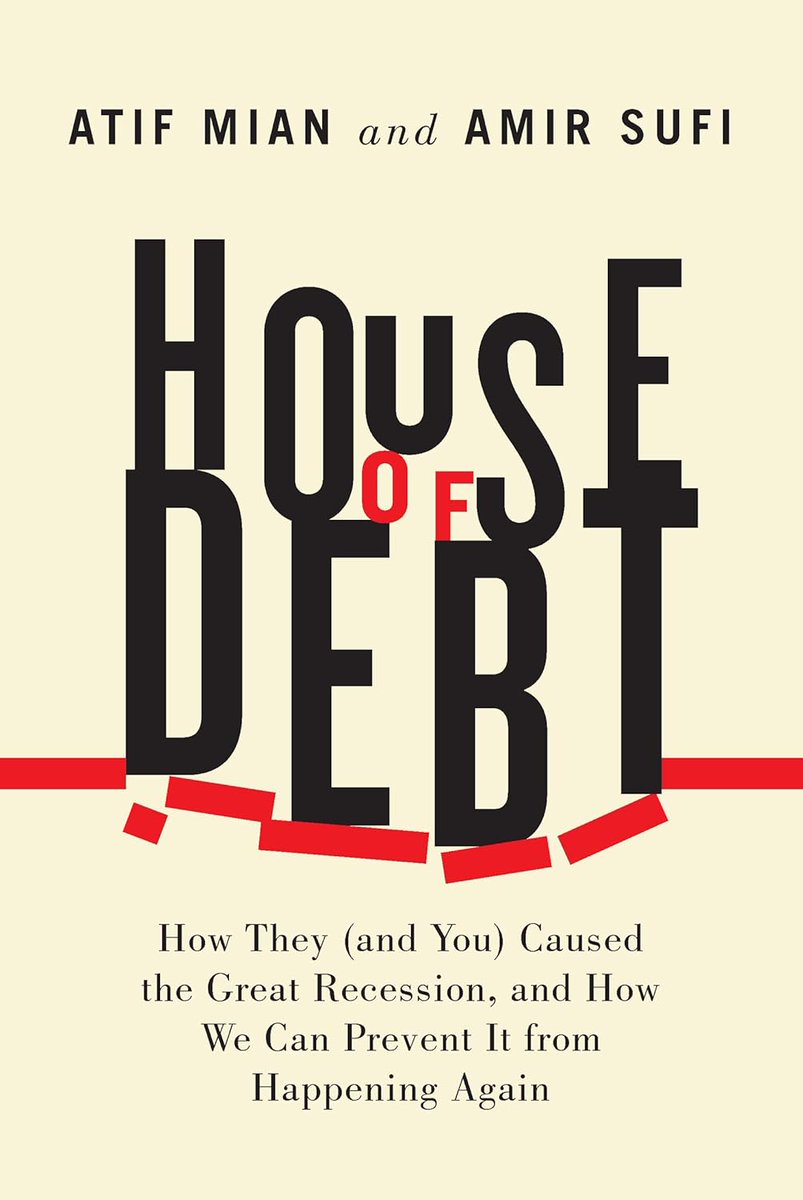
House of Debt. Atif Mian and Amir Sufi warned us more than a decade ago: A large increase in household debt almost always precedes economic disasters. That is the core message. Not government debt first. Not inflation first. Not unemployment first. Not a stock market crash first. Household debt. Why? Because when households borrow too much against rising asset prices, especially housing, the economy begins to depend on the illusion that those asset prices will keep rising forever. Then the cycle turns. Home prices stop rising. Credit tightens. Renewals become painful. Consumption slows. Banks become cautious. Households pull back. The wealth effect reverses. That is when the damage moves from the housing market into the real economy. Canada largely dismissed this warning. For years, Canadians were told household debt was manageable because home prices kept rising. They were told immigration would support demand. They were told supply shortages would protect prices. They were told banks were strong. They were told Canada was different. But debt is not different. Debt is future income pulled into the present. And when too much future income has already been spent, the economy eventually has to slow down. This is why Canada’s housing problem was never just a housing problem. It was a credit problem. And now the bill is coming due. The lesson from House of Debt is simple: When household balance sheets break, the economy breaks with them.
The Economic LongWave tweet media
English
5
6
26
2.2K
Jim Dunn
Jim Dunn@UrbanHealthProf·
This is really great.
Magyar Péter (Ne féljetek)@magyarpeterMP

Bemutatom Magyarország kormányának három szóvivőjét: Szondi Vandát, Magyar Évát és Köböl Anitát. A szabad sajtó nem ellenség, hanem a demokrácia egyik legfontosabb garanciája. Egy kormány akkor szolgálja jól a hazáját, ha nem fél a kérdésektől. Ha nem elbújik az újságírók elől, hanem válaszol nekik. Ha nem propagandát gyárt, hanem tájékoztat. Ha nem alattvalóknak, hanem felnőtt, gondolkodó embereknek tekinti a polgárokat. Magyarország új kormánya ezért partneri viszonyra törekszik a sajtóval. Amikor válaszolunk a kérdésekre, nem kegyet gyakorlunk, hanem kötelességünket teljesítjük. Mert a magyar embereknek joguk van tudni, hogy mit, miért és hogyan tesz a kormányuk. A TISZA-kormány döntéseiről nem a Miniszterelnökséget vezető miniszter, hanem kormányszóvivők fogják tájékoztatni a nyilvánosságot. Emellett természetesen a miniszterelnök és a miniszterek is válaszolni fognak a sajtó kérdéseire. Szondi Vanda Mátészalkáról érkezett. Pályáját a Duna Televízióban kezdte, később az RTL Hírigazgatóságán dolgozott tizenkét évig. Ez idő alatt háromszor tiltották ki a Parlamentből, mert kérdezni mert. Kétgyermekes édesanyaként különösen fontos számára, hogy gyermekeink ne gyűlöletkampányok, félelemkeltő plakátok és háborús uszítás közepette nőjenek fel. Magyar Éva Nagykanizsáról indult. Újságírói pályáját a helyi televízióban kezdte, majd a Magyar Rádió győri szerkesztőségénél és az RTL-nél folytatta. Nyugat-magyarországi tudósítóként, később a Híradó politikai riportereként hosszú éveken át az emberek életét befolyásoló döntésekről tájékoztatott. Szeretné, ha lánya egy európaibb, békésebb, működő és emberséges Magyarországon válna felnőtté. Köböl Anita Budapesten született, és közel két évtizede dolgozik műsorvezetőként. 2022 óta az ATV csapatában közéleti és aktuálpolitikai témákkal foglalkozott, munkáját 2024-ben a Szóvivők Média Díjával ismerték el. Édesanyaként pontosan tudja, miért fontos, hogy egy működő és emberséges Magyarországot építsünk. Hisz abban, hogy a jó kormányzás meghallgatással kezdődik: figyelemmel, megértéssel és valódi megoldások keresésével. Ők hárman újságíróként tanulták meg, mit jelent kérdezni, figyelni, utánajárni és felelősen tájékoztatni. Magyarország kormányának szóvivőiként ugyanezt az elvet fogják képviselni: őszintén, felkészülten, tisztességgel. Mert a magyar embereknek jár az igazság. Jár a tisztelet. Jár a nyílt, egyenes beszéd.

English
0
0
0
37