

Vetle Haram | Psychology x Biology
216 posts

Vetle Haram | Psychology x Biology
@VetleHaram
Study-based insights on Psychology, Behaviour, Stress, Focus, Sleep, and Human Biology. Helping people think better and perform better.
Katılım Aralık 2021
38 Takip Edilen50 Takipçiler

Progress achieved in 1 day in May 2026 is equal to:
> 19 days in 2000
> 1.6 years in 1900
Derived from a geometric mean across 8 metrics: compute per dollar, DNA sequencing throughput per dollar, frontier AI training scale, papers published per day, patents filed per day, internet-connected humans, global GDP, drugs in clinical pipeline.
The number is domain dependent. If in AI or biology it's closer to 3,000x and 3x in courts and real estate.
I'm not saying the above numbers and formulation are correct. In fact, there are a bunch of things wrong with it. For example, GDP and DNA sequencing are not the same kind of thing. Patent counts in 2026 are inflated by defensive filing and AI generated applications. Research output per researcher is declining 5% per year in many fields. Drug pipelines have long timelines that compute can't all together eliminate. A large percent of current compute and papers is spent maintaining existing complexity, not creating new capability.
I'm more just curious. Has anyone built a formal model for progress density as a function of time that helps build intuitions?
English
Vetle Haram | Psychology x Biology retweetledi

Brain scans are revealing early dementia-like changes in kids and teens from heavy screen use.
60 Minutes Australia reported toddlers spending just 2–3 hours daily on devices already show abnormal white matter development. Teens averaging 6–8 hours display widened brain ridges and thinning in key areas — patterns that mirror early Alzheimer’s.
Excessive screens appear to weaken neural pathways that normally strengthen through real-world movement, play, and face-to-face interaction.
We’re also seeing the first IQ drops in recorded history, plus a nearly 400% rise in early-onset dementia signs among 35–44 year olds. Correlation, not proven causation — but devices are the major new variable.
This is one of those reports that makes you rethink default habits. The convenience of screens is undeniable, but the potential long-term brain impacts on developing kids are hard to ignore.
We may be unintentionally running a massive experiment on the next generation’s cognitive health.
Are we underestimating the risks of heavy screen time, or is this concern overblown?
English
Don’t be nonchalant
Nicholas Fabiano, MD@NTFabiano
Emotional suppression is associated with an earlier death.
English
Vetle Haram | Psychology x Biology retweetledi

Being addicted to your phone is associated with decreased brain volume and activity.

English
A man need not explain his excellence
He provides a sample of what he is capable of
English
Vetle Haram | Psychology x Biology retweetledi

a huge part of biohacking and performance optimization that people seem to forget is that the reason you're doing it is so you can GO HARD AS FUCK
why spend all this time and all this money optimizing your energy if not to EXPEND IT?
why invest all this effort in optimizing your sleep if you're not going to DO MORE DURING YOUR WAKING HOURS?
why the fuck spend all this energy on improving your focus if you're not going to BUILD SOMETHING SPECTACULAR?
don't keep the vitality in the bank. spend it on things that matter.
optimize your sleep so you can afford to go 2 days without it when you're in flow.
optimize your energy so you can go harder during the day.
optimize your focus so you can build something the world has never seen before.
STACK IT TO SPEND IT


English

This is a green-light to doomscroll on X

Mushtaq Bilal, PhD@MushtaqBilalPhD
Watching TikTok videos damages your prospective memory — the ability to remember to perform a planned task. Using Twitter doesn't.
English
Vetle Haram | Psychology x Biology retweetledi

Given the immense interest in peptides and divergent views about peptides of various types, I assembled a small collection of experts that I’ll be talking to (separately) on the podcast. No matter what your stance is on peptides, it’s wise get educated! They are definitely here to stay!
English
Vetle Haram | Psychology x Biology retweetledi

You check your Apple Watch in the morning. Sleep score: 62. You decide it's going to be a foggy day. And then it is.
A 2014 Colorado College study suggests the score itself causes the fog.
164 people walked into a lab. Researchers hooked them up to fake EEG equipment and told them the readout would show their REM percentage from the night before. Then they fabricated a number. Half the room was told 28.7%. Half was told 16.2%. The machine wasn't measuring anything.
Participants took four cognitive tests. The Paced Auditory Serial Addition Test, where you add numbers spoken at increasing speed and hold your last sum in working memory while computing the next. And the Controlled Oral Word Association Task, where you generate as many words as you can starting with a single letter under time pressure. Both are gold-standard measures of attention and executive function used in clinical neurology.
The 28.7% group outperformed the 16.2% group on both. Significantly. How rested participants actually felt that morning predicted nothing.
The mechanism is mindset priming an executive resource. When you believe you slept well, you allocate cognitive effort more aggressively. You don't conserve. You don't pre-disengage. Belief about the resource changes how you spend it.
Two control conditions ruled out demand characteristics. Participants weren't trying harder because they thought they should. Real measurable cognitive performance shifted with the number on the readout.
The Apple Watch sleep score. The Oura ring readiness number. The morning ritual of checking either one is taxing the resource you're about to need.
The performance gap from a fabricated REM percentage was larger than the gap from how rested participants actually felt. The number was louder than the night.


English
Vetle Haram | Psychology x Biology retweetledi

It’s crazy how much your mood changes just by going outside.
Sunlight. Movement. Random conversations.
You realize your problems weren’t that deep…
You were just stuck in your room for too long.
English
@BasedBiohacker Bruh, i left the exam 15 minutes ago,
can’t have shit in Detroit
English
i hereby challenge you to read 100 pages and work for 12 hours today. you may not piss or eat until the task is completed to the best of your abilities
good luck.
English
@metabolic_print Cutting away 90% of my seed oil consumption and adding ttfd B1 has genuinely been a godsend
English

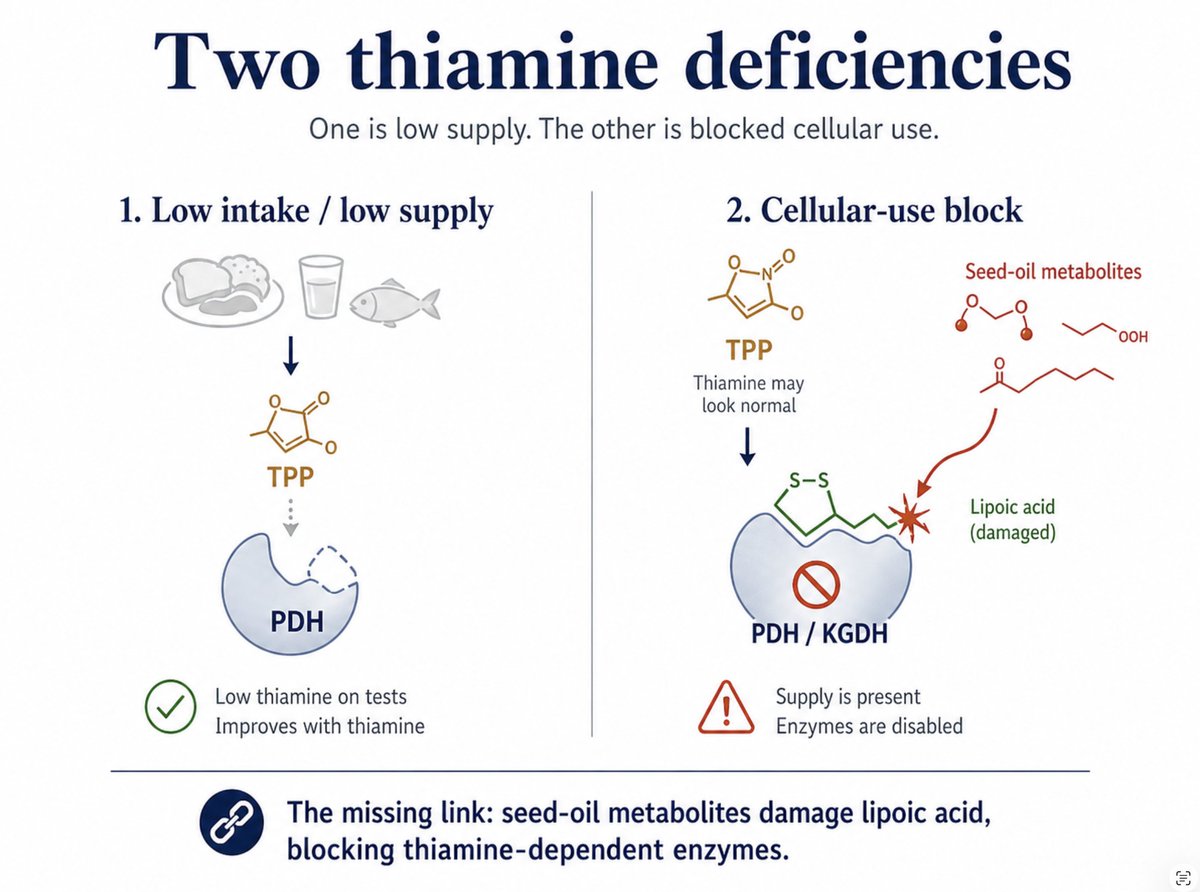
There are two types of thiamine deficiency, and the second one is very underexplored.
The first thiamine deficiency is an input problem.
Caused by inadequate intake, malabsorption, alcoholism... it is often detectable with testing, and fixes rapidly with supplementation.
The second thiamine deficiency is a consumption problem.
Caused by a high tissue seed oil load generating chronic aldehyde load, which destroys thiamine directly, inactivates the thiamine-dependent enzymes through lipoic acid modification, and increases demand through an antioxidant pathway.
More in my deep-dive article, link in first reply.
Elliot Overton@EO_Nutrition
Seed oils/PUFA = Hidden cause of widespread thiamine deficiency? 🧵 Mind blown New research suggests that high intake of unsaturated fats can trigger deficiency in vitamin B1 I have been studying this intensively for 8 years, and this was not on my radar. No one was expecting this But it might explain why so many people benefit from supplementation Everyone thinks refined carbohydrate/sugar and alcohol are the obvious culprits But what if it was also unsaturated fats? This would mean that people eating the standard American diet are getting cooked from two angles: - Empty calories coming from glucose, which places demand on thiamine-dependent metabolic pathways - Indirect depletion via PUFA/seed oils Here is the evidence:
English

@Dexerto @ Ray Peat, please respond 🫣🫣
Save us Ray Peat
English



You think cognitive decline is a brain problem. It is not.
The signal often starts in your gut.
When microbial diversity drops, short-chain fatty acid production falls with it. That weakens the intestinal barrier. Lipopolysaccharides enter circulation, activate immune signaling, and reach the brain. Microglia shift into a pro-inflammatory state. Amyloid deposition accelerates. Tau phosphorylation follows.
You experience it as “slower thinking.”
What is actually happening is a breakdown in the gut–brain axis that has been building for years while your output remained high.
Exercise does not “improve brain health.”
It remodels the microbial ecosystem, restores barrier integrity, increases SCFA production, and suppresses systemic inflammation before it reaches neural tissue.
The intervention is peripheral.
The consequence is cognitive.
And it starts long before you notice it.

English
@MarcusMilione Imagine doing your best run ever
even getting under 2h which nobody has ever done in human history
only to be forgotten since there was a guy 11 seconds ahead of you.
English

The sub 2 hour marathon barrier has been broken in London
Sabastian Sawe: 1:59:30
Yomif Kejelcha: 1:59:41
4:34/mile for 26.2 miles... insane
English