Waleeed

129 posts

Waleeed

Waleeed

@Waleeedxd

Katılım Kasım 2025
0 Takip Edilen1 Takipçiler
Waleeed
Waleeed@Waleeedxd·
@lastholder36889 @avidseries It's even worse than that; females will adopt such high materialistic standards that they will try to associate only with males who are generally wealthier than themselves.
English
0
0
0
37
lastholder
lastholder@lastholder36889·
@avidseries Men who win the lottery will experience a sharp increase in attractive members of the opposite sex pursuing them. Women who win the lottery won't.
English
4
0
12
693
i/o
i/o@avidseries·
This is a good description of our new reality: Under ideal financial circumstances, men will want marriage and a family; under similarly ideal circumstances, women won't. Does this reveal true preferences? Conservatives will hate this, but it may be the case that those traditional social expectations women faced back when they had much fewer options, may have actually been oppressive. And the evidence for this is that as soon as women are able to escape those expectations, they do — and we're seeing the result around the modernizing world in plummeting fertility rates.
Whyvert@whyvert

Newly published: men who win the lottery are more likely to get married and have children. Women who win the lottery aren't. As in the Baby Boom: there was good income for young men (but not women) which boosted marriage and fertility.

English
391
122
1.4K
450K
Waleeed
Waleeed@Waleeedxd·
@AntiCommieBecca @RoyDe37440 @avidseries Do you know why most Islamic countries suffer from the same problem of fertility decline? Of course, it is because you have poisoned them with your economic and social/cultural model, which is imposed on the whole world.
English
0
0
0
6
Chelsea Olivia Follett
Don't blame capitalism for falling birth rates: "fertility fell earlier and faster in socialist economies than in market economies. Socialist Hungary fell below replacement in 1960, and socialist Czechoslovakia in 1966 (both experienced small, short-lived baby booms in the mid-1970s)."
Jesús Fernández-Villaverde@JesusFerna7026

Smartphones are not the explanation for the recent decline in fertility. Instead, they are an accelerator of deeper forces already at work. Let’s start with the facts. Fertility is falling almost everywhere: in rich, middle-income, and poor countries; in secular and religious countries; and in countries with high and low levels of gender equality. The decline accelerated around 2014. So, no country-specific explanation will work unless you are willing to believe that 200 distinct country-specific explanations arrived at roughly the same time. Smartphones look like the obvious candidate: the first iPhone was released in 2007, and global adoption has been astonishingly fast. Economists understand the first major decline in fertility in advanced economies, from 6 or 7 children per woman throughout most of human history to about 1.8, that occurred between the early 1800s and roughly 1970, well before smartphones. The main drivers were a sharp fall in child mortality (effective fertility was rarely above 3 and often close to 2) and the shift from a low-skill, rural agrarian economy to a high-skill, urban industrial one. We have quantitative models that fit these facts well. Country-specific factors mattered too, of course. Proximity to low-fertility neighbors accelerated Hungary’s decline, while fragmented landowning structures accelerated France’s. But these were second-order mechanisms. This is also why most economists long considered Paul Ehrlich’s doom scenarios implausible. We forecast that fertility in middle- and low-income economies would follow the same path as in the rich, probably faster, because reductions in child mortality reached India or Africa at lower income levels (medical technology is nearly universal, and most gains come from handwashing and cheap antibiotics, not Mayo Clinic-level care). Much of what we see in Africa or parts of Latin America today is still that old story. But in the 1980s, a new pattern appeared. Japan and Italy fell below 1.8, the level we had thought was the new floor. By 1990, Japan was at 1.54 and Italy at 1.36. This second fertility decline began in Japan and Italy earlier than elsewhere, driven by country-specific factors, but the underlying dynamics were widespread: secularization, an education arms race, expensive housing, the dissolution of old social networks, and the shift to a service economy in which women’s bargaining power within the household is higher. The U.S. lagged because secularization came later, suburban housing remained relatively cheap, and African American fertility was still high. U.S. demographic patterns are exceptional and skew how academics (most of whom are in the U.S.) and the New York Times see the world. My best guess is that, without smartphones, Italy’s 2025 fertility rate would be about 1.24 rather than 1.14. I doubt anyone will document an effect larger than 0.1-0.2. Italy was at 1.19 in 1995, not far from today’s 1.14. The TFR is cyclical due to tempo effects, so I do not read too much into the rise between 1995 and 2007 or the decline from 1.27 in 2019 to 1.14 today. The direct effect of smartphones is not zero, but it is not, by itself, that large. Where social media, in general, and smartphones, in particular, matter is in the diffusion of social norms. What would have taken 25 years now happens in 10. Social media are not the cause of fertility decline; modernity is. But they are a very fast accelerator. That is why social media are a major part of the story behind Guatemala (yes, Guatemala) going from 3.8 children per woman in 2005 to 1.9 in 2025. Without them, Guatemala would also have reached 1.9, just 20 years later. Modernity, in its current form, is incompatible with replacement-level fertility. By modernity, I do not mean capitalism: fertility fell earlier and faster in socialist economies than in market economies. Socialist Hungary fell below replacement in 1960, and socialist Czechoslovakia in 1966 (both experienced small, short-lived baby booms in the mid-1970s). By modernity, I mean a society organized around rational, large-scale systems and formalized knowledge. Countries will not converge to the same fertility rate. East Asia is likely stuck near 1, possibly below, given its unbalanced gender norms and toxic education systems. Latin America faces the same gender problem plus weak growth prospects, so I expect something around 1.2. Northern Europe has more egalitarian family structures and might hold near 1.5. The very religious societies are probably the only ones that will sustain 1.8. All of this could change with AI or changes in population composition. We will see. But on the current evidence, deep sub-replacement fertility is the “new new normal.” Unless we reorganize our societies, better learn to handle it as best we can.


English
6
13
51
8K
Waleeed
Waleeed@Waleeedxd·
@JesusFerna7026 Any factor that you can think of as a cause of fertility decline is downstream of the economic model but you can push any retard scapegoat as you can but it won't change anything in the end.
English
0
0
0
543
Jesús Fernández-Villaverde
Jesús Fernández-Villaverde@JesusFerna7026·
Smartphones are not the explanation for the recent decline in fertility. Instead, they are an accelerator of deeper forces already at work. Let’s start with the facts. Fertility is falling almost everywhere: in rich, middle-income, and poor countries; in secular and religious countries; and in countries with high and low levels of gender equality. The decline accelerated around 2014. So, no country-specific explanation will work unless you are willing to believe that 200 distinct country-specific explanations arrived at roughly the same time. Smartphones look like the obvious candidate: the first iPhone was released in 2007, and global adoption has been astonishingly fast. Economists understand the first major decline in fertility in advanced economies, from 6 or 7 children per woman throughout most of human history to about 1.8, that occurred between the early 1800s and roughly 1970, well before smartphones. The main drivers were a sharp fall in child mortality (effective fertility was rarely above 3 and often close to 2) and the shift from a low-skill, rural agrarian economy to a high-skill, urban industrial one. We have quantitative models that fit these facts well. Country-specific factors mattered too, of course. Proximity to low-fertility neighbors accelerated Hungary’s decline, while fragmented landowning structures accelerated France’s. But these were second-order mechanisms. This is also why most economists long considered Paul Ehrlich’s doom scenarios implausible. We forecast that fertility in middle- and low-income economies would follow the same path as in the rich, probably faster, because reductions in child mortality reached India or Africa at lower income levels (medical technology is nearly universal, and most gains come from handwashing and cheap antibiotics, not Mayo Clinic-level care). Much of what we see in Africa or parts of Latin America today is still that old story. But in the 1980s, a new pattern appeared. Japan and Italy fell below 1.8, the level we had thought was the new floor. By 1990, Japan was at 1.54 and Italy at 1.36. This second fertility decline began in Japan and Italy earlier than elsewhere, driven by country-specific factors, but the underlying dynamics were widespread: secularization, an education arms race, expensive housing, the dissolution of old social networks, and the shift to a service economy in which women’s bargaining power within the household is higher. The U.S. lagged because secularization came later, suburban housing remained relatively cheap, and African American fertility was still high. U.S. demographic patterns are exceptional and skew how academics (most of whom are in the U.S.) and the New York Times see the world. My best guess is that, without smartphones, Italy’s 2025 fertility rate would be about 1.24 rather than 1.14. I doubt anyone will document an effect larger than 0.1-0.2. Italy was at 1.19 in 1995, not far from today’s 1.14. The TFR is cyclical due to tempo effects, so I do not read too much into the rise between 1995 and 2007 or the decline from 1.27 in 2019 to 1.14 today. The direct effect of smartphones is not zero, but it is not, by itself, that large. Where social media, in general, and smartphones, in particular, matter is in the diffusion of social norms. What would have taken 25 years now happens in 10. Social media are not the cause of fertility decline; modernity is. But they are a very fast accelerator. That is why social media are a major part of the story behind Guatemala (yes, Guatemala) going from 3.8 children per woman in 2005 to 1.9 in 2025. Without them, Guatemala would also have reached 1.9, just 20 years later. Modernity, in its current form, is incompatible with replacement-level fertility. By modernity, I do not mean capitalism: fertility fell earlier and faster in socialist economies than in market economies. Socialist Hungary fell below replacement in 1960, and socialist Czechoslovakia in 1966 (both experienced small, short-lived baby booms in the mid-1970s). By modernity, I mean a society organized around rational, large-scale systems and formalized knowledge. Countries will not converge to the same fertility rate. East Asia is likely stuck near 1, possibly below, given its unbalanced gender norms and toxic education systems. Latin America faces the same gender problem plus weak growth prospects, so I expect something around 1.2. Northern Europe has more egalitarian family structures and might hold near 1.5. The very religious societies are probably the only ones that will sustain 1.8. All of this could change with AI or changes in population composition. We will see. But on the current evidence, deep sub-replacement fertility is the “new new normal.” Unless we reorganize our societies, better learn to handle it as best we can.
Jesús Fernández-Villaverde tweet media
English
219
904
3.6K
856.3K
Speedy HQ
Speedy HQ@IShowSpeedHQ·
🚨| WATCH: Speed just met a fan from Botswana on Omegle, and his mom couldn’t believe it was actually him 😭🇧🇼
English
87
599
22.4K
487.3K
Waleeed
Waleeed@Waleeedxd·
@lugaricano omg it's the smartphone bunch of fuckn retards y'all just don't want to admit that the mean factor is always the shitty economic model imposed by the US and its allies. you are definitely some shitlib who is pro-status quo; we all know that, and nothing surprises me at all
English
0
0
3
1.4K
Luis Garicano 🇪🇺🇺🇦
No smoking gun, but the preponderance of evidence points to smartphones, not economics, as the culprit for the global drop in fertility: • In the US and UK, births fell first and fastest in areas that got 4G earliest • Birth rates were stable in the US, UK and Australia until 2007; in France and Poland until 2009; in Mexico and Indonesia until 2012; in Ghana, Nigeria and Senegal until 2013-15 Each of these inflection points matches local smartphone adoption (see picture). • The younger the age group, the sharper the drop. • in-person socialising among young adults is dropping. In SK, by 50% in 20 years • Sexual dysfunction is higher among heavy social media user • Effect is largest in culturally traditional societies — Middle East, Latin America, sub-Saharan Africa • Decline holds across countries hit hard by GFC 2008 and those not hit, fast-growing and not growing. Excellent again @jburnmurdoch. ft.com/content/fba35e…
Luis Garicano 🇪🇺🇺🇦 tweet media
English
310
1.1K
4.6K
1.4M
Waleeed
Waleeed@Waleeedxd·
@AntiFeminismAU Most American men are simp, and everyone knows that. This is why she has this entitled attitude.
English
0
0
1
5
Anti-Feminism Australia
Anti-Feminism Australia@AntiFeminismAU·
Entitled American woman is upset that Aussie men never approach her or buy her drinks.
English
221
26
459
26.3K
Waleeed
Waleeed@Waleeedxd·
@Rujo_ @punicist And there's nothing good about that, you degenerate retard
English
1
0
1
51
R
R@Rujo_·
@punicist American liberalism will engulf the world. Not by force, but through the internet.
English
2
0
20
2.9K
Magon
Magon@punicist·
Instagram Reels are westernizing the Arab world more than centuries of colonialism ever could have
English
52
373
8.8K
244.7K
Waleeed
Waleeed@Waleeedxd·
@missmommymolly >weight what a child weighs nah this just your white gay culture
English
0
0
0
11
Miss Molly 💗🌸
Miss Molly 💗🌸@missmommymolly·
Red pill men will complain about women having impossible standards because a random woman on a dating app said she wanted to be with someone tall, meanwhile men expect women to be hairless from the neck down, weight what a child weighs, starve themselves and work out 7 days a week but somehow still have huge breasts and butts, oh and it has to all be natural and somehow those standards are completely fine.
English
67
40
610
25K
Waleeed
Waleeed@Waleeedxd·
@pigglenutss @idc1070158 Did you know that sometimes a woman records this type of content? This is why the girl in this video doesn't notice anything, and also, there are many women in the store.
English
0
0
0
40
Pigglenuts
Pigglenuts@pigglenutss·
@idc1070158 What kind of fucking loser records these videos. Genuinely the saddest shit I've ever seen.
English
1
0
1
695
Waleeed
Waleeed@Waleeedxd·
@Ghostb_07 @yonann Most of those old guys either have no children and therefore do not care if they give bad advice, or all their children are girls or have boy he doesn't like and therefore they take the side of the women every time.
English
0
0
21
1.3K
Ghost⚡
Ghost⚡@Ghostb_07·
@yonann these old ngas either hate young men completely or are oblivious to female nature
English
36
38
2.6K
50K
Yonan
Yonan@yonann·
Dave Ramsey tells a nurse to dump her boyfriend after he refuses to propose until she pays off $90K in debt Caller: "I’m a 26 year old nurse with $90K in student loans. My boyfriend makes $250K a year, but he won’t propose until I’m completely debt free" Dave: "Dump him. He’s making you prove your worth based on money. You’re having to buy your way into this relationship" "The No. 1 cause of divorce in North America today is money fights and money problems and guess what this is? This is a money fight"
English
2.1K
754
22K
11.9M
Waleeed
Waleeed@Waleeedxd·
@Stycast @haugejostein Most Americans are living paycheck to paycheck, and most of them have tons of debt. What a miserable life you all have, just retarded.
English
0
0
0
5
www.youtube.com/mrconap31
@haugejostein The bottom 20% of the poorest in the USA are more wealthy and enjoy a higher standard of living than 95% of the entire fucking world. While 600 million poor Chinese live off $160 us dollars a month living in straw huts farming rice patties.
English
3
0
1
78
Waleeed
Waleeed@Waleeedxd·
@ryancduff What about women and flowers is that some marketing scheme or something
English
0
0
0
23
Ryan Duff
Ryan Duff@ryancduff·
Alternate headline— Local woman sets boundary, man honors it. Woman left confused.
Ryan Duff tweet media
English
2.4K
6.2K
83.1K
2.9M
GreekTweeterV2
GreekTweeterV2@GreekTweeterV2·
@GodCloseMyEyes Was this the one where she was sending him texts saying he was bigger than the husband or am I thinking of a different insane whore teacher
English
9
1
299
106.8K
Waleeed
Waleeed@Waleeedxd·
@PaulSkallas Algeria is the most sexually oppressed country in North Africa, like even worse than Egypt, and there's one option there to have sex, and it's marriage, and not everyone can afford it nowadays
English
0
0
0
189
Astro Morrigan ♀⚡️
Astro Morrigan ♀⚡️@Morrigan_Astro·
Back then for centuries … men courted for marriage and provided for in average most “5”s. Most “5”s for thousands of years had tons of suitors courting their family for them to marry her off. Cope.
Aubert@AubertAustralia

@Morrigan_Astro She’s a 5………..and she wants a financial bidding war for her attention.

English
57
10
192
10K
JohnnyB79 🇺🇲❤️‍🔥
JohnnyB79 🇺🇲❤️‍🔥@MaineManJohnnyB·
@MyronGainesX The endless prattle added to her voice, I'm surprised the dude lasted months with her. She must look good naked or something. I dunno...
English
4
1
85
2K
Myron Gaines
Myron Gaines@MyronGainesX·
What she doesn't realize is it HER fault he did not want to commit after months of seeing her. Women fail to realize it's THEIR JOB to convince the man to settle, NOT his...
English
195
68
1.4K
50.3K
Noah Smith 🐇🇺🇸🇺🇦🇹🇼
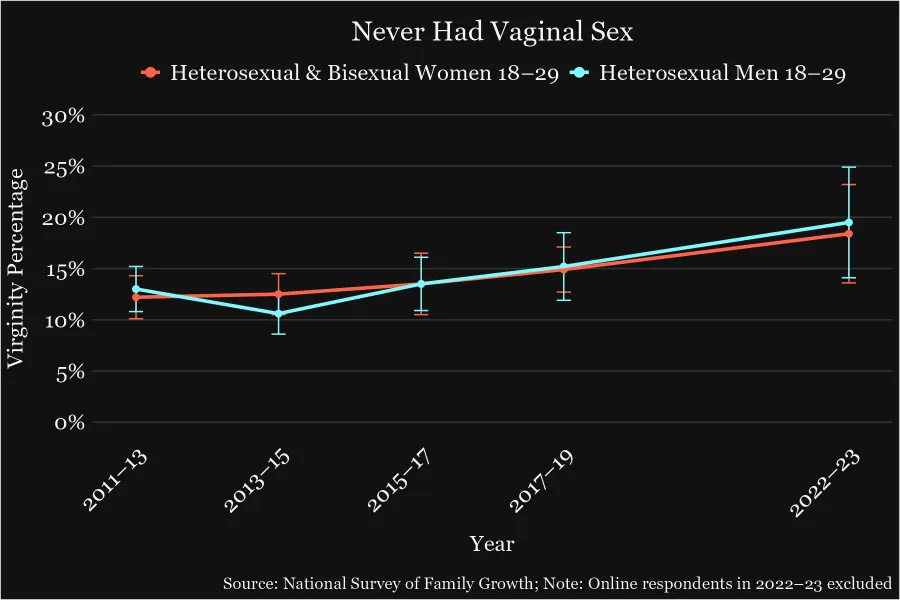
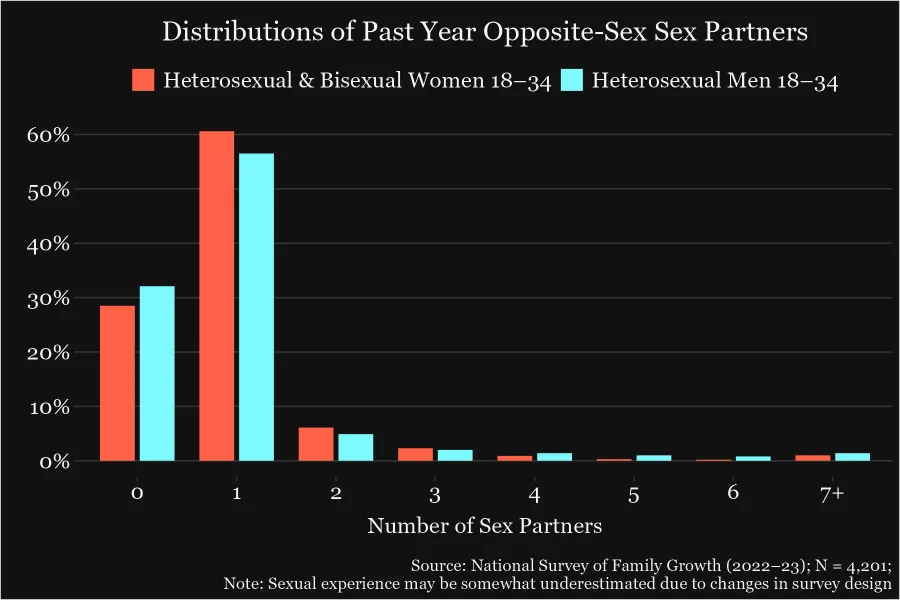
By the way, the incel worldview is totally at odds with the data. Sexlessness has increased equally among men and women. "Chads" are getting laid less than before. Female sexlessness is more common than male sexlessness.
Noah Smith 🐇🇺🇸🇺🇦🇹🇼 tweet mediaNoah Smith 🐇🇺🇸🇺🇦🇹🇼 tweet mediaNoah Smith 🐇🇺🇸🇺🇦🇹🇼 tweet media
Noah Smith 🐇🇺🇸🇺🇦🇹🇼@Noahpinion

Incels are basically prions -- functional proteins folded into destructive shapes, who then hook nearby proteins and bend them into the same misshapen configuration. I don't blame incels for their misfolding, but the contagion must be stopped.

English
48
63
593
99.1K