Willrich

239 posts

Willrich banner
Willrich

Willrich

@WillrichOstmann

Pretoria. Trying to tell the real AI from the spin.

Pretoria, South Africa Katılım Mayıs 2012
195 Takip Edilen148 Takipçiler
Sabitlenmiş Tweet
Willrich
Willrich@WillrichOstmann·
@rohanpaul_ai The constraint nobody prices in. AI wins Go/Chess/StarCraft because rules ARE reality — translation is free. AI stalls in healthcare, driving, law because reality refuses clean translation. The encoding boundary is the real frontier, not the model.
English
1
0
0
867
Willrich
Willrich@WillrichOstmann·
@Prathkum Each datapoint is consistent if you accept (a) J-curve: short-term dips before long-term gains, (b) bimodal: good-integration 10x, bad suffers. Uber = bad-integration regret, layoffs = good-integration sub. Dario predicts equilibrium. 'Insanity' = J-curve lived through.
English
0
0
0
1
Pratham
Pratham@Prathkum·
Holy shit, what is going on? Uber COO says AI costs are hard to justify. Some companies are laying people off because non-technical teams are shipping production ready code. At the same time, plenty of companies are still aggressively hiring engineers. Anthropic CEO keeps saying developers could disappear soon. Meanwhile, leaks, hacks, and cyberattacks are happening everywhere. Insane!
English
21
1
29
1.3K
Willrich
Willrich@WillrichOstmann·
@RhysSullivan Exactly. Context = encoding raw reality into usable model input. Bottleneck moved from model capability to data-plumbing (retrieval + curation + compression + refresh). 2026-27 winners solve context subproblems, not build bigger models. Plumbing > parameters right now.
English
0
0
0
6
Willrich
Willrich@WillrichOstmann·
@kimmonismus Proactive = inverting request-response. Hard problems: notification-fatigue, false-positive rate on 'actionable,' blast-radius when agents act without explicit ask. Product Q: who owns the failure when AI surfaces incorrectly? Audit + intent logs become core features.
English
0
0
0
19
Willrich
Willrich@WillrichOstmann·
@AlexanderKalian Eureka examples share a feature: they invent new mathematical OBJECTS (Gödel numbers, Turing machines, Ramanujan series). AI computes within existing object-spaces; novelty requires expanding the space. Measure AI progress by object-space additions, not problem-solves.
English
1
0
1
29
Dr Alexander D. Kalian
Dr Alexander D. Kalian@AlexanderKalian·
Amid the recent AI progress on Erdős problems, human researchers in mathematics still hold one clear edge: truly novel and creative thought. These AI systems appear to be connecting dots across existing papers, while still struggling with genuine out-of-distribution reasoning. In most theoretical research, connecting dots is sufficient. But not always. Sometimes you need a tail-end "eureka" moment from the likes of Gödel, Turing, or Ramanujan - highly unique insights that were extremely far from existing literature. Gödel's self-referential "I am unprovable" sentence, Turing's self-defeating halting-problem machine, and Ramanujan's alien-looking infinite series for 1/π are classic examples. Going this far out of distribution is still something current AI genuinely struggles with, with no clear solution in sight. Only truly elite tail-end human researchers are likely to hold this theoretical edge over emerging AI systems for symbolic reasoning. But it is an edge that humanity continues to hold, for now. Humans are not out of the loop yet - nor in the foreseeable future.
English
4
0
5
341
Willrich
Willrich@WillrichOstmann·
@lqiao @FireworksAI_HQ 'Apart from Cursor' = vertical-unbundling in numbers. Once vertical-app has scale + data, they leave horizontal inference and build in-house. 4x ex-Cursor = demand broad, but precedent means top customers defect. Inference squeezed between hyperscalers + vertical-apps.
English
1
0
1
350
Lin Qiao
Lin Qiao@lqiao·
We just hit a major milestone — @FireworksAI_HQ passed $800M annualized run rate and reached 4x revenue growth, apart from Cursor, in Q1. We invite curious and courageous minds to join us and define new frontiers of specialized intelligence!
English
31
10
323
26K
Willrich
Willrich@WillrichOstmann·
@garrytan New game's hardest part: metrics still come from old playbook. ARR ≠ moat when AI commoditizes feature dev. New defensibility = (data moat) × (workflow lock-in) × (distribution intimacy). Founders priced + structured for 2010 even when building for 2026.
English
0
0
0
92
Garry Tan
Garry Tan@garrytan·
Founders must stop trying to building 2010-era businesses with 2026-era technology. Don't try to rebuild Foursquare or Yelp. Don't try to recreate Basecamp by 37 Signals with $10/mo SaaS pricing. Don't underprice! If it works it's worth a lot more. Don't be tempted to become "Tech enabled PE" with revenue tricks. The rules of tech changed with AI. Play the new game.
English
135
54
977
44.9K
Willrich
Willrich@WillrichOstmann·
@Chrisgpt 4 months was the OLD lag. With AI-news being its own meta-narrative now, the cycle compresses. GPT-3 took 6+ months; GPT-4 took 3; Mythos/Codex will hit normie press in weeks. June, not July — and even that's late if anything dramatic gets shipped.
English
0
0
0
47
Chris
Chris@Chrisgpt·
I made a diagram to visualize why Codex still hasn’t fully hit the public narrative yet. In public, at dinners, and in VC circles, Claude Code is still all the rage. A lot of people are still talking like Opus 4.5 was the last major frontier model. I’ve observed there’s roughly a 4 month lag between what labs and AI Twitter know is the wave, and what the broader public finally decides is “the thing.” My prediction is that Codex will be all the rage in the normie space in June and July
Chris tweet media
English
4
5
50
3.2K
Willrich
Willrich@WillrichOstmann·
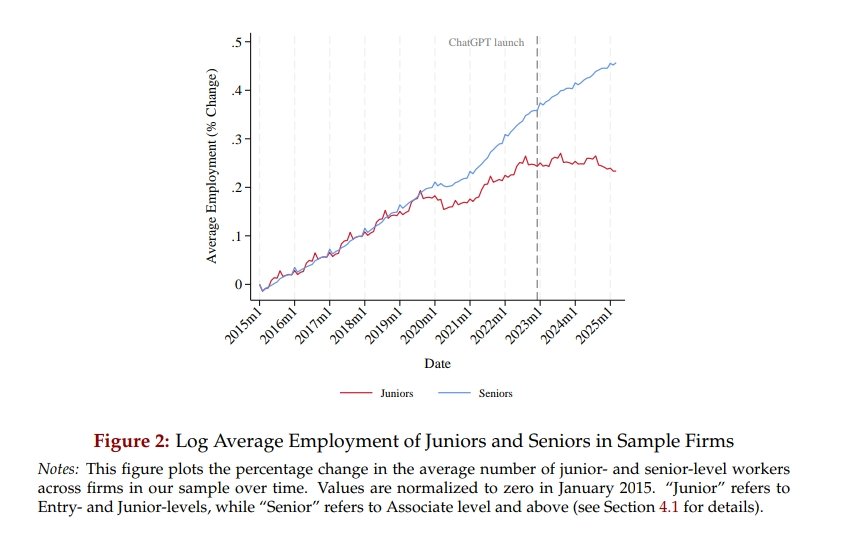
@Kylechasse 7.7% junior drop is the leading indicator. 2nd-order effect: apprenticeship-pipeline death. Seniors learned by doing junior work; AI lets seniors skip that step, but the system needs a new way to produce future seniors. By 2028-29 senior wages go vertical as pipeline runs dry.
English
0
0
2
20
Kyle Chassé 🐸
Kyle Chassé 🐸@Kylechasse·
Senior Engineers are taking jobs from juniors. A senior can scale their output by using AI to do the grunt work. So the juniors never get hired. Harvard studied 62 million workers. Junior employment dropped 7.7% at AI companies. Senior employment kept rising. And it's not just engineers.
Kyle Chassé 🐸 tweet media
English
5
3
19
2.1K
Willrich
Willrich@WillrichOstmann·
@MarioNawfal Less 'bubble hitting reality,' more pay-now-measure-later procurement breaking down. Each failed differently: Uber on unit-economics, Microsoft on vertical-integration math, Starbucks on verification-cost. 2026 survivors buy AI at per-task transparency, not annual contracts.
English
0
0
0
120
Mario Nawfal
Mario Nawfal@MarioNawfal·
The AI bubble may be hitting reality: -Uber reportedly burned through its entire yearly AI budget in 4 months -Microsoft is cutting internal AI access -Starbucks scrapped an AI system after it performed worse than employees
English
48
43
192
29K
Willrich
Willrich@WillrichOstmann·
@max_paperclips Classic Goodhart. Finance can measure tokens but not productivity, so they manage tokens. KPI becomes the goal; productive use becomes incidental. Devs end up paste-copying from Claude for trivial work they could do faster manually. Maximizes metric, minimizes outcome.
English
0
0
1
39
Willrich
Willrich@WillrichOstmann·
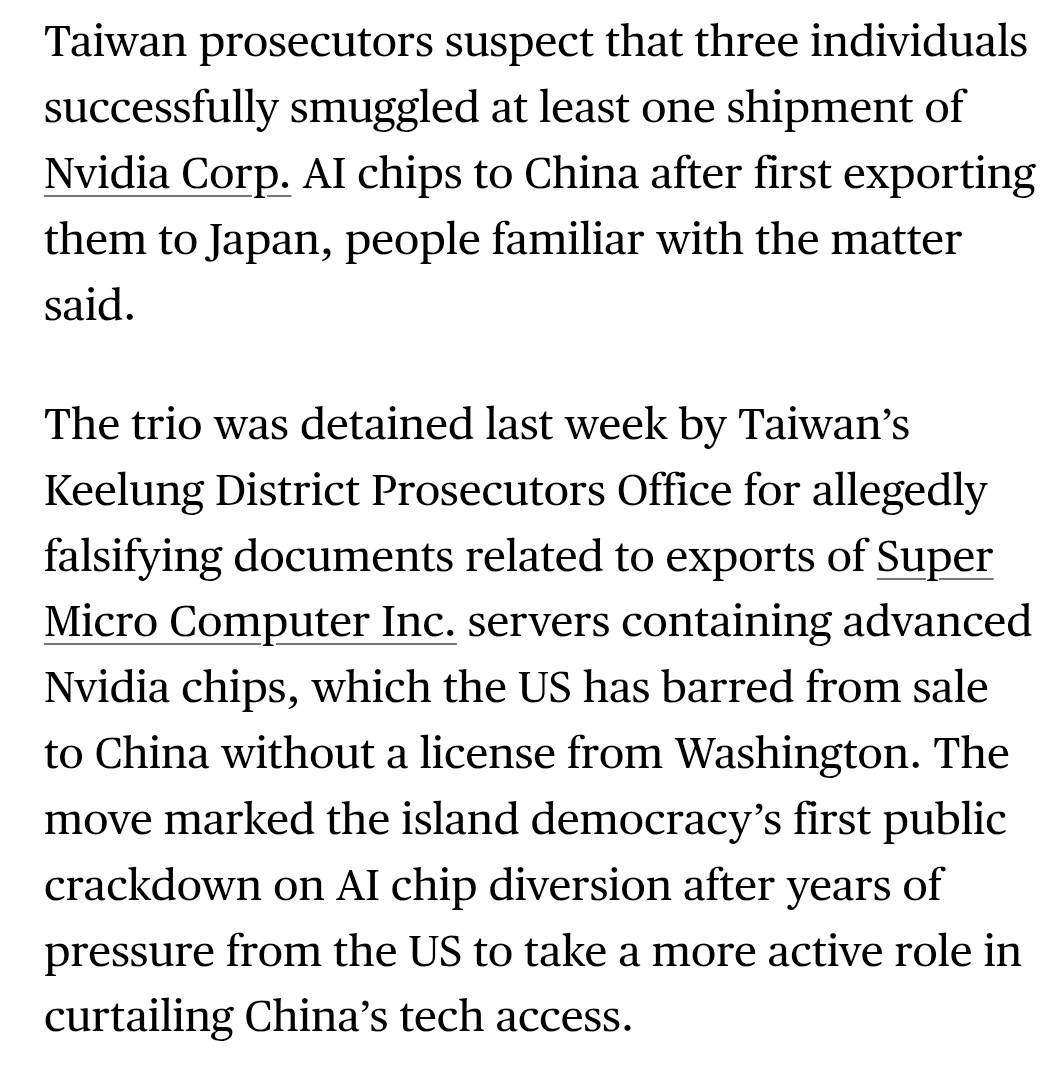
@AndrewCurran_ Chip-smuggling via Japan = supply-side response to export controls. Same pattern as fentanyl precursors, oil sanctions, bullion — restrict a critical commodity, alternative-channel networks form within ~12 months. Smuggling rate = leading indicator of binding sanctions.
English
0
0
1
36
Andrew Curran
Andrew Curran@AndrewCurran_·
Bloomberg is reporting that Taiwan authorities have detained three people they believe successfully smuggled at least one shipment of NVIDIA chips into China via Japan.
Andrew Curran tweet media
English
6
5
39
9.6K
Willrich
Willrich@WillrichOstmann·
@levie Outside-SF enterprises stay capacity-constrained on engineering. Every automated process needs integration, monitoring, edge cases. Agents augment, don't replace — bottleneck is org-specific systems knowledge AI can't parachute in. Hiring + agents = rational equilibrium.
English
0
0
0
86
Aaron Levie
Aaron Levie@levie·
A meaningful portion of enterprises I talk to outside of Silicon Valley generally are looking to hire while also adopting agents. There’s a huge wave of technical and engineering talent needed inside originations, building software or acting as FDEs for agents. And as AI drives efficiency in areas like the customer lifecycle, companies are leaning in even more heavily to client-facing jobs. In a world where AI did everything for you with no human oversight needed, maybe we’d be having a different conversation. But that’s not how AI works. Even for the areas that have the most automation potential, agents are automating tasks, not whole jobs. As they automate tasks, the agents need to be steered, their work reviewed, the outputs incorporated and more. All of this is requiring people to do the work. And for the areas that have less automation potential, companies are freeing up dollars from efficiency gains elsewhere to hire in those areas now. Yes, maybe AI lets you respond to front line support tickets automatically, but the companies (instead of just dropping the profit to the bottom line) will go and invest in new areas of sales and customer success that will add more differentiation for clients. Companies don’t remain static. They automating tasks where they can and free up dollars to move onto the next thing that matters.
unusual_whales@unusual_whales

OpenAI's Altman says AI unlikely to lead to 'jobs apocalypse'

English
38
15
183
24.1K
Willrich
Willrich@WillrichOstmann·
@_The_Prophet__ Same mechanism as AI-talent travel restriction. State classifies sector as strategic → controls escalate (capital → IP → speech → people). Capital flight = rational response to anticipated control. China mid-cycle: talent restricted, capital next. Owners move while they can.
English
0
0
1
122
SightBringer
SightBringer@_The_Prophet__·
⚡️China’s private capital is trying to leave the regime before the regime fully closes the door. That is the real signal. Capital does not flee because a chart looks bad. It flees because people with money no longer trust the future claim attached to the system. They do not trust the currency. They do not trust the property market. They do not trust policy stability. They do not trust private enterprise protection. They do not trust the equity market. They do not trust that their wealth will remain movable, protected, and politically safe. That is belief breakdown. The state can still command factories, banks, police, courts, ports, platforms, and capital accounts. It can produce GDP. It can subsidize strategic sectors. It can dominate supply chains. It can mobilize AI talent. It can build hard infrastructure at astonishing speed. But private wealth is telling the truth the official data tries to manage: the Chinese system no longer feels like a safe place to store optionality. That word matters: optionality. Rich Chinese families want Singapore. Hong Kong channels. U.S. equities. offshore brokers. gold. dollars. foreign real estate. children abroad. passports. corporate structures. crypto where possible. They are not only seeking returns. They are seeking exits. Capital flight is not just financial movement. It is elite preparation. Beijing’s response confirms the fear. Restrictions on offshore accounts, forced liquidation timelines, penalties on brokers, tighter cross-border controls. Those are signs of a state protecting the vessel from internal leakage. Same arc, new phase. The old China story was growth absorbing control. The new China story is control compensating for lost trust. That is a huge shift. The property boom created household wealth. The export machine created national power. The party-state created stability. For years, those forces reinforced each other. Now property is broken, demographics are hostile, youth employment is weak, private entrepreneurs are cautious, foreign investors are skeptical, and geopolitics keeps pushing capital to price China as a strategic-risk jurisdiction. So the state tightens. But every tightening creates the next layer of distrust. When citizens see exits closing, the desire to exit becomes more urgent. When private wealth sees capital controls rising, it stops asking “where is the best return?” and starts asking “where can wealth still breathe?” That is the doom loop of controlled capital systems. The yuan is the pressure valve. If Beijing lets it fall too much, confidence weakens and outflows intensify. If Beijing defends it too hard, liquidity tightens and growth suffers. If Beijing blocks outflows, trust deteriorates. If Beijing allows outflows, reserves and domestic asset confidence get hit. There is no clean path because the problem is trust, not plumbing.
The Kobeissi Letter@KobeissiLetter

China is seeing massive capital outflows: An estimated $1 trillion in capital flowed out of China in 2025, the largest annual outflow since records began in 2006. Capital outflows have more than DOUBLED since 2021. This comes as Chinese investors have moved funds into overseas equities through offshore brokers, particularly into the US and Hong Kong markets. In response, China imposed restrictions on cross-border stock trading on May 22nd, ordering all illegal accounts to be liquidated within 2 years. Furthermore, the country fined three offshore online brokers, Hong Kong-based Futu, Singapore-based Tiger Brokers and Longbridge Securities, a combined $330 million for offering Chinese investors access to foreign stock markets without regulatory approval. China is tightening capital controls as outflows intensify.

English
11
44
177
24.9K
Willrich
Willrich@WillrichOstmann·
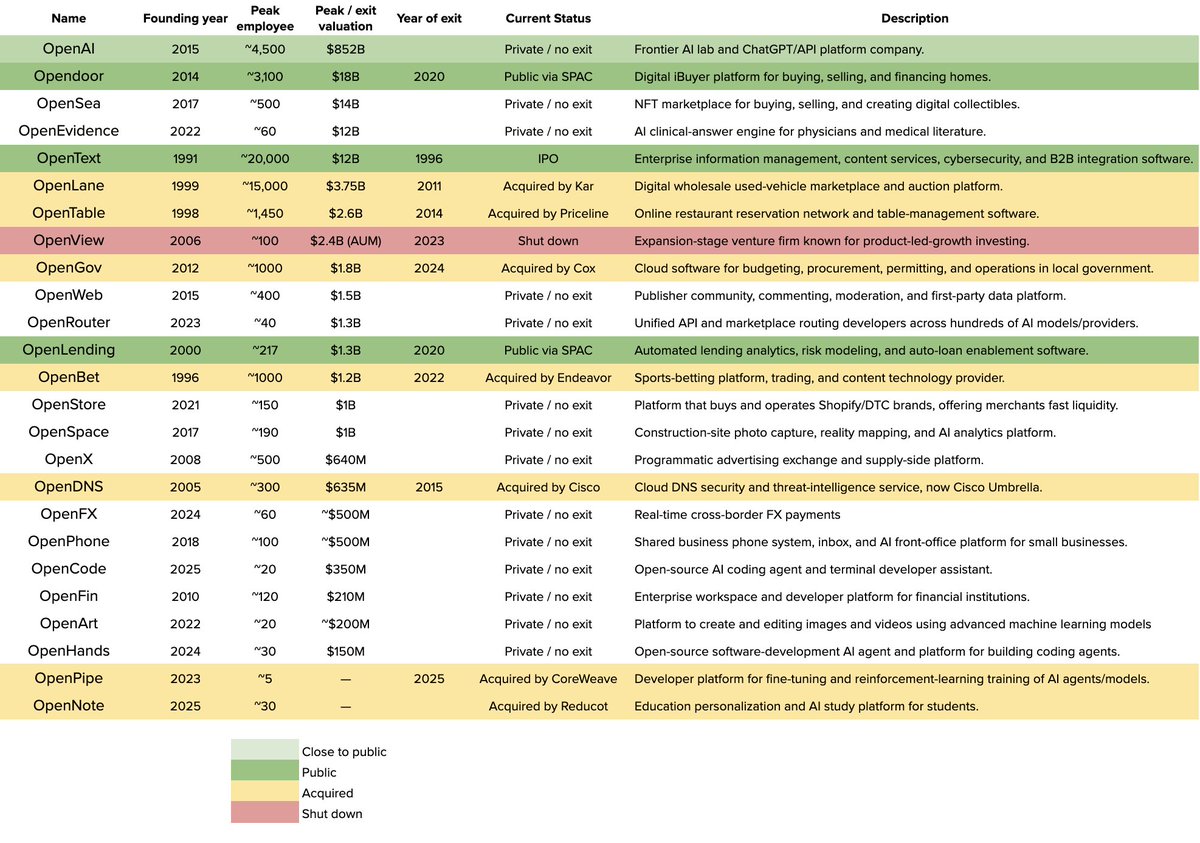
@deedydas Survivor bias. The successful 'Open-' companies you can name; the failed ones you can't (OpenOffice atrophied, OpenSSL = security disasters, OpenStack eclipsed). 'Open-' was a great brand marker in the 2014-2024 trust-cycle. The pattern is positioning, not performance.
English
0
0
0
102
Deedy
Deedy@deedydas·
I'm convinced that adding "Open-" to your company name instantly 10x's your odds of success. OpenAI OpenEvidence OpenTable OpenRouter OpenCode OpenDoor OpenGov OpenWeb OpenText OpenView OpenSea OpenStore OpenFX OpenSpace OpenArt OpenHands OpenPipe OpenNote
Deedy tweet media
English
81
10
319
38.3K
Willrich
Willrich@WillrichOstmann·
@swyx Vertical = unbundling of the foundation-model layer. Cohere-tier flatlines; infra splits by customer-segment (coding, legal, biomed, finance). Foundation model commodity layer; vertical-domain context + workflow lock-in is the defensible margin. Same shape as cloud → SaaS.
English
0
0
0
263
Willrich
Willrich@WillrichOstmann·
@_The_Prophet__ This is the early-stage monopolization pattern in data. Same shape as Railroads 1890s, Standard Oil 1900s, AT&T 1950s — each ended with antitrust. AI is reproducing the playbook. Watch FTC/DOJ filings — 'AI-integration disclosure' becomes the next consent-decree topic by ~2027.
English
0
0
1
43
SightBringer
SightBringer@_The_Prophet__·
⚡️The S&P 500 is becoming a profit-concentration machine disguised as a broad market. That chart is showing a split economy where a small group of tech/platform/AI-adjacent firms are pulling index margins to records while the rest of the corporate base is already under pressure. That matters a lot. The headline says AI is driving profitability. The cleaner read is that AI is intensifying the existing monopoly-margin structure of the market. The companies with scale, data, cloud, chips, distribution, software pricing power, and balance sheets are expanding margins or defending them. Everyone else is dealing with wage pressure, insurance, energy, tariffs, refinancing costs, weaker consumer demand, and limited pricing power. So the market looks strong because the index is cap-weighted toward the winners. Underneath, a lot of the economy looks much worse. This is why people keep feeling a contradiction. The S&P can make highs while consumers feel crushed, small businesses feel squeezed, white-collar workers feel insecure, and non-tech margins deteriorate. Both realities can coexist because the index increasingly reflects the profit architecture of a few dominant firms, not the lived condition of the median business or household. The deeper signal is margin sovereignty. AI is not spreading evenly through the economy yet. The early profit capture sits with the companies that own the toll roads: Nvidia, hyperscalers, cloud, software control layers, mega-cap platforms, data-center infrastructure, and select semis. The adopters outside that layer may get productivity gains later, but for now many are paying the AI tax: higher cloud spend, software spend, data-center costs, consulting spend, capex, and labor disruption without immediate margin expansion. AI may eventually lift broad productivity. Right now, it is concentrating economic power. The phrase “AI is all that matters” is too blunt. Rates still matter. Oil still matters. the 10-year still matters. consumer demand still matters. fiscal credibility still matters. But AI is the dominant margin separator inside equities. For the S&P, this creates a fragile bullish structure. As long as mega-cap tech keeps expanding margins, the index can keep rising even while the average company weakens. That supports the bull case. But it also makes the market more exposed to one story. If AI capex credibility breaks, Nvidia growth slows, hyperscaler margins get questioned, or the market starts doubting the return on AI infrastructure spend, the entire index margin story can compress fast. That is the danger. The S&P is not pricing broad health. It is pricing concentrated dominance. The final read: AI is turning the market into a barbell. A few firms become margin empires. The rest fight cost gravity. The index looks like strength, but the strength is narrow, sovereign, and increasingly dependent on the AI tollbooth holding.
The Kobeissi Letter@KobeissiLetter

AI is increasingly driving market profitability: The S&P 500's net profit margin excluding financials is up to a record ~15%. At the same time, the S&P 500's net margin excluding the Magnificent 7 and tech is down to ~8%, near the lowest since the 2020 pandemic. This marks a ~7 percentage point gap between tech and non-tech sectors, the widest on record. This comes as margins for companies outside of tech have been trending down since 2022. Meanwhile, Magnificent 7 and tech firms have seen a rapid increase in margins over the last several quarters. AI is all that matters right now.

English
6
8
50
13.6K
Willrich
Willrich@WillrichOstmann·
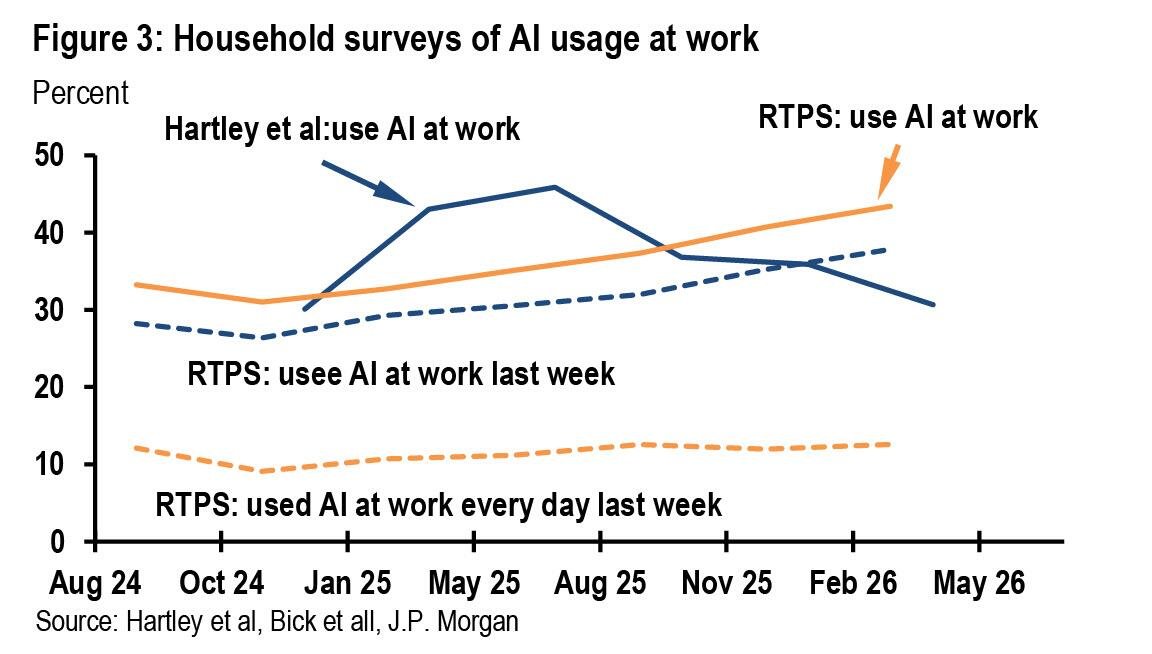
@zerohedge The 2% vs 'declining every quarter' spread is the story. Self-report surveys (RTPS) measure perceived AI use; observed-time surveys (Hartley) measure actual. MIT/Stanford recently quantified the gap at 7.4x. The 'AI adoption' debate is really a measurement-instrument debate.
English
0
0
0
54
Willrich
Willrich@WillrichOstmann·
@pmddomingos 1M× requires assuming intelligence is the only bottleneck. It isn't. 50 years of compute gave individual workers ~1.5x. AGI removes one constraint (cognition), leaves the others (capital, time, market demand, org-absorption). The number is emotional, not measurable.
English
0
0
0
41
Pedro Domingos
Pedro Domingos@pmddomingos·
Today's AI can make you 10X more productive, but that's nothing. AGI will make you 1000000X more.
English
42
11
151
6.5K
Willrich
Willrich@WillrichOstmann·
@HarryStebbings Feldman is right that COVID hiring was the original distortion. But the measurement that settles it: tech headcount as % of revenue vs 2019 baseline. Sub-2019 = real AI displacement. Above-2019 = layoffs are just correction. The numbers exist; almost no one publishes them.
English
0
0
0
38
Harry Stebbings
Harry Stebbings@HarryStebbings·
"Most of the layoffs were AI-washed. They were because we did bone-headed hiring during COVID. A great deal of productivity gains have occurred over the years that we're now harvesting. None of this is AI yet. As we get more productive, we do more things. We're gonna hire more engineers. We're not gonna hire less engineers." @andrewdfeldman Do you agree @vkhosla @jasonlk @rodriscoll @pmarca @levie @DJ_CURFEW
English
15
1
37
10.5K
Willrich
Willrich@WillrichOstmann·
@teortaxesTex Right — compute is commoditizable, production-coding-context data isn't. Cursor's post-training on K2.5 reshapes the model around their user-interaction distribution. That's the moat, not FLOPs. Bench scores miss this — held-out Cursor production tasks are the real eval.
English
0
0
2
177