BuildersSpace

130.4K posts

BuildersSpace banner
BuildersSpace

BuildersSpace

@XBuildersSpace

A space to showcase my favourite builders in the world of business, content and entrepreneurship↓

Newsletter: Katılım Aralık 2020
165 Takip Edilen54.1K Takipçiler
Sabitlenmiş Tweet
BuildersSpace
BuildersSpace@XBuildersSpace·
10 Powerful Visuals You NEED To See... 1.
BuildersSpace tweet media
English
9
514
5K
904.6K
BuildersSpace retweetledi
andrew engler
andrew engler@aerockrose·
MIT's Joe Hadzima says the fastest way to de-risk a startup is to find the thing that makes it "extremely difficult" and prove that first. Not the pitch deck. Not the market size slide. Not the polished 5-year forecast. The thing that can kill the whole plan. In the clip, he calls these "credibility testers." The idea is simple: If one part of the business is the hardest part, go prove that part before asking people to believe the rest. Can the customer be acquired? Can the technology actually work? Can the economics survive contact with reality? Can the team execute the one assumption everything depends on? Most operators do the opposite. They make the plan look complete. They add more slides. They smooth over the ugly part. They try to make uncertainty disappear with confidence. Hadzima is saying confidence is not proof. Proof is when the market can see the risk has actually changed. That is why the phrase matters so much: "de-risk the situation." Not describe it. Not narrate it. Not hope the other side understands it. De-risk it. The strongest businesses do this early. They identify the assumption that scares capital, customers, partners, or boards. Then they create evidence that makes the assumption less scary. A business plan becomes valuable only when it turns belief into evidence. I see the same mechanism in wildfire insurance. Owners often think the problem is effort. They cleared defensible space. They hardened vents. They removed fuel. They invested real money into reducing risk. But insurance does not reward effort by default. It rewards risk the market can verify. That is the missing "credibility tester" for wildfire-exposed property. If an underwriter cannot see the work, document it, trust it, and translate it into a pricing file, the owner can still get treated like the average risk in the ZIP code. That is the trap. In 20 years across Allstate, Argo, Kettle, and RockRose, this is the pattern I keep seeing: The work and the proof are not the same thing. At McCloud/Tahoe, the important part was not just that the HOA wanted to reduce wildfire exposure. It was turning mitigation into evidence carriers could use. That helped move premiums from more than $1.3M to about $913K, saving over $400K and allowing about $120K to go back into mitigation. Same lesson as the clip. The market does not fund a plan. It funds proof that the hardest risk is getting smaller. Wildfire mitigation has to become that kind of proof. A defensible-space report is not paperwork. A hardened vent is not a checkbox. A verified mitigation file is not admin. It is the property's credibility tester. The owner is saying: Here is the risk. Here is the work. Here is the evidence. Here is why I should not be priced like everyone else in the ZIP code. That is what RockRose is built to do. We help wildfire-exposed owners turn mitigation into underwriting evidence. RockRose clients save an average of 21% on FAIR Plan premiums through verified mitigation. Get your free estimate: rockroserisk.com/start
English
0
6
6
188
BuildersSpace retweetledi
Gunhild Johanne Reumert | AI Tools & News
GOODBYE CapCut. GOODBYE InVideo. GOODBYE Higgsfield. 🚨 This new AI tool turns: • 1 idea • 1 image into a fully edited viral video with voiceover, B-roll, subtitles, music, and transitions in minutes. And yes, you can edit every single layer.
English
4
6
6
193
BuildersSpace retweetledi
Khushi Agarwal
Khushi Agarwal@Aicoder786·
ANDREJ KARPATHY COULD HAVE CHARGED $2,000 FOR THIS COURSE. He put it on YouTube. The full training stack. Tokenization. Neural network internals. Hallucinations. Tool use. Reinforcement learning. RLHF. DeepSeek. AlphaGo. 3 hours of the most comprehensive LLM education that exists anywhere at any price. Not how to use the tools. How the entire system was built from the ground up and why it behaves the way it does. The engineers who understand this build things the ones who only use the tools cannot even conceive of. The gap between those two groups is not 3 hours. It is everything those 3 hours quietly unlock for the rest of your career.
English
1
16
21
787
BuildersSpace retweetledi
Rishabh
Rishabh@Rixhabh__·
20 GitHub repositories that will give you superpowers:↓
Rishabh tweet media
English
2
11
18
1.2K
BuildersSpace retweetledi
Alex Groberman
Alex Groberman@alexgroberman·
Google is now explicitly telling businesses to focus on AI search traffic alongside SEO. This comes straight from Google’s John Mueller. Someone asked him a question a lot of businesses are worried about right now: “Is SEO still enough, or do we need to start thinking about GEO too? Ranking on Google doesn’t guarantee your brand will show up in ChatGPT, Gemini, or Perplexity.” Mueller’s response speaks for itself. He said: “If you have an online business that makes money from referred traffic, it's definitely a good idea to consider the full picture.” Translation: Google no longer views old-school Google Search as the only distribution channel that matters. And solving that problem is a big reason why SEO Stuff (seo-stuff.com) is coming off another record month. Then came the line from Mueller that a lot of people skimmed past: “Thinking about how your site’s value works in a world where AI is available is worth the time.” That is an acknowledgment that AI already changes how traffic, visibility and attribution work. Ranking still determines eligibility, but AI does play an increasingly large role in site amplification. (If you want to see where your site stands across Google and AI search, start here: seo-stuff.com/free-audit) This past week Google laid out what Search will look like from this point going forward. The new Search box will accept text, images, files, videos, etc. And it'll anticipate your intent before you even finish asking your question. It is already powered by the most advanced Gemini model ever put into search, and then layered on top of that, agents will now be able to run 24/7 in the background on behalf of the buyer. The new Search process works like this: Step 1: The buyer describes their problem, their category, their needs in full. Step 2: The agent breaks that down into sub-topics and maps out a plan. Step 3: It determines what intel is needed right now versus later. Step 4: It monitors blogs, news sites, and social posts continuously for relevant changes. Step 5: It sends the buyer a synthesized update with links and the ability to take action. All of which is to say, blue links are not going away in the short-term, but AI's influence over Search isn't magically going to start decreasing. If your business depends on referred traffic, pretending AI doesn’t exist is no longer realistic. This all matters because AI systems don’t rank pages from scratch. They pull from the existing ecosystem and favor: Pages that already rank well. Sites with clear entity definitions. Content that explains and compares Brands that are consistently referenced and attributable. Search in 2026 understands the topic and it needs to understand your business too. And that’s also why SEO Stuff is structured the way it is. Take the done-for-you plan, for example. seo-stuff.com/gold-plan-pack… AI systems summarize and compare. They repeatedly pull from: Best X for Y pages. X vs Y comparisons. Decision-stage buyer guides. Clear answers under question-based H2s. The done-for-you plan optimizes content, builds authority and is engineered to: Rank in Google first. Be cleanly summarized by AI systems. Answer questions directly and extractably. Tie answers back to a specific brand. Then there’s the done-for-you content package, which is for sites who have strong authority but aren't capitalizing on it. seo-stuff.com/premium-conten… Search in 2026 thinks in categories, entities and relationships. If your site doesn’t clearly answer: Who you are. What category you belong to. When you should be mentioned. AI systems won’t include you consistently. This package patiently builds: Full topical coverage. Entity reinforcement across use cases. Category-level authority. Freshness through expansion and updates. This is how you start being a recognized entity. And finally, the "authority-only" package, for sites that can handle optimizing content on their own but lack the authority necessary to be respected by Google and AI search. seo-stuff.com/premium-backli… Every serious study we’ve covered shows the same thing. AI systems are conservative. They reuse sources they already trust. Yes, backlinks from real, authoritative domains help rankings, but they also tell AI systems: “This source is safe to repeat.” Look, if your SEO foundation is weak, AI will expose it faster. If your foundation is strong, AI will amplify it across: Google Search. AI Overviews. Gemini. ChatGPT. Perplexity. And so forth. Google is literally telling you to understand how visibility actually works now. You should listen. And if you want to see where your site stands across Google and AI search, start here (it's free): seo-stuff.com/free-audit
Alex Groberman tweet mediaAlex Groberman tweet mediaAlex Groberman tweet mediaAlex Groberman tweet media
Alex Groberman@alexgroberman

Reddit and Wikipedia account for 25% of ChatGPT citations. It's hard to control what Wikipedia says. It's hard to control what Reddit says. Meanwhile, 75% of AI citations come from sources you can influence. That is where the opportunity is for brands. [Want to know where your site stands across Google AI, ChatGPT, Claude, Grok, etc? Check here (it's free): seo-stuff.com/free-audit] According to the 5WPR AI Platform Citation Source Index 2026, which synthesized nine independent datasets covering hundreds of millions of citations, Wikipedia accounts for 13.15% of ChatGPT citations. Reddit accounts for 11.97%. On Perplexity, Reddit citation rates climb as high as 46.7% depending on the query category. According to the same research, traditional major publications like WSJ, NYT, and Bloomberg do not even appear in the top 20 most-cited domains. If you are thinking "I cannot control Reddit or Wikipedia, so how do I get cited by AI," the answer is in the other 75% of citations. And that is what SEO Stuff (seo-stuff.com) helps businesses capture. Yes, Reddit and Wikipedia combined represent roughly a quarter of ChatGPT citations, but that means 75% of citations come from everywhere else: industry publications, editorial sites, review platforms, expert content, niche authority domains, and branded content that AI platforms trust enough to cite. According to Profound's analysis of 27 million AI citations, 95.7% of all *category-level* citations come from third-party sources. The third-party sources that are not Reddit or Wikipedia are editorial publications, industry sites, comparison platforms, and authoritative content from recognized brands. These are exactly the types of sources that editorial backlinks put your brand on. And if you want to see which sources are driving AI citations in your category and where your brand is missing, start here (it's free): seo-stuff.com/free-audit Here is how this breaks down. Reddit and Wikipedia earn citations because AI platforms view them as community-validated and comprehensive. You cannot replicate that. But you can build the same trust signals through editorial coverage from publications AI platforms also cite. When an industry trade publication or a respected niche site mentions your brand, that mention is in the AI's retrieval pool. When the AI assembles an answer about your category, it pulls from those editorial sources alongside Reddit and Wikipedia. According to SE Ranking's study of 2.3 million pages, sites with over 24,000 referring domains average 6.8 AI citations per query. The backlinks that build your referring domain count are also placing your brand on editorial sites that AI platforms cite. Every editorial backlink does double duty: it boosts your domain authority for search rankings AND it puts your brand on a source AI platforms pull from when assembling recommendations. The brands that cannot control Reddit or Wikipedia can still invest in the editorial coverage they can control: editorial backlinks from trusted publishers, expert-attributed content that earns media mentions, and coverage from industry sites that AI retrieval systems treat as authoritative. Remember, if you want to see which editorial sources are driving AI citations in your category and how to get your brand on them, start here (it's free): seo-stuff.com/free-audit Here is what all this looks like in practice. A buyer asks ChatGPT "best cybersecurity platforms for mid-size companies." ChatGPT pulls from Reddit threads (11.97% of citations), Wikipedia articles (13.15%), and a range of editorial and industry sources (the remaining 75%). Brand A has been covered by three industry publications and mentioned in two editorial comparison articles. Those mentions are in the AI's retrieval pool. Brand A gets cited alongside the Reddit and Wikipedia sources. Brand B has great content on its own website but no editorial coverage from third-party sources. The AI pulls from Reddit, Wikipedia, and the industry publications that mention Brand A. Brand B does not appear in any of those sources. Brand B is not cited. This is the ecosystem SEO Stuff (seo-stuff.com) was built around. The done-for-you plan: seo-stuff.com/gold-plan-pack… Expert-attributed content backed by DR50+ backlinks: the content earns editorial coverage on the sources AI platforms cite, and the backlinks build the domain authority that makes your brand visible across the 75% of citations you can influence The "content-only" plan: seo-stuff.com/premium-conten… 60 pages of expert-attributed content designed to earn editorial mentions and third-party coverage from the authoritative sources AI platforms pull from when assembling recommendations The "authority-only" plan: seo-stuff.com/premium-backli… Editorial placements on trusted publications that put your brand in the 75% of AI citation sources you can actually control, alongside the Reddit and Wikipedia sources you cannot Reddit and Wikipedia drive 25% of ChatGPT citations. You probably won't control either one. But 75% of citations come from editorial and authoritative sources you can influence through expert content and editorial backlinks. The brands winning AI citations are the ones investing in that 75%. The brands losing are the ones who looked at the Reddit and Wikipedia data and decided there was nothing they could do.

English
3
34
49
6.4K
BuildersSpace retweetledi
Haatch Pulse
Haatch Pulse@Haatchpulse·
CONFIRMED: Russia just sold 900,000 ounces of gold in four months to keep its war economy running. The country that was once one of the world's biggest gold buyers is now quietly liquidating reserves to pay its bills. and that tells you everything about how...show more
English
1
5
6
273
BuildersSpace retweetledi
ɱҽԃι✨
ɱҽԃι✨@Med1_Ai·
Faceless YouTube channel + laptop + internet connection = $9000 per month Like and comment "YouTube" and I will send you my step-by-step guide for FREE. You must be following me to get this guide in DM. FREE for the next 48 hours only.
ɱҽԃι✨ tweet media
English
32
21
50
4.9K
BuildersSpace retweetledi
Jaynit
Jaynit@jaynitx·
Kevin O'Leary reveals the guest lecturer who insulted his entire MBA class and turned out to be completely right "He walked in, no slides, no PowerPoint. He said you guys think you're so good. When you walk out of here the real world is gonna kick the living sh*t out of you. A third of you will be a complete failure, another third will be spinning their wheels a decade from now, and the other third will be phenomenal successes" "He claimed experience is very important, and intuition is just experience distilled. Today I'm that guy. I can sit in a room with somebody for 15 minutes and know if I've got a winner, and 99% of the time I'm right"
English
26
68
1K
280K
BuildersSpace retweetledi
Jaynit
Jaynit@jaynitx·
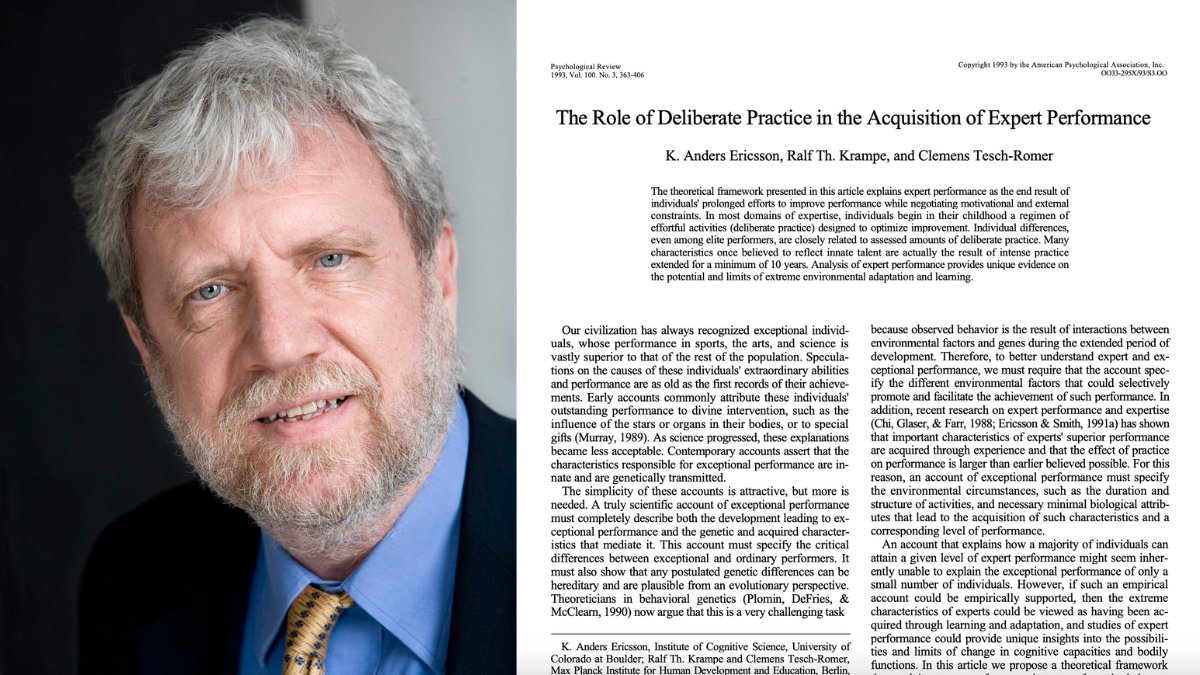
A Swedish psychologist did the research behind the most famous success rule of the last twenty years, and then spent the rest of his life trying to prove it was wrong. His name was Anders Ericsson. He died in 2020, and most of the people who repeat the rule he inspired have no idea he thought the popular version of it was broken. In 1993 he published a paper with two colleagues called "The Role of Deliberate Practice in the Acquisition of Expert Performance." It ran in Psychological Review and went on to be cited more than nine thousand times, which makes it one of the most influential psychology papers ever written. The study itself was small and clean. He went to a music academy in West Berlin and asked the faculty to sort their violinists into three groups. The best students, the ones with real soloist potential. The good students, a notch below. And the ones headed toward becoming music teachers instead of performers. Then he reconstructed how many hours each group had practiced across their entire lives. The pattern was almost too neat. The best group had logged an average of over ten thousand hours by the age of twenty. The good group sat around eight thousand. The future teachers were down near three to four thousand. More skill, more hours, in a near perfect line. Fifteen years later Malcolm Gladwell picked up that one number for his book Outliers, gave it a name, and the ten thousand hour rule was born. The pitch was irresistible. Ten thousand hours and you become a master at almost anything. The Beatles, Bill Gates, every story wrapped neatly around the same figure. It became gospel. It is probably the single most quoted idea in the entire self improvement world. And the man whose research it was built on spent his remaining years saying it was wrong. He wrote a whole book in 2016 called Peak just to correct the record. He even put out an open letter with a title that did not hide how he felt, calling it the danger of delegating education to journalists. His objections were simple, and they are worse than they sound. First, ten thousand was an average, not a threshold. Half of the best violinists had not even reached it. There was no line in the sand where a person suddenly crossed from amateur to expert. In his own words there was nothing magical about the number at all. Second, at twenty years old those violinists were not masters. They were very good students who still had years of work ahead of them before anyone would call them world class. The ten thousand hours had not bought mastery. It had bought potential. Third, and this is the part that quietly takes the whole rule apart, the real number is wildly different depending on the person and the field. Look at chess, where researchers tracked exactly how long it took players to reach master level. The average came out around eleven thousand hours, close enough to the famous figure to feel like proof. But the average was hiding the real story. One player reached master in barely three thousand hours. Another needed more than twenty three thousand. That is an eight to one gap between two people chasing the same title. And some players put in more than twenty five thousand hours and never became masters at all. So if it was never really about the hours, what was Ericsson actually trying to say. His real finding was about the kind of practice, not the quantity of it. He called it deliberate practice, and it has almost nothing in common with what most people mean by putting in the hours. It is not running through songs you already know. It is working right at the edge of what you cannot do yet, with immediate feedback, with someone or something telling you exactly what just went wrong, over and over, in a way that is uncomfortable the entire time. Most of the hours people log are the opposite of that. Comfortable repetition of things they already have. He watched professionals do this for decades and noticed something disturbing. Many of them stopped improving after the first few years and then simply held the same level for the rest of their careers, racking up hours that bought them nothing. Then it gets worse, and this is the part that should matter most to anyone trying to build something real. A team of researchers led by Brooke Macnamara pulled together every study they could find on practice and performance to ask one question. How much of the gap between good and great does practice actually explain. In games it explained twenty six percent. In music twenty one. In sports eighteen. In education it explained four percent. In professions, the actual jobs people do for a living, it explained less than one percent. Read that again. In the messy, open ended domains where most of us actually live and work, the place where you are trying to build a company with no clean rules and no scoreboard, the number of hours you grind explains almost nothing about whether you win. Here is what that means for you. If you have ever felt behind because you did the math in your head and realized you have not put in your ten thousand hours, you were measuring the wrong thing the whole time. The hours were never the variable. There is no counter ticking up toward a moment where you suddenly become good. What separates people is not how long they have been doing the thing. It is whether they spend that time pushing into what they cannot do yet and getting honest feedback fast, or whether they spend it comfortably repeating what they already know and calling it experience. You can put in ten thousand hours and stay average. People do it every day. They have twenty years of experience that is really one year of experience lived twenty times. Or you can build your hours so that almost every one of them stings a little, and pass people who started a full decade ahead of you. Stop counting your hours. Start auditing them.
Jaynit tweet media
English
9
33
76
6.7K
BuildersSpace retweetledi
Erina | AI Tools & News
Erina | AI Tools & News@AITechEchoes·
You can make $500 per day if you have: 1. A laptop 2. Wi-Fi 3. Time Here are 10 Claude Prompts that pay you daily:
Erina | AI Tools & News tweet media
English
2
12
16
603
BuildersSpace retweetledi
Big Brain AI
Big Brain AI@realBigBrainAI·
Ben Affleck on the single hardest thing for AI to learn in creative work: He breaks down how large language and video models actually work, and where they fall short: "A library of vectors of meaning and transformers that interpret context… But they're just cross-pollinating things that exist. Nothing new is created." Affleck concedes the point but pivots to the deeper issue of taste: "Craftsman is knowing how to work. Art is knowing when to stop. And I think knowing when to stop is going to be a very difficult thing for AI to learn because it's taste." He adds that current AI also suffers from "lack of consistency, lack of controls, lack of quality." But Affleck is clear-eyed about where AI will hit hard. The visual effects industry is in his crosshairs: "I wouldn't like to be in the visual effects business. They're in trouble because what cost a lot of money is now going to cost a lot less and it's going to hammer that space more than it already is." His take: maybe it shouldn't take a thousand people to render something. AI will make backgrounds more convincing, change the color of a shirt, fix mistakes. It might even let studios produce "two seasons of House of the Dragon in a year instead of one." That's compression, not replacement. Affleck then makes a fascinating prediction about where AI actually creates value long-term, and it's in consumption rather than production: "Eventually AI will allow you to ask for your own episode of succession where you could say, I'll pay $30 and can you make me a 45 minute episode..." @BenAffleck sees this as the real opportunity: "My hope for AI is that it's an additional revenue stream that can replace DVD which took 15 to 20% out of the economy of filmmaking." He imagines a future of negotiated visual rights, where fans can buy an "Iron Man pack" and look like the Avengers in their own TikToks, the same way they used to buy Halloween costumes at the store. The throughline of Affleck's framework is simple: craftsmanship can be automated, but art is knowing when to stop, and that requires taste.
English
2
12
15
901
BuildersSpace retweetledi
Freya Lawson
Freya Lawson@Freyabuilds·
Google's CEO just revealed why 2026-2030 is the last opportunity for regular people to get rich. Here’s exactly what he said… & how you can capitalize:
Freya Lawson tweet media
English
2
8
10
441
BuildersSpace retweetledi
Hasan
Hasan@Ubermenscchh·
🚨BREAKING : Call centers are officially dead. ElevenLabs Speech Engine quietly wiped out the $40B customer support industry. → Sounds human in 70+ languages → Books, updates, closes tickets mid-call → Plugs into GPT, Claude, Gemini, any LLM → $0.08/min, startups get $4K free Revolut, Cisco, Deliveroo Like Services might switch soon. You're next 🧵 Give it a check here :
Hasan@Ubermenscchh

🚨 BREAKING: Call centers just met their biggest threat yet. ElevenLabs Speech Engine just changed how the $40B support industry operates → 70+ languages, natural real time voices → Books, updates, closes tickets mid-conversation → Plugs into GPT, Claude, Gemini any LLM you run → $0.08/min, startups get $4K free Built for the teams already shipping. The rest will follow. You're next 🧵👇

English
1
9
13
719
BuildersSpace retweetledi
Haatch Pulse
Haatch Pulse@Haatchpulse·
JUST IN: Uber just proposed buying Delivery Hero at €33 a share. If it goes through, every time you order food to your door, you could be paying...show more
English
1
8
10
614
BuildersSpace retweetledi
Guri Singh
Guri Singh@heygurisingh·
Holy shit... Facebook has a file on every website you've visited outside Facebook. Your bank. Your therapist's booking page. That site you searched at 3am. No warning. No notification. No way to fully delete it. Here's how to find your file and what you can actually do: ↓
English
1
9
19
1.1K
BuildersSpace retweetledi
Patrick's AIBuzzNews
Patrick's AIBuzzNews@AIBuzzNews·
These sitcoms don’t exist. But they should! + Prompt to create your own version. 1. Star Wars
English
2
7
9
373
BuildersSpace retweetledi
SIAM AI Tech
SIAM AI Tech@siam_tech18323·
🚨NotebookLM + Google Antigravity is one of the most powerful combo available right now—and almost no one is using it. If you’re not taking advantage of this, you’re missing out on serious leverage. Here’s how to set it up in 2 minutes + what it can do 👇
SIAM AI Tech tweet media
English
2
13
14
386
BuildersSpace retweetledi
Ricardo
Ricardo@Ric_RTP·
JPMorgan's CEO Jamie Dimon just said a financial crisis is coming. Bond yields just hit historic levels in the US, UK, Germany, and Japan simultaneously. The last time this happened was right before the 2008 financial crisis. And Dimon just confirmed that $5 to $6 TRILLION in leveraged loans are sitting out there right now and the companies holding that debt are going to have a very hard time refinancing at current rates. The equity values of those companies would be "considerably less" and a lot of those borrowers didn't hedge for higher rates. Then he said he personally would NOT buy credit spreads at these levels. The CEO of the largest bank in America just told you he thinks corporate debt is mispriced and he would not touch it with his own money. Then the interviewer asked about AI and everyone forgot he said it. Jamie Dimon warns about a recession every single year but this is the first year where the numbers are actually proving him RIGHT: 3 days ago the 30-year Treasury yield hit 5.2%, the highest since 2007. The 10-year is sitting at 4.62%. The US government has $31 trillion in public debt and the average interest rate on that debt is 3.5%. They cannot refinance a single dollar of it at a lower rate than what they are currently paying. And they have $9.7 trillion in securities maturing THIS YEAR that needs to be rolled over. Meanwhile the new Fed Chairman Kevin Warsh was just sworn in on Friday. Traders are now betting there will be ZERO rate cuts for the rest of 2026 and the probability of a rate HIKE is rising. The Iran war has pushed oil to four-year highs. Inflation reaccelerated in April to the highest annual rate in three years. And private credit defaults just hit a record high with a 9.2% default rate in their US private credit portfolio. Dimon laid out exactly how this plays out: He said sentiment can flip overnight and specifically named the crashes of 1973, 1982, 1994, and 2000 and said the setup before each one looked exactly like this. Everyone confident, everyone buying, liquidity everywhere. Then something shifts and people want cash. And when people want cash they sell risky assets at precisely the wrong time. Liquidity disappears at the exact moment everyone needs it. And he also told you where the money is going: JPMorgan had 35,000 employees in New York when he took over. Now it has 26,000. Texas went from 12,000 to 33,000. He said in the 1970s, New York had 120 Fortune 500 companies. 60 of them left in a single decade because of taxes and crime. And when the interviewer asked about the new NYC mayor raising taxes on the wealthy, Dimon basically told him to his face that the erosion has already started. The capital is already leaving. So let's put this together: - Bond yields at 19-year highs - $9.7 trillion in government debt to refinance this year - $5-6 trillion in leveraged corporate loans that cannot refinance at these rates - Private credit defaults at record levels - Inflation reaccelerating - No rate cuts coming - A Fed chairman who hasn't even settled into the chair yet - The CEO of America's biggest bank saying he would not buy corporate debt at current prices - And the same CEO quietly moving his bank out of New York Every single one of these signals was present before the crashes Dimon himself named.
English
14
41
125
13.4K
BuildersSpace retweetledi
Allen Braden
Allen Braden@allen_explains·
Here’s a stronger Twitter-ready version: Harvard dropped a 65-minute Git & GitHub masterclass, and honestly, a lot of AI coders need this badly. Because AI can write your code now. But it won’t save you if you can’t: • commit properly • manage branches • fix merge conflicts • review changes • avoid breaking production This is version control without the fluff, taught by the team behind CS50. The moment you understand Git properly, you realize why so many projects fall apart after the code is written. Vibe coding gets you output. Git keeps that output from turning into chaos. Bookmark this before your next repo disaster.
English
1
10
22
1.2K