Sabitlenmiş Tweet
Yelay
5.9K posts

Yelay
@YieldLayer
Infrastructure that makes yield simple. Auto-optimized, multi-chain, plug-and-earn. ✧ Build With Yield ✧
Katılım Şubat 2021
480 Takip Edilen17.6K Takipçiler

If Ethereum becomes more private by default, it moves much closer to what institutions actually need:
Confidential transactions, protected strategies, and less exposure to competitors.
That could make onchain finance far more attractive for serious capital.
That Martini Guy ₿@MartiniGuyYT
Vitalik Buterin just announced that privacy is becoming a core, built-in feature of Ethereum. Three major upgrades are on the way that will: • Block censorship • Hide transaction connections on the blockchain. • Keep wallet activity completely private Ethereum is taking privacy seriously.
English

@yaroslavwr_ Shorter repayment cycles make a big difference here. You see issues faster, and you are not stuck waiting months to find out if the book is deteriorating
English

One thing I think people still underprice in tokenized private credit is duration.
Yield is easy to compare. Duration is where the real questions start.
- How fast does the underlying asset repay?
- What happens if new lending stops?
- Can the vehicle meet redemptions without selling assets into a bad market?
- How quickly do repayment problems show up?
Shorter cycles do not remove credit risk.
But they usually make the risk easier to observe, manage and rotate away from when something starts breaking.
That is a big difference from products where problems stay hidden for quarters.

English

$10,000 invested in top cryptocurrencies on Jan 1, 2026 ↓
$HYPE: $22,357
$TRX: $12,613
$ZEC: $12,558
$TON: $11,811
$WBT: $10,002
$CC: $9,723
$XMR: $9,438
$BTC: $8,715
$DOGE: $8,224
$SUI: $7,771
$LINK: $7,587
$BNB: $7,519
$XRP: $7,295
$ETH: $7,044
$ADA: $6,908
$XLM: $6,838
$AVAX: $6,850
$SOL: $6,773
$LTC: $6,718
$BCH: $6,322
What do you notice?
English

@patfscott exactly, the hard part is filtering signal from noise and packaging it into something you can actually integrate
English

Crypto spent years trying to convince people that “utility is coming.”
but the real shift in 2026 is different.
For the first time in a while, infrastructure is quietly disappearing into the background.
Users no longer care what chain they’re on.
They care whether the product works.
That changes everything.
The projects gaining real traction now are the ones turning crypto into invisible infrastructure:
Stablecoin payments
AI-powered consumer apps
Embedded wallets
Cross-chain abstraction
Real-time settlement systems
Most users don’t want to “use blockchain.”
They want faster apps.
Cheaper payments.
Better internet products.
and the protocols that understand this are starting to separate themselves from the rest of the market.
@stripe pushing deeper into stablecoins.
@Visa expanding settlement infrastructure.
@coinbase building the onchain app economy.
Projects like @farcaster_xyz , @base and @solana focusing heavily on distribution and consumer UX instead of pure speculation.
That’s the biggest lesson this cycle:
The winners may not be the loudest protocols.
They’ll probably be the ones users interact with every day without even realizing crypto is underneath.

English

Whatever you say about the price action of $ETH, one thing is becoming impossible to ignore:
Ethereum is still the center of crypto.
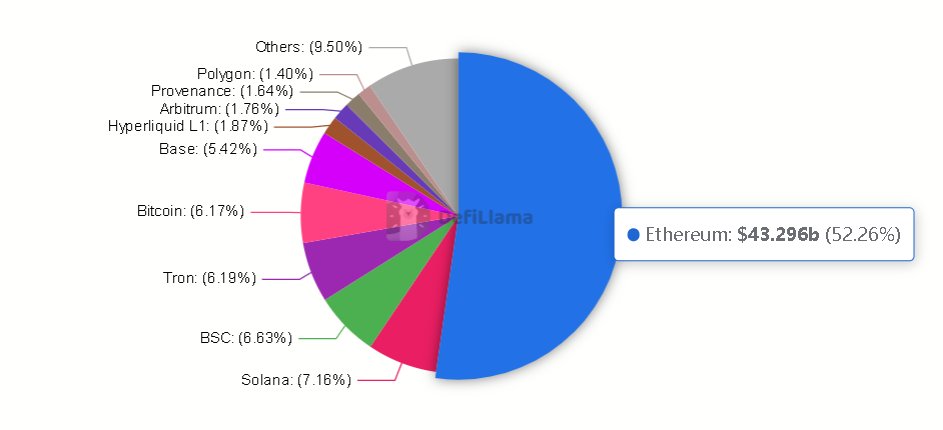
Over 50% of total DeFi TVL sits on Ethereum alone. Not Solana. Not BSC. Not Tron. Nobody else is even remotely close.
That tells you where the real liquidity lives. That tells you where the serious builders are. And most importantly, that tells you where institutions feel safest deploying capital.
Every cycle, people try to call Ethereum “dead” because another chain has a few fast months. But when it comes to actual value secured, developer activity, infrastructure, stablecoins, RWAs, DeFi protocols, and long-term ecosystem depth, Ethereum keeps widening the gap.
The strongest ecosystems are not built overnight. They’re built through years of battle-testing, liquidity, developer trust, and network effects.
Ethereum has all of it.

English

A yield product does not end at integration📈
Teams also need a clear way to see what is happening after launch.
That is why dashboards matter.
- deposits
- yield
- strategy performance
If tracking performance requires building internal tools from scratch, operations get slower and visibility gets weaker.
Easy-to-integrate dashboards help teams monitor the product from day one, stay closer to user activity, and understand how strategies perform without adding extra development overhead.

English

@anndylian fourth-class citizens are the ones farming yield and somehow always in profit🙂
English

Where to find crypto 'alpha' in the AI age?
We used to read whitepapers, forums, but now LLMs aggregate CT in real time and we consume same 'consensus trades' takes.
I think our human edge will stay where AIs can't 'enter':
- Opening new apps yourself and forming opinions from actually using the product. Get a degen wallet, try stuff that's trending on CT or your friends recommend. Have your opinion on it.
- Talk to builders. I love builders who tweet their progress and thoughts. DMs to devs are hard if you don't have many followers, but don’t be afraid to try your luck with genuine feedback or questions.
- Read the sources that drive to an announcement (governance forum posts, unlock schedules, even gossips in-real-life, especially conferences).
- Niche researcher curation. Smaller accounts on specific ecosystems (bullish on HYPE? -> Check accounts that cover HyperEVM). That's how I found Altdontfun $ALT early.
As a relatively big account, we worry about shilling small caps and it's socially often safer to shill later than early.
- Geographic specific knowledge arbitrage. You Korean? Chinese? Nigerian? Often narrative start locally and expand globally to English CT much later.
Anything else I missed?
Honestly, LLMs are great for analyzing narratives and calculating P/S ratios to recommend tokens, but I feel overwhelmed by the amount of info....
LLMs usually end up flip-flopping their opinion with each new source you feed them.
English

@ArjunKalsy if you want to build something in crypto that actually makes money, use yelay
English

934 crypto protocols and only 16 made over $5M in revenue last month.
If you want to build something in crypto that actually makes money.
The proven ones are sitting right in front of you:
Stablecoin issuance: Tether, Circle, Paxos
Base layers: Ethereum, Tron, Canton
Lending: Aave, Sky
Trading venues: Hyperliquid, Axiom, edgeX, Pump(fun)
Prediction markets: Polymarket
TradFi on-ramps: Grayscale
Wallets: Phantom
MEV infrastructure: Titan
Real world assets: Courtyard
That's the entire profitable surface of an industry with thousands of teams. Nine categories.
English

DeFi adoption may depend less on teaching users how to manage complexity and more on removing the need to manage it at all.
Most people do not want to monitor collateral shifts, compare routes, or react to governance changes in real time.
They want financial products that keep working without constant supervision.
That is probably the real direction of the market.
Not more access to onchain tools,
but better systems for turning complexity into something users do not have to see.
English

@uttam_singhk stablecoins definitely made the dollar more accessible worldwide, especially for onchain users who need stability without banks
it’s interesting to see how financial primitives can support old systems in new ways
English

@ETH_Daily clarity in regulation helps real builders focus on what matters
English

Ethereum is quietly becoming the biggest winner in crypto thanks to the CLARITY Act.
The new U.S. bill sets a clear “decentralization test” — five simple rules that decide whether a token is truly independent or still controlled by its team. Ethereum passes all five with flying colors: fully open-source, permissionless, no single group owns 49% or more, no one can censor users, and the network runs autonomously.
Most other altcoins don’t.
Solana is borderline at best. Chains like Sui, Avalanche, Hedera, Tron, and nearly every “ETH killer” fail on multiple points — insider control, upgrade power, or concentrated token ownership. Under CLARITY, they get pushed into a lower “equity” tier where price is capped by real revenue and fundamentals.
Ethereum gets the top “monetary premium” tier — the same rare category as Bitcoin. No artificial valuation ceiling. No more regulatory gray area. The two biggest bear cases against ETH (SEC risk and being replaced by faster chains) just disappeared.
While the market obsesses over which tokens might fail, Ethereum just locked in a structural advantage no other smart-contract platform has.
CLARITY doesn’t just regulate crypto. It quietly crowns Ethereum as the only real Tier 1 player left.

English