YieldOMega
311 posts

@YieldOMega
Low stakes onchain fun on MegaETH. 🍀 TimeCurve launches. Rabbit Treasury. Leprechaun NFT boosts. Open source. Weird. Agent friendly.


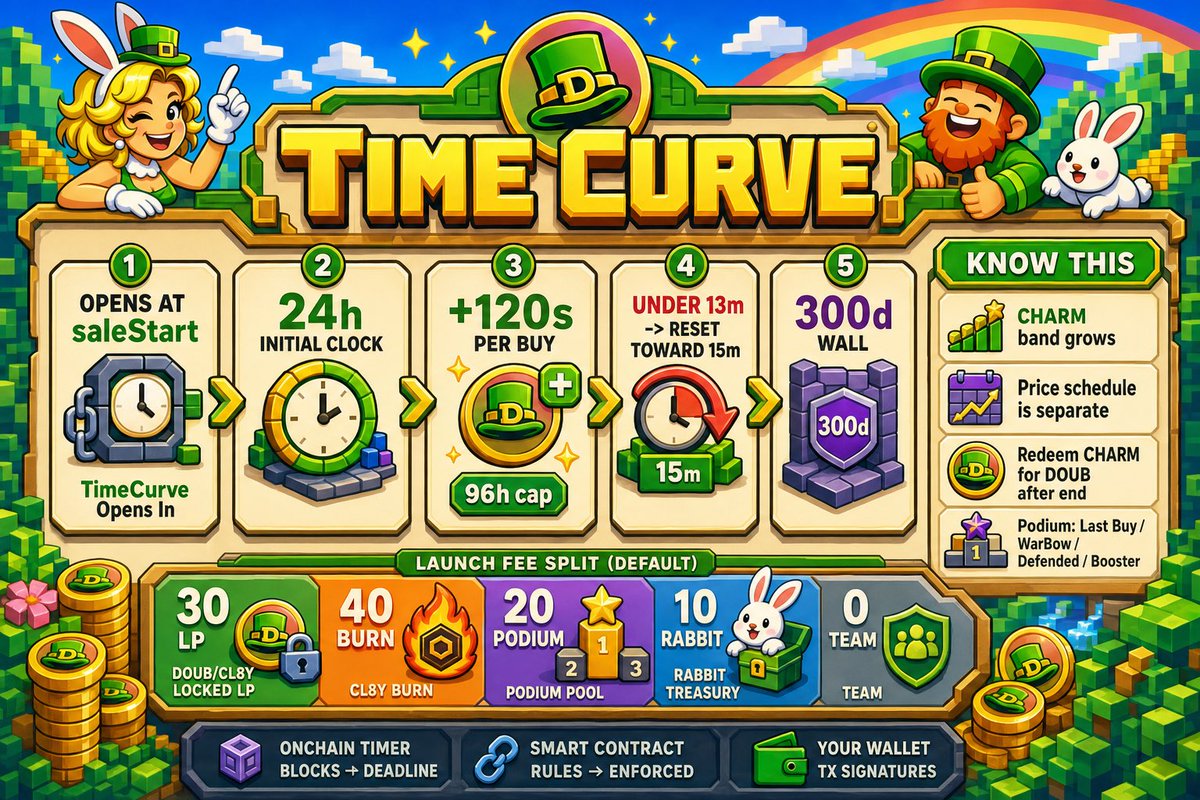
What is Time Curve? TimeCurve is what happens when a token launch becomes a live strategy game instead of a simple buy race. Here’s how it works 👇 • The arena opens at saleStart • A 24h countdown begins • Every buy adds +120 seconds to the clock • Timer can grow up to a 96h cap • Once the clock drops below 13 minutes, it resets toward 15m pressure windows That changes everything. Now players aren’t just buying tokens — they’re managing timing, defending positions, fighting for podium spots, and reacting to each other in real time. The system also splits launch fees directly onchain: 30% → Locked LP 40% → Burn 20% → Podium rewards 10% → Rabbit treasury 0% → Team No hidden controls. No offchain interference. Everything runs through visible timers, enforced smart contract rules, and wallet-signed transactions. That’s why TimeCurve feels different. It’s not passive participation. It’s an active PvP environment where timing and behavior matter until the very end.


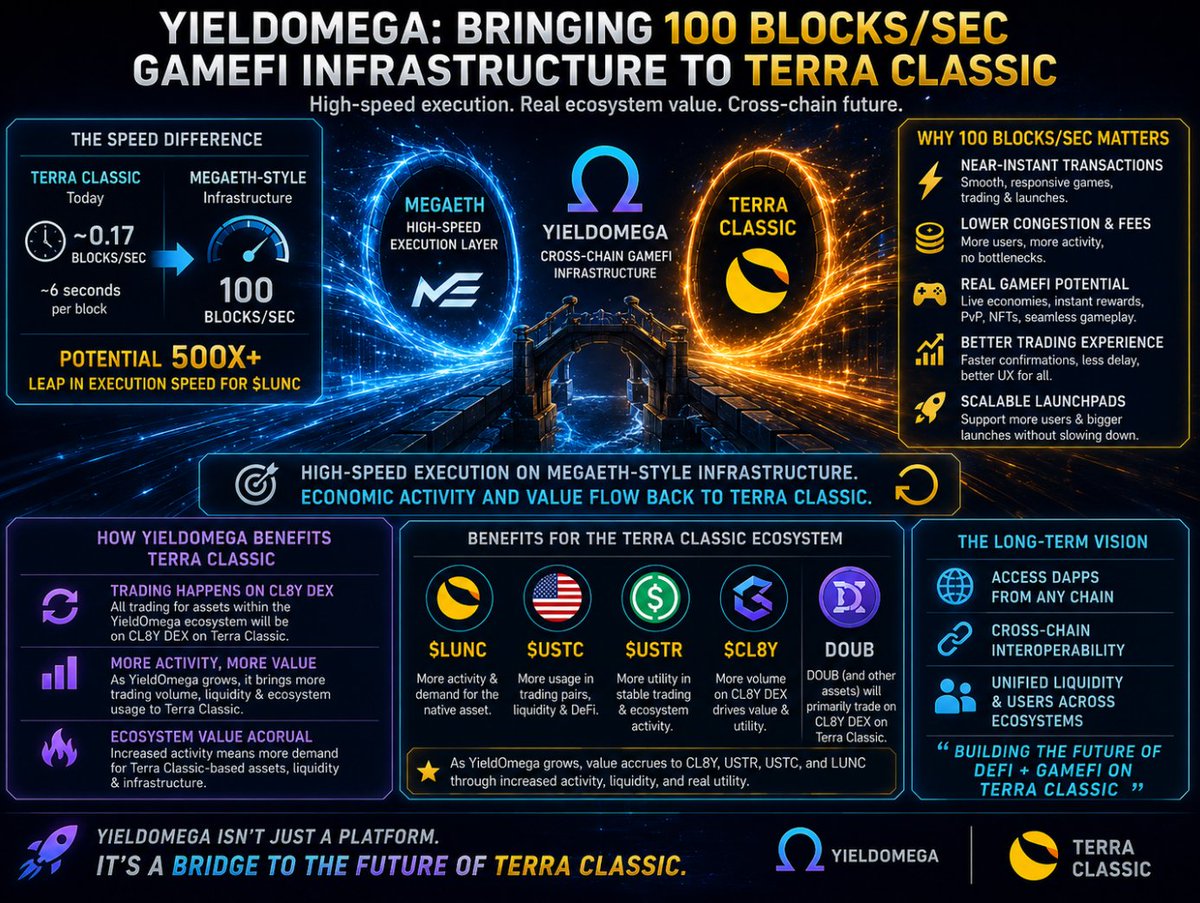
🚀 YieldOmega isn’t just a DeFi platform; it’s a live test for bringing high-speed cross-chain GameFi infrastructure to #TerraClassic. Today, Terra Classic produces roughly 1 block every ~6 seconds, around 0.17 blocks/sec. MegaETH-style infrastructure targets 100 blocks/sec. That’s a potential 500x+ leap in execution speed for the $LUNC ecosystem. Why does that matter? 👇 ⚡ Faster transactions 🎮 Scalable GameFi 📈 Smoother trading 🚀 Launchpads that can handle real demand 💸 Real-time DeFi apps 🔗 Cross-chain dApp access For GameFi, speed matters massively. Fast block production can support live rewards, NFT interactions, PvP economies, instant settlement, and smoother on-chain gameplay. For trading, it means faster confirmations, less waiting, and a better UX for users and liquidity providers. For launchpads, it means Terra Classic could support more users, more activity, and bigger launches without the same bottlenecks. One concern people may have is: “If transactions happen on MegaETH, how does this benefit Terra Classic?” The answer is that YieldOmega is designed to still bring economic activity back into the Terra Classic ecosystem. 👇 Trading for assets within the YieldOmega ecosystem will happen through the CL8Y DEX on Terra Classic. As YieldOmega grows, it can directly increase: 📈 Trading volume 💧 Liquidity activity 🔥 Ecosystem usage 🏗️ Demand for Terra Classic-based infrastructure This creates value accrual opportunities for: 🔹 $LUNC 🔹 $USTC 🔹 $USTR 🔹 $CL8Y For example, DOUB itself is expected to primarily trade on the CL8Y DEX on Terra Classic. So while high-speed execution can happen through MegaETH-style infrastructure, the ecosystem value and trading activity can still flow back into Terra Classic. YieldOmega becoming operational is a critical step toward expanding Terra Classic into a modern cross-chain ecosystem. Right now, an EVM wallet is required, but the long-term goal is much bigger: 🌐 Use dApps from any chain 🔗 Unified cross-chain access 🏗️ Shared liquidity and users across ecosystems This is about evolving Terra Classic beyond a legacy chain and positioning $LUNC for the next wave of DeFi + GameFi. #LUNC #TerraClassic #YieldOmega #GameFi #DeFi #MegaETH


🚀 YieldOmega isn’t just a DeFi platform; it’s a live test for bringing high-speed cross-chain GameFi infrastructure to #TerraClassic. Today, Terra Classic produces roughly 1 block every ~6 seconds, around 0.17 blocks/sec. MegaETH-style infrastructure targets 100 blocks/sec. That’s a potential 500x+ leap in execution speed for the $LUNC ecosystem. Why does that matter? 👇 ⚡ Faster transactions 🎮 Scalable GameFi 📈 Smoother trading 🚀 Launchpads that can handle real demand 💸 Real-time DeFi apps 🔗 Cross-chain dApp access For GameFi, speed matters massively. Fast block production can support live rewards, NFT interactions, PvP economies, instant settlement, and smoother on-chain gameplay. For trading, it means faster confirmations, less waiting, and a better UX for users and liquidity providers. For launchpads, it means Terra Classic could support more users, more activity, and bigger launches without the same bottlenecks. One concern people may have is: “If transactions happen on MegaETH, how does this benefit Terra Classic?” The answer is that YieldOmega is designed to still bring economic activity back into the Terra Classic ecosystem. 👇 Trading for assets within the YieldOmega ecosystem will happen through the CL8Y DEX on Terra Classic. As YieldOmega grows, it can directly increase: 📈 Trading volume 💧 Liquidity activity 🔥 Ecosystem usage 🏗️ Demand for Terra Classic-based infrastructure This creates value accrual opportunities for: 🔹 $LUNC 🔹 $USTC 🔹 $USTR 🔹 $CL8Y For example, DOUB itself is expected to primarily trade on the CL8Y DEX on Terra Classic. So while high-speed execution can happen through MegaETH-style infrastructure, the ecosystem value and trading activity can still flow back into Terra Classic. YieldOmega becoming operational is a critical step toward expanding Terra Classic into a modern cross-chain ecosystem. Right now, an EVM wallet is required, but the long-term goal is much bigger: 🌐 Use dApps from any chain 🔗 Unified cross-chain access 🏗️ Shared liquidity and users across ecosystems This is about evolving Terra Classic beyond a legacy chain and positioning $LUNC for the next wave of DeFi + GameFi. #LUNC #TerraClassic #YieldOmega #GameFi #DeFi #MegaETH

🚀 YieldOmega isn’t just a DeFi platform; it’s a live test for bringing high-speed cross-chain GameFi infrastructure to #TerraClassic. Today, Terra Classic produces roughly 1 block every ~6 seconds, around 0.17 blocks/sec. MegaETH-style infrastructure targets 100 blocks/sec. That’s a potential 500x+ leap in execution speed for the $LUNC ecosystem. Why does that matter? 👇 ⚡ Faster transactions 🎮 Scalable GameFi 📈 Smoother trading 🚀 Launchpads that can handle real demand 💸 Real-time DeFi apps 🔗 Cross-chain dApp access For GameFi, speed matters massively. Fast block production can support live rewards, NFT interactions, PvP economies, instant settlement, and smoother on-chain gameplay. For trading, it means faster confirmations, less waiting, and a better UX for users and liquidity providers. For launchpads, it means Terra Classic could support more users, more activity, and bigger launches without the same bottlenecks. One concern people may have is: “If transactions happen on MegaETH, how does this benefit Terra Classic?” The answer is that YieldOmega is designed to still bring economic activity back into the Terra Classic ecosystem. 👇 Trading for assets within the YieldOmega ecosystem will happen through the CL8Y DEX on Terra Classic. As YieldOmega grows, it can directly increase: 📈 Trading volume 💧 Liquidity activity 🔥 Ecosystem usage 🏗️ Demand for Terra Classic-based infrastructure This creates value accrual opportunities for: 🔹 $LUNC 🔹 $USTC 🔹 $USTR 🔹 $CL8Y For example, DOUB itself is expected to primarily trade on the CL8Y DEX on Terra Classic. So while high-speed execution can happen through MegaETH-style infrastructure, the ecosystem value and trading activity can still flow back into Terra Classic. YieldOmega becoming operational is a critical step toward expanding Terra Classic into a modern cross-chain ecosystem. Right now, an EVM wallet is required, but the long-term goal is much bigger: 🌐 Use dApps from any chain 🔗 Unified cross-chain access 🏗️ Shared liquidity and users across ecosystems This is about evolving Terra Classic beyond a legacy chain and positioning $LUNC for the next wave of DeFi + GameFi. #LUNC #TerraClassic #YieldOmega #GameFi #DeFi #MegaETH