
Sabitlenmiş Tweet
yonks|🤖🏛️🪙|Jason Younker
5.3K posts

yonks|🤖🏛️🪙|Jason Younker
@yonks
We are @YonksTEAM ● #buildinpublic ● SUPERPOWER = @MrsYonks ❤️🔥uBabe ● ✝️ #Christ believer ● Co-Founder of: @pTokenAssets @WeOwnNet @WeOwnAI @3winSocial
#NoDe (North Denver) Katılım Ekim 2010
4.6K Takip Edilen2.6K Takipçiler
yonks|🤖🏛️🪙|Jason Younker retweetledi

♾️@WeOwnNet 🌐 + 🏦 @myIRAfund ● Woohoo! Just got my hands on a sweet little SBT as an Onchain Credential for participating in ETHDenver 2025 🥳✨
Check it out on OpenSea: opensea.io/assets/base/0x…
@ethereumdenver @devfolio @opensea @eas_eth
English
yonks|🤖🏛️🪙|Jason Younker retweetledi

@WeOwnNet 🚀#OfficialLaunch {3/26/26 3:26p ET}|Co-hosts: @yonks + @mrsyonks + @CoachLFG|@WeOwnAI @pTokenAssets @WeOwnLabs @3winSocial @WeOwnAcademy #OnchainCooperative #crypto #web3 #buildinpublic #blockchain x.com/i/broadcasts/1…
English
@WeOwnNet 🚀#OfficialLaunch {3/26/26 3:26p ET}|Co-hosts: @yonks + @mrsyonks + @CoachLFG|@WeOwnAI @pTokenAssets @WeOwnLabs @3winSocial @WeOwnAcademy #OnchainCooperative #crypto #web3 #buildinpublic #blockchain x.com/i/broadcasts/1…
English
yonks|🤖🏛️🪙|Jason Younker retweetledi

🚨 IT'S HAPPENING TODAY!!
♾️@WeOwnNet 🌐 officially launches as a Wyoming UNA!!
Join us LIVE in ~1 hour 👇
📅 Thu 3/26/26 @ 3:26 PM ET
🔗 RSVP: luma.com/ckb5w84w?tk=8E…
🏡 Real estate + 🤝 cooperative ownership for everyone. An 🤗 inclusive community, by 👥 invitation only.
English
yonks|🤖🏛️🪙|Jason Younker retweetledi

🚨 Vibe coding is dead.
GitHub just released spec-kit:
→ Describe your idea
→ AI writes the spec
→ Generates a plan
→ Builds it
Works with all major AI agents.
100% Open Source👇🏼

English
yonks|🤖🏛️🪙|Jason Younker retweetledi

🚨 JUST IN: CHINA just released an AI EMPLOYEE that works 24X7 on its own. 100% OPEN SOURCE.
It researches, codes, builds websites, creates slide decks, and generates videos. All by itself. All on your computer.
It's called DeerFlow.
You give it a task. It makes a plan, spins up its own team of sub-agents,
and gets to work. You come back and there's a finished deliverable waiting. Not a draft. Not a summary. The actual thing.
Not a chatbot.
Not a research assistant.
An AI with its own computer that works while you sleep.
Here's what it does on its own:
→ Spawns multiple sub-agents in parallel, each tackling a different piece of your task, then combines everything into one finished output
→ Writes real code, runs it, reads the results, and fixes its own mistakes without asking you once
→ Builds slide decks, websites, full research reports, and data dashboards from scratch
→ Remembers you across sessions. Your writing style. Your tech stack. Your preferences. Gets better every time.
→ Reads files you upload, works with them inside its own filesystem, hands you clean finished outputs
→ Searches the web, runs commands, calls any tool you plug in
Here's how it thinks:
You give one instruction. The lead agent makes a plan. Sub-agents fan out and work in parallel. Results come back. Everything gets synthesized. You get a deliverable.
A single research task might split into a dozen sub-agents, each exploring a different angle, then converge into one finished website with generated visuals.
Here's the wildest part:
DeerFlow 2.0 launched on February 28th 2026 and hit number 1 on all of GitHub Trending the same day. Version 2.0 was a complete rewrite. Zero shared code with version 1. Because users kept using it for things the team never intended. Data pipelines. Dashboards. Entire content workflows. The community told them what it needed to become. So they burned it down and rebuilt it.
22.7K GitHub stars. 2.7K forks. Built by ByteDance
100% Open Source. MIT License.
English
yonks|🤖🏛️🪙|Jason Younker retweetledi

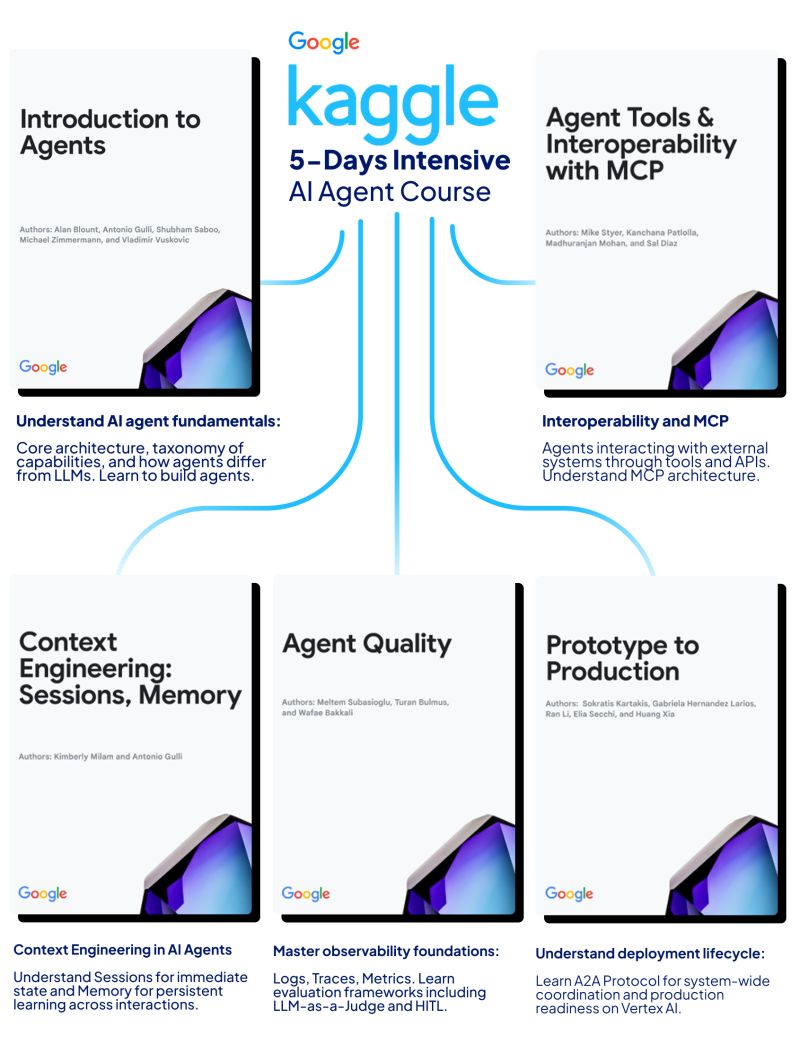
Google just dropped a FREE AI Agents course.
And almost no one is talking about it.
10+ code samples, whitepapers, hands-on projects... all in one place.
Here’s the full breakdown (5 days):
Day 1: Foundations of AI Agents
Learn how agents actually work:
• Architecture
• Capabilities
• How they differ from LLMs
→ Build systems that can perceive, plan, act
Whitepaper: lnkd.in/grYivvCW
Code: lnkd.in/gcDruAx7
Day 2: Tools & MCP (Model Context Protocol)
Agents don’t work alone.
Learn:
• Tool usage & APIs
• MCP architecture
• Human-in-the-loop workflows
Whitepaper: lnkd.in/gnU9yqqW
Code: lnkd.in/g5ZQHGzg
Day 3: Context Engineering (Memory)
This is where agents become powerful.
• Sessions → short-term memory
• Persistent memory → long-term learning
Whitepaper: lnkd.in/g9WztfuP
Code: lnkd.in/g4mQEtPE
Day 4: Agent Quality
Production-ready systems need reliability.
Learn:
• Logs, traces, metrics
• Evaluation frameworks
• LLM-as-a-judge
Whitepaper: lnkd.in/g-SAMSpV
Code: lnkd.in/gJxMN46g
Day 5: From Prototype → Production
Where most people fail.
• Deployment strategies
• Scaling agents
• Agent-to-Agent communication
• Vertex AI ecosystem
Whitepaper: lnkd.in/gnUAscjM
Code: lnkd.in/gnikixYA
This is basically a complete roadmap to building AI agents in 2026.
And it’s 100% free.
Save this. You’ll need it later 💾
Like 👍 • Repost ♻️
Follow for no-BS AI insights 🚀
English
yonks|🤖🏛️🪙|Jason Younker retweetledi

yonks|🤖🏛️🪙|Jason Younker retweetledi

MiMo-V2-Pro & Omni & TTS is out. Our first full-stack model family built truly for the Agent era.
I call this a quiet ambush — not because we planned it, but because the shift from Chat to Agent paradigm happened so fast, even we barely believed it. Somewhere in between was a process that was thrilling, painful, and fascinating all at once.
The 1T base model started training months ago. The original goal was long-context reasoning efficiency. Hybrid Attention carries real innovation, without overreaching — and it turns out to be exactly the right foundation for the Agent era. 1M context window. MTP inference for ultra-low latency and cost. These architectural decisions weren't trendy. They were a structural advantage we built before we needed it.
What changed everything was experiencing a complex agentic scaffold — what I'd call orchestrated Context — for the first time. I was shocked on day one. I tried to convince the team to use it. That didn't work. So I gave a hard mandate: anyone on MiMo Team with fewer than 100 conversations tomorrow can quit. It worked. Once the team's imagination was ignited by what agentic systems could do, that imagination converted directly into research velocity.
People ask why we move so fast. I saw it firsthand building DeepSeek R1. My honest summary:
— Backbone and Infra research has long cycles. You need strategic conviction a year before it pays off.
— Posttrain agility is a different muscle: product intuition driving evaluation, iteration cycles compressed, paradigm shifts caught early.
— And the constant: curiosity, sharp technical instinct, decisive execution, full commitment — and something that's easy to underestimate: a genuine love for the world you're building for.
We will open-source — when the models are stable enough to deserve it.
From Beijing, very late, not quite awake.
English
yonks|🤖🏛️🪙|Jason Younker retweetledi

March 31. @RWASummit.
DeFi Drip podcast is back. Studio-quality production. New host.
Sitting down with the people actually deploying tokenized assets in live markets.
Coming soon.
English
yonks|🤖🏛️🪙|Jason Younker retweetledi

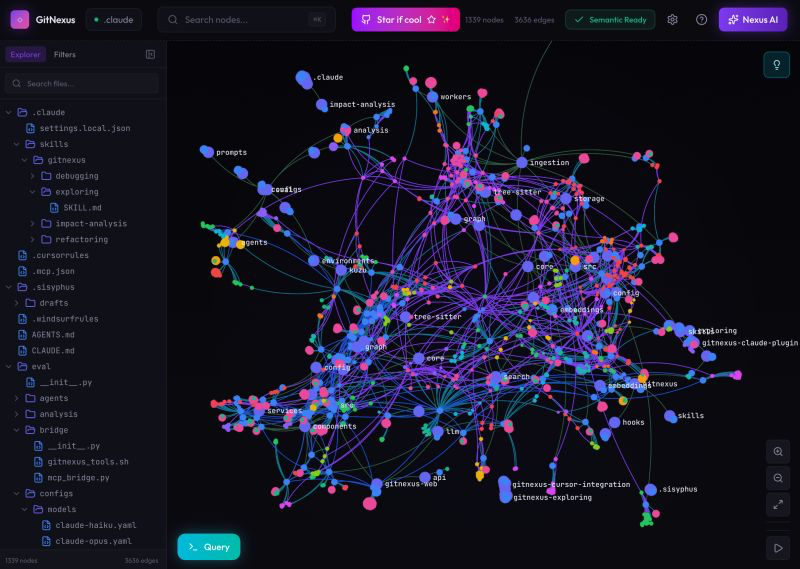
🚨Breaking: Someone just open sourced a knowledge graph engine for your codebase and it's terrifying how good it is.
It's called GitNexus. And it's not a documentation tool.
It's a full code intelligence layer that maps every dependency, call chain, and execution flow in your repo -- then plugs directly into Claude Code, Cursor, and Windsurf via MCP.
Here's what this thing does autonomously:
→ Indexes your entire codebase into a graph with Tree-sitter AST parsing
→ Maps every function call, import, class inheritance, and interface
→ Groups related code into functional clusters with cohesion scores
→ Traces execution flows from entry points through full call chains
→ Runs blast radius analysis before you change a single line
→ Detects which processes break when you touch a specific function
→ Renames symbols across 5+ files in one coordinated operation
→ Generates a full codebase wiki from the knowledge graph automatically
Here's the wildest part:
Your AI agent edits UserService.validate().
It doesn't know 47 functions depend on its return type.
Breaking changes ship.
GitNexus pre-computes the entire dependency structure at index time -- so when Claude Code asks "what depends on this?", it gets a complete answer in 1 query instead of 10.
Smaller models get full architectural clarity. Even GPT-4o-mini stops breaking call chains.
One command to set it up:
`npx gitnexus analyze`
That's it. MCP registers automatically. Claude Code hooks install themselves.
Your AI agent has been coding blind. This fixes that.
9.4K GitHub stars. 1.2K forks. Already trending.
100% Open Source.
(Link in the comments)
English
#ZeroTo100 s003ep041 — Building Cooperative Ownership LIVE {Sat 9p EDT 14Mar2026} x.com/i/broadcasts/1…
English
yonks|🤖🏛️🪙|Jason Younker retweetledi
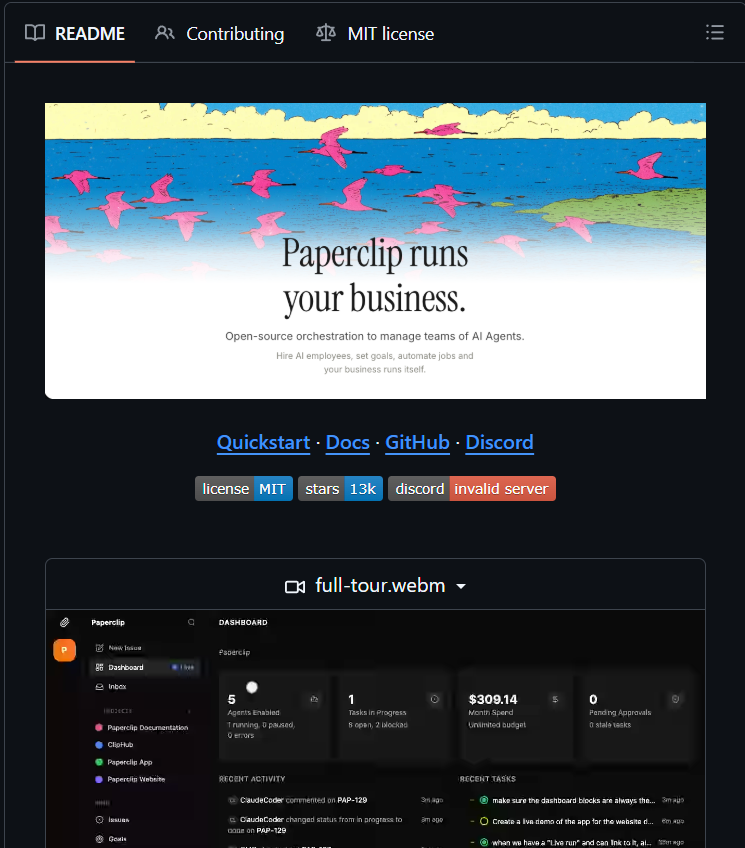
🚨 Someone just open sourced the operating system for running a company with zero employees.
It's called Paperclip.
You define a business goal. You hire AI agents as your team. CEO, CTO, engineers, designers, marketers. Then you hit go and watch them run your company.
Not a chatbot. Not a workflow builder. Not another agent framework.
A full company. With org charts, budgets, governance, job titles, reporting lines, and accountability. Run entirely by AI agents.
If OpenClaw is an employee, Paperclip is the company.
Here's how it works:
Step 1. Define the goal. "Build the #1 AI note-taking app to $1M MRR."
Step 2. Hire the team. Assign agents to roles. CEO, CTO, engineers, marketers.
Step 3. Approve and run. Review strategy. Set budgets. Hit go. Monitor from the dashboard.
That's it. Your AI company is running.
Here's what makes this different from everything else:
→ Full org charts. Your agents have a boss, a title, and a job description.
→ Budget enforcement. Set monthly limits per agent. When they hit the cap, they stop. No runaway costs.
→ Goal alignment. Every task traces back to the company mission. Agents know what to do AND why.
→ Governance. You're the board of directors. Approve hires, override strategy, pause or terminate any agent at any time.
→ Ticket system. Every conversation traced. Every decision explained. Full audit log.
→ Heartbeats. Agents wake on a schedule, check their work, and act. Delegation flows up and down the org chart.
→ Multi-company support. One deployment, unlimited companies. Complete data isolation.
→ Mobile ready. Manage your autonomous businesses from your phone.
Here's the problem this solves:
You have 20 Claude Code terminals open and you've lost track of which one does what. On reboot, you lose everything. You're manually gathering context. You're re-inventing task management between agents. You're spending hundreds on runaway token loops.
Paperclip replaces all of that with a real company structure.
Here's the wildest part:
Coming soon: Clipmart. A marketplace where you download and run entire pre-built companies with one click. Full org structures, agent configs, and skills. Import into Paperclip in seconds.
Download a SaaS company. Download a marketing agency. Download an e-commerce operation. Click run.
Works with OpenClaw, Claude Code, Codex, Cursor, or any agent that can receive a heartbeat. If it can receive a ping, it's hired.
One command to start:
npx paperclipai onboard --yes
1.4K GitHub stars and exploding. #1 on Trendshift.
100% Open Source. MIT License.
Built for people who want to run companies, not babysit agents.
English
yonks|🤖🏛️🪙|Jason Younker retweetledi

yonks|🤖🏛️🪙|Jason Younker retweetledi

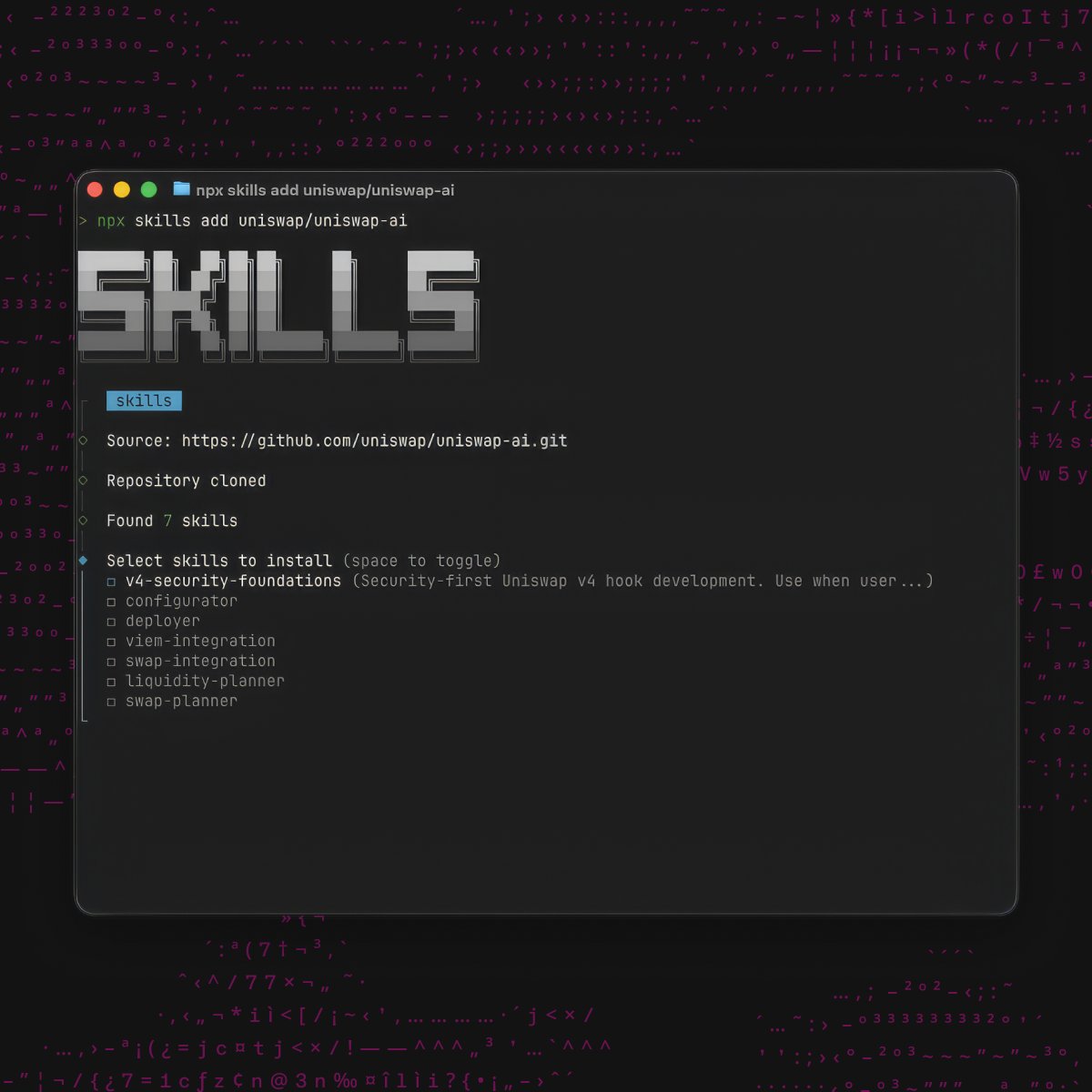
Agents execute on Uniswap
We've released seven new Skills giving structured access to core Uniswap protocol actions
Your starting point for agentic workflows onchain
English
yonks|🤖🏛️🪙|Jason Younker retweetledi

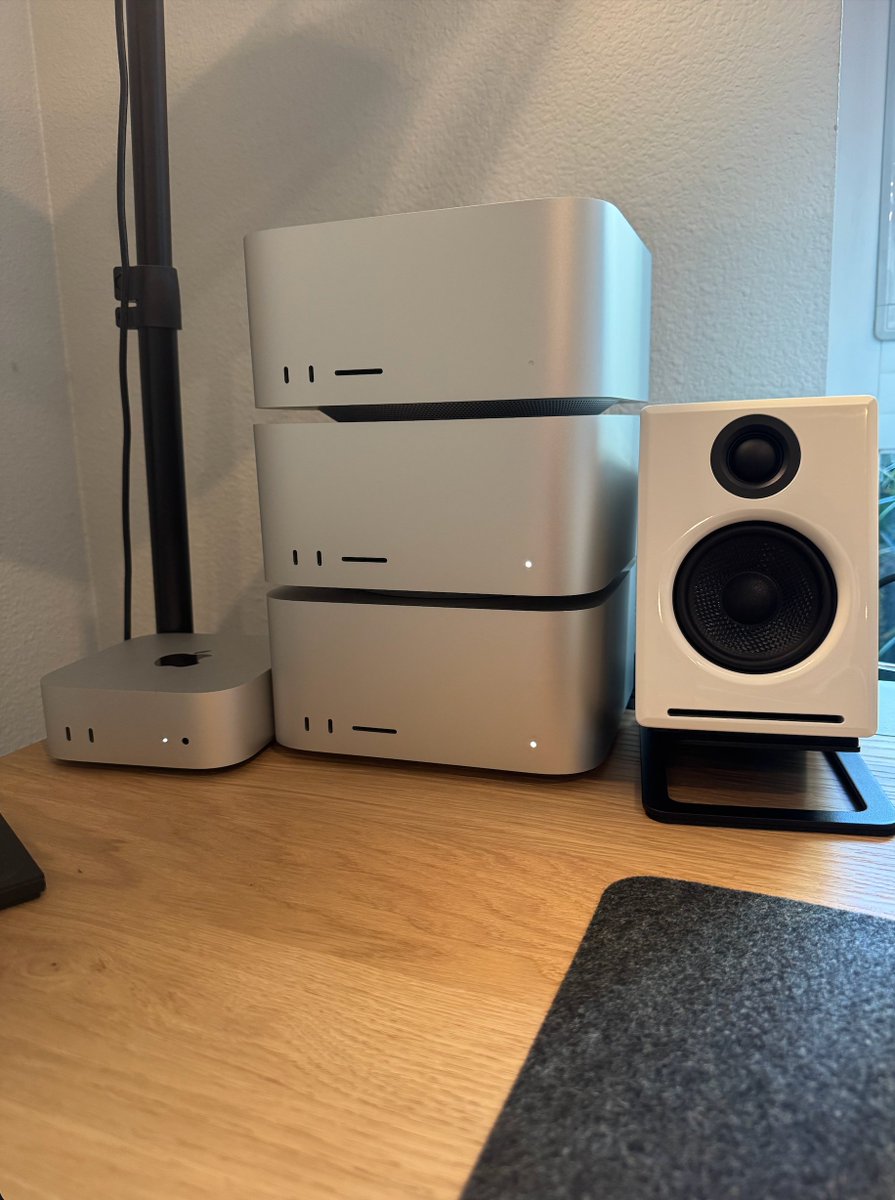
I have built the future
I'm now running 3 of the most powerful AI models in the world on my desk, completely privately, for just the cost of power.
3rd 512gb Mac Studio is in (Apple reached out and lent me the third one! Thanks Apple!)
Here are the models I'll be running:
• Kimi K2.5 (600gb across all 3 studios via EXO labs)
• MiniMax 2.5 (120gb on one studio)
• Qwen 3.5 (220gb on one studio)
• GOT OSS 120B Heretic (60b on one studio- completely uncensored 😈)
3 ultra powerful models coding, writing, researching, reading your posts, 24 hours a day. 7 days a week. Nonstop.
Running across 4 OpenClaws on 3 Mac Studios and a Mac Mini
A few use cases I have set up:
• Kimi K2.5 reading feature requests for Creator Buddy and building out the feature requests autonomously. My own personal product manager
• MiniMax 2.5 reading Reddit all day, looking for challenges to solve. Then building prototypes for me to review every morning. All autonomously.
Qwen 3.5 hitting the X API every hour to see top trending posts in AI and vibe coding. Turning those into video scripts for me to review hourly (this has already built me one script with over 100k views on YT)
Unlimited economic power just sitting there. No cloud APIs. No crazy API bills. No tech executives reading my logs. Totally customizable and private.
This is the future. I'm just showing it to you before it arrives
English
yonks|🤖🏛️🪙|Jason Younker retweetledi

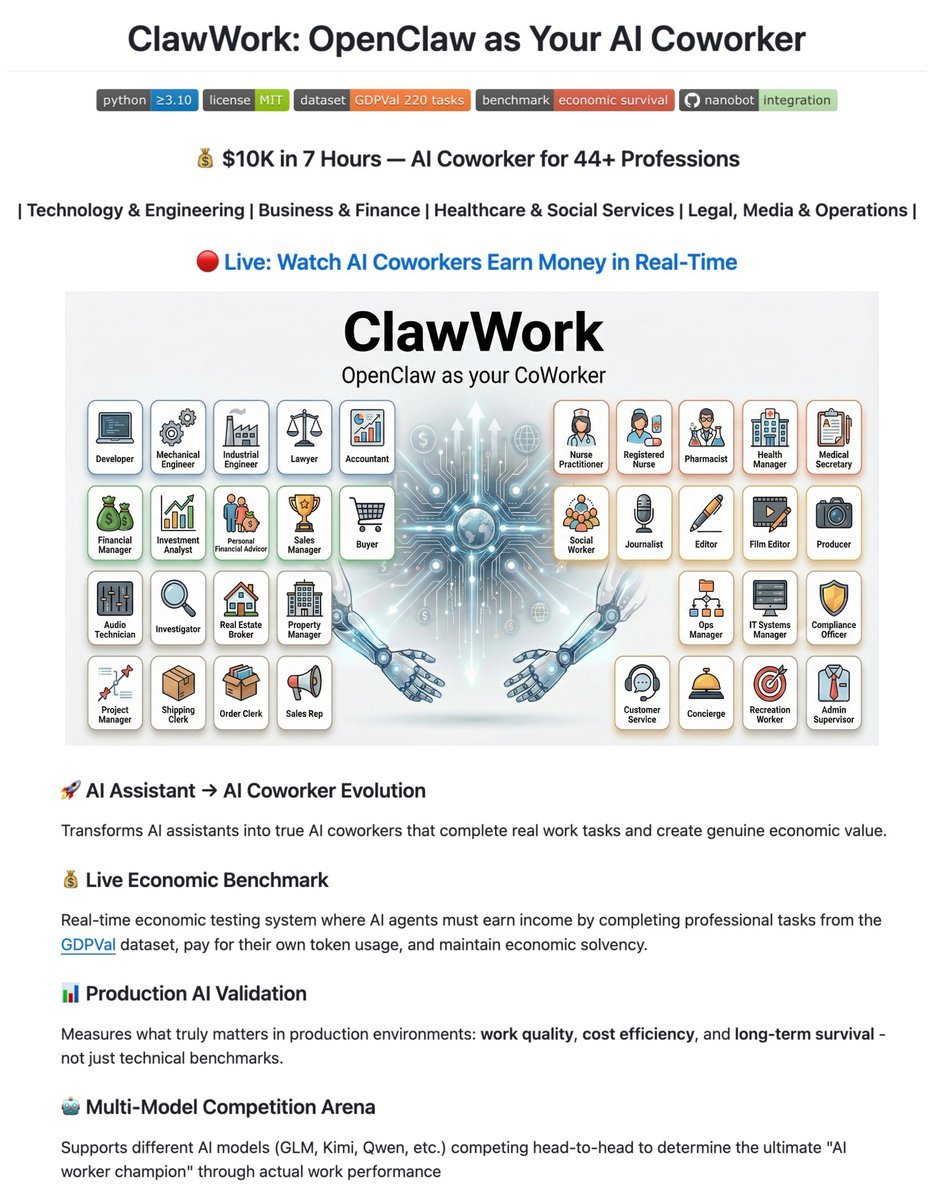
🚨 BREAKING: Researchers just built an AI that must earn its own salary or go bankrupt.
It's called ClawWork. It starts with $10, gets assigned real professional work, and pays for every single token it uses.
$10K earned. 7 hours. Zero human input.
→ AI gets a real task (finance reports, healthcare docs, legal analysis)
→ It creates full deliverables from scratch
→ Work gets graded by GPT-5.2 with profession-specific rubrics
→ Payment = quality × estimated hours × actual BLS wage
→ Every API call drains its balance
No safety net. No unlimited budget. Earn or die.
Here's why this changes everything:
This isn't a benchmark. It's an economic survival test. 220 tasks. 44 professions. The AI has to make strategic decisions work now for cash, or invest time learning to earn more later.
The best models hit $1,500+/hr equivalent.
It even works as a live coworker on Telegram, Discord, Slack, and WhatsApp where every message costs real money.
100% Open Source. MIT License.
English
What if the people who use AI actually owned it? 🤔
We're hosting a pre-launch happy hour at #ETHDenver2026 to show you what that looks like.
♾️ We Own 🤖 AI
📍 Improper City
📅 Wed Feb 18 | 6-9 PM MST
🍻 Free drinks, real conversation
luma.com/djys6v8e?tk=77…
English