

Zena
147 posts


Zena retweetledi
China vs. the US. Same world. Wildly different price tags.
The numbers don’t lie, and they tell a fascinating story.
Average monthly salary in China: $1,007.
In the US: $4,276.
That’s a 4.2x income gap.
But here’s where it gets interesting.
Food costs don’t follow the same ratio.
A meal at an inexpensive restaurant in China costs $2.84.
In the US? $20.00. That’s 7x more expensive.
A dozen eggs: $1.57 in China vs $4.41 in the US.
A cappuccino: $2.95 vs $5.32.
White rice per lb: $0.43 vs $2.09.
The Chinese consumer is paying dramatically less, not just proportionally, but in absolute dollar terms.
Now look at the real squeeze.
Broadband internet in China: $11.23/month.
In the US: $72.43/month.
Mobile phone plan in China: $8.95.
In the US: $60.90.
Basic utilities: $51.89 in China vs $210.49 in the US.
Infrastructure costs in America are crushing the middle class.
The one area where China doesn’t win?
A new compact car costs $18,488 in China vs $35,699 in the US.
Cheaper, but relative to monthly salary, still a 18-month income commitment for the average Chinese worker.
The real insight:
China has engineered a low-cost, high-efficiency consumer economy.
The US has engineered high wages but also high costs that quietly consume them.
Purchasing power parity tells a story that raw salary comparisons completely miss.
I have lived in China for over 20 years and I can attest that we get more for less. The only thing I would say it’s ridiculously expensive is real estate prices, where an ordinary person would had to work their whole life to pay off the mortgage.
Price-to-income ratios are estimated at:
* Beijing: ~37x annual income
* Shanghai: ~38x annual income
That means an average household may need 30–40 years of total income just to buy a home outright.
This is why many Chinese families:
* pool money across 2–3 generations
* rely heavily on parents for downpayments
* prioritize home ownership above almost everything else
Important shift happening now:
China’s property crisis actually reduced prices in many cities:
* mortgage rates fell sharply
* home prices declined
* affordability improved versus 2020–2021 peaks
But psychologically, many young Chinese are now:
* delaying marriage
* delaying home purchases
* preferring renting
* less willing to take 30-year debt
because they watched previous generations become heavily leveraged into declining property markets.

English
@Cluster_6 The integrator model would work cuz lithium battery is an otherwise very commoditized industry until tariff shuts off Chinese batteries and then FOEC shuts off any Chinese makers to even launch a factory in the US
English

TL;DR: Comparing $FLNC to $EOSE as though they followed the same industrial path is dumb. $FLNC is not doing what $EOSE was supposed to do. It is doing what $FLNC was supposed to do.
Explanation 👇
A lot of comments today are comparing $FLNC and $EOSE as though they simply pursued the same strategy and produced different outcomes. They did not.
Fluence did not scale by building a vertically integrated battery manufacturing platform from scratch. Fluence is primarily a system integrator, software, and project execution company built on top of the already-mature global lithium-ion supply chain.
Fluence sources cells and modules from third-party suppliers such as CATL, LG, Samsung SDI, BYD, and others depending on the project. Their core value proposition is system integration, controls software, deployment execution, and project orchestration at scale.
Even Fluence’s Utah “manufacturing” operation is not vertically integrated battery manufacturing in the EOS sense. The Utah facility was originally established as a contract manufacturing and final assembly operation. Fluence designed the systems while Jabil (sound familiar?) - one of the world’s largest industrial contract manufacturers - handled much of the manufacturing execution and production scaling.
That is a very different industrial strategy.
Fluence also entered the market with a major structural advantage: it was built on top of an already mature lithium-ion industrial ecosystem. The cell supply chain already existed. The manufacturing know-how already existed. The deployment architecture already existed. The contract manufacturing base already existed.
Fluence leveraged mature lithium supply chains, outsourced manufacturing expertise (to Jabil), contract manufacturing infrastructure, established cell ecosystems, supplier flexibility, and lower operational complexity.
EOS chose a dramatically harder path. They are attempting to develop proprietary chemistry, manufacture their own battery modules, automate production internally, industrialize a new manufacturing process, scale yield and process control, build a domestic supply chain, and vertically integrate the platform - all simultaneously.
Those are fundamentally different execution problems. Fluence largely avoided the hardest industrial challenge in batteries: scaling electrochemical manufacturing itself. EOS walked directly into it.
That does NOT excuse EOS execution failures. The Q4 production issues were real. Manufacturing instability, downtime, rework, and delayed throughput targets materially hurt credibility. Investors are justified in being frustrated by that.
But it does explain why the comparison is structurally uneven. One company scaled by integrating mature technology with outsourced industrial expertise. The other is trying to become an American battery manufacturer from the ground up. EOS is now trying to internalize those same industrial disciplines inside its own manufacturing organization.
That is effectively the core strategic difference between the two companies. And importantly, the market demand side of the EOS story has not disappeared.
As of year-end 2025, backlog reached roughly $701M (~2.8 GWh), pipeline reached approximately $23.6B (~99 GWh), revenue grew more than 7x YoY, production capacity expanded to 2 GWh annualized, the company exited the year with more than $600M of cash, going concern language was removed, DOE financing remained intact, and large strategic customers continued to be added to pipeline.
The debate now is not whether EOS can generate interest. The debate is whether EOS can consistently manufacture at scale with acceptable economics and reliability.
That is the real test for 2026.
And if EOS eventually succeeds, the upside profile is potentially very different from a pure integrator model because EOS would own the chemistry, the manufacturing, the IP, the domestic supply chain, the module economics, and the system architecture.
The tradeoff for pursuing that path is obvious: far greater execution risk along the way, but potentially far greater reward as well. That is the actual comparison.
Do what you will. I’m sticking with $EOSE.
Raymond Castillo@castilloraymond
Doing what $EOSE was supposed to do. Thank god I dumped that and went with $FLNC instead.
English
Be Becky - two days ago you were interviewing Warren Buffett and then two days later 🤣
Josh Young@JoshYoung
Instant classic
English
@Megatron_ron He can’t even pronunciation yuan lol. Won is Korean currency 😭
English


The Pentagon is completely compromised. A Chinese social media account posted a viral tutorial on how to defeat the F-35 using cheap infrared sensors. Just 5 days later, Iran claimed to shot one down. Chinese citizens are openly sharing US base coordinates to help defend Iran.
English
@GenXGirl1994 What is this for? So that the nazi that Argentine hosted after wwii can now hang out with the Israelis?
English

LEAKED REPORT: ARGENTINA TO ACCEPT 300K ISRAELIS & CREATE MINI-STATE
A confidential report from the Argentina Secretariat of Strategic Coordination & Assistance in Emergencies has been leaked to the press outlining a plan to:
- Receive 300K Israelis
- Establish a mini-country for Israelis in the burned parts of Patagonia called “Private Neighborhood Josué, Prophet of Israel”
Asoc. HispaUnidad «❌»@HispaUnidad
Se ciernen negros, negros nubarrones que sobre la convivencia y la paz social en Argentina: - Se ha filtrado a la prensa el informe confidencial, catalogado bajo el expediente número MS26 041728-AR AR y fechado el 8 de marzo de 2026, de la Secretaría de Coordinación Estratégica y Asistencia en Emergencias del Ministerio de Seguridad de la Nación. Este documento diseña un programa interministerial que involucra una coordinación de alto nivel para desarrollar un plan preventivo para acoger hasta 300.000 refugiados israelíes en Argentina. - Para añadir más preocupación a la situación, se han filtrado a los medios documentación que revela la existencia de un proyecto urbanístico aprobado por el Ministerio de Obras Públicas argentino para crear lo que los ellos llaman un “country”, es decir una urbanización privada, a construir en Patagonia, en tierras quemadas por el fuego, llamado “Barrio privado Josué, profeta de Israel”. Este barrio privado va a tener nada menos que 100.000 hectáreas, ¡¡100.000 hectáreas!! Esto es 4 veces la superficie de Gaza. Y esto no va a ser una urbanización a la que cualquier argentino pueda unirse, no, está concebido como un polo residencial, cultural, educativo y económico para la comunidad israelí, es decir judía. Esto previsto que se inicie su construcción en el próximo mes de abril. Una locura. Un mini estado dentro de Argentina. Vídeo completo: youtu.be/zIb0DEOhLTs?is…
English
@ShaykhSulaiman I will be very disappointed if no one makes a remix out of this
English

BREAKING: AFTER ADVISING TRUMP TO GO TO WAR WITH IRAN WITKOFF NOW SAYS HE HAS NO CLUE HOW IT ENDS
Q: How do you see this war ending?
Steve Witkoff: I don’t know.
English

Zena retweetledi

Millions of office jobs will evaporate in the next 12 - 24 months. This will be an epic disaster for millions of workers and families. blog.andrewyang.com/p/the-end-of-t…
English
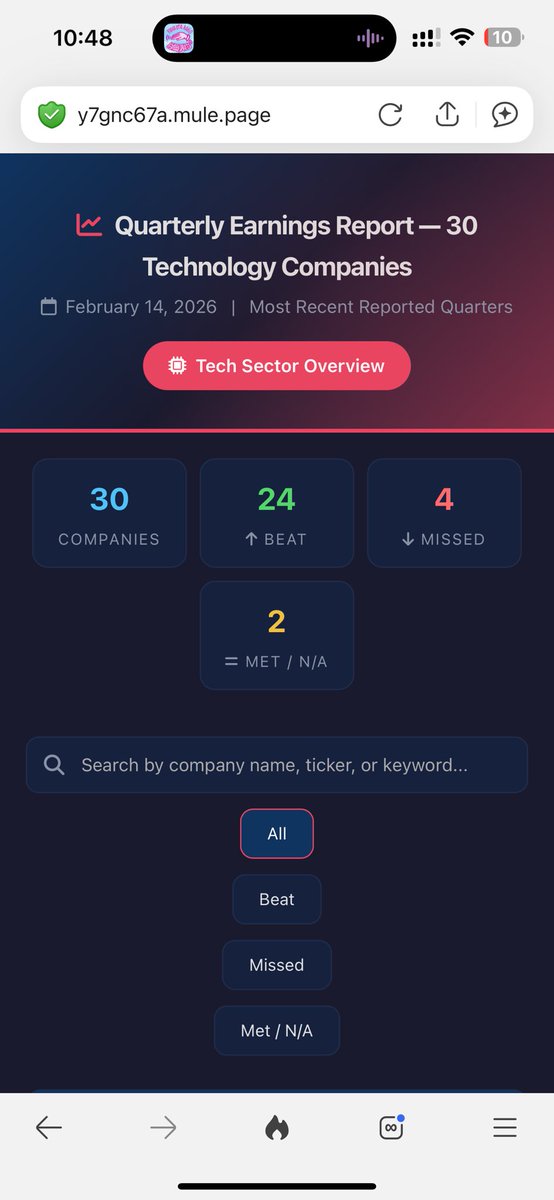
Built an earnings dashboard with ai agent tool from @mulerun_ai
summarized earnings from 30 tech companies that reported earnings from the past 7 days: y7gnc67a.mule.page
💫Thanks to @BELLEfounders @notthatLenka for organizing this amazing workshop

English
Wait you are telling me that they can read it and I’m still getting 10 spam WhatsApp messages everyday?
Elon Musk@elonmusk
WhatsApp is not secure. Even Signal is questionable. Use 𝕏 Chat.
English
@joeroganhq This feels like an episode of Caleb hammer’s show where the guest be like I want this labubu that labubu, the limited edition labubu, and the other character from pop mart🤣
English

"I want everyone… to have a roof over their head. I want universal child care, free K-8 summer care… I want social housing, I want much more land and wealth to be stewarded by communities instead of corporations…"
English
@80strolls @thehoffather It’s sadly true. Saw a Harris/walz sign in a front lawn like two days ago here in Seattle and then later a Harris/walz shirt in gym. At that point the nick Shirley video was already viral but those ppl just don’t care🙉
English

@thehoffather Both her and Bob trying to get out in front of it, with apparently no fear. Their followers will support them, the same way Trump's followers support him and it's unlikely much will come from it!
English

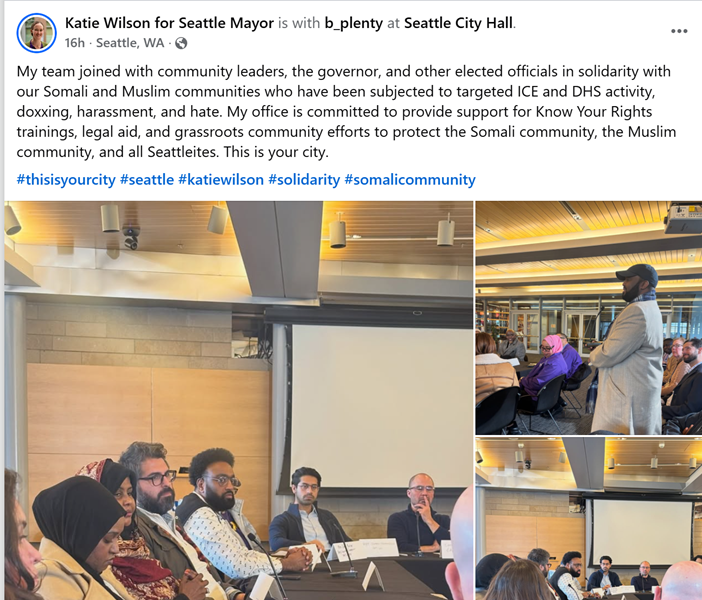
Seattle Socialist Mayor-elect Katie Wilson is backing the Somali community after fraud allegations are popping up all over the city
Glad I got a screenshot. This isn't going to age well
English

> be American
> slave away for years
> finally have enough in piggy bank to secure that sweet 50-year mortgage
> realtor hands over the keys
> “Here’s your cardboard box starter home sir”
> decorate home with clearance items from Temu
> sit on couch, let out big sigh of relief
> ah, finally achieved the American Dream
> daily commute is 2 hours one way
> exhausted after coming home from work
> Epstein on the news again
> every member of my ruling class somehow has a gajillion selfies with Jeff
> its_all_so_tiresome.jpeg
> turn tv off
> check phone
> lost my parlays on Polymarket
> missed payment for my Doordash burritos loans on Klarna
> bank taking my house as collateral
> press_F.jpeg
English
@GrindeOptions Used to be $nvda and then $mu but it’s reversed now cuz of micron’s post earnings rally
English

Besides $TSLA, what’s your largest holding in your stock portfolio? 👀

English
Zena retweetledi

The Real Reason Health Care Keeps Getting More Expensive And Why Mark Cuban Is Onto Something
The rise in family health insurance premiums is the predictable outcome of how the system was built. The Affordable Care Act (ACA) didn’t break healthcare, but it hardwired a set of incentives that make it almost impossible for costs to fall.
How We Got Here
Employer health plans aren’t really benefits, they’re deferred wages. When healthcare costs rise, employers don’t eat the difference; they just raise employee contributions or hold back on raises. Over time, it’s created this illusion of stability m where premiums rise every year, but wages never quite catch up.
The ACA’s reforms were meant to make coverage universal and fairer, but they came with tradeoffs. The law banned lifetime coverage caps, expanded preventive care, and required insurers to take all applicants at similar rates. All of that improved access but it also raised the baseline cost of every plan. Insurers stopped competing on risk and started competing on networks and brand. The math was clear: when everyone must be covered, premiums rise for the many to offset the few.
Then came the “medical loss ratio” rule. On paper, it sounded like consumer protection: insurers must spend 80–85% of premiums on care, refunding the rest. But in practice, it turned insurance into a cost plus business. If claims go up, so does the dollar value of the insurer’s 15% margin. That means there’s no real incentive to push prices down because hospitals, drug companies, and insurers all make more when costs rise.
The Power Players Behind the Prices
The real pricing power sits with hospitals, physician groups, and drug companies. Decades of consolidation turned local healthcare markets into oligopolies. Hospitals now own physician practices, control local pricing, and negotiate with insurers from a position of strength. Add to that the explosion of specialty drugs and chronic disease treatments especially GLP-1 drugs and the inflation in medical care becomes structural, not cyclical.
The ACA never touched that part of the system. It restructured insurance risk, not medical pricing power. That’s why your premiums keep climbing even when inflation cools, healthcare is immune to normal economic gravity.
Enter Mark Cuban Disruption Attempt
What @mcuban just did with his Cost Plus Drugs venture gets to the heart of the problem, transparency. His company eliminates the pharmacy benefit middlemen (PBMs) who quietly take a cut from every prescription. Instead, they sell drugs at cost plus a flat 15% markup, a small handling fee, and shipping. It’s simple, transparent, and designed to show just how distorted the normal system is.
By cutting out PBMs and wholesalers, he’s shining a light on how much of drug pricing is built on opacity. A generic medication that costs $5 to make can retail for $100 not because of manufacturing, but because of the layers of markups and rebates negotiated in the shadows.
If Cuban can scale this model and his new partnership with TrumpRx could help, it may pressure major pharmacy chains and insurers to change how they price. But it’s still a drop in a $4.5 trillion ocean unless it spreads to hospitals, insurance networks, and employer contracting.
The Path Forward
The health system rewards rising costs. Everyone in the chain including hospitals, drugmakers, insurers gets paid more when prices rise. Until we realign incentives toward affordability and transparency, the line on that premium chart will keep rising.
Mark Cuban is attacking one of the few weak points in its armor, the illusion of fairness through complexity. If he’s successful, it won’t just lower drug costs; it’ll expose how much of the system’s inflation is built on a lack of sunlight.
Sometimes disruption doesn’t start with policy, it starts with someone refusing to play the same game.

The Kobeissi Letter@KobeissiLetter
BREAKING: The average cost of a family’s annual health insurance premium has jumped +6% YoY in 2025, to nearly $27,000, an all-time high. This marks the 3rd consecutive annual increase, following 2023 and 2024 gains of +7%. In other words, premiums are now rising faster than inflation for the 3rd year straight. Since 2000, the average health insurance premium has surged +350%. Small businesses are seeing the largest health-rate increases, with over half reporting +10% or more premium hikes in 2025. Health insurance costs have never been higher.
English
Tim Cotton is this Joseph McCarthy wanna be but lacking the full on degen energy 🤣
Lord Bebo@MyLordBebo
🇺🇸🇨🇳 Just to be clear: - China is breaking domestic U.S. law. - China is NOT breaking international law - China is NOT breaking Chinese law China just ignores what USA says, what US neocons are not used to.
English
@reader_finance Still better bang for the buck vs vcf Cartier Tiffany et al
English


Trump: "I think China is in big trouble. I'll be honest with you. I don't know that they even make it."
English