

Zerθ..
309 posts


Looking for internship
Experienced:
- 7 Years of Programming Rust
- Electronics and Electrical (made angular leveling with straight line assist, smart drill, bluetooth speaker, custom ESC, custom multimeter, smart lamp and iot project)
- Custom Driver for any sensor using Rust
- CAD design (with FreeCAD)
- Game dev (with Avian3D and Bevy)
- App dev (stack: egui, iced-rs, tauri + svelte)
- Teacher (taught: 11th and 12th Science Students)
English
Age :17
Weight: i don't know
Height: don't know
Past relationship:None
Fell in love: No
Smoking: never
Job : unemployed
Fav food : Dal chawal
Fav colour: Black
Fav drink : lemon water
Fav snacks: don't know
Kirti Sharma@SsharmaKirti
Age: 20 Weight: 52 Height: 5'7 Past relationships: None Fell In Love: No Smoking: NEVER Job: Unemployed Fav Food: Chhole Bhature Fav Color: Idk maybe Royal Blue Fav Drink: Nimbu paani Fav Snacks: Samosa
English

this guy just built a real-time combustion engine simulator on the web. 💀🫡
English

I had two seniors who were crazy cracked
one of them was single digit in everything and 2x gold medal in icho - recently found out she is an swe at vc firm in usa rn
another of them was a madlad, never studied bio, got interested in bio in class 11/12 - but he didn't give neet, he got all exam double digit rank, joined top IIT cs, gave neet next year air 2, and he was one of the leading helpers during covid times for vaccines all over rthe world
Richa Sharma@richa_lq
I’ve been dying to reconnect with her since this person deleted all the social media when she turned 17 to hyper focus and I lost touch ever since she moved to the states for her undergrad. I look upto her so damn much & kinda just wanna work with her again. Last I heard she was at Stanford. I might just have to find her 😭 directly.
English

@HBCSE_TIFR @narendramodi @PMOIndia @DrJitendraSingh @PIB_India @PIBMumbai @DAEIndia @IndiaDST @EduMinOfIndia @TIFRScience @ddsahyadrinews Congratulations 🎉🎉
English

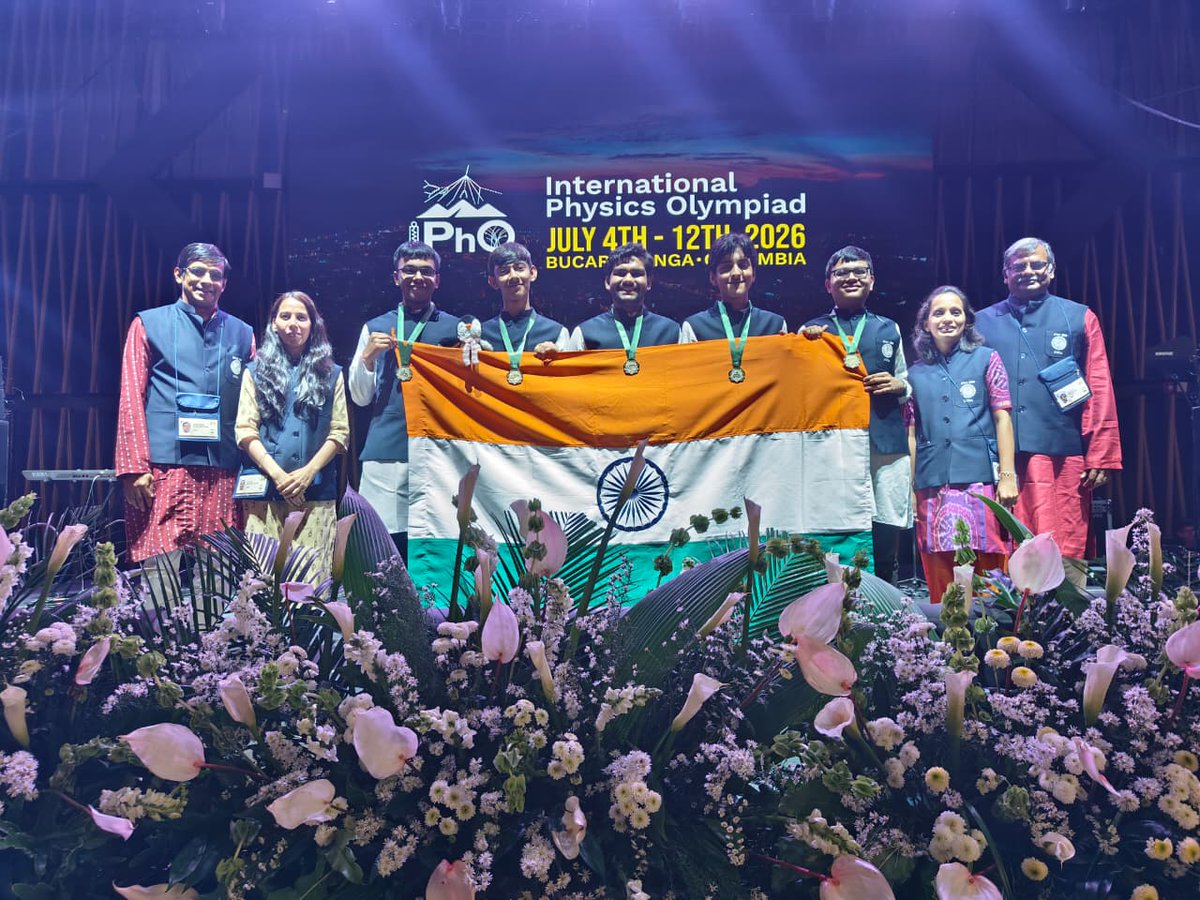
🇮🇳GOLDEN SWEEP FOR INDIA 🏆
All 5 Indian students win GOLD at the 56 International Physics Olympiad (IPhO) 2026 in Bucaramanga, Colombia -placing India at Rank #1 in the world (jointly with China, Kazakhstan, Russia, South Korea & Taiwan) among 381 students from 87 countries 1/5
English
Zerθ.. retweetledi

I am making the biggest community of builders on the internet and you need to be part of it
With the help of @TheKrishSinghh we have made the discord server so engaging and useful for you that once you join, you would not want to leave it
we have deep tech conversation and senior engineers there who will help you in doubts.
we post tech resources there, and job opportunities too.
come join us and be part of this.
link in replies
English


@thatdudeakshay @Riya_geoinv7 Bro i also want improves my maths although I am good in mathematics but i need more improve and I am going to join college this year
English

@Riya_geoinv7 Solidifies what I wrote here
x.com/i/status/20744…
Akshay@thatdudeakshay
In Maths sometimes the lack of Mathematical Tools is one of the major reasons why certain Conjectures / Hypothesis haven't been proven yet Here's one more way to look at it "Why you should build your Mathematical Toolkit we'll if you're into Proofs" This person in my DM is quite good at Maths but he had some doubts regarding how to approach proofs, that's the fun part. whenever you study proofs, your goal must be to actually understand the underlying mechanism of each step. think of it like this: if you show a proof to someone who has never studiwd a proof, they won't even be able to read it, let alone understand it. the real purpose of studying proofs is to extract the methods and ideas used to reach a certain conclusion. He is totally right, you can't remember proofs permanently because they aren't meant to be memorized, A rigorous proof is generalized abstract reasoning built on a strict, unbroken chain of prior logic. there is definitely another way to understand proofs where you study math topics in their most generalized, abstract forms from the get go. when you build up from those foundational building blocks, it does feel intuitive. but that takes time to learn. you have to approach every proof like this, when dissecting them Say you're given "Prove x, based on our initial givens and conditions y" look at the rigorous proof and map out the entire chain of thought that led there. once you're sure you've got it, write it down once to cement it, and then compress that information. break it down into steps as a chain of logical arguments. a lot of it relies on Maths toolkit. like in calculus, that toolkit comes from real analysis, where you're introduced to stuff like monotonicity tests, to evaluate whether a function or sequence consistently increases or decreases across its domain, because that specific behavior becomes useful to you later. Other similar tools are things like the Intermediate Value Theorem and the Mean Value Theorem. you don't memorize the paths. you master the tools of that specific subject and use them to connect your known facts until they align with your goal. Combinatorics and Number theory use a different toolkit, like the fundamental theorem of arithmetic, but the process of compressing it to the core logical pivot is the exact same. so long story short: you observe the proof, compress the core strategy, and connect the dots using your logic chain. Mathematical Facts often isolated until you look deep enough and figure out that there is a chain connecting them all. When studying proofs your goal is to understand those connections You can't generate a good proof of anything if you don't know your facts nd tools
English

One regret I have: I wish I'd taken math seriously much earlier.
It quietly becomes an unfair advantage everywhere - competitive exams, coding, AI, physics, finance, even research.
If you're starting from scratch, build your foundation with math first.

English
Everybody says "Study Maths" but they don't tell where to start.
Here I'm gonna provide a direction which you may follow to start your journey in Maths.
This will help everyone to fall in love with Maths.
All the Resource links are attached below.
The Foundations (regardless of what your field is, you must study this):
Calculus 1 To understand calculus, you must understand Pre Calculus. This is the entry point for everyone. Professor Leonard makes all of it feel so easy and intuitive. Just watch the first 4 lectures and you'll thank me later!
But here's the brutal truth: nobody can get good at Maths if they aren't willing to sit with it consistently. The Pre Calculus playlist of Professor Leonard is 115 lectures long, but I guarantee you that you will literally be understanding each and every topic. For all the basic topics like Functions, Exponential Functions, Logarithmic, Trigonometric Functions, Polar Forms, and Graphs of all the functions, you'll feel, "Well, that's soo easy to understand."
Basically, the Pre Calculus series from Professor Leonard not only prepares you for Calculus, but also prepares you to tackle advanced Maths. How? By helping you build a mindset that Maths can literally be studied and understood by anyone if they had a good teacher like him.
Well, enough about Pre Calculus. Then you must move to his playlist, Calculus 1. Now, this is where you'll make a fatal mistake if you do not practice extra questions of each topic which he'll teach you! Understanding concepts in depth and solving quality problems have to go hand in hand.
Also, observe how Professor Leonard looks at Maths topics, and try to adapt his point of view into yours. While you study from a great teacher, your goal should be to absorb his mindset. That's what will make you great at any subject.
Well then, if your goal or university demands Calculus 2,3 too, which I'm sure it will because everybody's into AI ML, right? Then they are non negotiable.
By following this approach, you'll be making sure that you internalized all those concepts.
"YOU WILL HAVE TO PRACTICE HIGH QUALITY QUESTIONS OF EACH TOPIC." Use Gemini, Claude, GPT, whatever you prefer. I personally prefer Gemini as an assistant while studying.
Now, that's all for The Absolute Foundations of Calculus.
Now, the next section is for those who wanna get into Proof Based Maths, where you have to rigorously prove everything.
Study "Linear Algebra Done Right" by Sheldon Axler. If you manage to understand every single line written in this book, your linear algebra paired with an abstract understanding of it will make you fall in love with it even deeper. And lemme tell you, this book is hard! This is especially true for someone who never had exposure to Mathematics in an abstract form, so you need to understand a proof based approach, which takes us to our next section.
And this is where pure Maths begins. There are lots of ways to start this, and here's what I did. Start studying:
1) Arithmetic of Integers
2) Principle of Mathematical Induction
3) Fundamental Theorem of Arithmetic
This is exactly what's gonna slowly drag you into the world where you are attempting proofs like, "Prove there exists infinite primes of some form," or proving this and that. You'll be using the rigorous Mathematical Facts you learned when studying these three topics.
Follow "Challenge and Thrill of Pre College Mathematics." Make sure to study its Chapters 1 and 2 in depth, attempt each example, and do every single exercise. You'll struggle if it's your first time, but sit with problems reread lines ! but make sure you understand those topics well.
Honestly, Euclidean Geometry scares tf out of me so I won't be able to provide anything for that.
But this is where things get interesting now:
Will cover in Next Post
how to transfer your basic proof skills you built in these chapters to the Calculus based Proofs and Proofs involving Polynomials (yes, they're hard too), Combinatorics, etc

English

Monday Rant
Because of my stupid lazy ancestors, today I have to go to office🤬🤬
They should have worked hard and saved money for me...
Instead of working hard, my stupid grandfather produced 10 kids
Poor people should stop making children... You are making your children's and grand children's life hell
English

Reporting from on ground at Sriharikota. Stage 1 assembly has been completed!
Team Skyroot is entering the final stretch of the launch operations. 🙌
#Vikram1


English

#WATCH | Raipur, Chhattisgarh: Mahima Rajput, a 10th-class student, is selected for the international space Mission 'ShakthiSAT' from India. Students from 108 countries will participate.
Mahima Rajput says, "I am selected for the Mission 'ShakthiSAT', which my principal told my guidance teacher, and she registered me after that. After I registered, some modules came up, which clarified your basic concepts about science and satellites. There were a total of 21 modules and 365 lessons, which helped us a lot. We were trained in how to make satellites, which includes a total of 108 countries. On the 23rd of August, we have to go to Delhi, where we will build a satellite that will land on the surface of the Moon, and another satellite will revolve in the Moon's orbit, and then we will launch it in October..."
English
jensen huang right now
GIF
OpenAI@OpenAI
We’ve designed and built our first AI chip: Jalapeño. Designed from the ground up by OpenAI and brought to production with @Broadcom, Jalapeño is purpose-built for the LLM workloads powering ChatGPT, Codex, the API, and future agentic products. Chips are foundational to the AI economy. Building our own expands our full-stack platform from products to models to infrastructure, and will help us scale intelligence, serve more people, and expand access to AI.
English

@VazeKshitij they perform coz I tweet
x.com/i/status/20691…
neural nets.@cneuralnetwork
messi wtf mate
English
Space is tough field, one small mistake everything becomes Zero so I hope vikram 1 rocket become successful 🤞🤞.
Gareeb Scientist@gareebscientist
Skyroot is Ready to Launch, and i got exclusive access to checkout the Vikram 1 rocket before launch, with ofcourse a nerdy discussion with founders @PawanKChandana and @bharathdaka , link to full video below, @SkyrootA FACTORY TOUURRR in 4K
English