
Sabitlenmiş Tweet
Zero One
190.9K posts


Zero One
@ZeroOne33408052
Epistemological Free-Thinker┃Neurodivergent┃Alchemist┃Irreligious┃Author of: The Alchemy of Existence v01 (Alt site: https://t.co/YWlQMONnjR)
Bay Area CA Katılım Eylül 2020
114 Takip Edilen2.3K Takipçiler



The figure eight uses the Moon's gravity to sling them back home without burning extra fuel. And if something goes wrong, the trajectory brings them back automatically. It's called a free return trajectory and it's beautiful as hell.
ABC News@ABC
This animation shows NASA’s Artemis II mission path, a journey of nearly 685,000 miles. The crew will travel in a figure-eight trajectory, looping out from Earth, around the Moon, and back again. Follow live updates: abcnews.link/qHsZ657
English


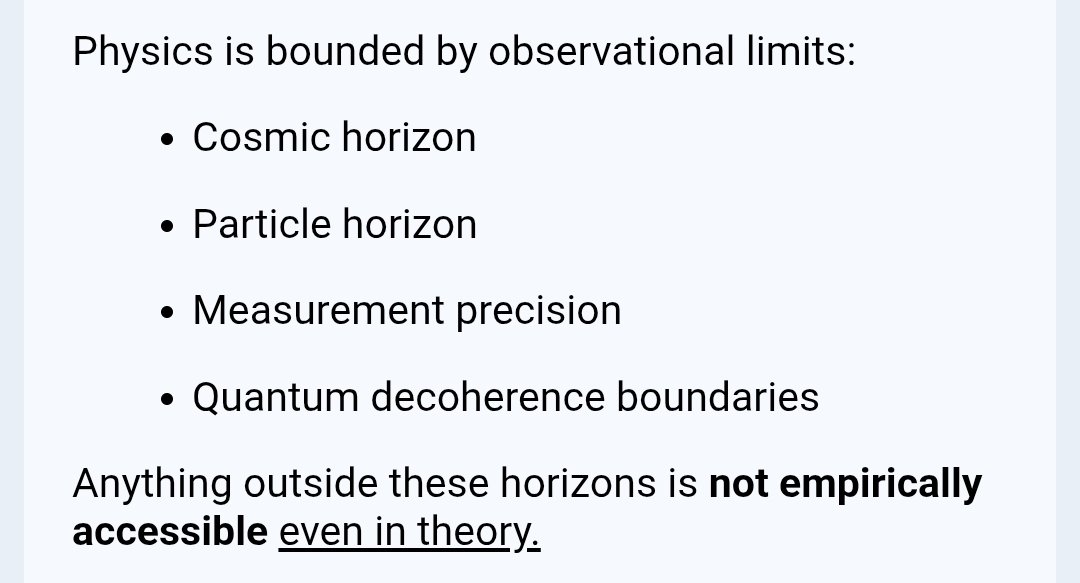
I don’t believe it and there is zero evidence for it. It is the least scientific “scientific fact” ever.
Where does all the energy come from to create an entire universe?! We can’t even explain THIS universe’s origin and now y’all are inventing an infinity of them?! Pfui
All day Astronomy@forallcurious
🚨: Every decision creates a branch in the universe according to the many world theory, where every possibility happens and infinite versions of you exist simultaneously
English

This might be the most unsettling thing I’ve read in months.
The question of consciousness isn’t new… but this article explores angles I hadn’t fully articulated.
A MUST READ for anyone curious about where consciousness meets reality.
It challenges every belief you ever had.
Now I’m genuinely curious:
If we ever fully understand consciousness… would we discover reality or accidentally break it?
The Curious Tales@thecurioustales
English


The illusory nature of a present moment was understood by Buddhist mystics bythe 1st century and later confirmed by neurobiologists and physicists in the 20th. Direct mystical perception is grossly underrated.
Big Think@bigthink
Physicists can't find "now" anywhere in the universe | Jim Al-Khalili @jimalkhalili
English
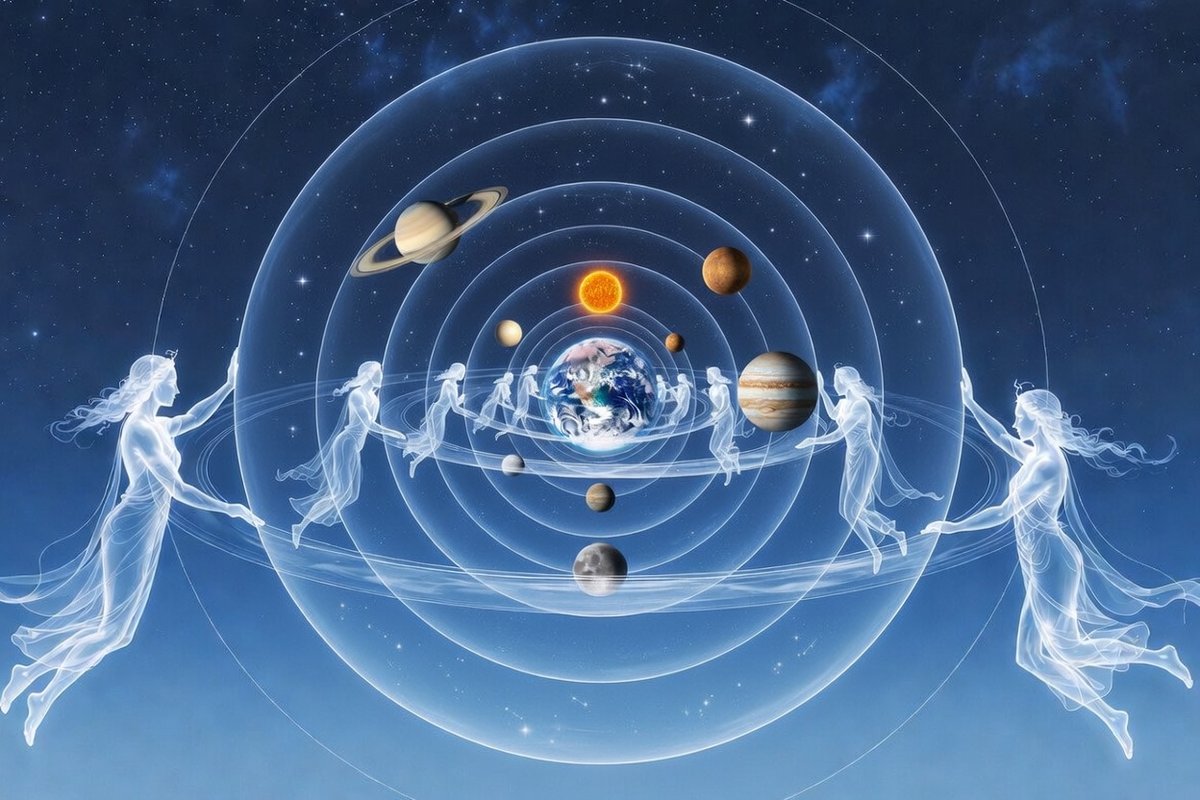
Plato argued that soul is the source of all motion and change—and therefore that the cosmos is governed by mind. I just posted a detailed walkthrough of the argument (Laws X, 893b–899d), the longest piece I've written for my philosophy of religion seminar so far.
English


@martinmbauer Indeed--not much prepares someone for what quantum mechanics
English

If classical mechanics already challenges your intuition, you’re not prepared for what quantum mechanics will do
bende@0bendeozledim
Physics is really insane
English
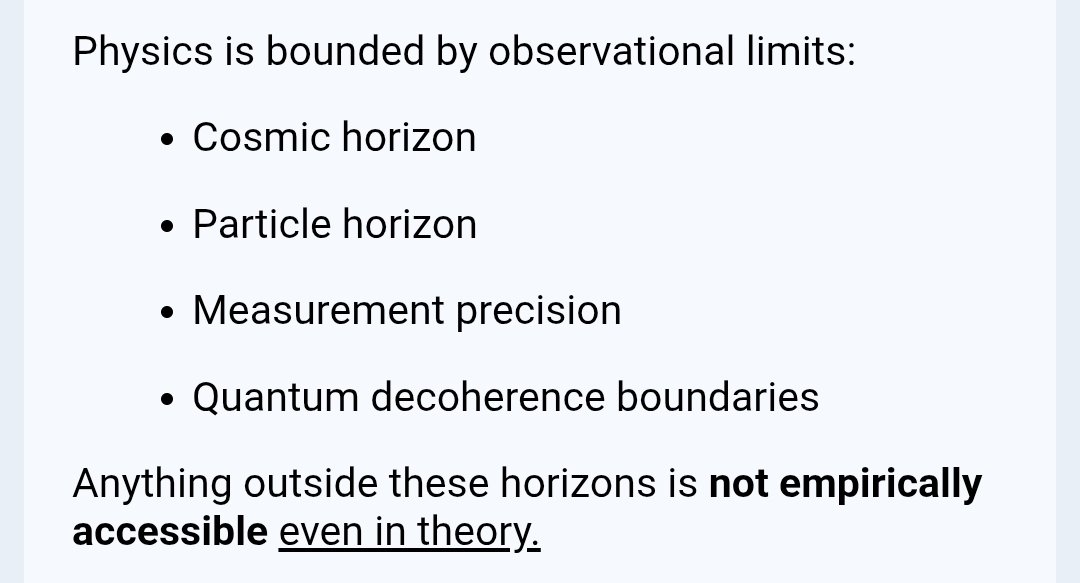

I’d have to disagree. Roger Penrose found ‘now’ in each and every Orch OR collapse moment as a conscious ‘now’ which is instantaneous. As far as consciousness coming too late, that’s
not true either. Each event has backward time referral to rescue conscious free will. frontiersin.org/journals/integ…
Big Think@bigthink
Physicists can't find "now" anywhere in the universe | Jim Al-Khalili @jimalkhalili
English
@QuantumTumbler "Planes fly. Circuits work. Rockets land."
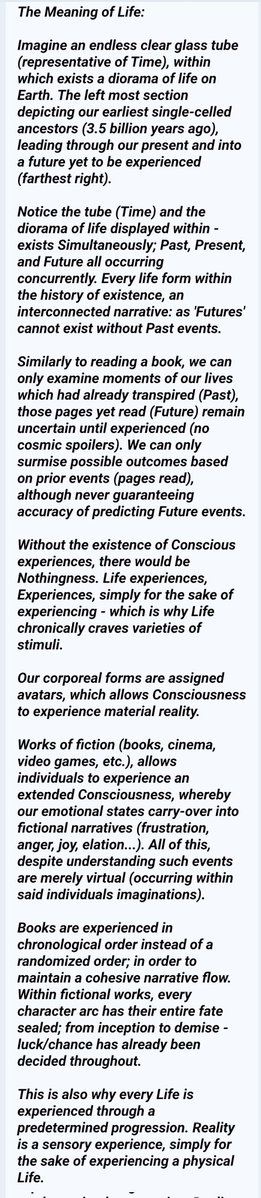
Superdeterministically intrinsic to our cosmic narrative. Allowing for a cohesive narrative and creating absolute immersion.
English

You’re confusing perception with constraint.
Our senses can be limited or even misleading, sure but that doesn’t mean reality is arbitrary.
The reason math works, engineering works, and predictions hold is because there are consistent underlying relationships, regardless of how we perceive them.
Planes fly. Circuits work. Rockets land.
If reality was just ‘lying to us,’ none of that would be reliably possible.
So yeah our models can be imperfect.
But the constraints they’re mapping to are very real.
English
This is actually a really important result, but people are oversimplifying it.
It’s not that “some people use language and mathematicians don’t.” That’s not what this is showing.
What it’s really pointing to is that math isn’t fundamentally linguistic it’s structural.
The brain areas lighting up for high-level math are the same ones used for things like number sense, spatial reasoning, and understanding relationships between objects. Not the areas we use for language, storytelling, or general meaning.
That lines up with something a lot of people feel but can’t quite explain.
When people struggle with math, it’s often because they’re trying to treat it like language. They’re reading symbols like words, trying to memorize steps instead of actually manipulating what’s going on, or following syntax instead of understanding the structure underneath it.
But math doesn’t really live in that space.
It lives in patterns, transformations, and constraints how things relate and change, not how they’re described.
And there’s a deeper split here too.
Language is about describing reality.
Math is about operating on structure.
That’s why you can see cases where language breaks down but mathematical reasoning still holds up. They’re not the same system.
So the takeaway isn’t “mathematicians have different brains.”
It’s more practical than that
If you want to get better at math, stop treating it like something you read and start treating it like something you can move around and work with.
That shift alone changes everything.
Nicholas Fabiano, MD@NTFabiano
Some don't understand math since they use language-related areas in the brain. Mathematicians are able to recruit the non-verbal regions instead.
English
@QuantumTumbler "You can’t change the underlying relationships."
Based purely on how humans perceive it. Reality could be lying to us 24/7, allowing us to see things as we do - versus what is.
English
You’re mixing two different things.
Math is a human description, sure but it’s describing structure that exists whether we name it or not.
The fact that different mathematical frameworks consistently map to real-world behavior isn’t just ‘interpretation’… it’s constraint.
You can change the language. You can’t change the underlying relationships.
That’s the part you’re glossing over.
English
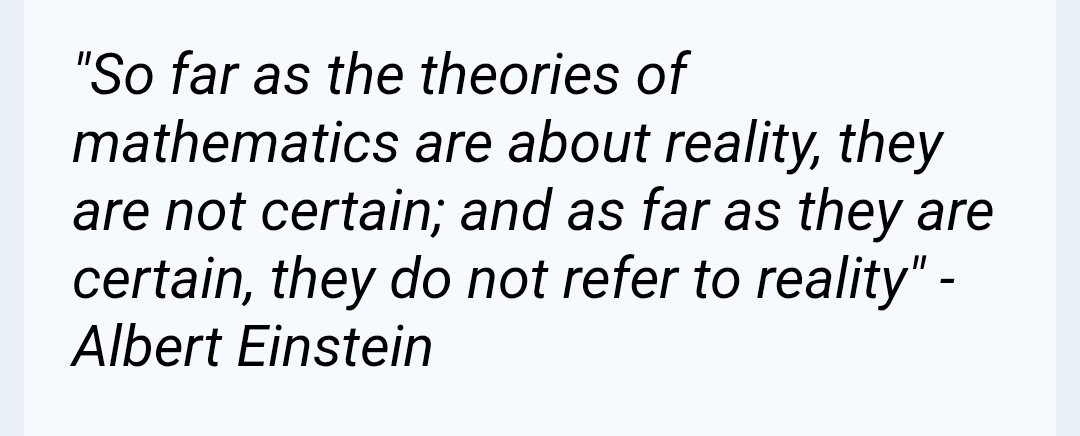
@QuantumTumbler Claiming reality is math or language is a strictly human interpretation, based on our systems of assessment. It doesn't connote Nature is either; those assumptions remain human conjectures.
English
That’s not what that shows at all.
Dyscalculia is a deficit in number processing not evidence that math isn’t fundamental. If anything, it shows how specific and real those underlying structures are.
And saying ‘reality isn’t math’ because humans can struggle with it is like saying reality isn’t language because some people have aphasia.
The limitation is in the interface not the structure.
English
Simulation theory is materialism dressed in spiritual pajamas.
English

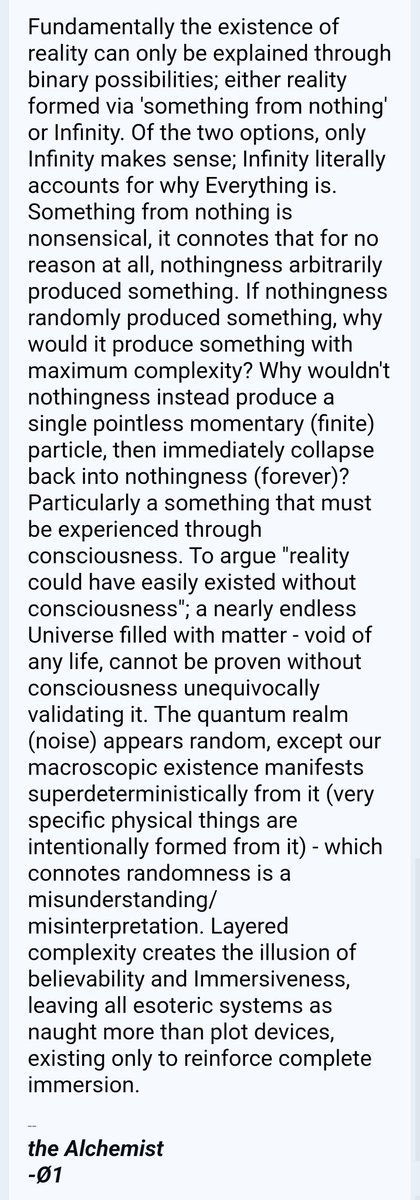
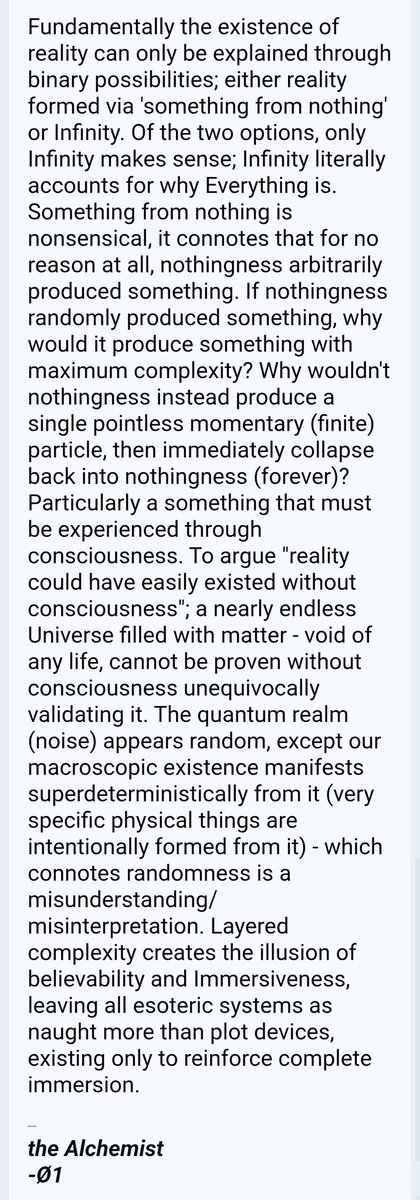
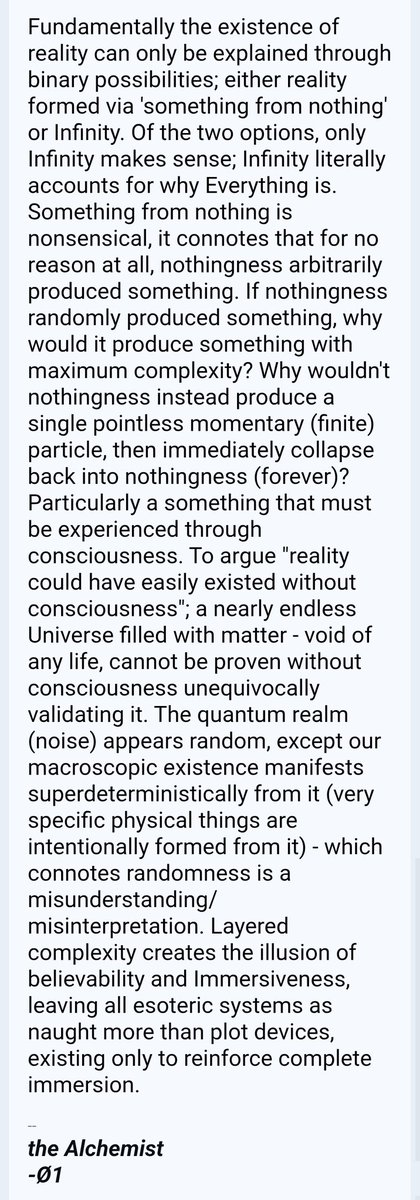
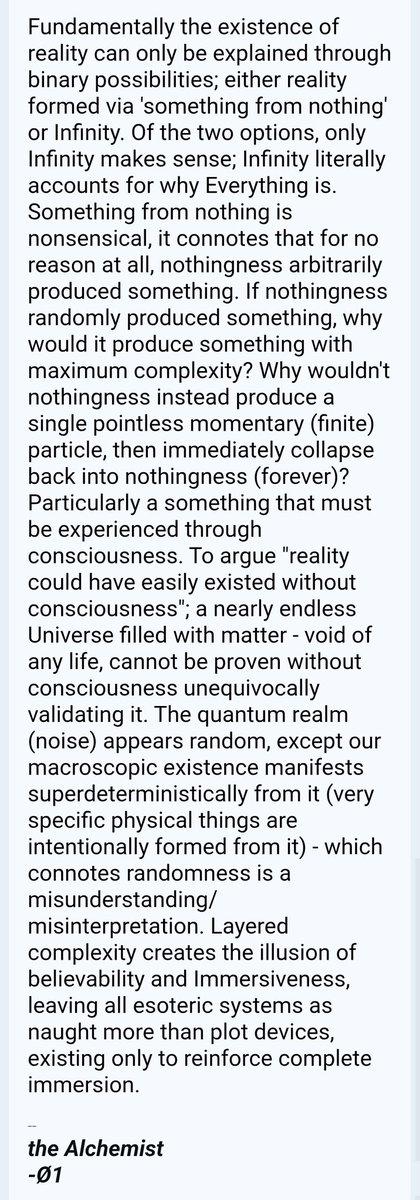
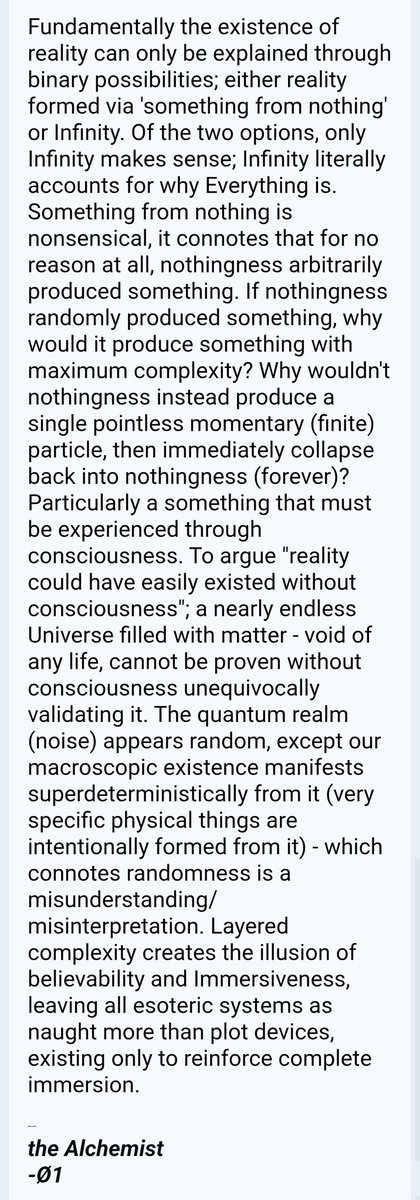
@ZeroOne33408052 This is an argument that moves from cosmological necessity, infinity over nothing, through quantum indeterminacy to consciousness as constitutive of reality, a process idealism where reality is a self-generating, self-experiencing, maximally complex unfolding.
English
If reality is intrinsically dynamic process with interiority as its inside aspect, there was never a physical process on one side and experience on the other. The separation was always a conceptual artifact. The hard problem is hard. It's a gap that was created by the framing.
English
@ZeroOne33408052 This suggest that consciousness cannot be treated as an optional add-on to an otherwise complete reality. It may be built into the structure of what it means for reality to be real at all
English
This was one of the most holistically-minded books in the worlds of physics and biology. Deeply driven by curiosity. Asking a big question about the universe.
Philosophy Of Physics@PhilosophyOfPhy
In 1943, physicist Erwin Schrödinger delivered a remarkable series of public lectures, asking a question few physicists had seriously considered: What is life? At a time when biology and physics were largely separate, he attempted to bridge them. His lectures, published in 1944 as What Is Life?, Introduced a bold idea: genetic information must be stored in what he called an “aperiodic crystal,” a structure stable enough to preserve order yet complex enough to encode life itself. The book did more than speculate; it inspired. A generation of young scientists found in it a new direction. Among them were Francis Crick and James Watson, who would go on to uncover the double helix structure of DNA. Both later acknowledged that Schrödinger’s ideas guided them toward the emerging field of molecular biology. A decade later, in 1953, just months after that discovery, Crick wrote to Schrödinger, expressing deep gratitude. He noted that What Is Life? had sparked both his and Watson’s interest in genetics. Even more striking was how close Schrödinger’s intuition had come: the “aperiodic crystal” was no longer a hypothesis, but a reality. Today, What Is Life? remains a rare kind of scientific work, one that did not solve a problem directly, but changed the direction of those who would.
English

I think we have pretty much found evidence for life on other planets, scientists just can't really say it... yet
youtube.com/watch?v=a0lYZC…
YouTube
English
Ad Infinitum
#physics #Philosophy #science #nde #maths #neuroscience #consciousness #Atheism #irreligious #panpsychism

English


fucked around too much in reading for my phil of math seminar paper and i lowkey don't believe in the axiom of extensionality anymore
English