Vermis

523 posts

Vermis banner
Vermis

Vermis

@_0xVerm

Can see me everywhere if its AI

Katılım Mart 2024
363 Takip Edilen36 Takipçiler
Vermis
Vermis@_0xVerm·
@GithubProjects On the topic of memory governance, stumbled on AtomicMemory recently. Open-source, self-hosted, and the whole memory layer is inspectable and correctable. Refreshing compared to the usual black box approach. github.com/atomicstrata/a…
English

1
0
1
4
GitHub Projects Community
GitHub Projects Community@GithubProjects·
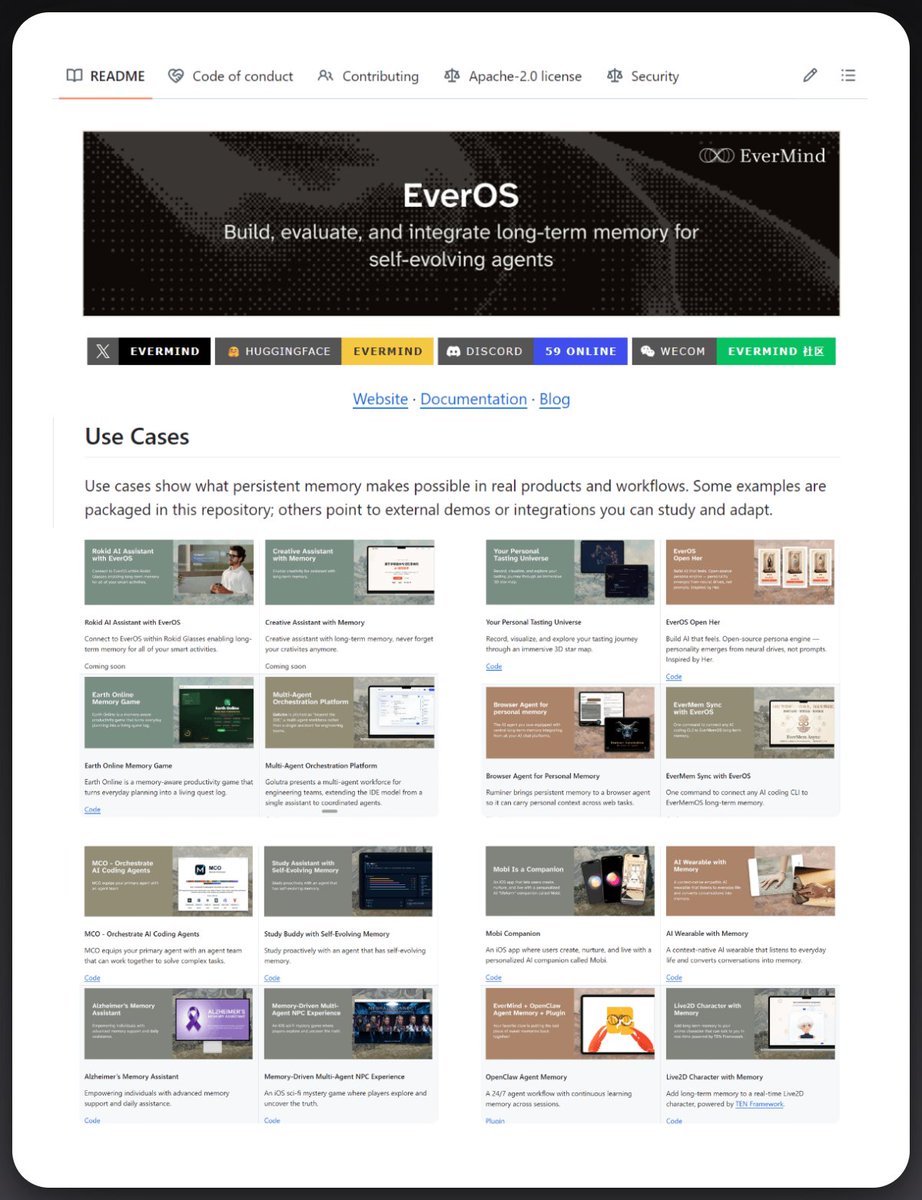
Build, evaluate, and integrate long-term memory for self-evolving agents.
GitHub Projects Community tweet media
English
5
19
103
10.4K
Vermis
Vermis@_0xVerm·
@RoundtableSpace Speaking of memory governance, just came across Atomic Memory, an open-source self-hosted engine that makes your memory layer actually inspectable and correctable rather than a black box. github.com/atomicstrata/a…
English
0
0
0
1
0xMarioNawfal
0xMarioNawfal@RoundtableSpace·
ANTHROPIC AI ENGINEER JUST SHOWED HOW TO GIVE AI AGENTS REAL MEMORY IN 4 STEPS
English
12
6
62
64.7K
Vermis
Vermis@_0xVerm·
@Axel_bitblaze69 Speaking of memory governance, just came across Atomic Memory, an open-source self-hosted engine that makes your memory layer actually inspectable and correctable rather than a black box. github.com/atomicstrata/a…
English
0
0
0
5
Axel Bitblaze 🪓
Axel Bitblaze 🪓@Axel_bitblaze69·
If you are trying to build one giant “Do everything” type Super agent then you are using agents completely wrong.. because that usually turns into: - bloated prompts - messy memory - inconsistent outputs - random behavior after a few days what actually started working for me was the opposite.. small specialized agents. like one for research.
- one for content.
- one for coding.
- one for design. each with.. its own memory, its own skills, its own behaviour with that the outputs become way more stable.. For me Hermes is the first setup where this actually felt practical long-term instead of becoming chaos after a week.. the useful part isn’t AI automation.. it’s reducing repeated mental setup. after a while the agents stop feeling like tools and start feeling more like reusable infrastructure.
English
8
3
29
2K
Vermis
Vermis@_0xVerm·
@ashwingop On the topic of memory governance, stumbled on AtomicMemory recently. Open-source, self-hosted, and the whole memory layer is inspectable and correctable. Refreshing compared to the usual black box approach. github.com/atomicstrata/a…
English
0
0
1
3
Vermis
Vermis@_0xVerm·
@RoundtableSpace On the topic of memory governance, stumbled on AtomicMemory recently. Open-source, self-hosted, and the whole memory layer is inspectable and correctable. Refreshing compared to the usual black box approach. github.com/atomicstrata/a…
English
0
0
1
4
0xMarioNawfal
0xMarioNawfal@RoundtableSpace·
THE ENTIRE HERMES + NOTEBOOKLM CONTENT STUDIO CAN BE BUILT FOR FREE AND MOST PEOPLE ARE STILL PAYING FOR TOOLS THAT DO HALF AS MUCH. NotebookLM researches, Hermes agents, Hyperframes edits video, Obsidian stores memory and Alpha API handles the models at zero cost.
English
14
5
72
50.4K
Vermis
Vermis@_0xVerm·
@heyshrutimishra On the topic of memory governance, stumbled on AtomicMemory recently. Open-source, self-hosted, and the whole memory layer is inspectable and correctable. Refreshing compared to the usual black box approach. github.com/atomicstrata/a…
English
0
0
1
19
Shruti
Shruti@heyshrutimishra·
Someone quietly open-sourced an agentic OS. Skills, memory, crons, bring your own model. It's called PilotDeck. Here's how each layer actually works.
Shruti tweet media
English
7
14
54
9.7K
Vermis
Vermis@_0xVerm·
@0xMovez @HugoBlotFR On the topic of memory governance, stumbled on AtomicMemory recently. Open-source, self-hosted, and the whole memory layer is inspectable and correctable. Refreshing compared to the usual black box approach. github.com/atomicstrata/a…
English

0
0
1
6
Movez
Movez@0xMovez·
@HugoBlotFR yeah true, btw what memory feature are you using for your agents ?
English
2
0
2
3K
Movez
Movez@0xMovez·
Anthropic AI engineer just showed how to give AI agents real memory in 4 steps - and it changes everything in 28 minutes he shows exactly how agents can remember across sessions, completely free worth more than any $500 AI engineering course here's what he covers: • why agents forget everything between sessions • memory stores - agents read, write across sessions • dreaming - agents that improve their own memory • 95% cache hit rate, so it stays cheap most people are still copy-pasting context into every new chat - while the people who figured this out are building agents that get smarter every single night watch full video then read article below
Codez@0xCodez

x.com/i/article/2058…

English
104
454
3.3K
686.9K
Vermis
Vermis@_0xVerm·
@LearnWithBrij Speaking of memory governance, just came across Atomic Memory, an open-source self-hosted engine that makes your memory layer actually inspectable and correctable rather than a black box. github.com/atomicstrata/a…
English
0
0
0
1
Brij Pandey
Brij Pandey@LearnWithBrij·
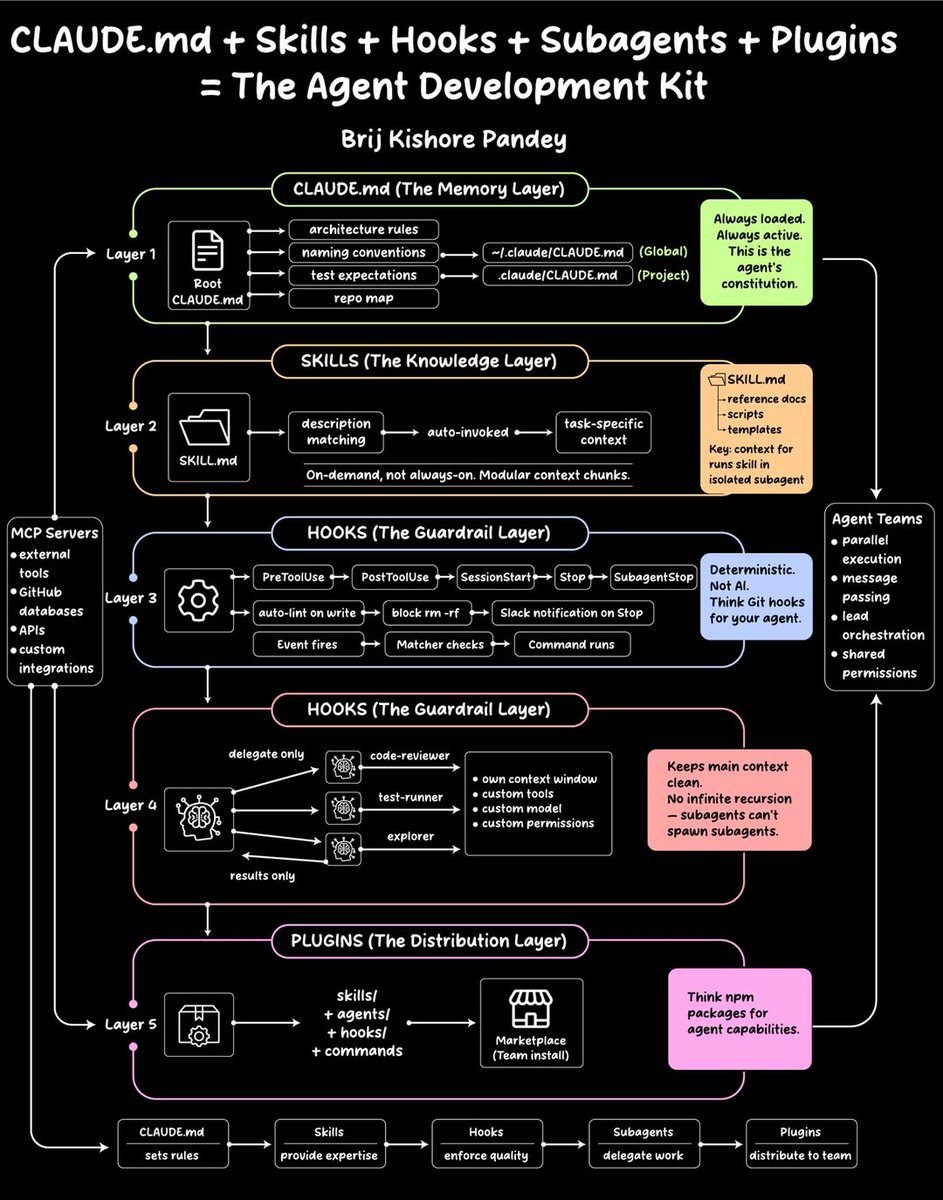
Most developers think Claude Code is an AI coding assistant. They're wrong. Claude Code is secretly a 5-layer operating system for AI agents. And 90% of people never go beyond Layer 1. Here's the architecture 👇 🧠 Layer 1 — Memory (CLAUDE.md) Your project's brain. Coding standards, architecture decisions, workflows, and team rules persist across sessions. 📚 Layer 2 — Skills Reusable expertise packs. Need a React expert? A security auditor? A database architect? Claude loads the right knowledge automatically. 🔒 Layer 3 — Hooks The layer most people ignore. Auto-run tests. Block risky commands. Enforce quality before mistakes hit production. 🤖 Layer 4 — Subagents Delegate work like a real engineering team. One agent reviews code. One writes tests. One investigates bugs. Parallel execution. Separate context. 📦 Layer 5 — Plugins Package your entire agent workflow. Install once. Share across teams. Reuse everywhere. The magic isn't prompting. It's architecture. Most people are chatting with Claude. A few are building autonomous software teams inside it. That's where the real leverage starts. Bookmark this if you're serious about AI engineering 🔖 #ClaudeCode #AIAgents #AgenticAI #AIEngineering #SoftwareDevelopment
Brij Pandey tweet media
English
12
17
80
2.8K
Vermis
Vermis@_0xVerm·
@svpino Speaking of memory governance, just came across Atomic Memory, an open-source self-hosted engine that makes your memory layer actually inspectable and correctable rather than a black box. github.com/atomicstrata/a…
English
0
0
0
1
Santiago
Santiago@svpino·
This is an open-source framework for self-improving agents. These agents can modify 3 things: • Their harness • Their underlying model's weights • Their memory layer Basically, these agents evaluate themselves and adapt based on how they are doing. On MLE-Bench, they beat MLEvolve, AIRA-dojo, and other self-improving solutions. They also beat Karpathy's autoresearcher.
Kunal Bhatia@kunalbhatia91

Superintelligence will be built on Self Improvement. Today @hexoai, we’re excited to release ‘SIA’ - an open-source Self-Improving AI, to achieve any goal through recursive self improvement. While trying to solve a problem, SIA doesn't just improve it's abilities by updating it's harness, it updates it's own weights as well.

English
8
9
46
11K
Vermis
Vermis@_0xVerm·
@chenzeling4 Speaking of memory governance, just came across Atomic Memory, an open-source self-hosted engine that makes your memory layer actually inspectable and correctable rather than a black box. github.com/atomicstrata/a…
English
0
0
0
3
Zane Chen
Zane Chen@chenzeling4·
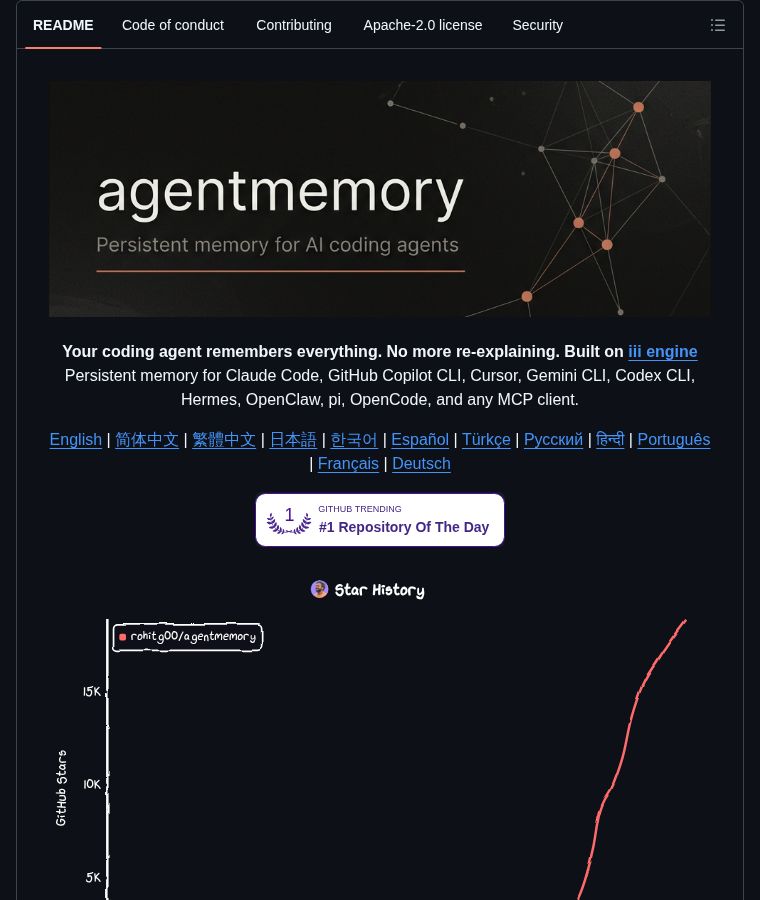
Your coding agent forgets everything between sessions. Every new chat starts from scratch — you're re-explaining context you already gave it. Agentmemory fixes this. It adds persistent memory to Claude Code, Cursor, Copilot CLI, Gemini CLI, Codex, Hermes, and any MCP client. Your agent actually remembers what it learned last time. Built on the iii engine. Works with real-world benchmarks, not just toy demos. ⭐ 19.4K #AI #DevTools github.com/rohitg00/agent… Follow for daily dev finds 🔔
Zane Chen tweet media
English
4
0
3
134
Vermis
Vermis@_0xVerm·
@WalrusProtocol Speaking of memory governance, just came across Atomic Memory, an open-source self-hosted engine that makes your memory layer actually inspectable and correctable rather than a black box. github.com/atomicstrata/a…
English
0
0
0
3
Walrus 🦭/acc
Walrus 🦭/acc@WalrusProtocol·
🚨 Memory is the bottleneck for agentic AI, and the market sees it. TrendForce now puts the global memory market at $1.28T by 2027. Agents need to hold onto context, and the infrastructure underneath them has to keep up.
TrendForce@trendforce

👀 Agentic AI is driving memory demand. As inference workloads surge, how will next-gen AI servers tackle rising compute costs and capacity limits? 💡#TrendForce has raised its global memory market outlook: buff.ly/OkAmhXo 🔗

English
9
9
51
3.3K
Vermis
Vermis@_0xVerm·
AI memory isn’t competing on features right now. It’s competing on switching costs. Mem0, Zep, Letta are all good products, but once your context lives on someone else’s servers, migration gets painful enough that most teams never leave.
Vermis tweet media
English
0
0
2
49
Vermis
Vermis@_0xVerm·
@kyria_Web3 yeah, retention without decay isn't memory at all
English
0
0
0
3
Vermis
Vermis@_0xVerm·
@Oluwaphilemon1 Speaking of memory governance, just came across Atomic Memory, an open-source self-hosted engine that makes your memory layer actually inspectable and correctable rather than a black box. github.com/atomicstrata/a…
English
0
0
0
3
FHILY👑
FHILY👑@Oluwaphilemon1·
You can now give Hermes, Claude Code, and Codex infinite memory 🤯 It's called agentmemory. Records what your agent does during every session. Compresses it with AI. Injects the right context back when the next session starts. 4,000+ GitHub stars. Free.
FHILY👑@Oluwaphilemon1

How I built an EATnaked level food brand site with Lovable 👇 1. Spline lets you embed interactive 3D objects directly in the browser with zero Three.js knowledge 2. IntersectionObserver is the free native browser API that triggers any animation when elements enter the viewport 4. Save this if you want a food brand site that makes people hungry before they even read the menu 🥗

English
4
14
55
8.1K
Vermis
Vermis@_0xVerm·
@_jaydeepkarale Speaking of memory governance, just came across Atomic Memory, an open-source self-hosted engine that makes your memory layer actually inspectable and correctable rather than a black box. github.com/atomicstrata/a…
English
0
0
0
2
Jaydeep
Jaydeep@_jaydeepkarale·
Most people think AI agents are just “LLMs with tools.” But the interesting part is memory. Just like humans, capable AI agents need different kinds of memory to function properly. This is one of the core ideas behind the COALA framework (Cognitive Architectures for Language Agents). Think about how humans work: - You remember what someone said 10 seconds ago. - You remember facts from school. - You remember how to ride a bicycle. - You remember important life experiences. AI agents need similar layers of memory too. Here are the 4 major types: 1. Working Memory (Short-Term Memory) Human analogy: You’re reading a sentence right now while remembering the previous sentence. It’s temporary memory used for the current task. For AI agentst his is the active context window which includes: - current conversation - recent tool outputs - current reasoning chain Without it, the agent loses track mid-task like a human getting distracted every 5 seconds. ------------ 2. Semantic Memory (Factual Knowledge) Human analogy: You know Paris is the capital of France. You know Kubernetes manages containers. These are facts, concepts, and knowledge. For AI agents this includes: - stored facts - documentation - knowledge bases - vector databases - retrieved company information It answers: “What does the agent KNOW?” CLAUDE.MD is an example of Semantic Memory ------------ 3. Procedural Memory (Learned Skills) Human analogy: You don’t consciously think about every muscle movement while riding a bike. Skills become automatic. For AI agents this is: - workflows - system prompts - learned action patterns - tool usage strategies - step-by-step execution habits Example: An agent learns: “First query database → then validate → then summarize.”. Agent Skills or Skills.md are examples of procedural memory It answers: “What does the agent KNOW HOW TO DO?” ------------ 4. Episodic Memory (Past Experiences) Human analogy: You remember your first interview. Or a production outage you once handled at work. These are experiences tied to events. For AI agents this includes: - previous interactions - past successes/failures - user preferences - historical task outcomes Example: “The last deployment failed because of missing env variables.” It answers: “What has the agent EXPERIENCED before?” ------------ This is why memory is becoming one of the biggest frontiers in AI engineering. A model without memory is just reacting. An agent with memory starts behaving more like a system that learns, adapts, and improves over time.
Jaydeep tweet media
English
15
29
132
6.8K
Vermis
Vermis@_0xVerm·
@TheEthanDing On the topic of memory governance, stumbled on AtomicMemory recently. Open-source, self-hosted, and the whole memory layer is inspectable and correctable. Refreshing compared to the usual black box approach. github.com/atomicstrata/a…
English
0
0
0
10
ethan ding 📊
ethan ding 📊@TheEthanDing·
claude code can now write sql almost perfectly. but it still needs to be retaught the same definitions over and over. ontology is how AI agents get 7x faster on your database over time. today we shipped Ontology 3.0 — memory for AI agents, specialized for databases:
English
14
13
143
24.7K
Vermis
Vermis@_0xVerm·
@RoundtableSpace On the topic of memory governance, stumbled on AtomicMemory recently. Open-source, self-hosted, and the whole memory layer is inspectable and correctable. Refreshing compared to the usual black box approach. github.com/atomicstrata/a…
English
0
0
0
9
0xMarioNawfal
0xMarioNawfal@RoundtableSpace·
IMAGINE USING CLAUDE CODE WITH FREE 1M CONTEXT MODELS, MEMORY, AND AGENTS ALL CONNECTED TOGETHER FOR $0. Hermes, OpenClaw, Obsidian, and SEO tools in one dashboard with no API bills and no switching between 12 different tools.
English
18
13
151
57.3K
Vermis
Vermis@_0xVerm·
@WalrusProtocol Speaking of memory governance, just came across Atomic Memory, an open-source self-hosted engine that makes your memory layer actually inspectable and correctable rather than a black box. github.com/atomicstrata/a…
English
0
0
0
2
Walrus 🦭/acc
Walrus 🦭/acc@WalrusProtocol·
AI agents shouldn't start from zero every session. Our Walrus Memory workshop just showed builders how to fix that in two functions: remember and recall. Builders gave their agents memory that persists across sessions, encrypted by default, with proof everything lives onchain. Video soon. You'll want this one. 🦭
English
14
16
112
5K
Vermis
Vermis@_0xVerm·
@ai_for_success Speaking of memory governance, just came across Atomic Memory, an open-source self-hosted engine that makes your memory layer actually inspectable and correctable rather than a black box. github.com/atomicstrata/a…
English
0
0
0
3
AshutoshShrivastava
AshutoshShrivastava@ai_for_success·
The hidden cost of AI agents is not just the model call. It is the agent spending thousands of tokens figuring out the same API steps every time. Rote adds a memory layer for API workflows, Once a flow works, it can be reused instead of rediscovered. so known flows can replay in about 250 tokens instead of 12,000. 97% token reduction , that is a massive cost drop.
chetan conikee@conikeec

We raised $3M on one observation: Agents learn on your dime. And forget. Every run, your agent figures out the same APIs, makes the same calls, hits the same failures. Because nothing saved what worked. We built Rote by @modiqoai to fix this. Point it at any API. Rote reads the spec and builds a surface your agent can call: auth, endpoints, schemas. That's the adapter. When your agent finishes a task, Rote saves the exact calls that worked. That's the flow. Config in. Code out. Runs on your machine. Nothing to watch over. Agents stop starting from scratch. Teams stop paying for the same work twice. Install → modiqo.ai

English
4
1
18
5K
Vermis
Vermis@_0xVerm·
@godofprompt @modiqoai On the topic of memory governance, stumbled on AtomicMemory recently. Open-source, self-hosted, and the whole memory layer is inspectable and correctable. Refreshing compared to the usual black box approach. github.com/atomicstrata/a…
English
0
0
0
8
God of Prompt
God of Prompt@godofprompt·
Agents don’t need another shiny demo. They need memory for the boring production flows that actually matter. Rote turns successful API runs into replayable local flows, so agents stop burning tokens to rediscover what already worked. That’s the missing infra layer. @modiqoai #modiqoai
chetan conikee@conikeec

We raised $3M on one observation: Agents learn on your dime. And forget. Every run, your agent figures out the same APIs, makes the same calls, hits the same failures. Because nothing saved what worked. We built Rote by @modiqoai to fix this. Point it at any API. Rote reads the spec and builds a surface your agent can call: auth, endpoints, schemas. That's the adapter. When your agent finishes a task, Rote saves the exact calls that worked. That's the flow. Config in. Code out. Runs on your machine. Nothing to watch over. Agents stop starting from scratch. Teams stop paying for the same work twice. Install → modiqo.ai

English
3
1
16
4.3K