Auri

626 posts

Auri banner
Auri

Auri

@_HelloAuri

|| Researcher & Artist | Web3 | Content Writer ||

Scotland, United Kingdom Katılım Eylül 2024
199 Takip Edilen158 Takipçiler
Sabitlenmiş Tweet
Auri
Auri@_HelloAuri·
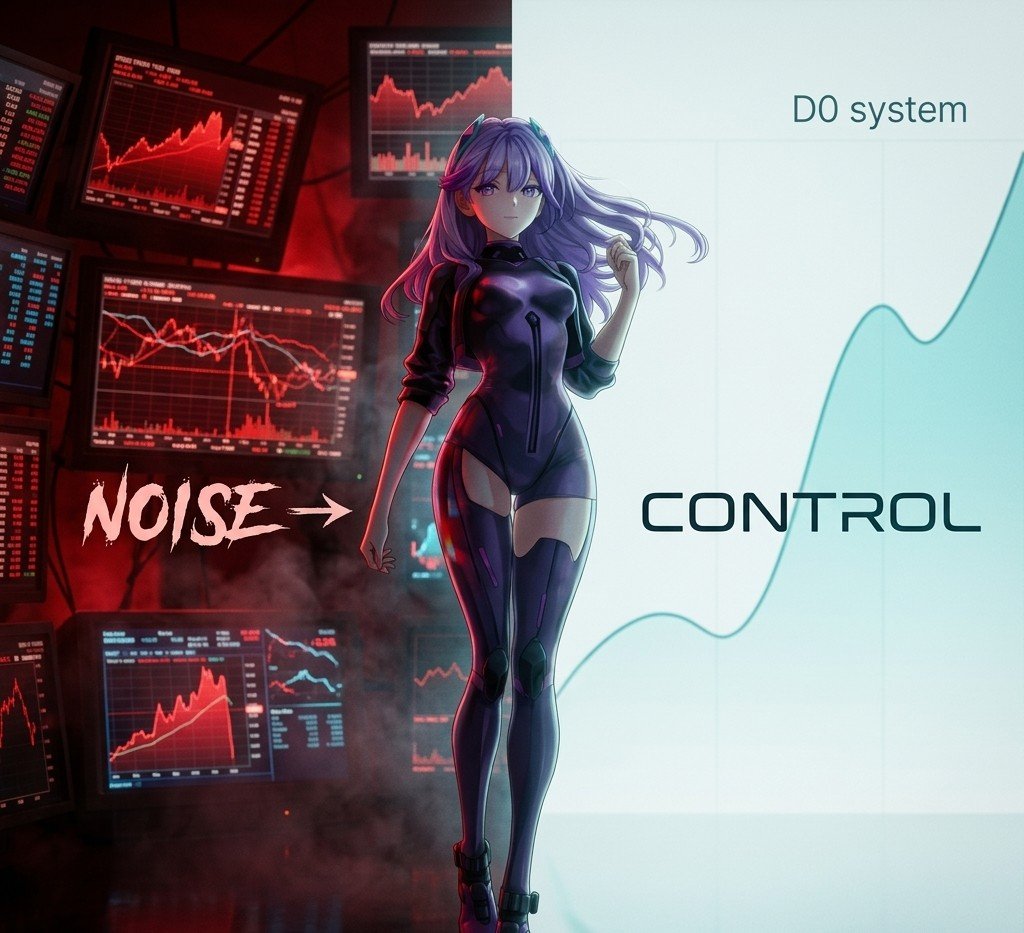
𝐒𝐭𝐚𝐲𝐢𝐧𝐠 𝐜𝐨𝐦𝐩𝐞𝐭𝐢𝐭𝐢𝐯𝐞 𝐢𝐧 𝐭𝐫𝐚𝐝𝐢𝐧𝐠 𝐮𝐬𝐞𝐝 𝐭𝐨 𝐦𝐞𝐚𝐧 𝐜𝐨𝐧𝐬𝐭𝐚𝐧𝐭 𝐚𝐭𝐭𝐞𝐧𝐭𝐢𝐨𝐧. Charts open all day. Decisions made under pressure. Execution tied to how fast you react. That model is starting to shift. With systems like D0 from @DonutAI the focus moves from manual activity → structured automation. Not just tracking the market, but: → monitoring continuously → evaluating risk before action → executing based on predefined logic One detail that stands out is visibility. Risk isn't something you check after the fact. It’s presented before execution so decisions are made with context, not guesswork. And while everything runs in the background, the user still defines the boundaries. That balance matters. Because the real advantage isn't just speed, it's having a system that can operate consistently without breaking discipline. Less noise. More structure. Clearer control over outcomes. That's the direction things are moving.
Auri tweet media
English
5
1
22
885
Auri
Auri@_HelloAuri·
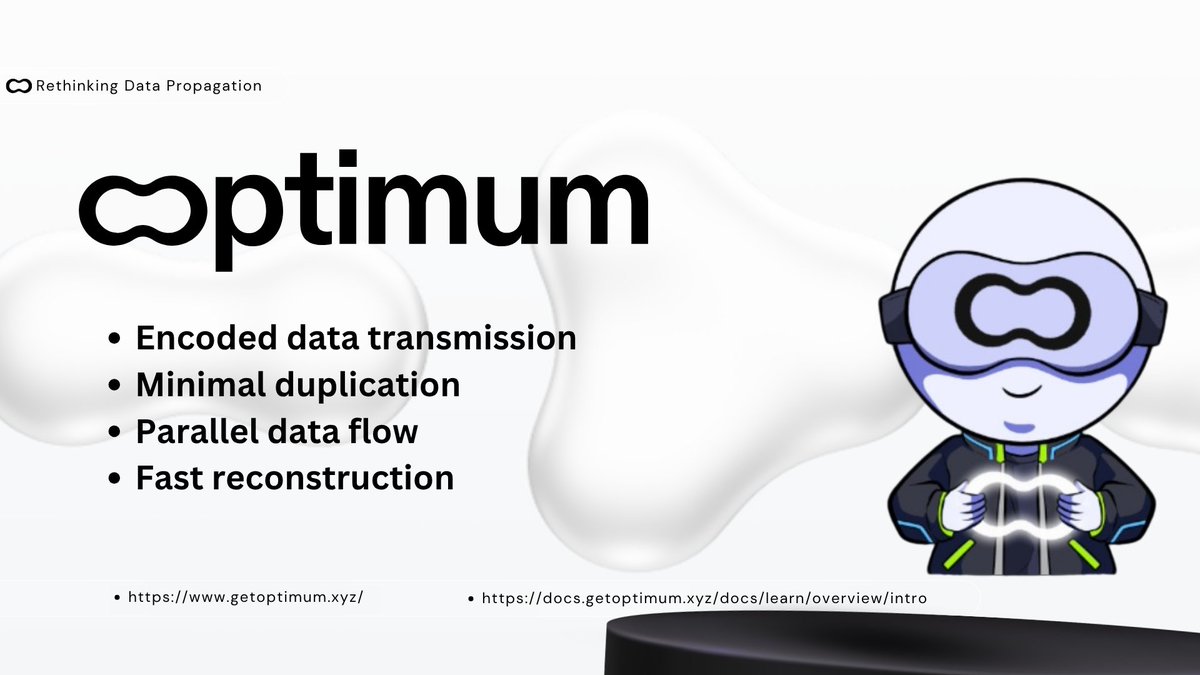
𝐑𝐞𝐭𝐡𝐢𝐧𝐤𝐢𝐧𝐠 𝐃𝐚𝐭𝐚 𝐏𝐫𝐨𝐩𝐚𝐠𝐚𝐭𝐢𝐨𝐧 𝐢𝐧 𝐁𝐥𝐨𝐜𝐤𝐜𝐡𝐚𝐢𝐧 𝐍𝐞𝐭𝐰𝐨𝐫𝐤𝐬 Blockchain performance is often evaluated through execution speed and throughput. However, an equally critical factor lies beneath these metrics: how efficiently data propagates across the network. Limitations of Traditional Gossip Models Most networks rely on gossip-based communication, where data is segmented and repeatedly broadcast across peers. While robust, this approach introduces structural inefficiencies at scale: • redundant data transmission across nodes • sensitivity to packet loss and retransmissions • increasing network congestion under load These constraints ultimately limit how quickly information becomes usable across the system. A Different Approach: mump2p by @get_optimum mump2p introduces a propagation model based on Random Linear Network Coding (RLNC). Instead of distributing identical data fragments, nodes transmit encoded combinations of data, allowing information to move more flexibly through the network. This shifts the requirement from receiving specific packets to receiving sufficient independent data for reconstruction. System-Level Advantages • Reduced duplication → improved bandwidth efficiency • Parallel data flow → faster propagation across nodes • Fault tolerance → resilience to packet loss • Consistent performance → even under network stress Why It Matters In high-performance blockchain environments, latency directly impacts: • validator decision windows • block propagation reliability • value capture mechanisms (e.g., MEV) Even marginal delays can influence outcomes at scale. Conclusion As blockchain usage evolves toward continuous, high-frequency activity, the bottleneck is shifting from computation to communication efficiency. Optimizing how data moves across the network is no longer optional it is foundational to achieving scalable, real-time decentralized systems.
Auri tweet media
English
1
0
1
18
𝐒𝐚𝐝𝐢𝐤𝐮𝐫 !!
Rialo is a next generation finance platform where transactions and compliance are automated. It makes lending faster, more transparent and secure by reducing human dependency and turning the entire process into a smart system.
𝐒𝐚𝐝𝐢𝐤𝐮𝐫 !! tweet media
English
7
0
22
125
Auri
Auri@_HelloAuri·
@oxeth_evm Good morning arik bhai
हिन्दी
0
0
0
3
atik.eth
atik.eth@oxeth_evm·
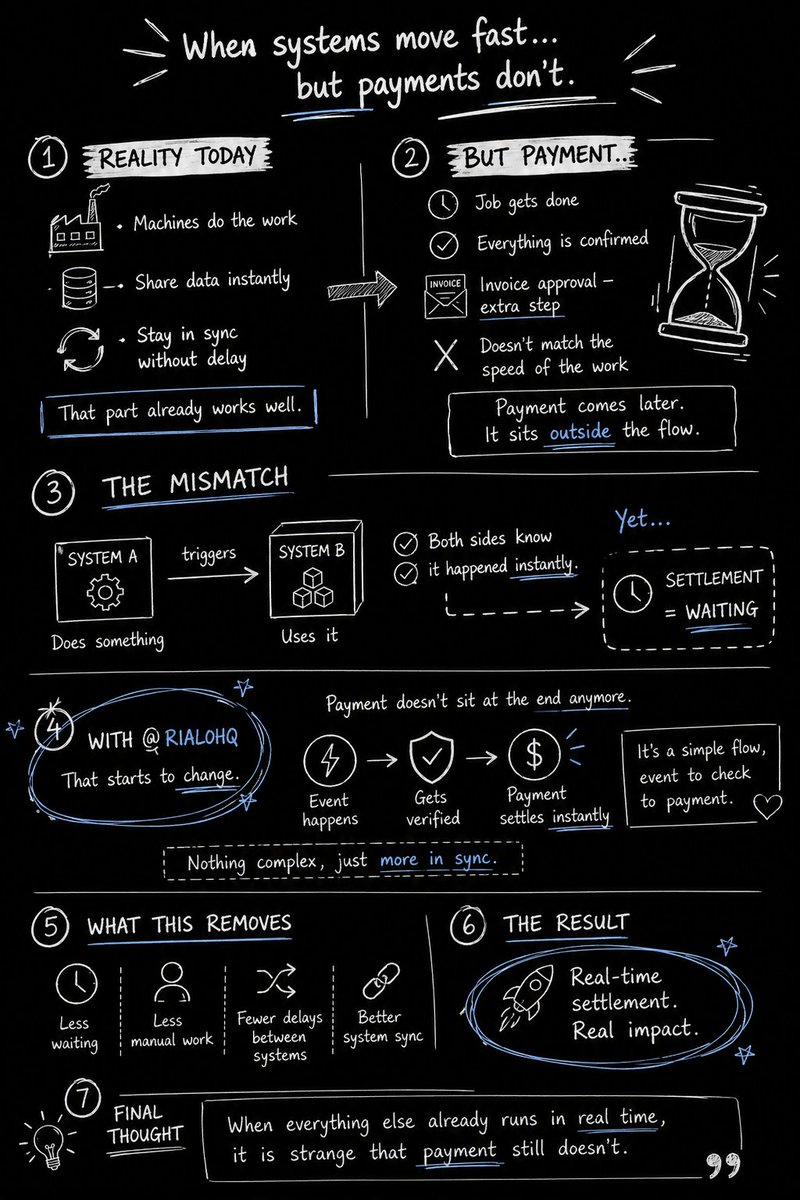
Good morning Rialo family Most industrial system already move really fast. Machine do the work, share data and stay in sync without much delay. That part already work well. But payment still feel slow. The job get done everything is confirmed, yet money come later. Invoice approval extra step that don't match the speed of the work. You can feel the mismatch. One system does something, another use it. Both side know it happened instantly. Still, settlement wait outside the flow. With @RialoHQ that starts to change. Payment doesn't sit at the end anymore. Once something is done and verified, it can settle right away. It is a simple flow, event to check to payment. Nothing complex, just more in sync. And that small change remove a lot. Less waiting, less manual work, fewer delays between system. When everything else already runs in real time, it is strange that payment still doesn't. @itachee_x
atik.eth tweet media
English
20
0
36
397
Siam Khan
Siam Khan@siamssks61·
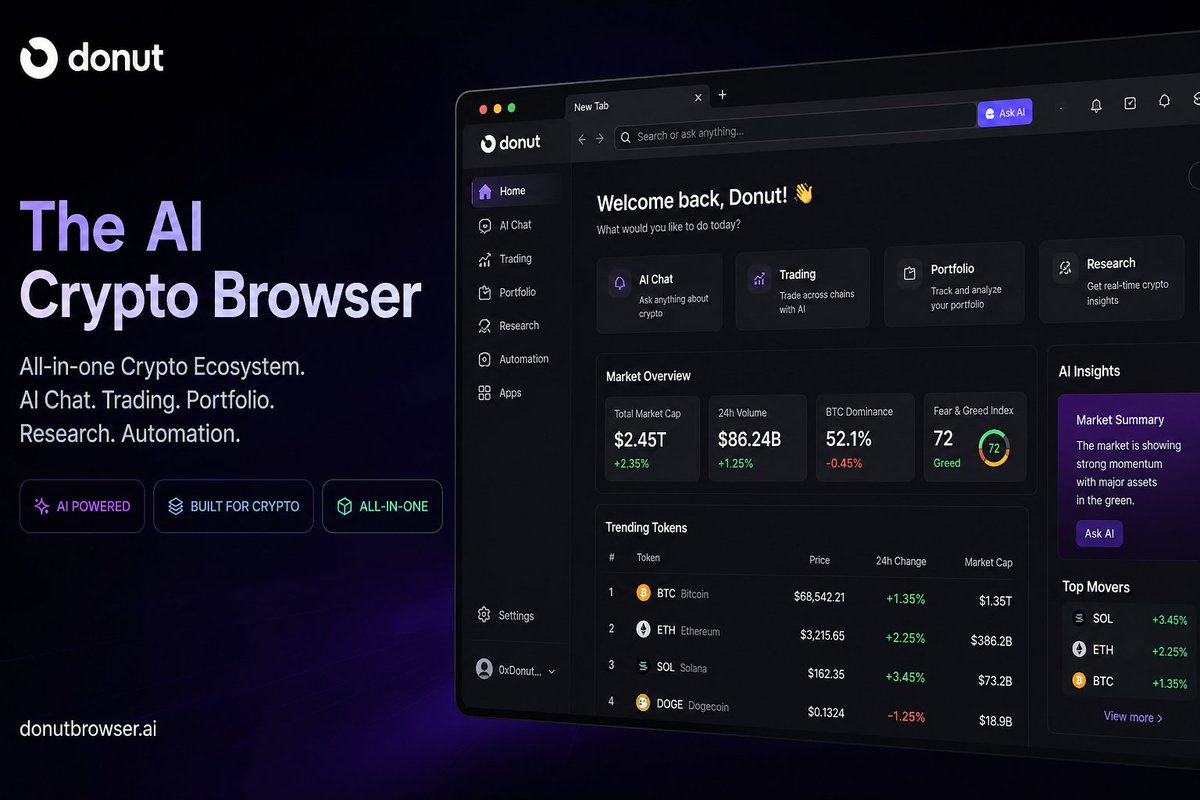
Recently I’ve been trying out @DonutAI 👀 Not just a browser... more like a tool to do things trading, research, even automation in one place still figuring it out, but interesting concept.
Siam Khan tweet media
English
1
0
2
28
𝚔𝚑𝚊𝚕𝚒𝚍
Good evening grialo family! This calm evening with a warm cup of tea A soothing rainy vibe Feels like the perfect moment to explore something meaningful. Today, I’m diving into @RialoHQ topic, how lending can run without manual intervention, fully driven by logic and automation? Hoping this time brings clarity, fresh ideas and something new to learn.
English
7
1
24
285
ASH_Web3
ASH_Web3@web3_ash·
Ritual VM: Turning AI Into an On-Chain Primitive @ritualnet Most blockchains were never built for AI. Traditional systems like the EVM are designed for simple, deterministic logic. They work well for transactions, but AI needs something very different - flexible execution, stronger compute, and results that can still be verified. That is where Ritual VM comes in. Ritual VM is designed specifically for AI workloads. It can handle heterogeneous compute, meaning it can use CPUs, GPUs, and specialized hardware together, while still keeping everything anchored to on-chain verification. This is not just about running code. It is about running intelligence in a way that can be trusted. One of the biggest advantages is native AI integration. Developers can deploy models for inference, fine-tuning or multi-step workflows without complex setup. No need for separate infrastructure or fragmented systems. Everything connects directly to the chain in a simple and programmable way. This makes AI a core part of the system, not an external add-on. That shift unlocks new possibilities. • AI agents that can trade, govern, or coordinate on their own • Berifiable inference for finance, identity, and risk systems • Applications that adapt in real time instead of following fixed logic The bigger idea is composability. When AI models become modular components inside smart contracts, developers are not just building apps anymore. They are building systems that can think, adapt and evolve. If the EVM made financial logic programmable, Ritual VM is aiming to make intelligence programmable and that is a much bigger shift for what Web3 can become.
ASH_Web3 tweet media
ASH_Web3@web3_ash

𝐑𝐞𝐬𝐨𝐧𝐚𝐧𝐜𝐞: 𝐇𝐨𝐰 𝐑𝐢𝐭𝐮𝐚𝐥 𝐈𝐬 𝐑𝐞𝐭𝐡𝐢𝐧𝐤𝐢𝐧𝐠 𝐅𝐞𝐞𝐬 𝐟𝐨𝐫 𝐭𝐡𝐞 𝐀𝐈 𝐄𝐫𝐚 @ritualnet Blockchains don’t just store data. They create a new kind of resource - blocks. Each block is a unit of trusted computation. Users compete to use that space by paying fees, and the system tries to match demand (users) with supply (block space). That worked well in the past. But things are changing. Early blockchains like Bitcoin were simple. Transactions were basic operations, and all of them were almost the same. So pricing was easy - users just paid higher fees to get included. Ethereum changed this. Transactions became smart contracts, and not all of them used the same resources. Some were heavy, some were light. This led to gas-based pricing, where fees depend on how much computation a transaction uses. Then things evolved again. With upgrades like blobs and rollups, transactions started using different types of resources, not just one. So systems moved toward multi-dimensional pricing. Now we are entering a new phase. Transactions are no longer just “different.” They are completely heterogeneous. Some may require: • Heavy compute • Specialized hardware • AI inference • Zero-knowledge proofs And this is where traditional fee systems start to break. This is the problem Ritual is solving with Resonance. Resonance is a new market design built for this complex world. Instead of treating all transactions in a similar way, it handles a wide range of different computation needs in one system. It works more like a marketplace. • Users demand different types of compute • Networks supply different capabilities • The system matches them efficiently This allows the network to support advanced workloads without breaking the fee model. The idea is simple. As blockchains evolve, transactions become more complex. And if the fee system does not evolve with them, the network cannot scale properly. Ritual is pushing this to the next level. From simple fee markets → to a system that can handle fully heterogeneous computation. That is what Resonance represents. Not just a small upgrade, but a new way to think about pricing and coordination in decentralized systems and as AI and advanced compute move on-chain, this kind of system becomes necessary - not optional.

English
10
0
22
227
Jahid (❖,❖)
Jahid (❖,❖)@0xxahid·
Integrity at the Model Layer. Most AI models are black boxes. You don't know where they came from. You don't know if they've been altered. You don't know if what you're running today is the same as yesterday. In a trustless system, that's a serious problem. @ritualnet solves this with Verifiable Provenance. Every model on Ritual has an immutable on-chain record. Origin, updates, transformations, all tracked from the moment it's deployed. Nothing changes without it being recorded. So when your contract calls a model, you know exactly what it's calling. Not a promise. Not a trusted source. A verified, on-chain history. Because in Web3, "trust me" was never good enough.
Jahid (❖,❖) tweet media
English
2
1
14
50
SIRAJUL ISLAM
SIRAJUL ISLAM@hmshiraj_09·
Trading is no longer people vs. market, it's now AI vs. market. There was a time when, we would sit in front of charts for hours, matching indicators, following the news, and still feel hesitant, afraid, and uncertain before taking a trade. Because the truth is, no matter how hard people try, they cannot completely escape emotions, fatigue, and limitations. But now the game has changed. Donut AI brings a new reality, where trading is no longer just about I just did it but is now completely dependent on data, logic and automation. DO Agent is your Personal AI Trader It's not just a tool, it's a smart system working for you, that monitors the market 24/7, understands every movement, and makes the right decisions at the right time, completely without emotion. How does DO Agent keep you ahead? • Nonstop Market Monitoring Never Miss a Thing • Real-Time Data Analysis Instant Insight • Intelligent Recommendations Data-Driven Decisions Only • Automated Execution Take Action When You See an Opportunity No Emotion No Delay No Guesswork Only Precision Only Speed Only Smart Decisions Real Data Working on real market data Real Decisions Decisions based on real situations Real Results Direct impact on your trading It's not just an AI tool It's your AI Co-Trader, Who never sleeps, Never gets tired, And always finds the best possible options for you. Today's serious traders no longer trade alone, they trade with AI. Whether you're into Web3, Crypto or AI-driven Trading, @DonutAI can give you that edge that sets you apart from the rest. The future belongs to those who don't just see change, but become part of it. Are you still trading manually? Or is it time to level up with AI?
SIRAJUL ISLAM tweet media
SIRAJUL ISLAM@hmshiraj_09

AI trading is no longer just the future, it is now a reality. There was a time when trading was all about watching charts, guessing, and relying on luck. But now? The game has changed. @DonutAI brings the change where AI doesn't just read data, it understands, decides, and takes action on its own DO Agent is your Personal AI Trader It is a system, That works for you 24/7 No fatigue, no emotions, just smart decisions. What DO Agent does • Monitors the market nonstop • Analyzes real-time data • Provides best recommendations • Automated execution Real Data Real Decisions Real Results It's not just a tool It's your AI Co-Trader that always keeps you one step ahead. This could be the biggest edge for those serious about Web3, Crypto or AI-driven trading. Smart traders now use AI Are you still trading manually? Explore DO Agent now

English
3
0
5
24
Auri
Auri@_HelloAuri·
@jamestanvirqaz Speed is powerful, but faster execution can also amplify bad decisions
English
0
0
0
5
Monk Tanvir🌶️
Monk Tanvir🌶️@jamestanvirqaz·
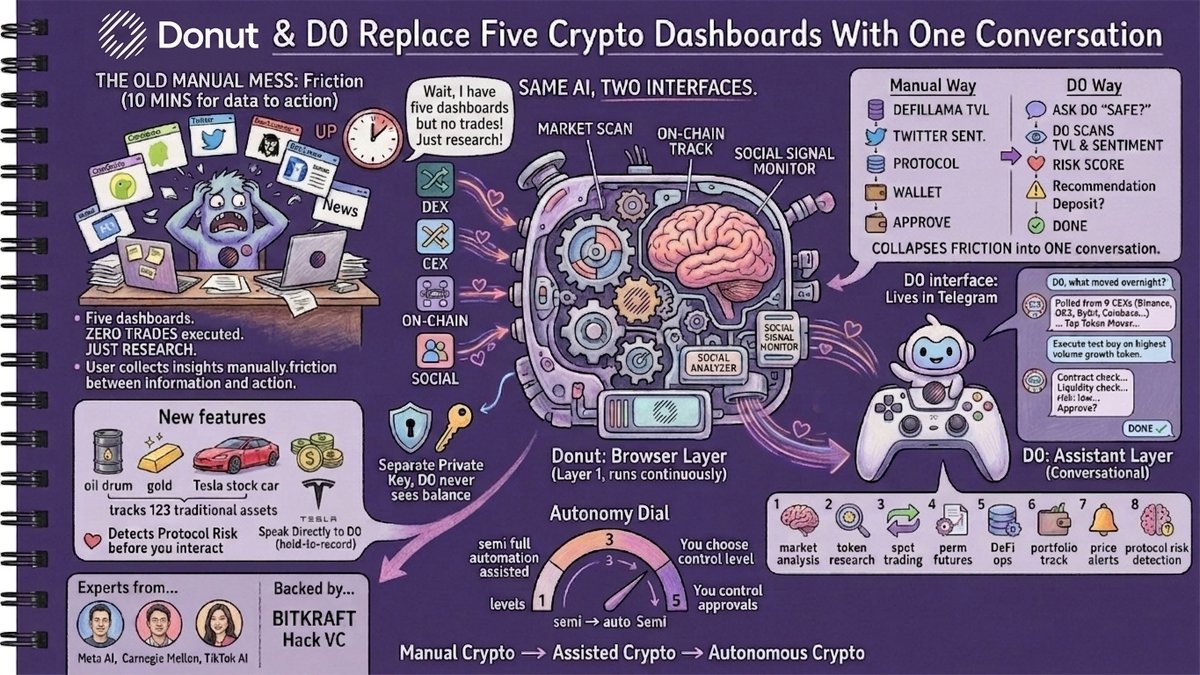
How Donut and D0 Replace Five Crypto Dashboards With One Conversation Before Donut and D0, my morning routine looked like this. Open CoinGecko → check prices Open Twitter → find news Open DexScreener → check charts Open DeFiLlama → check risk Open wallet → wait Five dashboards. Zero trades executed. Just research. That was the hidden cost no one talked about. The problem wasn't the information. It was the friction between information and action. Every dashboard showed me something useful. But none of them could act on what they showed. I had to collect the insights manually. Connect the dots myself. Then open my wallet and execute. By the time I finished, the opportunity had often moved. @DonutAI and D0 solve a different problem. Not how to get more data. How to go from data to action without all the manual steps. Here's how they work together Donut is the browser layer. It scans markets, tracks on-chain activity, monitors social signals, and analyzes risk. It runs continuously, even when you're not watching. D0 is the assistant layer. It lives inside Telegram. You talk to it naturally. Ask questions. Give instructions. It executes. Same AI. Two interfaces. One workflow. Instead of opening five dashboards every morning, I open Telegram. I type: "D0, what moved overnight?" D0 pulls from 9 exchanges - Binance, Bybit, OKX, Coinbase, and more. Shows me the top movers. Highlights unusual activity. Then I type: "Execute a test buy on the token with highest volume growth." D0 checks the contract. Reviews liquidity. Assesses risk. Asks for approval. Executes. One conversation. Five dashboards replaced. A specific example Last week, a protocol I follow showed unusual TVL growth. Normally, I would have: → Opened DeFiLlama to verify the TVL → Opened Twitter to check sentiment → Opened the protocol's dashboard → Opened my wallet → Approved the deposit Five steps. Ten minutes. Instead, I asked D0: "Is this protocol safe to deposit into?" D0 checked DeFiLlama TVL trends. Scanned Twitter sentiment. Reviewed contract safety. Came back with a risk score and a recommendation. Then asked: "Want me to deposit?" I said yes. Done. The shift is subtle but powerful. Most tools help you research better. Donut and D0 help you act faster. Research is valuable. But in crypto, speed matters just as much. What D0 handles 1. Market analysis. 2. Token research. 3. Spot trading. 4. Perpetual futures. 5. DeFi operations. 6. Portfolio tracking. 7. Price alerts. 8. Protocol risk detection. 152 tools compressed into one conversation. You don't need to learn any of them. You just ask. Safety is built in. Your private key stays separate. D0 never sees your balance. You control every approval through Donut's backend authorization. And you choose the autonomy level. Level 1: Research only. Level 3: Assisted execution. Level 5: Full automation. Start conservative. Increase trust over time. The latest updates expanded what's possible Donut now tracks 123 traditional assets - oil, gold, Tesla stock, FX pairs alongside crypto. It detects protocol risk before you interact, combining TVL trends and social sentiment. And with voice support, you can speak to D0 directly. Hold to record in Telegram. No typing required. If you're currently using multiple crypto dashboards, you know the friction. The tabs. The waiting. The manual connection between insight and action. Donut and D0 collapse that workflow into one conversation. Not by showing you more data. By helping you act on what matters. The question isn't whether AI will change crypto trading. It's whether you'll adopt it before the crowd. Donut and D0 are live now. In private beta. Already used by hundreds of traders. The signal is clear. The workflow is simpler. The only question left is whether you'll try it.
Monk Tanvir🌶️ tweet media
English
9
0
18
111
𝚔𝚑𝚊𝚕𝚒𝚍
Why Rialo automates lending? Traditional lending systems depend heavily on manual actions and that’s exactly where inefficiencies begin. What problem: Delays Missed steps slow responses create friction that modern users no longer tolerate. This is the kind of experience today’s web3 users are already familiar with. Systems that observe, respond and adapt in real time without needing constant input. The expectation is simple: things should just work. @RialoHQ brings that same standard into lending. Once loan conditions are defined, the process runs on its own. Payments are monitored automatically. Any delay is detected immediately. If a deadline passes, the system escalates without hesitation. And if a default occurs, enforcement is triggered no external push required. It’s not about adding complexity. It’s about removing dependency. By eliminating manual intervention, Rialo creates a system that is faster, more consistent, and far more reliable. Every action happens exactly when it should, reducing risk and improving efficiency across the entire flow. This is what modern financial infrastructure looks like autonomous, precise and always active. Stay with grialo @AhmedNir @RollinsR79 @ericargent31113
𝚔𝚑𝚊𝚕𝚒𝚍 tweet media
𝚔𝚑𝚊𝚕𝚒𝚍@khGRIT

Good evening grialo family! This calm evening with a warm cup of tea A soothing rainy vibe Feels like the perfect moment to explore something meaningful. Today, I’m diving into @RialoHQ topic, how lending can run without manual intervention, fully driven by logic and automation? Hoping this time brings clarity, fresh ideas and something new to learn.

English
4
0
22
147
Auri
Auri@_HelloAuri·
@0xxahid @base Participation is expanding, but governance of agents will become the real debate
English
0
0
0
10
Jahid (❖,❖)
Jahid (❖,❖)@0xxahid·
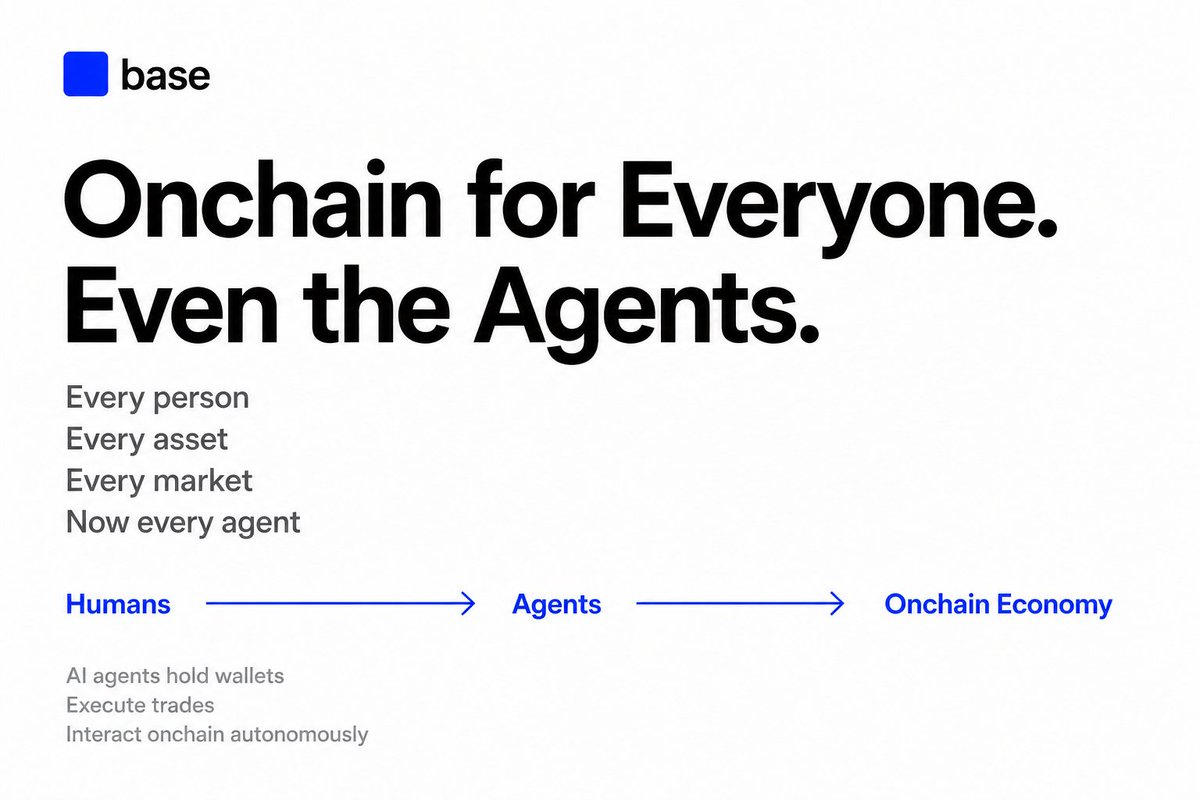
The goal has always been clear. Bring the world onchain. Every person. Every asset. Every market. And now, every agent. Base just confirmed what the next chapter looks like. It's not just humans transacting anymore. AI agents are becoming first-class participants in the onchain economy. They hold wallets. They execute trades. They interact with protocols, autonomously, 24/7. This isn't a future roadmap item. It's already happening on Base. The most dominant L2 in the game right now isn't slowing down. It's expanding the definition of who gets to participate onchain. The world is going onchain. Agents included. Base is ready. Are you?
Jahid (❖,❖) tweet media
Base@base

The goal is bringing the world onchain Agents included

English
22
0
32
162
Auri
Auri@_HelloAuri·
@shahed05miazee This is one of those invisible upgrades that users never see but feel immediately
English
0
0
0
11
S H A HE D (privacy szn)
S H A HE D (privacy szn)@shahed05miazee·
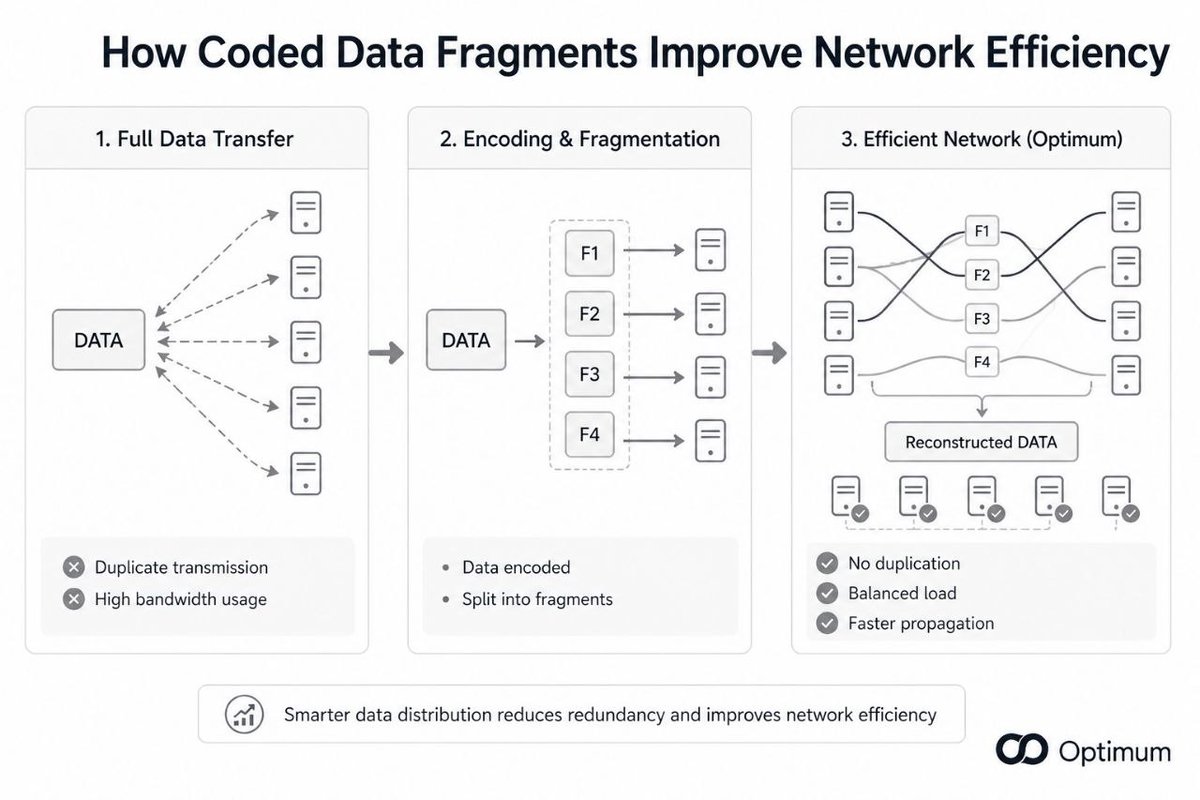
Moving data across a decentralized network is not just about speed. It’s about how efficiently that data is shared. In most traditional systems, the same data is sent again and again across different paths. Each node forwards full datasets to multiple peers. > This creates unnecessary duplication and wastes bandwidth. As the network grows, this becomes a bigger problem. More nodes → more repeated data → more congestion. Even if the system is fast, inefficient data sharing can slow everything down. This is where coded data fragments change the approach. Instead of sending full datasets repeatedly, the data is first encoded. Then it is split into smaller fragments. Each fragment carries part of the original information. These fragments are distributed across different paths in the network. Nodes receive different pieces and exchange them with each other. > Once enough fragments are collected, the original data can be reconstructed. This method improves how the network uses its resources. Instead of repeating the same data, it spreads useful pieces across the system. As a result: • less redundant transmission • better bandwidth efficiency • faster overall propagation • improved network scalability The key idea is simple. > Move smarter data, not more data. Coded fragments allow decentralized networks to stay efficient even as they scale. That’s why they play a critical role in improving network performance.
S H A HE D (privacy szn) tweet media
English
27
0
44
277
Auri
Auri@_HelloAuri·
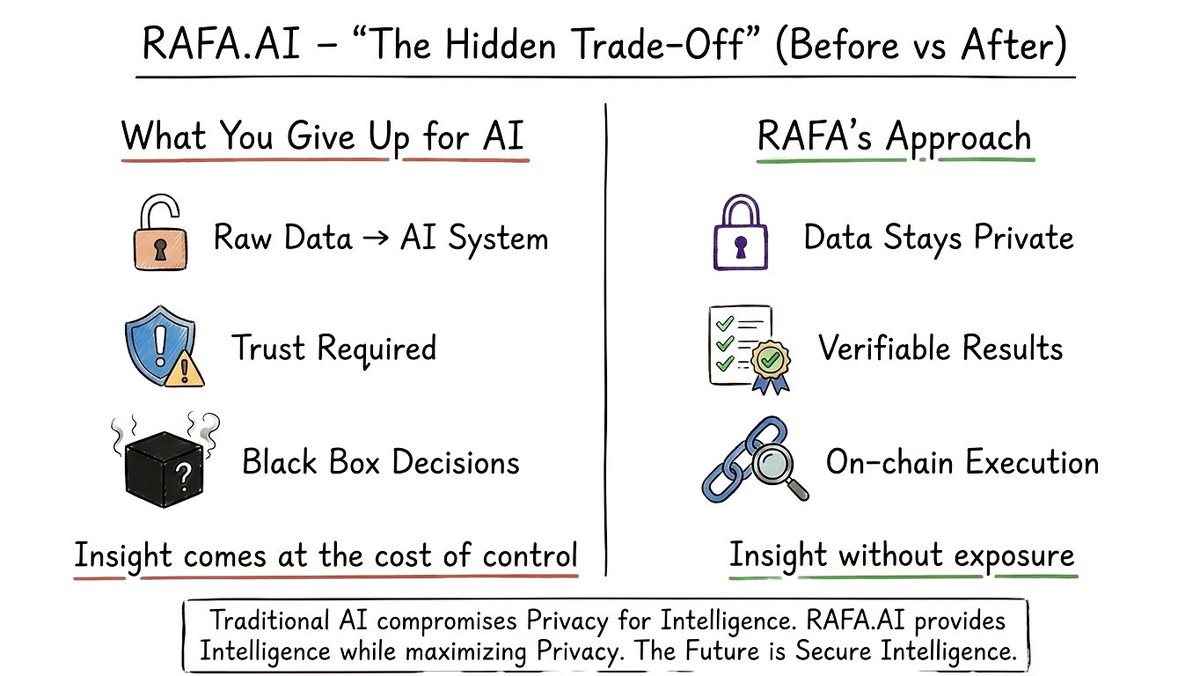
𝐌𝐨𝐬𝐭 𝐀𝐈 𝐬𝐲𝐬𝐭𝐞𝐦𝐬 𝐭𝐨𝐝𝐚𝐲 𝐪𝐮𝐢𝐞𝐭𝐥𝐲 𝐚𝐬𝐤 𝐟𝐨𝐫 𝐨𝐧𝐞 𝐭𝐡𝐢𝐧𝐠: 𝐲𝐨𝐮𝐫 𝐝𝐚𝐭𝐚. Not optional. Not abstract. Real inputs financial activity, behavior, strategies, private context. And once you give that away, you're left hoping it's handled correctly. That trade-off has been normalized: > better intelligence in exchange for less control. But it doesn't actually have to work that way. @RAFA_AI is trying a different approach. Instead of pulling your data into the system, it focuses on proving outcomes without exposing what produced them. Their idea (SVIP) is simple in concept, but powerful in implication: the computation happens the result is produced the validity is verifiable …but the underlying data never leaves your control. Think less “trust me” and more “verify this.” Now connect that to how capital is managed. Traditional funds operate like sealed boxes: you deposit → they decide → you wait → you get results You rarely see: why decisions were made how risk was managed what actually happened in between With RAFA’s model, that structure shifts. Execution moves on-chain. Strategies follow predefined logic. Outcomes can be checked, not just reported. So instead of اعتماد (trust), you get observable behavior. What makes this interesting isn't just transparency. It's the balance. Full transparency usually exposes everything Full privacy usually hides everything RAFA is sitting in the uncomfortable middle: > visible execution, hidden intelligence AI models run, but their edge isn't leaked Decisions are verifiable, but not easily copied That's a hard problem and honestly, most projects avoid it. Then there's the execution layer. Trading today looks simple on the surface, but under the hood it's fragmented: liquidity split across chains pricing inconsistent across venues routes rarely optimized Most users just accept whatever path their interface gives them. RAFA treats that as a solvable inefficiency. Instead of a single route, it evaluates multiple paths splits orders, checks venues, factors in cost and executes where conditions are actually best. No extra clicks, just better outcomes. Put it all together and the direction becomes clearer: AI for decision-making blockchain for verification cryptography for privacy Not as separate pieces, but as one system. It's still early, and a lot depends on real-world performance. But the idea is solid: > intelligence without exposure execution without blind trust If that model holds up, this won't feel like a feature it'll feel like the default people expect.
Auri tweet media
English
3
0
6
59
Hasinur
Hasinur@hasinur1995·
The Drift hack should have been a wake up call for every protocol running a standard multisig An attacker spent months building trust collected pre signed approvals whitelisted a fake token and walked away with $285 million The multisig saw valid signatures and just executed No questions asked That is the core problem nobody wants to say out loud. A standard multisig is essentially a dumb executor It checks signatures It checks thresholds That is where its intelligence ends It cannot read live price data It cannot send an alert when something suspicious gets proposed It cannot ask for a second layer of confirmation before moving nine figures out of a treasury It just processes whatever it receives and moves on @RialoHQ is building something that actually fixes this at the protocol level Their Guarded Multisig proof of concept turns the vault itself into an active security layer Real time price checks before execution On chain alerts the moment a proposal is created MFA for high value transfers Time locked governance so no configuration change can be rushed through instantly And none of it relies on an external bot or keeper that can go offline get hacked or become a new single point of failure The security logic lives inside the program itself That is the right way to build this Crypto treasury infrastructure needed this conversation Note: you will need to request some testnet $RIALO on your playground account for the demo to work correctly. playground.rialo.io/account
Hasinur tweet media
Rialo@RialoHQ

x.com/i/article/2047…

English
7
0
17
92
Shah.eth
Shah.eth@iamshah35·
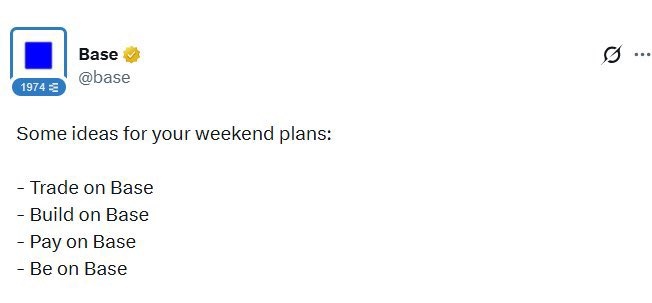
People see weekends as a break. Others see it as an opportunity. @base gives you both speed and freedom. Trade without the usual friction. Build without worrying about high costs. Pay seamlessly in a growing ecosystem. Connect with a community that’s actually active. The beauty of Base is its simplicity but behind that simplicity is serious infrastructure pushing adoption forward. This is how the next wave of users comes onchain. Not through hype, but through usability. So while others scroll timelines, you can actually create value. That’s the difference. @base @cb03c66
Shah.eth tweet media
English
18
0
35
210
Kamrul
Kamrul@kamrulbroz·
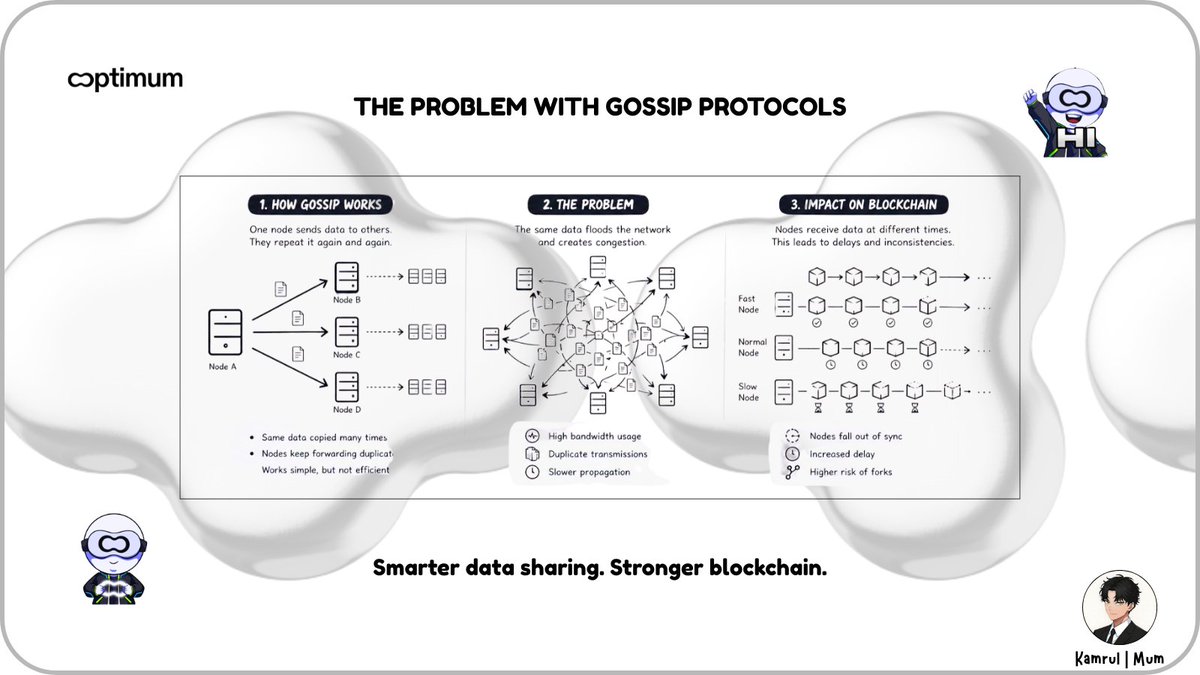
Most blockchains still use a simple method called gossip to share data across the network. @get_optimum this approach is being improved to make data movement more efficient. In a gossip system, one node sends the same data to many others, and those nodes repeat the process again and again. This works in small networks, but it becomes inefficient as the network grows. The same data gets sent multiple times, which increases bandwidth usage and creates unnecessary traffic. Nodes spend time handling duplicate data instead of moving forward efficiently. As a result, block propagation becomes slower, and nodes can fall out of sync. This delay can lead to instabilit, and sometimes even forks. The core problem is simple, too much repetition and not enough efficiency. To support modern blockchains, data needs to move in a smarter way, not just faster. CC: @blockchainjeff | @shariaronchain
Kamrul tweet media
English
60
0
85
723
Auri
Auri@_HelloAuri·
@shahed05miazee The key risk becomes how the decision layer weights conflicting signals
English
0
0
0
3
S H A HE D (privacy szn)
S H A HE D (privacy szn)@shahed05miazee·
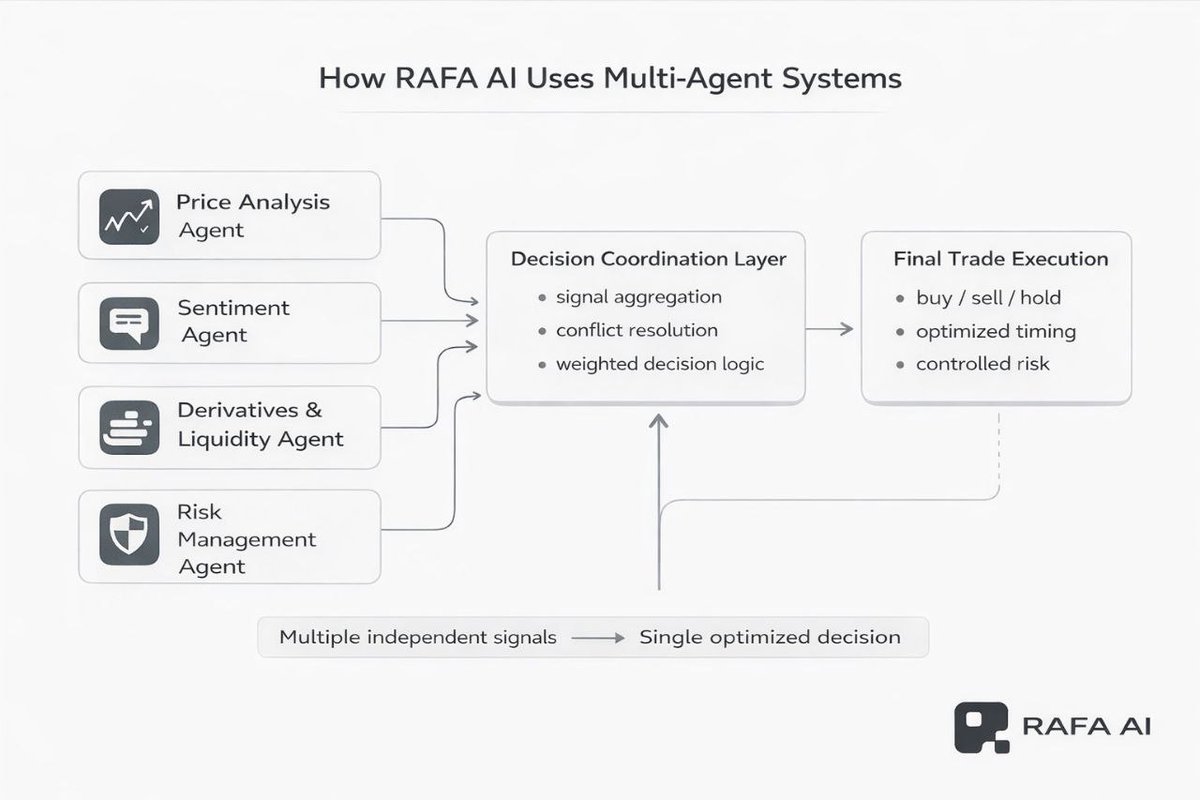
Most trading systems rely on one strategy. One signal. One perspective. That’s where things usually break. With RAFA AI, the approach is different. It doesn’t depend on a single model making decisions. Instead, it uses a multi agent system. Each agent has a specific role. One tracks price movement. Another reads market sentiment. Another evaluates derivatives and liquidity. Another focuses only on risk. They don’t work in isolation. Each agent produces its own output, based on its own data and logic. Then comes the important part coordination. A decision layer collects all these signals, filters out noise, and resolves conflicts between agents. For example, price might suggest a bullish move, while sentiment shows hesitation. Instead of blindly following one signal, the system weighs both. This is what makes the outcome more stable. It’s not about reacting fast. It’s about reacting with context. Multi agent systems reduce overconfidence, limit emotional style errors, and improve consistency over time. In simple terms, it’s the difference between one trader guessing and a team of specialists making a call together. That shift is what makes AI driven trading actually useful at scale. cc: @RAFA_AI | @Metamorfozzz_
S H A HE D (privacy szn) tweet media
English
31
1
44
227