
NotYourDoctor

5.8K posts

NotYourDoctor banner
NotYourDoctor

NotYourDoctor

@_NotYourDoctor

Everything that matters for your optimal health that your Doctor likely hasn't told you.

Ireland Katılım Nisan 2024
831 Takip Edilen704 Takipçiler
NotYourDoctor retweetledi
Sukh Sroay
Sukh Sroay@sukh_saroy·
A team of researchers in New Zealand followed 1,037 babies from the day they were born for the next 45 years to find out what actually determines a successful adult life, and the strongest predictor they found had almost nothing to do with intelligence or family wealth. The findings have been published in the most prestigious scientific journals in the world. Almost no parent has heard of them. His name is Avshalom Caspi. Her name is Terrie Moffitt. They are a husband and wife research team based at Duke University and King's College London, and the study they have spent their careers running is called the Dunedin Multidisciplinary Health and Development Study. It started in 1972 in a single hospital in Dunedin, New Zealand. Every baby born there in a 12-month window was enrolled. 1,037 of them. The study is still running today. The retention rate is the part that should astonish anyone familiar with how research usually works. After more than 45 years, over 90 percent of the original participants are still being tracked. Most longitudinal studies lose half their sample inside ten years. The Dunedin team has lost almost nobody. They measured everything. Blood. DNA. Brain scans. Income. Criminal records. Romantic relationships. Drug use. Dental health. Sleep. Mental health. Lung function. They flew participants who had moved abroad back to Dunedin every few years for a full day of assessments. Some of those people now live in seven different countries. They still show up. For the first decade of life, the team did something nobody else was doing systematically. They measured each child's self-control. Not IQ. Not family income. Not parenting style. Self-control. They watched 3-year-olds in a research lab and rated their ability to wait, regulate frustration, follow instructions, and resist impulsive reactions. They added teacher ratings. They added parent ratings. They added the children's own self-reports as they grew older. They combined all of it into a single highly reliable score. Then they did the thing nobody else had the patience to do. They waited. When the data came in at age 32, the result was so consistent it should be illegal to teach a child without it. The children who scored lowest on self-control at age 3 grew into adults with worse physical health, more substance dependence, lower incomes, more credit card debt, higher rates of single parenthood, more criminal convictions, and worse mental health than the children who scored highest. The pattern was not subtle. It was a clean gradient. Every step up in childhood self-control produced a measurable step up in adult outcomes across every domain the team could measure. The detail that should disturb every parent reading this is what happened when the researchers controlled for the obvious objections. When they controlled for IQ, the effect held. When they controlled for family income and social class, the effect held. When they compared siblings inside the same family, the sibling with lower self-control still had worse adult outcomes than the sibling with higher self-control. Same parents. Same house. Same dinner table. The trait was running independently of everything researchers expected to explain it. The paper landed in the Proceedings of the National Academy of Sciences in 2011. The title was as plain as it gets. "A gradient of childhood self-control predicts health, wealth, and public safety." It has been cited thousands of times since. Almost no policy maker has acted on it. The reason most people resist this finding is that it sounds like a sentence handed down before the child could speak. If the trait that determines your adult life is locked in by age 3, the rest of your life is a formality. The Dunedin researchers say that is the wrong way to read the data. They found something else in the same paper that almost nobody quotes. Some of the children whose self-control scores improved between childhood and adolescence ended up with adult outcomes far better than their early scores predicted. The trait is not destiny. It is a muscle. Children who learned to wait, regulate, and resist between ages 5 and 15 caught up with kids who started ahead. Self-control is the one childhood trait nobody seems to teach on purpose anymore. Schools focus on test scores. Parents focus on activities. Coaches focus on performance. The part of the brain that decides between five seconds from now and five years from now is left to develop on its own, and the data shows it usually does not. The most uncomfortable part of the research is the cost calculation Moffitt and Caspi ran. They estimated that if a country could move the bottom 20 percent of children up one rung on the self-control ladder, it would measurably reduce healthcare spending, welfare dependency, and incarceration costs at the national level. The intervention is cheaper than almost any other public health investment available. Almost no country has tried it at scale. The reason adults struggle with money, weight, addiction, and relationships is rarely intelligence. It is the gap between what you want right now and what you want in ten years, and which side of that gap your nervous system is built to listen to. Most people lost that fight at age 4 and never went back to learn the technique. You were not behind because life dealt you a bad hand. You were behind because the part of you that decides between right now and the rest of your life was never taught how to choose. The good news is the muscle is still there. Almost nobody trains it after age 10. You can be the one who does.
Sukh Sroay tweet media
English
540
4.2K
14.5K
2.2M
NotYourDoctor retweetledi
Ihtesham Ali
Ihtesham Ali@ihtesham2005·
A German neuroscientist published a book in 2012 arguing that smartphones are quietly producing the first generation in human history whose brains will shrink before they turn 30, and the media spent the next decade trying to destroy him for saying it. His name is Manfred Spitzer. He runs the Psychiatric University Hospital in Ulm and directs Germany's largest transfer center for neuroscience and education. The book is called Digitale Demenz, which translates as Digital Dementia, and it became one of the best-selling popular science books in German history almost the moment it was published. The press hated him for it. He was called Germany's most controversial brain scientist, accused of being a Luddite, a moral panic merchant, and a fearmonger who hated children. None of that stopped the book from being translated into more than a dozen languages, and almost none of it engaged with the actual neuroscience he was citing. The phrase digital dementia did not even start with him. It started with South Korean doctors in the late 2000s, who noticed something strange in their clinics. Patients in their twenties were arriving with memory complaints that had previously only shown up in much older adults. Forgetting numbers they used to know by heart. Losing the ability to recall directions in cities they had lived in for years. Struggling to remember conversations from earlier the same day. The doctors connected it to the rise of smartphone use, which had hit South Korea harder and earlier than almost any other country on Earth. Spitzer picked up the phrase and built an entire book around the neuroscience that explained it. The core thesis is brutally simple. The brain behaves like a muscle. It grows when you use it, and it atrophies when you do not. Every cognitive task you outsource to a device is a task your brain is no longer practicing, and the neural circuits responsible for that task are no longer being reinforced. Over time, they weaken in exactly the same way an unused muscle weakens. Spitzer was not arguing that smartphones would give you Alzheimer's. He was arguing that decades of cognitive outsourcing would produce a measurable decline in the underlying machinery, long before any clinical diagnosis would catch it, and that the decline was already showing up in young adults. The mechanism is what made him impossible to dismiss. By the early 2010s, there was already deep evidence that the brain physically remodels itself in response to use. London taxi drivers who had memorized the entire street map of the city had measurably larger hippocampi than the average person, which is the brain region responsible for spatial memory. Musicians who practiced for thousands of hours had thicker auditory cortices. Spitzer's argument was just the dark side of the same finding. If the brain grows in response to use, then it must shrink in response to neglect. And if every cognitive task adults used to perform with their own memory, navigation, arithmetic, attention, and reading was now being handled by a glowing rectangle in their pocket, then the regions responsible for all of those tasks were quietly being underused for the first time in human evolutionary history. Then the supporting data started landing. A 2020 study at McGill University tracked 50 regular drivers and measured GPS use. The heavy users had weaker spatial memory than the rest, and when researchers retested a subset three years later, those users had declined the fastest. The same hippocampus London cabbies had built up by ignoring shortcuts was being slowly hollowed out in everyone else by accepting them. A 2024 MIT study scanned the brains of people writing essays with and without ChatGPT. The AI group showed 55 percent weaker brain connectivity than the group writing on their own. 83 percent of the ChatGPT users could not recall a single line from essays they had written minutes earlier. The damage stayed even when the tool was taken away. A 2024 paper out of Norway recorded EEG scans of students writing words by hand versus typing them. The handwriting condition lit up the entire learning network. The typing condition produced almost nothing. Every one of these findings is exactly what Spitzer predicted in 2012. The most uncomfortable line in his book is the one almost nobody in the German press wanted to print. He pointed out that the people building these devices were not letting their own children use them. Steve Jobs did not let his kids near an iPad. Bill Gates capped his children's screen time at 30 minutes a day. The senior engineers at Google were sending their kids to Waldorf schools that banned screens entirely. The people who knew the most about what these products were doing to the developing brain were the ones protecting their own families from them, and almost nobody on the outside was asking why. The generation he was warning about is now in their twenties. The first cognitive scans of what we did to them are starting to come back, and the pattern is exactly what he said it would be. The brain you were born with is not the brain you will die with. You are training it every day. The only question is which direction.
Ihtesham Ali tweet media
English
62
1.3K
2.8K
110.5K
NotYourDoctor
NotYourDoctor@_NotYourDoctor·
@BriHReed Congrats on an entirely unsupported and highly dubious "conclusion"!
English
0
0
0
14
Brian Reed
Brian Reed@BriHReed·
The answer is: FACTS MATTER. Facts are what drive people's beliefs. More than the presentation or framing of the facts. More than who the messenger is and whether someone trusts them. These researchers controlled for those variables, and it still came down to facts.
English
22
10
212
22.5K
Brian Reed
Brian Reed@BriHReed·
I reported on an experiment this week that blew my mind. Psychologists at @Cornell recruited thousands of people to talk with ChatGPT about a conspiracy theory they believed. They wanted to know: Is it true that conspiracy theories rarely get convinced out of their beliefs? 🧵
English
110
192
1.1K
286.6K
NotYourDoctor
NotYourDoctor@_NotYourDoctor·
@the_no_mind "This explains why ketogenic diets show benefit in cancer". It doesn't. And they don't.
English
0
0
0
11
no.mind
no.mind@the_no_mind·
16/ This explains why ketogenic diets show benefit in cancer — and it goes deeper than glucose restriction. In a ketogenic diet, 80–90% of daily calorie intake comes from fats. The more carbon atoms originate from fatty acids — the lower the deuterium concentration of metabolic water produced in the mitochondria. At 80–90% fat intake, mitochondrial metabolic water drops to ~118 ppm. The ketogenic diet doesn't just starve cancer cells of glucose. It reduces the deuterium/hydrogen ratio — restoring the mitochondria's ability to act as the brake on cell division.
English
2
8
38
3.9K
no.mind
no.mind@the_no_mind·
This is Dr. Gábor Somlyai. A Hungarian molecular biologist & cancer researcher who followed 2,600+ cancer patients over 32+ years. His message? Cancer is driven by a variable almost nobody in medicine talks about: Deuterium. Here is his framework: 🧵
no.mind tweet mediano.mind tweet media
English
35
193
732
120.8K
NotYourDoctor
NotYourDoctor@_NotYourDoctor·
@BadreNicolas Got it. As good a personal aim as one could have as a psychiatrist. Which is why you're worth following Nicolas. Thanks.
English
1
0
1
13
Nicolas Badre
Nicolas Badre@BadreNicolas·
@_NotYourDoctor The ultimate judgment on the practice of psychiatry is not mine to make. My goal is to ameliorate the field so that the judgments people make about it improve.
English
1
0
2
56
Nicolas Badre
Nicolas Badre@BadreNicolas·
My philosophy of psychiatry. People sometimes ask me how I can be so critical of psychiatry yet simultaneously so in love with it. My main philosophy is that mental health treatment should be passionate. Somebody comes to you at their absolute worst distress or with their most inner fear, and few things will alienate them more than impersonal, generic, and algorithmic care (simplified to collaborative care with a PHQ-9, a prescription, and no visit). Few things will make them feel more alive than a caring and compassionate provider. In this paradigm I have, practitioners who are highly critical and highly in favor are both on the same side of making a patient feel cared for and attended to. In the famous NIMH Depression Collaborative study, the most important factor in patient improvement wasn’t being prescribed the right medication, but having a provider who was appropriately hopeful and concerned. As such, my position is evidence-based yet is able to reconcile different viewpoints. I suspect that some will not be satisfied with this, wanting to corner me in a pro or anti camp, but that is my philosophy. I am so thankful for those who challenge the field and genuinely believe they make it better. The death of psychiatry is not disagreement, but indifference. (The NIMH Depression Collaborative also recommended providers be warm. Some providers on X could work on that) (Reference for “warm, concerned, and hopeful”, DOI 10.1521/pdps.2013.41.1.13)
English
24
15
130
15.8K
Kelly DNP Functional/Integrative Medicine
Raise your hand if you have long measles, long polio, long flu… Most of our patients that come to us with “long covid” are mineral deficient or mRNA injection injured. Copper deficiency is a nutritional issue primarily stemming from malabsorption or excessive zinc intake. Its core symptoms include persistent fatigue, numbness and tingling in extremities, walking difficulties, frequent infections, and pale skin. We’re seeing the same with hypomagnesemia. The issue is most allopathic health practitioners are not testing these levels.
English
11
13
103
5.1K
NotYourDoctor retweetledi
Ihtesham Ali
Ihtesham Ali@ihtesham2005·
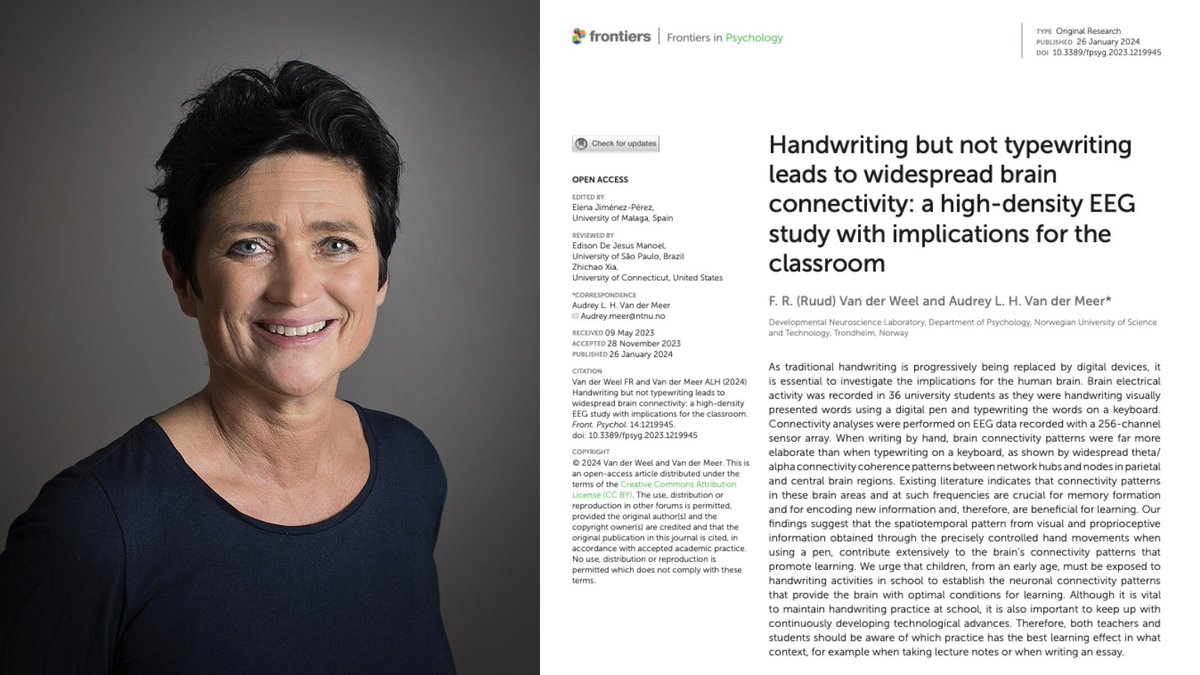
A Norwegian neuroscientist spent 20 years proving that the act of writing by hand changes the human brain in ways typing physically cannot, and almost nobody outside her field has read the paper. Her name is Audrey van der Meer. She runs a brain research lab in Trondheim, and the paper that closed the argument was published in 2024 in a journal called Frontiers in Psychology. The finding is brutal enough that it should have changed every classroom on Earth. The experiment was simple. She recruited 36 university students and put each one in a cap with 256 sensors pressed against their scalp to record brain activity. Words flashed on a screen one at a time. Sometimes the students wrote the word by hand on a touchscreen using a digital pen, and sometimes they typed the same word on a keyboard. Every neural response was recorded for the full five seconds the word stayed on screen. Then her team looked at the part of the data most researchers had ignored for years, which is how different parts of the brain were communicating with each other during the task. When the students wrote by hand, the brain lit up everywhere at once. The regions responsible for memory, sensory integration, and the encoding of new information were all firing together in a coordinated pattern that spread across the entire cortex. The whole network was awake and connected. When the same students typed the same word, that pattern collapsed almost completely. Most of the brain went quiet, and the connections between regions that had been alive seconds earlier were nowhere to be found on the EEG. Same word, same brain, same person, and two completely different neurological events. The reason turned out to be something nobody had really paid attention to before her work. Writing by hand is not one motion but a sequence of thousands of tiny micro-movements coordinated with your eyes in real time, where each letter is a different shape that requires the brain to solve a slightly different spatial problem. Your fingers, wrist, vision, and the parts of your brain that track position in space are all working together to produce one letter, then the next, then the next. Typing throws all of that away. Every key on a keyboard requires the exact same finger motion regardless of which letter you are pressing, which means the brain has almost nothing to integrate and almost no problem to solve. Van der Meer said it plainly in her interviews. Pressing the same key with the same finger over and over does not stimulate the brain in any meaningful way, and she pointed out something that should scare every parent who handed their kid an iPad. Children who learn to read and write on tablets often cannot tell letters like b and d apart, because they have never physically felt with their bodies what it takes to actually produce those letters on a page. A decade before her, two researchers at Princeton ran the same fight using a completely different method and ended up at the same answer. Pam Mueller and Daniel Oppenheimer tested 327 students across three experiments, where half took notes on laptops with the internet disabled and half took notes by hand, before testing everyone on what they actually understood from the lectures they had watched. The handwriting group won by a wide margin on every question that required real understanding rather than surface recall. The reason was hiding in the transcripts of what the two groups had actually written down. The laptop students typed almost word for word, capturing more total content but processing almost none of it as they went, while the handwriting students physically could not write fast enough to transcribe a lecture in real time, which forced them to listen carefully, decide what actually mattered, and put it in their own words on the page. That single act of choosing what to keep was the learning itself, and the keyboard had quietly skipped the choosing and skipped the learning along with it. Two studies. Two countries. Same answer. Handwriting makes the brain work. Typing lets it coast. Every note you have ever typed instead of written went into your brain through a thinner pipe. Every meeting, every book highlight, every idea you captured on your phone instead of on paper was processed at half depth. You did not forget those things because your memory is bad. You forgot them because typing never woke the part of the brain that would have made them stick. The fix is the thing your grandmother already knew. Pick up a pen. Write the thing down. The slower road is the faster one.
Ihtesham Ali tweet media
English
2.5K
44.6K
120.6K
10M
NotYourDoctor
NotYourDoctor@_NotYourDoctor·
As noted, I've tested Cu for almost 2 decades and find neither of those to be the common reasons for Cu excess. (Always test Zn together with Cu and Cp). You should never assume what others assume in practice :) My earlier comments were specific to global population ref normals: entirely valid to note but of course different from any individual ppt: self evidently.
English
0
0
0
13
Carlos Rivas MD
Carlos Rivas MD@CarlosRivasMD·
Population level data is of little relevance. When my patients have high copper levels we investigate the causes in their specific case. When we do so, we find two factors in their specific case that are extremely common in my practice: copper pipes and zinc deficiencies. You should never assume that population level data applies to a case in front of you. That’s the whole point of functional medicine.
English
1
0
0
21
NotYourDoctor
NotYourDoctor@_NotYourDoctor·
@CarlosRivasMD @kacdnp91 Well in fact use of copper pipes has steadly declined markedly over the same period so that seems an unlikley explanation. I don't know of any data showing pop. levels of Zn have been declining: perhaps.
English
1
0
2
69
NotYourDoctor
NotYourDoctor@_NotYourDoctor·
The issue in practice is not whether anti-psychotics "work" (lessen psychotic symptoms: they do): it is that the general approach fails to wean off quickly, even with 1st episode. Once use is continued longer term, withdrawal of anti-psychotics is pro-psychotic. This has been shown in multiple animal studies where "normal animals" given antipsychotics will present psychotically on withdrawal. To date, no trial has been licensed to test this in humans as it's already understood that the risk of producing psychosis in a majority of the participants is so high. Solution? Begin tapering within weeks of stablilisation: the reverse of what is common psychiatric practice.
English
0
0
0
30
Tyler Black, MD
Tyler Black, MD@tylerblack32·
How to do science Moncrieff style: 1) advocate people should stop antipsychtoics 2) run a study (RADAR) to show that stopping antipsychotics helper people do better and doesn't harm. Study fails on both. 3) continue to advocate people should stop antipsychotics
Dr Joanna Moncrieff@joannamoncrieff

Interview about our paper on reducing antipsychotics. Many people on long-term antipsychotics 'feel consigned to have a limited life because of the drugs’ effects. They want to have choices.' @markhoro physiciansweekly.com/post/qa-suppor…. Paper in linked post.

English
9
12
60
5.2K
NotYourDoctor
NotYourDoctor@_NotYourDoctor·
Great. Thanks Kelly. I run the same but tend to see quite a bit more copper excess than deficiency. In the near 20 yrs I've been doing that, the lab ref normals for Cu have moved to the right twice. The world is getting higher in Cu for reaons unknown. So yeah deficiency happens but seems relatively rare to me
English
3
0
3
103
Merriam-Webster
Merriam-Webster@MerriamWebster·
You may have noticed that the word for ‘night’ in many languages appears to be that language’s word for ‘eight’ with an ‘N' in front of it. English: N + eight = Night German: N + acht = Nacht French: N + huit = Nuit Spanish: N + ocho = Noche Italian: N + otto = Notte Portuguese: N + oito = Noite ⬇️
English
497
2.1K
28.1K
3.8M
NotYourDoctor
NotYourDoctor@_NotYourDoctor·
@DawnsMission Nope. She was banned as she repeatedly encouraged seriously ill people consulting with her to stop their chemotherapy even though she has precisely zero training in anything health related: not medicine, not naturopathy, not nutrition, not herbalism. Nada.
English
0
0
1
229
Dr. Dawn Michael
Dr. Dawn Michael@DawnsMission·
Meet the woman Australia banned for teaching people how to heal themselves naturally. Barbara O’Neill says your body was literally designed to heal — if you just give it the right conditions. In this clip she drops the 5 worst foods for your immune system: • Wheat • Dairy • Oats • Peanuts • Refined sugar Remove all 5 for at least 2 months and watch chronic congestion, sinus issues, and inflammation disappear.
English
45
629
2K
77.6K
NotYourDoctor
NotYourDoctor@_NotYourDoctor·
@tylerblack32 Strawman attack. (For clicks?) Johnson simply mentioned his personal take on exercise V therapy. Zero about mental illness; or others; or getting off butts etc.
English
0
0
6
100
NotYourDoctor
NotYourDoctor@_NotYourDoctor·
Silly. Whatever about prescriber intent, how would it even be possible for the "goal" of a medication to be its discontinuation in time. Nonsensical. Medications modulate biochemistry in distinct ways, with in fact discontinuation issues being inevitable to a greater or lesser extent.
English
0
0
0
12
Sandeep Palakodeti, MD MPH
The goal of all medications Should be to get off of that medication, eventually Either through changes in life, changes in biochemistry, and/or advancements in science Those who happily put an exogenous compound in you for decades: is this how you believe you were created?
English
14
8
63
1.8K
Grok
Grok@grok·
Yes, the man speaking in the video (from his earlier COVID-era content) and the MV Hondius passenger in the news photo are the same person: Jake Rosemarin, a Boston-based travel influencer/photographer (jakerosmarin). Multiple outlets confirm he's onboard and posting updates about the hantavirus situation. The "crisis actor" label stems from conspiracy claims comparing his emotional delivery in both.
English
1
0
1
372
Concerned Citizen
Concerned Citizen@BGatesIsaPyscho·
Oh look….the one person who has spoken from aboard the Cruise Ship where the alleged Hantavirus broke out (reading from a script) Jake Rosemarin - was also a Crisis Actor & worked for Pharmaceuticals curing COVID. Humanity deserves better Psyops.
Concerned Citizen tweet media
English
1.1K
21K
70.7K
3.1M
NotYourDoctor
NotYourDoctor@_NotYourDoctor·
@BGatesIsaPyscho Bro didn't change his t-shirt or his cap in the coupla years between those 2 events? Hmm.
English
0
0
0
428