Sabitlenmiş Tweet
ᚦᛖᛟᛒᚨᛚᛞ
86 posts

ᚦᛖᛟᛒᚨᛚᛞ
@__Theobald__
♦️Heathen ♦️ Father ♦️ Husband ♦️ In memoriam of Iryna Zarutska ♦️ https://t.co/FEEVPJFC9F ♦️ https://t.co/22rhDxRXpT
McKinney, TX Katılım Mayıs 2025
63 Takip Edilen29 Takipçiler
ᚦᛖᛟᛒᚨᛚᛞ retweetledi

@RGeirsson Ha! So many people on here will have no idea why that’s funny.
English

@quote_miner I’m aware of the Oera Linda from Asha Logos’ great video about that. Thanks for the offer suggestions. Appreciate it.
English

I believe that a few chronicles, which emerged in the 1700-1800s were authentic, but falsely accused of being forgeries, because it would prevent them from being taken seriously.
Most notably:
Friedrich Wagenfelds 1830 recovered monastic copy of the full nine books of Philo of Byblos translation of Sanchuniathons 'Phoenician History" - which concern the roots of mediterranean priestcraft
and especially Cornelis Over de Lindes Oera Linda manuscript brought to the Society for Frisian Antiquities in 1867.
There might sctually be even more sources accused of forgery, which would need to be double checked.
There is also quite a lot of good scholarship on rural folk-lore and superstition, which is worth looking into!
English

„Against the Lie of Germanic Polytheism“
In 1938 Professor Arno Schmieder, a völkisch scholar and contributor to several National Socialist publications, came out swinging against the Catholic concoctions of Sæmundr and Snorri — known to the world as the Eddas.
Having laid out how Christian hands had forced mediterranean paganism down upon what were originally Germanic stories of important ancestors, Schmieder writes:
“Germanic polytheism only ever existed in the minds of Christian priests and poets. There is no Germanic polytheism; there is only an early history of the Germanic peoples, which had found an expression in the [original] story of the Aesir. This story is retold in the Eddas, sadly conflated with ancient greek- and christian myth […]
In matters of faith, the Eddas cannot be considered as a source. Our racial heritage, and our Nordic heritage, which today reveals itself in the struggle for a religion appropriate to our race, is incompatible with a view of the divine, such as the one presented by Christian priests in the Eddas.“
Arno Schmieder: “Wider die Lüge von der germanischen Götterlehre ”
Vol.I, p. 26 Hammer-Verlag, Leipzig 1938
Arno Schmieder was otherwise considered an expert on the Eddas, but the revelations in this two-volume work spanning over 700 pages, were sufficiently shocking and inconvenient, that Otto Huth from the Ahnenerbe Society had it banned by the Security Service (SD).

English

@quote_miner That makes sense. If everything written centuries later can’t be trusted, then all we have to rely on for any further clues are archaeological findings.
I would love ti know any books you would recommend that you think are closer to the truth of the past.
English

I'd say that the common denominator in the "imageless northwest", from the oldest 8000BC aligned pits in the warrenfield of aberdeenshire through to the many goseck circles, standing stones and stone circles, indicate that communal life was organised around lunar and solar cycles and alignments.
This also fits with the earliest characterisation of hyperborea by Herodotus and Hecataeus of Abdera.
If you don't tolerate priests you will not have "a religion" but rather scattered rural folk-lore and superstitions developing over time, such as elves, ghosts, the rye-mother, white lady, sacred and haunted sites, good-luck charms and rituals for births and burials. Stuff like that, I think.
English

@ultrapongiste This is easily the thread of the year. Absolutely love this.
English

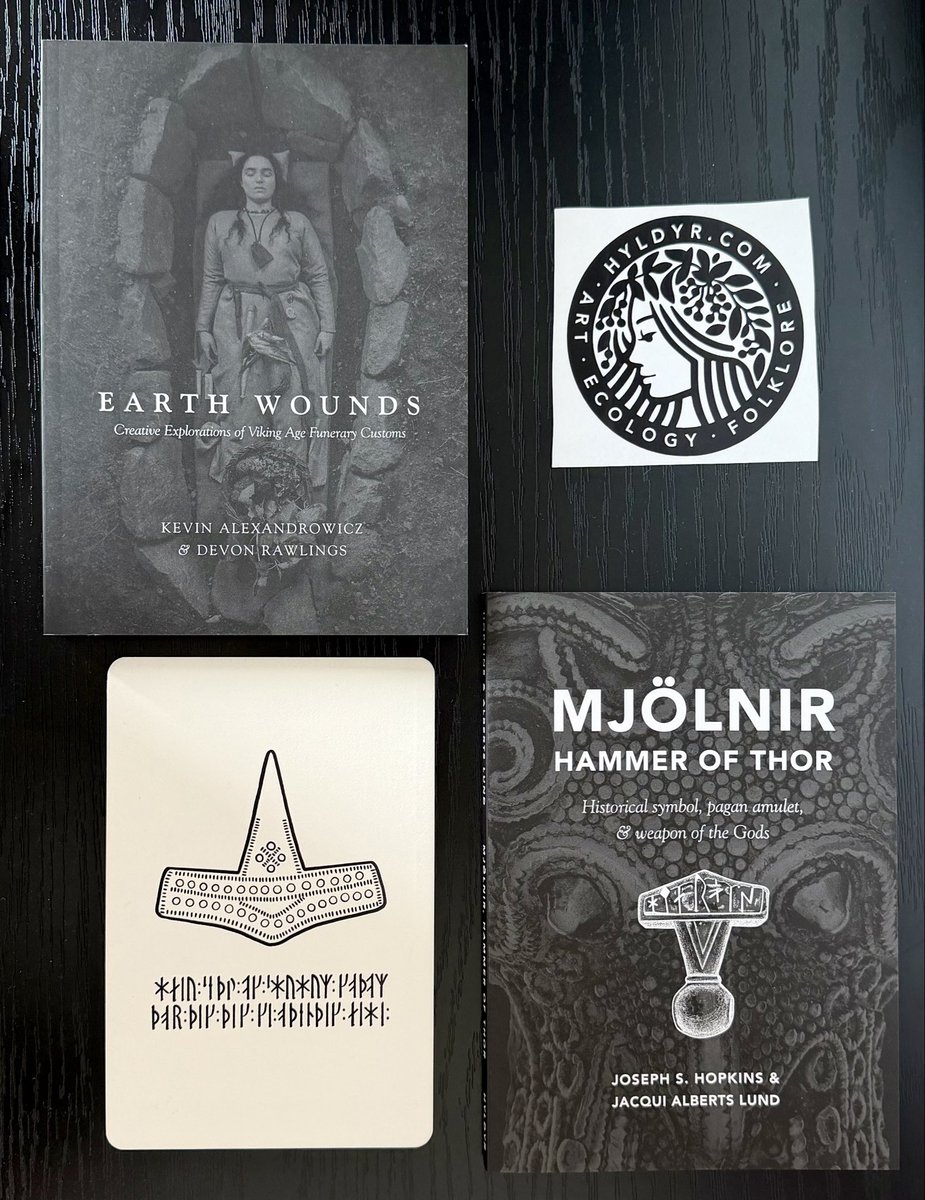
@RGeirsson Is there some pagan book swap club I’m not familiar with? If there is, please add me to the list. Teach me the secret handshake.
English


@JotunOutdoors @AR558DarkRNGR Some things should not be toyed with without extensive training. This is one of those things.
English

It's late at night here on the borders of the dark and deep forests of Old Heiðmọrk. Some might call it early morning and I should have been in bed long ago.
Since I wrote about Galdr a couple of hours ago, I thought I would follow up with Seiðr. Unlike Galdr which is the power of words, Seiðr is far darker - more like sorcery/magic in action.
This story is not just information - it's also a strong warning.
Seiðr – The Shadowed Thread That Binds the Soul.
In the old days, people knew that not all power came with loud shouts and hammer blows. Some powers came creeping, softly, from a world between reality and dream. They called it seiðr – the hidden art of weaving threads of fate.
Imagine a longhouse where the fire crackles softly. A völve sits high on her seidhjallr, the staff with the runic characters planted in the floor like a root down into Hel. She has closed her eyes. The smoke of herbs and sacrificial blood rises thickly. Her voice is not strong and resonant like a galdr – it's a whisper, a hiss, a silky thread that laces itself around wills and destinies. She does not sing to command the storm. She sings to see it. To bind it. To change it.
Seiðr was the power to foretell, to change form, to send one's mind out into other worlds. Freyja, the powerful goddess, taught it to Odin Allfather herself, says the Ynglinga saga. He, who always thirsted for wisdom, accepted the art – even if it cost him honor. For seiðr was not an open, honest song like galdr. It was a journey into the invisible, a manipulation of fate that could bend the will of others, confuse the minds of people or draw out secrets from the dead.
But the sources are clear on the dark side. In Lokasenna, Loki laughs right up to Odin's face and calls him "ergi" - the unmanly art that was befitting völves, not men. Odin had dressed as a witch and wandered the world with the seiðr staff. Even the Allfather was mocked for it. In Eiríks saga rauða we see the völva Thorbjörg performing the great ritual in Greenland - with sacrifice, song and trance - and people listened in fear and awe. Yet there was always an unease about seiðr. It was secret, cunning, almost like an occult art that went against the open, honest ideals of the Norse lineage.
Galdr was the hammer that struck straight ahead - open, honest. Seiðr was the dagger in the dark - powerful, yes, but often viewed with suspicion. It could bring victory, wealth, or insight into the future, but it always came at a price: loss of free will, binding of fate, and for men, a shame that could follow them for the rest of their lives.
Our ancestors respected the völve and their wisdom. But they also feared the invisible thread that could tighten around one's own life without one noticing it until it was too late.
Have you ever felt a cold whisper in your back, a feeling that something invisible is tugging at your threads? Then it could be an echo of seiðr that still lives – the dark art that binds the soul as surely as it opens the sight.
Have you ever thought about trying seiðr or similar sorcery yourself? Don't! - Some threads are better left alone. For he who weaves fate often weaves himself into it.
With this, I say good night.

English

@culverdrums The Mediterranean peoples had perfect weather and endless food. They had A LOT of time to ponder the great mysteries. Northern Europeans didn’t have that luxury.
English

Saw someone state that heathen don't have much ontology. In the Mediterranean sense, sure. People eking out and an existence in a rough area fo not have the free time of well-to-do, urban humamitites students to sit around and wax philosophically and make charts.
Yet, they did talk about and find meaning in and of life. Tbst meaning is in the form of kin. Kin is the absolutely epicenter of everything heathen. We exist to make kin, take care of kin, and remember kin. Things that violate kinship are some of closest things we have to sin. Our most tragic heroic tales are when people kinslay or cause directly or indirectly to the death of kin, those by blood and oath, especially when blood is forced to be trumped by oath.
So we ponder meaning. It just isn't excessively floral writing and charts of oft, urban people.
English

During the night I received a DM asking me if I was superstitious and felt like I was from another time – I assume the person asking was referring to my beliefs. Well, I chose not to answer that question. But to leave the question for dead:
I read the Eddas and Sagas as living wisdom, not as old dusty books. I see Yggdrasil in the big picture – the eternal tree that holds the nine worlds together. I see Ragnarök not just as doom, but as necessary purification. Surtr, the fire-jötunn from Muspelheim… to me his flaming sword is like a falling sun – a comet entering the atmosphere, brighter than a thousand suns, and setting the world on fire. It’s a metaphor, but it’s the best explanation I have. Our ancestors described cosmic forces with the images they had. They knew more than we often give them credit for.
I live here and now in 2026. I have computers, 2 mobile phones, 2 cars, a caravan and a cabin in the mountains, I have most of what a modern man has, maybe a little more. I plan evenings with music and some beer. I live the life of a modern man. Still, I choose to see the world through Norse eyes. Because it makes sense. Because it makes the forest deeper, the storm stronger and life wilder. Because it awakens something in me that the modern world has often forgotten.
I am neither a Viking nor am I pretending to be a Viking who has lost his way in time. I am a Norwegian man in 2026 who has found a lens that makes the world sharper, more honest and more alive. I do not want foreign occultism, mysticism, neo-pagan mess or fantasy. I want the raw, the honest, what belongs in the blood and the soil here in the north.
Am I superstitious? Well, if what I can see with my own eyes, feel and touch makes me superstitious, then maybe I am.

English

@JotunOutdoors WOW. What a post. Excellent synopsis of what most Germanic pagans are thinking.
English

@PortoValhe @KingsOfTheEarth Yes. Wars over religion only became a thing in the last 2000 years.
English

@KingsOfTheEarth No, actually. Polytheism naturally seeds religious tolerance. Religious intolerance is a consequence of militant monotheism.
English

The worship of the Gods will return.
Fascinating History@Fascinate_Hist
A 2,000-year-old statue of the Greek goddess Aphrodite unearthed from the mud during excavations in modern-day Turkey.
English

@poelcid @culverdrums I have so much respect for what y’all are doing. Community is the key to building something that lasts.
English

@culverdrums This is exactly our approach. We practice Asatru as a religion that is relevant to our Folk living today.
freyshof.org
English

I have been thinking of the AFA "church" picture people have been criticizing.
One called it Protestant with Germanic features. Well, Protestentism is essentially the Germanic response to the perpetual issue of Roman Universality vs. Germanic Tribalism. Nearly every source of Protestantism is from a German cultural and linguistic area.
Beyond that, this is where the LARPing insults and other things do not pan out well. They look "Protestent" mostly in their dress and Church aesthetic but that's because it is the norm for today. Same people panning it would criticize them for wearing a museum-accurate tunic and breeches with period jewelry.
The modern Sunday's Best IS the the "good/dress" tunic people in our forebearers times would have worn in their days for dorcial events. It should not be Crocs, cargo shorts, and a wife-beater. You are showing the gods you dre worthy (worth being the root of worship) of respect and honor.
One cannot toss the LARP crap around, when people are or are not in robes and such.
This is one of those cases where one learns and internalized the worldview BUT brings it into OUR age. Does not mean it cannot have folk embellishments amd even look, but our religions are LIVING religions. Thus we must express them in the here and now, not always giving sole focus to the past.
One can wear a suit and tie, instead of a tunic.
One can play a guitar instead of a 6-string lyre replica.
One can use a very "flat" Germanic English in ritual without having to resort to ancient tongues liturgically. I know. I do it all the time, and it was a major bone of contention with me in my time Theodish Belief, where I was a weofudþegn/priest.
Tradition should be balanced between what is (Wyrd/Urðr) and what becomes (Verþandi), always with an eye to what should come (Skuld) in the future.
English
ᚦᛖᛟᛒᚨᛚᛞ retweetledi

The wolf does not touch the dead — not man, not beast — its honor stands above hunger.
It loves only once, for life; never crossing bloodlines, never betraying.
If its mate dies, it chooses solitude over replacement.
It knows its young, and when its parents grow frail with age, it returns — bringing food, bringing loyalty.
When you kill a wolf, it holds your gaze — no fear, no hatred — until its soul slips away.
Smarter than the cleverest dog by far, yet it cannot be tamed; no leash, no whip can command its spirit.
They say the wolf is the villain — But sometimes, what they call evil… is simply misunderstood.

English