EBADF

3.9K posts

EBADF banner
EBADF

EBADF

@__iameli

Software Engineer stuff. Open Source stuff. Formula one stuff. Lewis Hamilton stuff

Katılım Ocak 2014
1K Takip Edilen342 Takipçiler
EBADF retweetledi
ayush🔮👨‍💻🔮
ayush🔮👨‍💻🔮@ayushagarwal027·
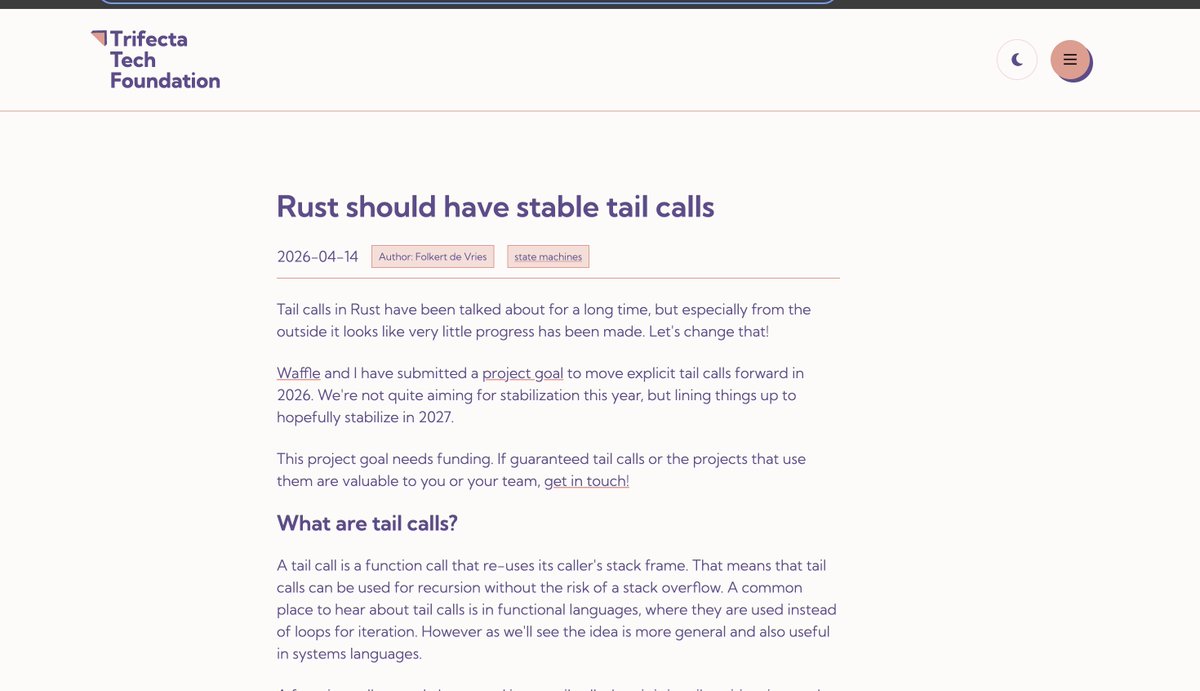
🦀 Rust is finally getting stable tail calls! Folkert de Vries (Trifecta Tech Foundation) just published a great writeup on why this matters and what's happening in 2026. ⚡ Why care? Tail calls unlock stack-safe recursion and blazing-fast state machines, essential for interpreters, parsers, and decoders. 🎯 The plan: A Rust Project Goal is submitted for 2026, aiming for stabilization in 2027. Worth a read if you care about low-level Rust performance. 🔬 👉 trifectatech.org/blog/tail-call… #RustLang #Rust #SystemsProgramming #Performance #Compilers
ayush🔮👨‍💻🔮 tweet media
English
2
21
198
12.6K
EBADF
EBADF@__iameli·
Performance = Instructions per cycle(IPC) x frequency So increasing any of these parameters should result in a performance increase. However, one weird thing is, the IPC is in some ways affected by frequency. Low frequency = longer cycles = more instructions in a cycle
English
0
0
2
103
EBADF retweetledi
LaurieWired
LaurieWired@lauriewired·
In the 90s, Hitachi came up with a bizarre way to conserve memory bandwidth. Their SuperH architecture, intended to compete with ARM, was a 32-bit architecture that used…16 bit instructions. The benefit was really high code density. If you can fit twice as many instructions into every cache line, the CPU pipeline stalls way, way less. This was *really* important for embedded devices, which were often extremely bandwidth constrained in the era. Sega famously used the processors for the Dreamcast, and ARM actually ended up licensing their patents for Thumb mode! I think perhaps the weirdest thing about SuperH was its concept of “upwards compatibility”. The ISA itself is a microcode-less design, all future instructions were trapped and emulated by older chipsets. It’d be slow…but you could run future code on very old chips! Very neat design, a massive success through the 90s and 2000s, that slowly faded.
LaurieWired tweet mediaLaurieWired tweet media
English
73
450
4.7K
389.2K
EBADF
EBADF@__iameli·
So basically modern CISC chips are RISC underneath; decoding instructions into μops so the backend can easily parallelize them, but RISC chips mostly map 1:1. Explains why writing ARM assembly always feels verbose
English
0
0
1
57
EBADF retweetledi
Ryan Peterman
Ryan Peterman@ryanlpeterman·
Leslie Lamport (Creator of LaTex): "If you think you know something but don't write it down. You only think you know something. It reveals what you haven't said. And that there's steps in there. You may think they're obvious, but you haven't written them down. And that's where errors come in. That's where that one third of the paper's errors come in, because it really makes you honest."
Ryan Peterman@ryanlpeterman

Leslie Lamport won a Turing award for his fundamental contributions to distributed systems. For instance, he invented the Paxos consensus algorithm that is a critical component of many distributed systems today. I interviewed him about his work and career. We discussed: • Why he never considered himself smart • The stories behind Paxos and Byzantine Generals Problem • Experiences working with Dijkstra • Paxos vs Raft Algorithms • How to improve your thinking Where to watch: • YouTube: youtu.be/U719vQz-WFs • Spotify: open.spotify.com/episode/7JHYsz… • Apple Podcasts: podcasts.apple.com/us/podcast/the… • Transcript: developing.dev/p/turing-award…

English
18
301
1.8K
133.4K
EBADF retweetledi
Ryan Peterman
Ryan Peterman@ryanlpeterman·
Leslie Lamport (Turing Award Winner, Inventor of Paxos & Latex): "I would meet with Dijkstra once a week. When he thought of something, had some idea, he would write it down and send it out to people. He sent the first concurrent garbage collection algorithm. I looked at it, and I realized that I could simplify the algorithm. That seemed to me like a very simple idea, a very obvious idea. And I sent it to him, and then I got the next version of the paper. I discovered he had made me an author, and that had actually impressed Dijkstra. The reason for my success, the reason I wound up getting a Turing Award, was not that I was particularly that smart, but that I had this gift of abstraction, and Dijkstra was smart enough to realize that."
Ryan Peterman@ryanlpeterman

Leslie Lamport won a Turing award for his fundamental contributions to distributed systems. For instance, he invented the Paxos consensus algorithm that is a critical component of many distributed systems today. I interviewed him about his work and career. We discussed: • Why he never considered himself smart • The stories behind Paxos and Byzantine Generals Problem • Experiences working with Dijkstra • Paxos vs Raft Algorithms • How to improve your thinking Where to watch: • YouTube: youtu.be/U719vQz-WFs • Spotify: open.spotify.com/episode/7JHYsz… • Apple Podcasts: podcasts.apple.com/us/podcast/the… • Transcript: developing.dev/p/turing-award…

English
7
90
1.1K
171.9K
ALTON THE BUILDRRR
ALTON THE BUILDRRR@joulezalton·
@FOjebiyi @_Augustine_F Nigerians will see an idea flourishing and start making copies When they were building for months, you didn’t “built an open-source alternative in one week” They finished the work, launched and are onboarding media teams That’s when you thought it necessary No issue sha 🤗
English
10
0
10
4.1K
FO
FO@FOjebiyi·
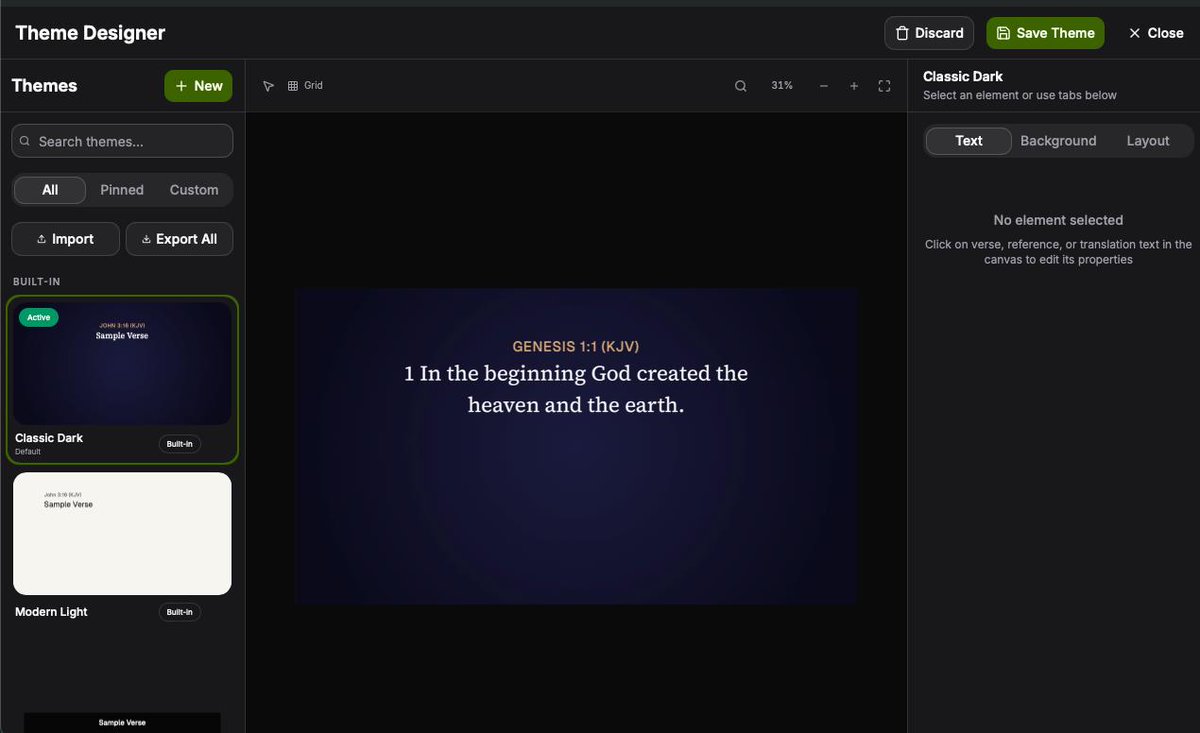
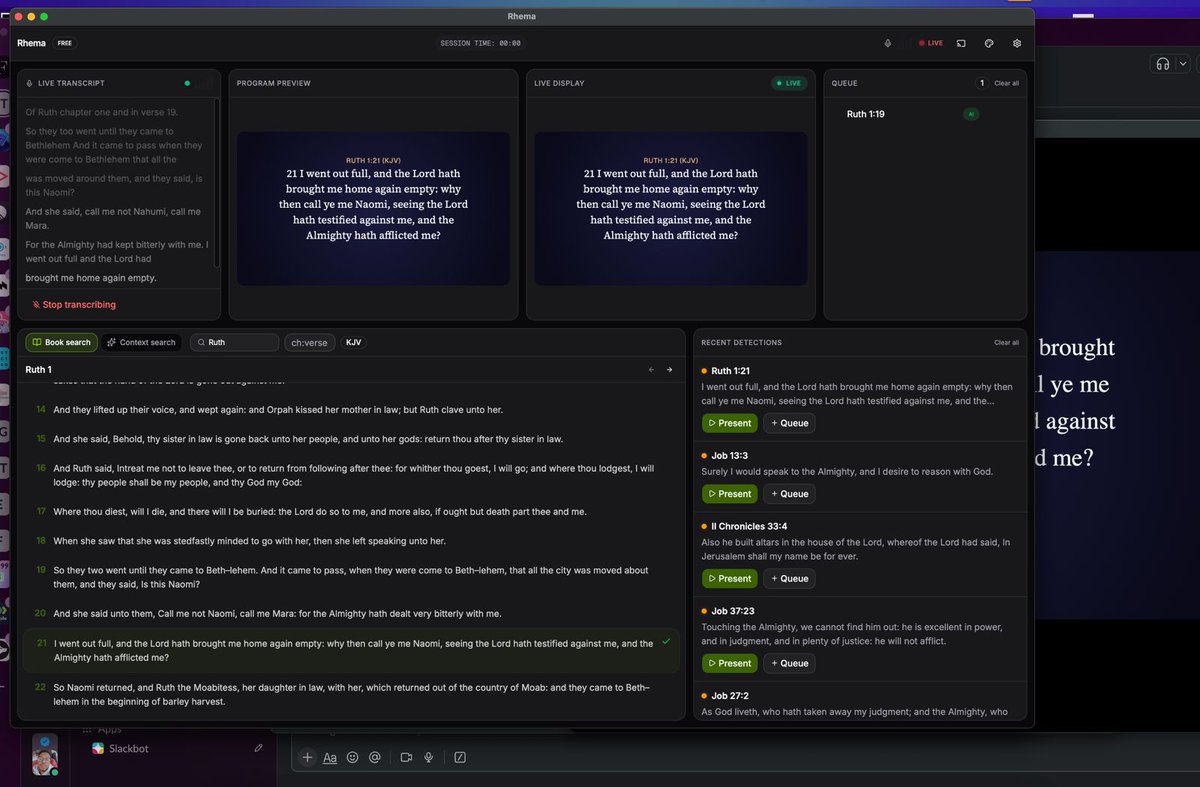
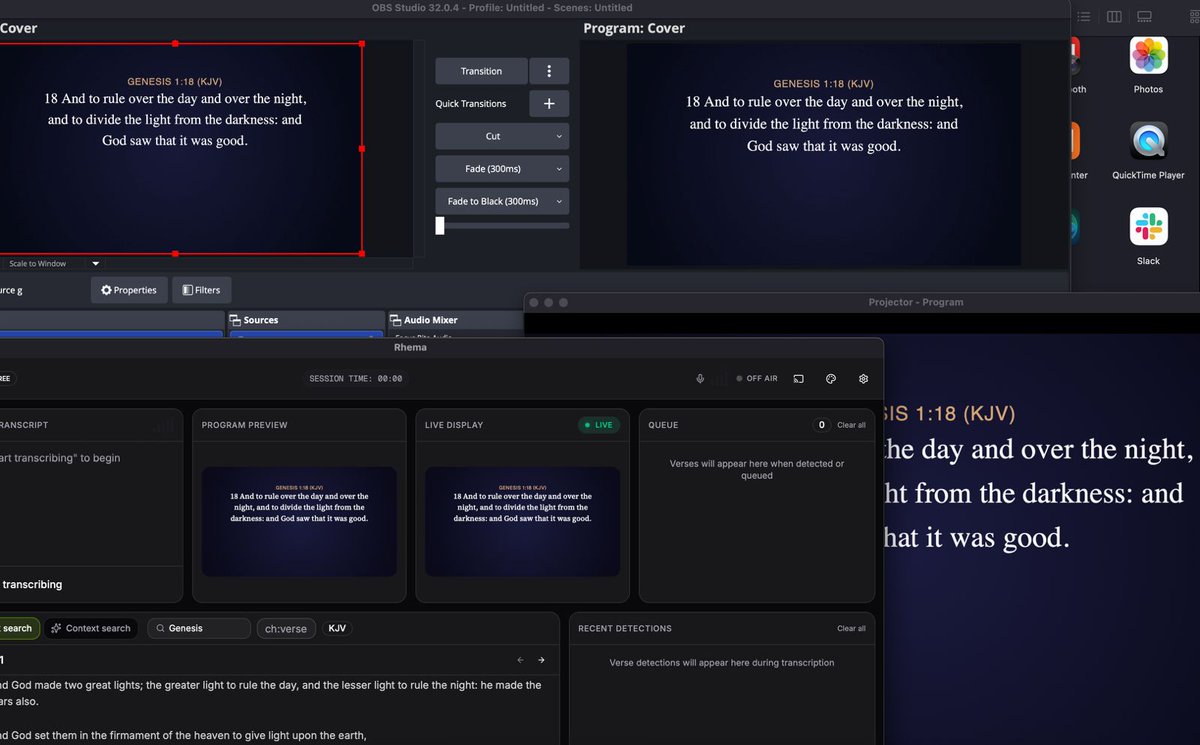
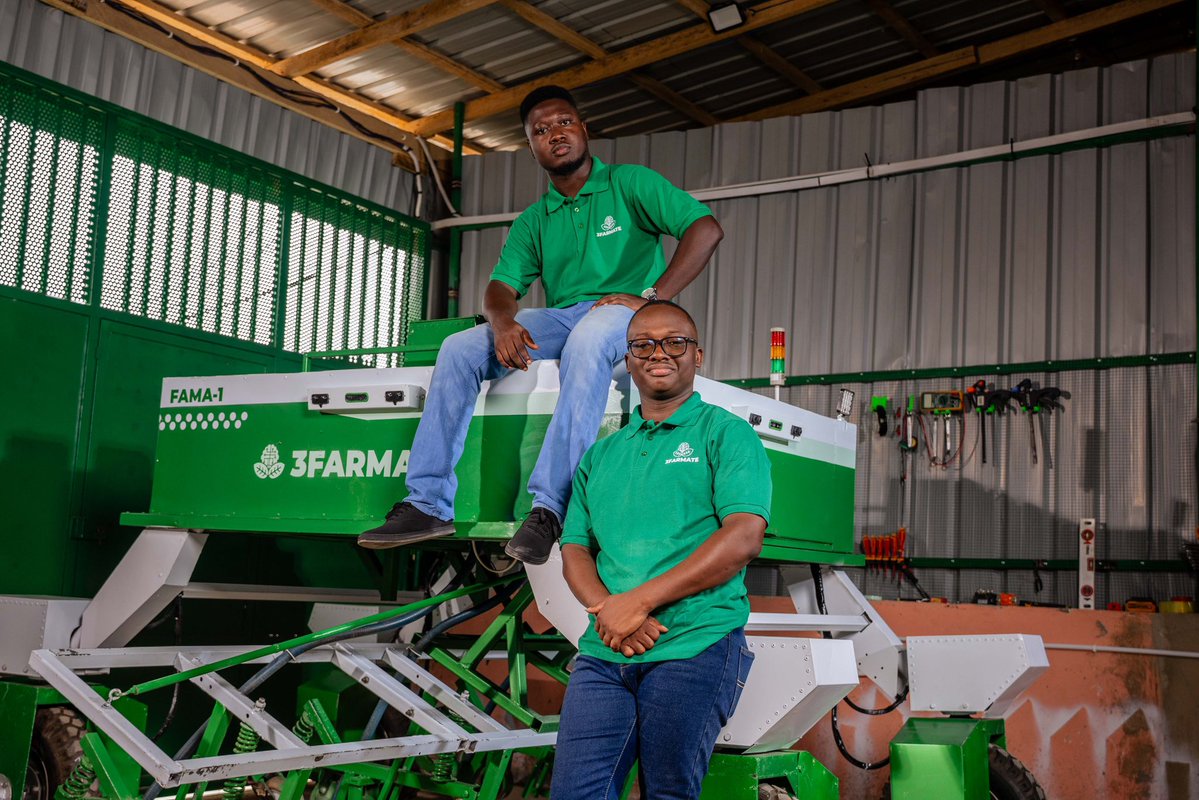
Hi guys, I built an open-source alternative to @pewbeam_ai in one week. github.com/openbezal/rhema Started coding during a Sunday church service. By the following Sunday, we were using it live during our church service. Wild. Here's what Rhema does: it listens to your pastor's sermon in real-time, detects Bible verse references as they're mentioned, and displays them on screen instantly. No manual clicking, no dedicated slide operator needed. The tech stack: - Tauri 2.0 with a Rust backend handling all the heavy lifting: audio capture, transcription pipeline, verse detection logic, and system tray integration - Local AI embeddings using Qwen3-0.6B so everything runs on-device with zero cloud dependency. Your sermons never leave your machine - Real-time audio transcription paired with semantic search against a full Bible verse database The Rust backend was a deliberate choice. We needed low latency audio processing and efficient memory usage for running an embedding model locally, and Rust delivers on both. Is it perfect? Probably not. But the core functionality works and we're already using it in a real church environment This is where you come in. Rhema is fully open source and we need contributors to help take it to the next level. Whether it's improving the verse detection accuracy, adding multi-language support, building a better overlay UI, adding support for more Bible translations, or optimizing the transcription pipeline, there's real work to be done and real impact to be made. If you're a Rust developer, a frontend engineer, an ML enthusiast, or just someone who loves building tools for the church, come build with us. Star the repo. Fork it. Open a PR. Let's make this the go-to open-source solution for live Bible verse display in churches worldwide. github.com/openbezal/rhema
FO tweet mediaFO tweet mediaFO tweet mediaFO tweet media
English
248
359
1.9K
811.6K
EBADF retweetledi
LaurieWired
LaurieWired@lauriewired·
Modern DRAM is based on a brilliant design from IBM. But, we're still paying for a latency penalty that's existed since the 60s! In this video, I'm introducing my research project (Tailslayer) that immensely reduces p99.99 latency on traditional RAM! By implementing a hedged read strategy taking advantage of (undocumented!) channel scrambling offsets, I've gotten as much as 15x reductions in tail latency. The technique works across Intel, AMD, Graviton, DDR4, DDR5, x86, ARM, you name it. Check out the C++ lib I wrote, watch the video, and try it yourself!
English
212
884
11K
859.1K
EBADF retweetledi
Amit
Amit@amitpr·
sweet summer child, don't you know your CPU is already a distributed system
English
10
12
360
18.6K
EBADF retweetledi
DevCongress
DevCongress@DevCongress·
Did you enjoy the system design session? Would you like more sessions, perhaps with a longer duration? Additionally, join our Slack channel for more system design sessions.
English
3
11
27
2.2K
EBADF
EBADF@__iameli·
Every single day, I keep getting drawn to doing a PhD. A PhD in applied math, computer science or applied physics
English
1
0
1
77
EBADF
EBADF@__iameli·
@chinedu_10 @smartfarmai @FFmpeg Lool. It's an April fools joke. I don't think they'd move to Rust when they keep writing assembly faster than C
English
0
0
4
314
MARK OFORIQUAYE
MARK OFORIQUAYE@cropinvestment·
WE @3farmatebots have an upcoming X-space this week prior to launch to engage everyone on this app who may not be present at the event. The CEO/CTO @oxncgen @koffi_cobbin will explain more about our products and service while I drive the conversation with other co-hosts. REPOST, bookmark and look out for the official flyer. 3farmate.com
MARK OFORIQUAYE tweet media
Daniel Paradise@pmeconature

Ghana's FAMA robot has a launch date-April 2026. I've watched too many promising climate technologies stall at 'pilot phase.' A countdown beats a white paper every time.

English
3
24
52
1.1K
EBADF retweetledi
MARK OFORIQUAYE
MARK OFORIQUAYE@cropinvestment·
Hello, Ghana 🇬🇭 Your Excellency, @JDMahama Hello Africa and the world. We @3farmatebots are proud to announce the official launch of FAMA—Ghana's FIRST AI-powered autonomous farming robot for large-scale crop production. Founded in 2021 by @oxncgen (CEO) and @koffi_cobbin (CTO), the company began in a dorm room at @KNUSTGH, where its first prototype was developed. Since then, the team has engineered FAMA into a full-scale autonomous robot capable of planting seeds, applying fertilizer, weeding, and spraying across real farm environments. FAMA navigates using a vision-based AI system instead of GPS, allowing it to operate reliably in areas where GPS is unavailable or inconsistent. The robot runs on batteries charged by solar panels while in the field and can operate across uneven terrain, loose and muddy soils, and variable weather conditions. A single operator can oversee multiple robots, each covering 27 to 35 acres per day with sub-85mm planting precision. 3Farmate targets large-scale staple crop producers in Ghana, starting with corn and soybeans. We operate a service model, charging farmers per acre and removing the need for upfront equipment investment. Over 70 farmers and several large-scale crop production companies are currently in discussions, with commercial deployments beginning in the 2026 planting season. Approximately $200,000 has been raised to date, including investment from @776foundation (Alexis Ohanian, Reddit co-founder) and a grant from @kicghana. Our team consists of young engineers specializing in robotics, embedded systems, software, and mechanical design. With 8 major iterations, 60+ field test runs, 100+ cumulative acres covered, and thousands of runtime hours in real farm conditions, FAMA is market-ready to become the ultimate farmer-assistant. We built FAMA right here in Ghana, inspired by Dr. Kwame Nkrumah’s belief that “Africa must industrialize to achieve true independence.” We built FAMA as a true testament to every young engineer in Africa that “IT IS POSSIBLE.” FAMA is designed to operate seamlessly on Ghanaian soil and is adaptable to diverse agricultural environments worldwide. Join us as we drive innovation across global agriculture. We call on the government of Ghana, stakeholders, international organizations, and agri-industry leaders to partner with us in transforming agriculture together. This is not history in the making, because history has already been made, and we thank you for being a part of our journey. On this note, we are officially launched! For more information, visit 3farmate.com. 3FARMATE – The future is here.
MARK OFORIQUAYE@cropinvestment

HELLO GHANA 🇬🇭 You’re invited to the launch & live field demonstration of FAMA — Ghana’s first autonomous farming robot, powered by solar energy & AI (built in Ghana by my team @3farmatebots. We specially invite you to be part of this history-making moment on April 4, 2026.

English
39
664
1.5K
145.7K
EBADF retweetledi
Dmitrii Kovanikov
Dmitrii Kovanikov@ChShersh·
Python doesn’t care about performance. You’d think it cares about correctness. No. You’d think it cares about static types. Also no. You’d think it cares about tooling. Also no. You’d think it cares about coding practices. Also no. You think it cares about security. Also no.
English
97
25
635
47.4K
EBADF retweetledi
piq and 69 others
piq and 69 others@piq9117·
I thought C/C++ or rust was going to be the barrier to entry for hardware then I learned that hardware api is terrible. lol. Spec sheets are different for every manufacturer! fuck that. im just gonna be part of the permanent underclass.
English
9
6
72
4K
EBADF
EBADF@__iameli·
I'll be speaking on Memory Consistency and cache coherence tomorrow at @DevCongress
English
2
5
18
2.5K