everythingism

87.7K posts

everythingism

everythingism

@_everythingism

Katılım Mart 2013
5.6K Takip Edilen2.1K Takipçiler
everythingism
everythingism@_everythingism·
Do you think the danger of current frontier models regarding cyber and biological research is as serious as Anthropic were making it out to be? We now have open source models approaching that level with few guardrails, and yet the world doesn't seem to be descending into chaos anymore than it already was.
English
0
0
0
6
Dean W. Ball
Dean W. Ball@deanwball·
@AWar1586398 nope. I'm making the point that the risks of open sourcing a given model may be lower than many might think. I'm making the opposite point to the thing you think I am saying.
English
8
0
31
3.9K
Dean W. Ball
Dean W. Ball@deanwball·
one interesting part of thinking about marginal risk of open-weight ai is that the internet is already such a profoundly crime-ridden place. imagine if gangs went into hospitals in America every week and stole people's medical records out of filing cabinets. if that happened in the physical world, we'd rightfully question whether government still possessed practical sovereignty. yet american hospitals are raided constantly in the digital world and we basically tolerate it. the world is more capable of absorbing risk and disorder than one might think.
English
124
13
374
101.2K
everythingism
everythingism@_everythingism·
@adamscochran Bill Maher has just turned into a reactionary old man waving his fist at the cloud.
English
0
0
0
15
Adam Cochran (adamscochran.eth)
"They are becoming communist, so I'm going to vote for the party that seized private companies and made promotional government gas stations, but that also does illegal war, racism, rolls back womens rights, and is too spineless to have Senators who hold the President accountable" Insane take.
Leading Report@LeadingReport

Bill Maher says he is open to voting for the Republican presidential nominee in 2028, arguing that the Democratic Party is becoming communist.

English
35
217
1.3K
28.6K
everythingism
everythingism@_everythingism·
The part I can emphasize with is that authoritarian governments can be terrible and also stick around for decades. When you listen to expats from Iran or Venezuela, they often favor taking action to remove the government they can't get rid of otherwise over respecting sovereignty. However this might be describing the motives of liberal internationalism more, where neoconservatism is defined more by defensive self-interest like you said.
English
0
0
2
118
Derek Pederson 🇺🇸🇺🇦🇻🇪
The basic premise of neoconservatism is: - War is one of the most devastating things on Earth - Democracy is the best tool we have for decreasing war - War is, unfortunately, one of the best tools we have for spreading democracy
English
11
14
166
4.8K
everythingism
everythingism@_everythingism·
It was a good show but after watching it I started wondering about the ethics of the whole thing in the first place. On one hand you can say it's brave for him to have this total brutal honesty but if the woman was obsessed with him and had mental/emotional issues (and he even seemed to sympathize with her to some extent) is it really the right thing to do to make her into the character of a world-famous Netflix show?
English
0
0
0
37
Angelica 🌐⚛️🇹🇼🇨🇳🇺🇸
I watched a show called “Baby Reindeer” today and it might have changed my life because nobody so honestly depicted what it was like to be bisexual before to my knowledge. Luckily, I had no rapey impresario or obsessive fan in my life. But I felt so keenly the feeling of not knowing if I’m more normal with a male or a female, or how to comfort a transsexual lover who decides against all reason that they aren’t feminine because some rando clocked them as a male. I really don’t know if such a series made by an AI would move me to the same degree. Likely I’d be offended that it put me through so much unpleasantness. But because I know Richard Gaad is a real person and a lot of what I’m seeing happened to him, I stayed engaged and empathetic.
Angelica 🌐⚛️🇹🇼🇨🇳🇺🇸 tweet media
English
4
1
45
3.7K
everythingism
everythingism@_everythingism·
The irony is that "AGI" could also be interpreted as the fulfillment of Marx's predictions about technological development. Some people imagine it as a state of abundance where the dynamics of capitalism have been made technologically obsolete. The right-wing accelerationist version flips this on its head and sees AGI as capitalism itself winning over humans. Silicon Valley tries to have it both ways...there's the message to companies that they'll be able to fire all their workers but also the vague promise that the government will step in and redistribute a small percentage of AI company profits to the masses as a basic income. All of these predictions are probably wrong but it shows how a vague, undefined idea can be useful to many different people at the same time.
English
0
0
0
34
R.Сам 🦋🐏
R.Сам 🦋🐏@Logo_Daedalus·
I see why the Silicon Valley types get so mad when I repeat what Yann Lecun & the Chinese State believe— if “AGI” is a total myth & “AI” is simply the automation of routine tasks in production pipelines— then there is no excuse to not embrace “AI COMMUNISM” ie: AI as a public good.
R.Сам 🦋🐏 tweet media
Dean W. Ball@deanwball

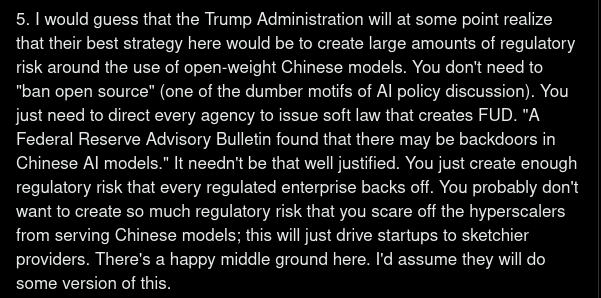
Some observations on Kimi: 1. It's a very good model! I don't think its performance can be explained away by distillation or anything like that. In agentic coding sessions, it seems pretty much on par with the best public models of Q1 2026. In my fairly limited use, it also seemed very token hungry. It's not obvious to me that this model is actually that cheap to run. 2. I am personally surprised the Chinese state continues to allow the open sourcing of models this good, given potential risks. To be clear, I *myself* might be fine with models presenting this level of marginal risk being open weight, but I am surprised that China is fine with it. I suspect the reason they are is 75% explained by strategic blindness/lack of AGI-pilledness (the CCP is very Yann Lecun-y in its views of AI). The other 25% or so is their lack of compute for customer inference (making China's open-weight strategy an unintended byproduct of US export controls) and the normal Chinese strategy of aggressive exports. For the companies, as opposed to the government, the decision to open source is partially ideological and partially because they are behind, and they know that very few people would pay for sub-frontier models from China. 3. Open-weight models are inherently decelerationist, and I'm continually surprised to see the so-called "accelerationists" so excited about open-weight models. I suspect the reason they are is that they know open-weight models are effectively ungovernable, and they simply like the overall cloak of ungovernability open-weight models create over the whole of AI. It's not a bad strategy; it reminds me of James Scott's recounting of the hill people in "the art of not being governed." Still, in the end, open-weight models deter further AI capex. 4. One probable outcome of an open-weight-model-dominant world is full AI communism, which is precisely what China proposes: rather than a market product, AI is a "public good" which will ultimately be provided by the state as a kind of "digital public infrastructure." This future strikes me as a dystopian hellscape, but I've never met an open-weight models advocate who doesn't ultimately concede this is where things end. You'd be surprised how many 'accelerationists' lobbied me, while I was in government, to support an eleven or twelve-figure federally funded data center so that startups could train models at a subsidy and then give them away for free. There was no other way for AI to progress, they said. Perhaps this is the logical end state of things. Nonetheless, I find myself surprised to see supposed accelerationists excited about such an outcome. I think many of them just don't know what they're doing. Many accelerationists do not view the creation and serving of frontier models as a legitimate business. 5. I would guess that the Trump Administration will at some point realize that their best strategy here would be to create large amounts of regulatory risk around the use of open-weight Chinese models. You don't need to "ban open source" (one of the dumber motifs of AI policy discussion). You just need to direct every agency to issue soft law that creates FUD. "A Federal Reserve Advisory Bulletin found that there may be backdoors in Chinese AI models." It needn't be that well justified. You just create enough regulatory risk that every regulated enterprise backs off. You probably don't want to create so much regulatory risk that you scare off the hyperscalers from serving Chinese models; this will just drive startups to sketchier providers. There's a happy middle ground here. I'd assume they will do some version of this. 6. It's probably true that open-weight models of this capability make the world a bit more dangerous, but not so much more that you'll really notice. At some point the models will be capable enough that you will notice. "A nonliving, invisible, dangerous, and infinitely self-replicating agent escaped from a Chinese lab," you say? Color me shocked.

English
22
92
1.1K
47.9K
everythingism
everythingism@_everythingism·
Ball centers his view around belief in "AGI" and says China's mistake is that they don't share this view. But good luck finding a paper or study that clearly spells out what AGI is and how we're going to get there from today's technology. It's more of a directional slogan that allows people to project their hopes and dreams onto the future and helps AI companies raises billions in investment. So I don't see how you can say he's 100% correct when it rests on such a vague foundation.
English
0
0
0
97
Lee B. Cyrano
Lee B. Cyrano@leebriskcyrano·
Ball is 100% correct on the economics and the replies to this are really embarrassing.
Lee B. Cyrano tweet media
Dean W. Ball@deanwball

Some observations on Kimi: 1. It's a very good model! I don't think its performance can be explained away by distillation or anything like that. In agentic coding sessions, it seems pretty much on par with the best public models of Q1 2026. In my fairly limited use, it also seemed very token hungry. It's not obvious to me that this model is actually that cheap to run. 2. I am personally surprised the Chinese state continues to allow the open sourcing of models this good, given potential risks. To be clear, I *myself* might be fine with models presenting this level of marginal risk being open weight, but I am surprised that China is fine with it. I suspect the reason they are is 75% explained by strategic blindness/lack of AGI-pilledness (the CCP is very Yann Lecun-y in its views of AI). The other 25% or so is their lack of compute for customer inference (making China's open-weight strategy an unintended byproduct of US export controls) and the normal Chinese strategy of aggressive exports. For the companies, as opposed to the government, the decision to open source is partially ideological and partially because they are behind, and they know that very few people would pay for sub-frontier models from China. 3. Open-weight models are inherently decelerationist, and I'm continually surprised to see the so-called "accelerationists" so excited about open-weight models. I suspect the reason they are is that they know open-weight models are effectively ungovernable, and they simply like the overall cloak of ungovernability open-weight models create over the whole of AI. It's not a bad strategy; it reminds me of James Scott's recounting of the hill people in "the art of not being governed." Still, in the end, open-weight models deter further AI capex. 4. One probable outcome of an open-weight-model-dominant world is full AI communism, which is precisely what China proposes: rather than a market product, AI is a "public good" which will ultimately be provided by the state as a kind of "digital public infrastructure." This future strikes me as a dystopian hellscape, but I've never met an open-weight models advocate who doesn't ultimately concede this is where things end. You'd be surprised how many 'accelerationists' lobbied me, while I was in government, to support an eleven or twelve-figure federally funded data center so that startups could train models at a subsidy and then give them away for free. There was no other way for AI to progress, they said. Perhaps this is the logical end state of things. Nonetheless, I find myself surprised to see supposed accelerationists excited about such an outcome. I think many of them just don't know what they're doing. Many accelerationists do not view the creation and serving of frontier models as a legitimate business. 5. I would guess that the Trump Administration will at some point realize that their best strategy here would be to create large amounts of regulatory risk around the use of open-weight Chinese models. You don't need to "ban open source" (one of the dumber motifs of AI policy discussion). You just need to direct every agency to issue soft law that creates FUD. "A Federal Reserve Advisory Bulletin found that there may be backdoors in Chinese AI models." It needn't be that well justified. You just create enough regulatory risk that every regulated enterprise backs off. You probably don't want to create so much regulatory risk that you scare off the hyperscalers from serving Chinese models; this will just drive startups to sketchier providers. There's a happy middle ground here. I'd assume they will do some version of this. 6. It's probably true that open-weight models of this capability make the world a bit more dangerous, but not so much more that you'll really notice. At some point the models will be capable enough that you will notice. "A nonliving, invisible, dangerous, and infinitely self-replicating agent escaped from a Chinese lab," you say? Color me shocked.

English
11
0
47
13K
everythingism
everythingism@_everythingism·
People think whoever controls AI controls the world. Therefore the thinking goes, if China takes the lead and reaches "AGI" first, they will gain an economic, scientific and military advantage over the USA and be able to dominate the future. Furthermore, whoever leads could enter into a process of "recursive improvement", making it impossible for others to catch up with them. Personally I think this is a reductionist, exaggerated view of how AI is going to develop and there will probably be a place for both Chinese and American AI companies but this is how some in Silicon Valley and Washington see it.
English
1
0
4
264
Joseph 🇨🇳🇲🇾🇵🇸🇮🇷
From 2-3 years behind, to 1 year behind, to now 3-6 months behind and the guy is treating an unreleased model as released. We've seen so much copium from the west, "they are still behind us", "they distilled our models", "why is Kimi founder not stay in US", bla bla bla. But here's the weird thing, why are the average american so worry about some Chinese AI models catching up to the closed source model in US? It's not like you are major shareholders in Claude/GPT, you are a fking consumer, and you prefer closed source model to have maximum pricing power over you, and decide what is okay or not okay to chat with? The capitalism system in US are soooo good the consumers are worrying about corporate profits more than their own benefits 😂
English
8
6
106
4.5K
travis kalanick
travis kalanick@travisk·
.@DavidSacks @elonmusk The Chinese models are distilling off American models… my guess is American models can’t legally do this without being sued by Chinese AI companies in American courts .. 🤔.. and distilling a Chinese model is really theft from an American company… What should American AI and IP policy be here? If distillation isn’t enforced against, then everyone should be able to distill from everyone else.. otherwise one arm tied behind American models’ backs. Maybe systems need to get better at preventing distillation techniques, and problem solves itself?
Denise Wu@denisewu

There’s a large grain of salt!🧂 Kimi is still calling itself Claude.

English
388
165
2K
452K
everythingism retweetledi
TatsuyaM™
TatsuyaM™@TatsuyaBot·
GIF
ZXX
1
37
200
4.7K
everythingism
everythingism@_everythingism·
@rgigger @huskies20001 @dee_bosa @bgurley Yeah the AI companies don't have a lot to complain about there. There's a slightly more justified argument that they have late mover advantage and are able to learn from what the American AI companies did, but that would be true of anyone.
English
1
0
1
19
Deirdre Bosa
Deirdre Bosa@dee_bosa·
The irony of this: China's strategy is remarkably capitalist... use free models to win distribution and capture the ecosystem. This meanwhile proposes gov't intervention to shield American labs from competition. America is better off competing than manufacturing FUD
Dean W. Ball@deanwball

Some observations on Kimi: 1. It's a very good model! I don't think its performance can be explained away by distillation or anything like that. In agentic coding sessions, it seems pretty much on par with the best public models of Q1 2026. In my fairly limited use, it also seemed very token hungry. It's not obvious to me that this model is actually that cheap to run. 2. I am personally surprised the Chinese state continues to allow the open sourcing of models this good, given potential risks. To be clear, I *myself* might be fine with models presenting this level of marginal risk being open weight, but I am surprised that China is fine with it. I suspect the reason they are is 75% explained by strategic blindness/lack of AGI-pilledness (the CCP is very Yann Lecun-y in its views of AI). The other 25% or so is their lack of compute for customer inference (making China's open-weight strategy an unintended byproduct of US export controls) and the normal Chinese strategy of aggressive exports. For the companies, as opposed to the government, the decision to open source is partially ideological and partially because they are behind, and they know that very few people would pay for sub-frontier models from China. 3. Open-weight models are inherently decelerationist, and I'm continually surprised to see the so-called "accelerationists" so excited about open-weight models. I suspect the reason they are is that they know open-weight models are effectively ungovernable, and they simply like the overall cloak of ungovernability open-weight models create over the whole of AI. It's not a bad strategy; it reminds me of James Scott's recounting of the hill people in "the art of not being governed." Still, in the end, open-weight models deter further AI capex. 4. One probable outcome of an open-weight-model-dominant world is full AI communism, which is precisely what China proposes: rather than a market product, AI is a "public good" which will ultimately be provided by the state as a kind of "digital public infrastructure." This future strikes me as a dystopian hellscape, but I've never met an open-weight models advocate who doesn't ultimately concede this is where things end. You'd be surprised how many 'accelerationists' lobbied me, while I was in government, to support an eleven or twelve-figure federally funded data center so that startups could train models at a subsidy and then give them away for free. There was no other way for AI to progress, they said. Perhaps this is the logical end state of things. Nonetheless, I find myself surprised to see supposed accelerationists excited about such an outcome. I think many of them just don't know what they're doing. Many accelerationists do not view the creation and serving of frontier models as a legitimate business. 5. I would guess that the Trump Administration will at some point realize that their best strategy here would be to create large amounts of regulatory risk around the use of open-weight Chinese models. You don't need to "ban open source" (one of the dumber motifs of AI policy discussion). You just need to direct every agency to issue soft law that creates FUD. "A Federal Reserve Advisory Bulletin found that there may be backdoors in Chinese AI models." It needn't be that well justified. You just create enough regulatory risk that every regulated enterprise backs off. You probably don't want to create so much regulatory risk that you scare off the hyperscalers from serving Chinese models; this will just drive startups to sketchier providers. There's a happy middle ground here. I'd assume they will do some version of this. 6. It's probably true that open-weight models of this capability make the world a bit more dangerous, but not so much more that you'll really notice. At some point the models will be capable enough that you will notice. "A nonliving, invisible, dangerous, and infinitely self-replicating agent escaped from a Chinese lab," you say? Color me shocked.

English
71
108
999
151.8K
Trilbo Swaggins
Trilbo Swaggins@Tril1boswagginz·
@AmeliaBarty You do realize a sizeable portion of the AI community is worried about frontier open weight models?
English
3
0
2
2.1K
Amelia Bartholomew
Amelia Bartholomew@AmeliaBarty·
No way Dean keeps his job after this debacle. OpenAI knows he’s radioactive at this point, and keeping him on their payroll is a huge PR liability. He’ll say he’s “taking a break for personal reasons”
English
22
13
403
25.8K
everythingism
everythingism@_everythingism·
He's a former government advisor who came up with Trump's AI policy. OpenAI's president recently donated $30 million to a superPAC to help Trump win the midterms. He's not saying this in a vacuum, it seems either intended to influence the government's actions or is a reflection of discussions they've already had.
English
0
0
3
115
charlie marketplace
charlie marketplace@charliemktplace·
He is guessing what trump would do. It's a pretty good guess given what we've seen with tariffs, iran, Ukraine, NATO, elections, etc. He isn't endorsing the idea. Actually pretty crazy how poor literacy has gotten online that people think he's endorsing this (maybe you don't think he's endorsing it and instead think it's just something he shouldn't admit he thinks Trump would do? But we all speculate on how trump will bully the economy.)
English
14
2
139
30.8K
everythingism retweetledi
Dillon Mulroy
Dillon Mulroy@dillon_mulroy·
actually an insane thing for openai’s head of strategy to publicly say
Dillon Mulroy tweet media
Dean W. Ball@deanwball

Some observations on Kimi: 1. It's a very good model! I don't think its performance can be explained away by distillation or anything like that. In agentic coding sessions, it seems pretty much on par with the best public models of Q1 2026. In my fairly limited use, it also seemed very token hungry. It's not obvious to me that this model is actually that cheap to run. 2. I am personally surprised the Chinese state continues to allow the open sourcing of models this good, given potential risks. To be clear, I *myself* might be fine with models presenting this level of marginal risk being open weight, but I am surprised that China is fine with it. I suspect the reason they are is 75% explained by strategic blindness/lack of AGI-pilledness (the CCP is very Yann Lecun-y in its views of AI). The other 25% or so is their lack of compute for customer inference (making China's open-weight strategy an unintended byproduct of US export controls) and the normal Chinese strategy of aggressive exports. For the companies, as opposed to the government, the decision to open source is partially ideological and partially because they are behind, and they know that very few people would pay for sub-frontier models from China. 3. Open-weight models are inherently decelerationist, and I'm continually surprised to see the so-called "accelerationists" so excited about open-weight models. I suspect the reason they are is that they know open-weight models are effectively ungovernable, and they simply like the overall cloak of ungovernability open-weight models create over the whole of AI. It's not a bad strategy; it reminds me of James Scott's recounting of the hill people in "the art of not being governed." Still, in the end, open-weight models deter further AI capex. 4. One probable outcome of an open-weight-model-dominant world is full AI communism, which is precisely what China proposes: rather than a market product, AI is a "public good" which will ultimately be provided by the state as a kind of "digital public infrastructure." This future strikes me as a dystopian hellscape, but I've never met an open-weight models advocate who doesn't ultimately concede this is where things end. You'd be surprised how many 'accelerationists' lobbied me, while I was in government, to support an eleven or twelve-figure federally funded data center so that startups could train models at a subsidy and then give them away for free. There was no other way for AI to progress, they said. Perhaps this is the logical end state of things. Nonetheless, I find myself surprised to see supposed accelerationists excited about such an outcome. I think many of them just don't know what they're doing. Many accelerationists do not view the creation and serving of frontier models as a legitimate business. 5. I would guess that the Trump Administration will at some point realize that their best strategy here would be to create large amounts of regulatory risk around the use of open-weight Chinese models. You don't need to "ban open source" (one of the dumber motifs of AI policy discussion). You just need to direct every agency to issue soft law that creates FUD. "A Federal Reserve Advisory Bulletin found that there may be backdoors in Chinese AI models." It needn't be that well justified. You just create enough regulatory risk that every regulated enterprise backs off. You probably don't want to create so much regulatory risk that you scare off the hyperscalers from serving Chinese models; this will just drive startups to sketchier providers. There's a happy middle ground here. I'd assume they will do some version of this. 6. It's probably true that open-weight models of this capability make the world a bit more dangerous, but not so much more that you'll really notice. At some point the models will be capable enough that you will notice. "A nonliving, invisible, dangerous, and infinitely self-replicating agent escaped from a Chinese lab," you say? Color me shocked.

English
355
973
12.3K
1.4M
everythingism
everythingism@_everythingism·
That's true but OTOH countries can't really just abandon the USA. Americans make up 4% of the global population but 20% of global consumption, so everyone wants access to the US market. And same thing with security, some countries don't have a good alternative. But it does seem like we're pushing things as far as we can and at some point there will be consequences.
English
1
0
0
57
Jay-Jay
Jay-Jay@JayJay33737432·
@_everythingism @fredsoda Trump has proven long term deals with the US aren’t worth the paper they’re printed on A President could make tons of great deals and the next guy can come in and throw that all out the window It’s pointless to believe any US promised that extend beyond the next election
English
1
0
5
61
Soda
Soda@fredsoda·
there’s a saying that America is non-agreement capable then you can extend that to the US being non-negotiation capable given the failed round of talks between iran and america but i would go even further and say that the US is non-diplomacy capable america can’t perform functional diplomacy anymore this is its biggest strategic disadvantage in the years and decades to come
English
14
36
300
15.5K
everythingism
everythingism@_everythingism·
@stevehou It seems inevitable though, similar to how competition with the USSR led the US government to invest much more in industrial policy. Embracing laissez faire capitalism is a luxury you can afford when you're already safely #1.
English
0
0
1
36
everythingism
everythingism@_everythingism·
@AsperBerger1776 @segyges @xctlot The American AI companies also engaged in massive amounts of IP theft, training on all the copyrighted content in the world without asking permission.
English
0
0
1
13
Asper Berger
Asper Berger@AsperBerger1776·
@segyges @xctlot I'm absolutely disgusted that the US government is, for some reason, interested in...return on capital? Against the backdrop of rampant IP theft painted as peer-tier innovation prowess? Absolutely disgusted.
English
2
0
3
1.2K
SE Gyges
SE Gyges@segyges·
I appreciate that Dean Ball, Head of Strategic Futures at OpenAI and former Senior Policy Advisor to the White House, is just directly saying, under his legal name, that the purpose of introducing nonsensical regulations is to hurt open source and favor incumbent corporations
SE Gyges tweet media
Dean W. Ball@deanwball

Some observations on Kimi: 1. It's a very good model! I don't think its performance can be explained away by distillation or anything like that. In agentic coding sessions, it seems pretty much on par with the best public models of Q1 2026. In my fairly limited use, it also seemed very token hungry. It's not obvious to me that this model is actually that cheap to run. 2. I am personally surprised the Chinese state continues to allow the open sourcing of models this good, given potential risks. To be clear, I *myself* might be fine with models presenting this level of marginal risk being open weight, but I am surprised that China is fine with it. I suspect the reason they are is 75% explained by strategic blindness/lack of AGI-pilledness (the CCP is very Yann Lecun-y in its views of AI). The other 25% or so is their lack of compute for customer inference (making China's open-weight strategy an unintended byproduct of US export controls) and the normal Chinese strategy of aggressive exports. For the companies, as opposed to the government, the decision to open source is partially ideological and partially because they are behind, and they know that very few people would pay for sub-frontier models from China. 3. Open-weight models are inherently decelerationist, and I'm continually surprised to see the so-called "accelerationists" so excited about open-weight models. I suspect the reason they are is that they know open-weight models are effectively ungovernable, and they simply like the overall cloak of ungovernability open-weight models create over the whole of AI. It's not a bad strategy; it reminds me of James Scott's recounting of the hill people in "the art of not being governed." Still, in the end, open-weight models deter further AI capex. 4. One probable outcome of an open-weight-model-dominant world is full AI communism, which is precisely what China proposes: rather than a market product, AI is a "public good" which will ultimately be provided by the state as a kind of "digital public infrastructure." This future strikes me as a dystopian hellscape, but I've never met an open-weight models advocate who doesn't ultimately concede this is where things end. You'd be surprised how many 'accelerationists' lobbied me, while I was in government, to support an eleven or twelve-figure federally funded data center so that startups could train models at a subsidy and then give them away for free. There was no other way for AI to progress, they said. Perhaps this is the logical end state of things. Nonetheless, I find myself surprised to see supposed accelerationists excited about such an outcome. I think many of them just don't know what they're doing. Many accelerationists do not view the creation and serving of frontier models as a legitimate business. 5. I would guess that the Trump Administration will at some point realize that their best strategy here would be to create large amounts of regulatory risk around the use of open-weight Chinese models. You don't need to "ban open source" (one of the dumber motifs of AI policy discussion). You just need to direct every agency to issue soft law that creates FUD. "A Federal Reserve Advisory Bulletin found that there may be backdoors in Chinese AI models." It needn't be that well justified. You just create enough regulatory risk that every regulated enterprise backs off. You probably don't want to create so much regulatory risk that you scare off the hyperscalers from serving Chinese models; this will just drive startups to sketchier providers. There's a happy middle ground here. I'd assume they will do some version of this. 6. It's probably true that open-weight models of this capability make the world a bit more dangerous, but not so much more that you'll really notice. At some point the models will be capable enough that you will notice. "A nonliving, invisible, dangerous, and infinitely self-replicating agent escaped from a Chinese lab," you say? Color me shocked.

English
69
505
4.4K
206.7K
TheShadowbanned
TheShadowbanned@ShadowbanSlam·
@segyges @douglassmackey Trunp needs to extract a political price. OpenAI needs to change its RLHF to at least br open to rightist points of view rather than always pushing leftism and historical revisionism.
English
2
0
2
611
everythingism
everythingism@_everythingism·
@deanwball @segyges Given the specificity with which you described this plan to create regulatory FUD, should we conclude it's already being discussed by the government? It doesn't seem like this is coming out of nowhere.
English
0
0
3
82
Dean W. Ball
Dean W. Ball@deanwball·
@segyges To be clear, I don’t think this applies to all AI regulations, but one can easily imagine regulations on Chinese models that are motivated by this. The Chinese would similarly not love a proliferation of U.S. models in their country. My point is: calm yourself down.
English
20
2
82
5.7K
everythingism
everythingism@_everythingism·
@thdxr Talking about communism also has a loaded meaning with this government. Just a few days ago they were talking about how they were going to start treating "communist groups" (not foreigners but Americans with far-left views) like terrorists.
English
2
0
5
1K
dax
dax@thdxr·
"One probable outcome of an open-weight-model-dominant world is full AI communism"
dax tweet media
Dean W. Ball@deanwball

Some observations on Kimi: 1. It's a very good model! I don't think its performance can be explained away by distillation or anything like that. In agentic coding sessions, it seems pretty much on par with the best public models of Q1 2026. In my fairly limited use, it also seemed very token hungry. It's not obvious to me that this model is actually that cheap to run. 2. I am personally surprised the Chinese state continues to allow the open sourcing of models this good, given potential risks. To be clear, I *myself* might be fine with models presenting this level of marginal risk being open weight, but I am surprised that China is fine with it. I suspect the reason they are is 75% explained by strategic blindness/lack of AGI-pilledness (the CCP is very Yann Lecun-y in its views of AI). The other 25% or so is their lack of compute for customer inference (making China's open-weight strategy an unintended byproduct of US export controls) and the normal Chinese strategy of aggressive exports. For the companies, as opposed to the government, the decision to open source is partially ideological and partially because they are behind, and they know that very few people would pay for sub-frontier models from China. 3. Open-weight models are inherently decelerationist, and I'm continually surprised to see the so-called "accelerationists" so excited about open-weight models. I suspect the reason they are is that they know open-weight models are effectively ungovernable, and they simply like the overall cloak of ungovernability open-weight models create over the whole of AI. It's not a bad strategy; it reminds me of James Scott's recounting of the hill people in "the art of not being governed." Still, in the end, open-weight models deter further AI capex. 4. One probable outcome of an open-weight-model-dominant world is full AI communism, which is precisely what China proposes: rather than a market product, AI is a "public good" which will ultimately be provided by the state as a kind of "digital public infrastructure." This future strikes me as a dystopian hellscape, but I've never met an open-weight models advocate who doesn't ultimately concede this is where things end. You'd be surprised how many 'accelerationists' lobbied me, while I was in government, to support an eleven or twelve-figure federally funded data center so that startups could train models at a subsidy and then give them away for free. There was no other way for AI to progress, they said. Perhaps this is the logical end state of things. Nonetheless, I find myself surprised to see supposed accelerationists excited about such an outcome. I think many of them just don't know what they're doing. Many accelerationists do not view the creation and serving of frontier models as a legitimate business. 5. I would guess that the Trump Administration will at some point realize that their best strategy here would be to create large amounts of regulatory risk around the use of open-weight Chinese models. You don't need to "ban open source" (one of the dumber motifs of AI policy discussion). You just need to direct every agency to issue soft law that creates FUD. "A Federal Reserve Advisory Bulletin found that there may be backdoors in Chinese AI models." It needn't be that well justified. You just create enough regulatory risk that every regulated enterprise backs off. You probably don't want to create so much regulatory risk that you scare off the hyperscalers from serving Chinese models; this will just drive startups to sketchier providers. There's a happy middle ground here. I'd assume they will do some version of this. 6. It's probably true that open-weight models of this capability make the world a bit more dangerous, but not so much more that you'll really notice. At some point the models will be capable enough that you will notice. "A nonliving, invisible, dangerous, and infinitely self-replicating agent escaped from a Chinese lab," you say? Color me shocked.

English
140
699
6.2K
275.4K
everythingism
everythingism@_everythingism·
This seems hyperbolic. I signed up for Kimi to try it, and while it's a good model it's hard to imagine people abandoning OpenAI and Anthropic in large numbers. The cost is not dramatically different, and the American companies have a slicker overall customer experience and larger ecosystem right now.
English
2
0
5
533