VibeDiligence

6.7K posts

VibeDiligence banner
VibeDiligence

VibeDiligence

@huskies20001

markets, privates, credit, diligence

USA Katılım Aralık 2018
2.2K Takip Edilen191 Takipçiler
VibeDiligence
VibeDiligence@huskies20001·
Idk how people use $HOOD with their UI. It’s as bad as vanguard but because it’s designed for 5-year olds. I moved $30k over to play around with @joinautopilot portfolios investing in @claudeportfolio . But I’m pulling it out bc the interface is so sloppy&dysfunctional
English
0
0
0
57
VibeDiligence retweetledi
Roman
Roman@Roman_232323·
Nuclear is a structural short. By the time power prices finally get high enough to send the demand signal for new nuclear, everyone else (CCGT, storage, solar — all with much faster timelines + lower LCOE) have already received the signal and build first. The industry becomes incredibly prone to massive overbuild at the absolute worst possible timing. Nuclear is always the last one in this long game of messengers. That’s exactly why $BE is primed right now given these market conditions. Quick-deploy, modular, no massive infra/turbine bottlenecks
English
1
0
2
511
SuspendedCap
SuspendedCap@ContrarianCurse·
The case for Nuke is getting worse and worse honestly. It is yes cheap, but people keep talking like 5-7 years to build out a greenfield. Does it feel like Hyperscalers have 5-7 years to wait? Also, the market will do what the market needs to do LCOE for nuke is super attractive.. if its there. But A-->B is racked with tons of execution and regulatory risk + escalating costs and limited access to know-how and trades that dried up decades ago When the common baseloads keep jacking price like Turbines have, all of a sudden all these technologies that were a side show because they were multiples of the cost are now DD %, and actually available. I think what the Turbine guys are doing is frankly insane and stupid IMO, this is why nuke has been pretty shit in the last few months, and I am not positive, at all on $GEV from here. If you can see that much demand, ESPECIALLY when you are playing for the long-tail of high margin service, what is the actual fuck are you doing not jamming capacity And I get it, they've been burned, but much like $TSM - like THIS is the cycle you choose prudence? THIS ONE?
English
23
1
100
39.1K
VibeDiligence
VibeDiligence@huskies20001·
@ContrarianCurse $GEV is too crowded and you can clearly see this. It’s priced to perfection with almost no room for upside.
English
0
0
0
43
VibeDiligence
VibeDiligence@huskies20001·
@regardingsemi It’s exhausting keeping up with this trade. Seems like the micro cap power semis are absolutely over crowded but the STmicros and MCHPs are less crowded. I can’t justify entry to $LITE and $COHR at these price points?
English
1
0
1
109
Regarding Semi
Regarding Semi@regardingsemi·
Current AI trade positions, in no particular order: Samsung $005930 Amazon $AMZN Noritake $5331.T Ajinomoto $2802.T Aixtron $AIXA Nokia $NOK Wolfspeed $WOLF Vishay $VSH STMicroelectronics $STM Lumentum $LITE Semtech $SMTC
Regarding Semi@regardingsemi

I was listening to a podcast with @ChrisCamillo, and he said something simple that every investor should think about: “Every day that you hold a stock is another day that you are choosing to buy that stock.” Every day, a thesis can change. You need to constantly review your book and ask yourself whether the original thesis is still intact. Holding is not passive. It is an active decision to continue owning the position. Each day is a new re-entry into the position.

English
4
1
20
11.9K
Admiral Donuts
Admiral Donuts@AdmlDntz·
@ZaStocks Right now people are making money. The problem is when these stocks eventually fall, a lot of people will lose money. It's an equalizer. You can't just make money while you can and "take advantage" because no one knows when things will fall apart. A lot of people will lose money!
English
2
0
0
137
Za
Za@ZaStocks·
The ability to look at the market and say things are crazy but at the same time participate and capitalize does not make someone a perma bull, idiot, etc. Yes the moves in $MRVL $ARM $DELL $SNDK etc. are crazy but it doesn’t matter, this has been an insane opportunity. Participating means you understand that markets don’t need to make sense in the moment to still be offering a massive opportunity window. Fighting that reality because it feels uncomfortable is how you miss these big moves. You can think it’s insane and still make money off it, that’s the entire point. Maybe these stocks drop 50% at some point but if they start to weaken it’ll show up in the charts ahead of time. Standing on the sidelines as the market goes higher pointing out why it shouldn’t be happening and mocking everyone who participates doesn’t make you smart.
English
30
26
312
18.6K
VibeDiligence
VibeDiligence@huskies20001·
@AdmlDntz @ZaStocks Sounds like somebody who hasn’t made any money. Agree the entry is brutal on a lot of these but just like OP said, a lot easier to rationalize not getting in than actually having an opinion
English
0
0
0
8
Jukan @COMPUTEX
Jukan @COMPUTEX@jukan05·
Is there any water? I don’t drink alcohol.
Jukan @COMPUTEX tweet media
English
17
0
134
25.3K
Scottie
Scottie@mrscottiem·
What I’m hearing is Memory/semis forecasts are extrapolated from a scaling assumption (quadratic attention) that efficiency work is actively breaking, while the financing of the buildout is more leveraged and more reflexively structured than any prior cycle — so the complex is exposed to both a demand-side forecast cut and a fast deleveraging, and the market is pricing neither. Is that right?
English
1
0
0
289
Brandon Carl
Brandon Carl@brandonjcarl·
Documenting the headwinds I now see for AI. It won't seem like it, but I love AI and am long-term positive. But when "math doesn't math" I take note. 1. The core thesis for foundation model lab investment has been high upfront investment made worthwhile by significant long-term profits. 2. These are capital intensive businesses and the compute commitments are very high relative to revenue and require strong growth over long time periods. The "leverage" (commitments versus revenue) is extremely high. 3. The fundamentals are not as positive as they previously were: • Input costs are higher (commodities, chips, power) • Interest rates are higher • Competition is more intense • Scaling Laws are now problematic: exponential costs/power cannot continue 4. Forecasting compute spend is challenging and high risk due to (a) revenue uncertainty and (b) algorithm uncertainty 5. Revenue growth appears to be slowing. The technology is valuable, but ROI is proving to be more expensive and take longer than anticipated. 6. The future is likely "different models for different use cases" with the lower end of the market being highly competitive. 7. Core use cases such as agentic software engineering are likely to need approaches beyond next-token prediction. They are Σ₂ᴾ complexity problems requiring multi-objective optimization and likely a combination of Transformers and other methods. 8. Current forecasts in memory makers are built largely on quadratic attention. That will not persist: we are already seeing work from DeepSeek, Minimax and Nvidia that can cut RAM needs by 80% or more. 9. This means semiconductor valuations are substantially overinflated and will go through the traditional glut versus shortage cycle. 10. For foundation model providers: lower costs with competitive differentiation is good. However, lower costs with a lack of differentiation would mean lower revenues. This makes it harder to (a) service commitments and (b) pay back investors. 11. Leverage is substantially higher than in previous cycles, evidenced by leveraged ETFs, call option activity and margin loans. Korea is particularly susceptible. 12. 0DTE options create a profile that has stronger parallels to portfolio insurance and 1987 than any other point I can remember. 13. The combination of exponential increases in call activity coupled with the ties of semiconductors to structured products means there is a non-trivial systemic risk to the financial system. 14. Implied earnings growth rates are inconsistent with other periods in history. 15. Macroeconomically we cannot and should not fund exponential cost increases. History has shown us repeatedly that there are better ways (see Quick Sort and Simplex). 16. Significant supply is hitting the market via IPOs. –– Taken together: costs and competition are increasing while revenue growth is likely slowing. Valuations are fragile and prone to technology disruptions that are already here. Systemic financial market risk is extremely high.
English
55
221
1.7K
521.4K
Scrooge McDuck
Scrooge McDuck@ScroogeCap·
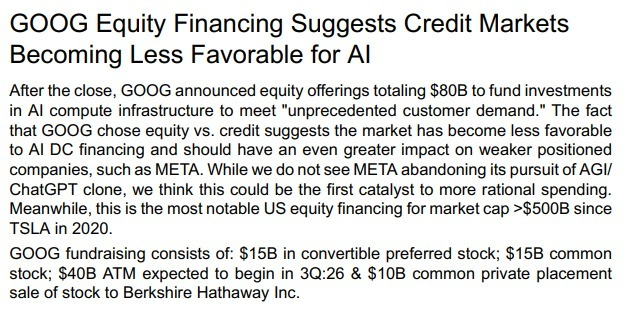
Oppenheimer brings out an interesting point here. If $GOOGL that prints massive FCF is tapping equity markets for $80B it's because credit is drying up. The private credit canary in the coal mine just died. The fact that their raise includes a massive $40B ATM and a $10B private placement to Berkshire Hathaway shows exactly how desperate the hunt for liquidity is becoming. So who else is very exposed to the credit markets? $ORCL would be the first to come in mind, right? Name has rallied a ton here and suddenly looks like all the financing issues they have are forgotten. Their debt to equity is still over 5x. $META is relentless in irrational spending. This might force Zucc to reevaluate his options here? Upgraded by Arete today btw. Who needs to borrow a ton to keep the lights on? $EQIX and $DLR come to mind, 200MW datacenter costs 8 billion, certainly a hefty amount. But the biggest one of them all is none other than $CRWV, that rallied on $DELL yesterday, yet carries $21B of debt, including $8.5B delayed-draw term loan backed by GPUs.
Scrooge McDuck tweet media
English
89
171
1.3K
868.5K
VibeDiligence retweetledi
Regarding Semi
Regarding Semi@regardingsemi·
I’m very much a believer that this party is still just getting started. Any meaningful dip should be bought. There’s too much uncertainty and speculation for anything to be priced “correctly.” There’s so much opportunity. This is a once in a multi decade market environment. “Bears sound smart, bulls make money.” - Someone
Kip Herriage@KHerriage

During the dot com melt-up of 1995-2000, Nasdaq put up gains of 572%. To date, from the 10/13/22 bear market lows, Nasdaq is up just 162%. Listening to bears calling this a bubble top could cost you a lot of money.

English
0
1
32
6.8K
Derrick Dao
Derrick Dao@derrick_dao·
The Nasdaq comparison tells you about equity multiple expansion, but not where real productive capital is being allocated. Nasdaq is up 162% from the 2022 lows while energy and mining capex as a share of overall capital expenditure remains near multi-decade lows — that's the divergence that builds the next supply shock. The tech bull market doesn't resolve the physical world's underinvestment problem; it often exacerbates it by crowding out capital that would otherwise go to commodity infrastructure. Returns are built in the scarcity, not in the multiple.
English
1
0
0
23
Kip Herriage
Kip Herriage@KHerriage·
During the dot com melt-up of 1995-2000, Nasdaq put up gains of 572%. To date, from the 10/13/22 bear market lows, Nasdaq is up just 162%. Listening to bears calling this a bubble top could cost you a lot of money.
English
192
242
3.9K
324.6K
VibeDiligence
VibeDiligence@huskies20001·
@HedgieMarkets Per usual you took an out of context clip and spread your doomerism all over it.
English
0
0
0
184
Hedgie
Hedgie@HedgieMarkets·
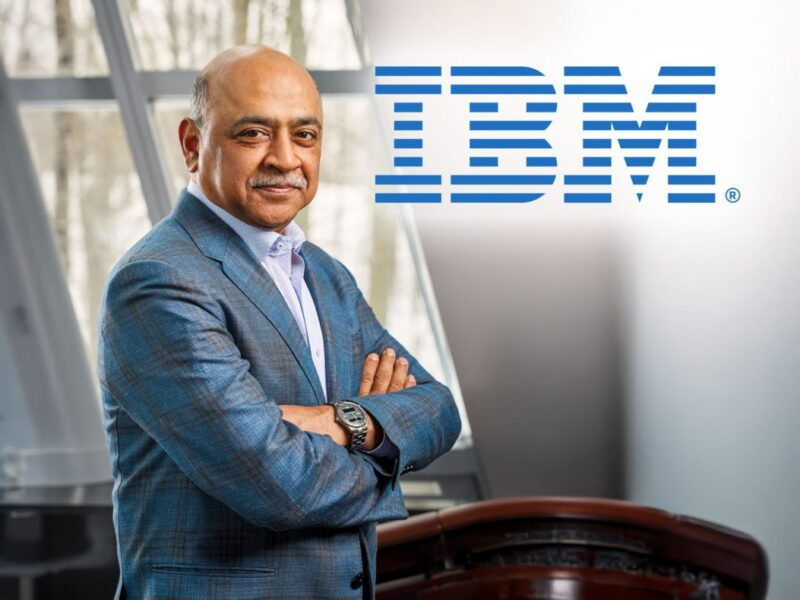
🦔IBM CEO Arvind Krishna says AI is "not a bubble" then estimates the industry needs $6 to $8 trillion in total capex for data center and chip buildout. To recover that over seven years, companies would need $1 to $2 trillion in new annual revenue. Krishna says he doesn't believe that revenue exists. He also thinks only two or three companies will succeed at building leading AI models. Everyone else is spending to stay in a race most of them will lose. My Take "Not a bubble" but $6 to $8 trillion chasing revenue that the guy doing the estimate says probably isn't there. I don't know what definition of bubble Krishna is using, but by mine that qualifies. He's the CEO of IBM, a company that sells AI infrastructure services to enterprises. If he's flagging that the payback doesn't work, and he benefits from the spending continuing, that should carry more weight than a random skeptic saying the same thing. Google just sold $80 billion in equity to fund its buildout. Oracle cut 30,000 workers to redirect salaries into capex. Anthropic filed its S-1 the same day GitHub Copilot's token billing collapsed and users fled. Krishna put a number on what everyone else is dancing around. The spending has outrun any realistic estimate of the revenue it can generate, and the companies writing the checks know it. They're just betting they're one of the two or three that survive long enough for it to pay off. Hedgie🤗
Hedgie tweet media
English
48
133
551
77K
Global Markets Investor
Global Markets Investor@GlobalMktObserv·
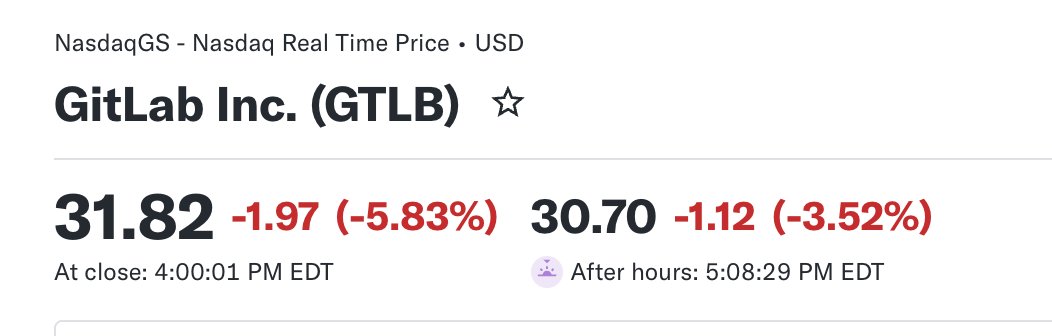
🚨US consumers are falling behind on their debt payments at a CRISIS PACE: The share of US consumer loans at least 30 days overdue hit 4.8% in Q1 2026, the highest in 9 YEARS. At the same time, Credit card serious delinquencies rose +0.4 percentage points in Q1 2026, to 13.1%, the highest since Q4 2010 and just below the post-2008 peak of 13.7%. Auto loan serious delinquencies rose +0.4 percentage points, to 5.6%, the highest on record. Student loan 90-plus day delinquencies jumped +0.7 percentage points, to 10.3%, the highest since Q1 2020. Meanwhile, 21.3% of credit cardholders carry balances of more than $10,000, the highest since data began in 2018. The average American consumer is struggling.
Global Markets Investor tweet media
English
6
32
100
12K
VibeDiligence
VibeDiligence@huskies20001·
@randgroup Slop GPT GENERATED tweet with no nuance. All these things are priced to the moon and you forgot about the little pesky power permits and utilities regulation. We’ve been at the power trade if you’re ready to get your legs cut out from under you by regulators.
English
0
0
1
44
Rand Group
Rand Group@randgroup·
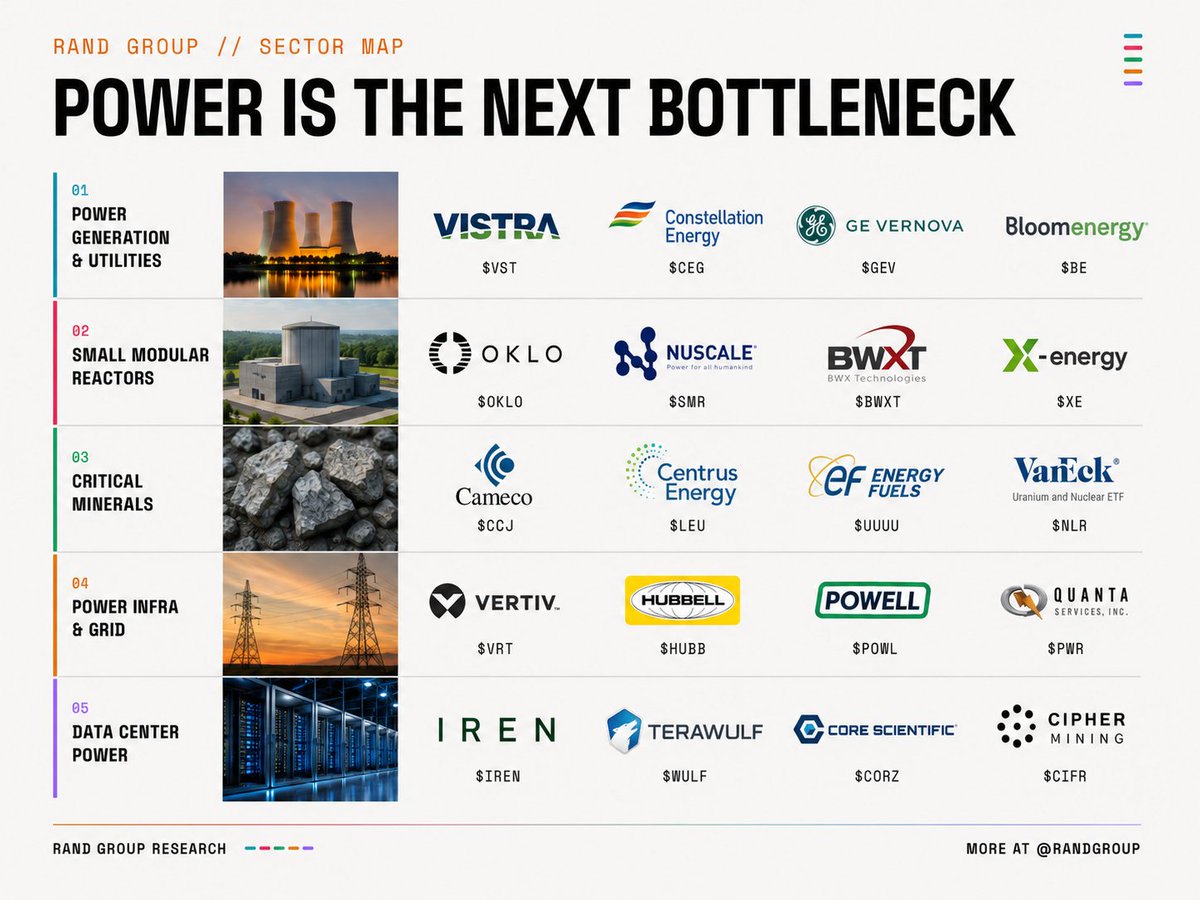
Every hedge fund I respect is suddenly talking about the same thing, and... it is not the chips. It is the one bottleneck that breaks the entire AI story if it is not solved. Around 20 public companies sit on it. I put them all in one map across 5 layers. Let's dive into it 🧵 Here is the thing nobody priced in two years ago. We spent a decade with flat electricity demand in this country. Utilities planned around it. Then AI showed up asking for gigawatts at a time. The Electric Power Research Institute now thinks data centers could eat 9% to 17% of all US electricity by 2030, up from roughly 4% in 2023. Former Google CEO Eric Schmidt told Congress the sector may need 67 more gigawatts by the end of the decade. That is not a tweak to the demand curve. That is a new industrial revolution landing on a grid built for a different century. Every company below sits somewhere between a power plant and a server rack. This is the map. 🔌 POWER GENERATION & UTILITIES Start at the source. These are the companies that actually make the electrons. For years this was the most boring corner of the market: regulated returns, slow growth, dividend investors only. Then the hyperscalers started signing power contracts directly with generators, and the whole category repriced. $VST Vistra This is the one I watch most closely in the group. Vistra signed Meta to a power purchase agreement for roughly 2,600 megawatts at its PJM nuclear sites, which tells you everything about where this is going: tech giants are now buying nuclear output directly. Q1 2026 adjusted EBITDA hit a record for a first quarter at $1.494 billion. They have hedged almost all of their 2026 generation, and they have bought back about 30% of the company since late 2021. A generator that trades like a buyback machine with an AI tailwind bolted on. $CEG Constellation Energy The largest nuclear fleet in the country, and the company that put nuclear back on the front page when it agreed to restart Three Mile Island for Microsoft. In January it closed the $21.8 billion Calpine acquisition, adding around 23 gigawatts of mostly gas and renewable capacity, and Q1 2026 revenue more than doubled the year before to $11.1 billion. The thesis is simple: when an AI company wants carbon free baseload power tomorrow, there are very few phone numbers to call, and this is one of them. $GEV GE Vernova If you only own one name in this entire map, my honest take is that it should probably be this one. GE Vernova makes the gas turbines and the grid equipment, the literal picks and shovels of the buildout. In a single quarter its Electrification segment booked $2.4 billion in data center equipment orders, more than it booked in all of 2025. Total backlog sits around $163 billion and management pulled forward its $200 billion target to 2027. The gas turbine backlog jumped from 83 to 100 gigawatts in one quarter, and they are raising prices into that demand. This is the cleanest expression of the trade. $BEPC Brookfield Renewable Note the ticker: this is Brookfield Renewable, $BEPC, not the $BE on most charts (that is Bloom Energy). Brookfield operates about 47 gigawatts and is developing a pipeline north of 200. It signed a framework with Microsoft to deliver over 10 gigawatts, roughly eight times the size of the largest single corporate power deal ever signed before it, plus a multi gigawatt hydro deal with Google. It also owns about half of Westinghouse alongside Cameco. The patient, contracted, dividend paying way to play the same wave. ⚛️ SMALL MODULAR REACTORS Now the speculative end. The promise here is clean, firm baseload power in a compact box you can site right beside a data center. The catch: almost none of these are producing commercial power at scale yet, so you are buying a timeline as much as a company. Price that carefully. $OKLO Oklo The most exciting and the most expensive name in the room. In May the NRC approved the principal design criteria for Oklo's Aurora powerhouse in under half the usual review time, a real regulatory step forward. The customer pipeline is around 14 gigawatts, anchored by a 12 gigawatt agreement with Switch and a 500 megawatt deal with Equinix, and it added a research partnership with NVIDIA and Los Alamos. Just remember Oklo plans to build, own and operate its reactors and has essentially no revenue yet. This is a call option on a 2028 plus story. $SMR NuScale Power The one with the regulatory lead. NuScale has NRC design approval for both its 50 and 77 megawatt modules, which genuinely derisks deployment. It is sitting on about $1.2 billion in liquidity and is working toward a definitive power agreement with TVA through its ENTRA1 partner, with its first project tied to RoPower in Romania. Revenue was a rounding error last quarter because the licensing work wrapped up, so this is still a story about getting the first units in the ground. $BWXT BWX Technologies The adult in the room, and the name I would own if I wanted nuclear exposure without buying a lottery ticket. BWXT actually makes money: Q1 2026 revenue of $860 million and net income of $91 million, and it raised full year guidance. It builds reactors for the US Navy, produces medical isotopes, and just acquired Precision Components Group to push into commercial nuclear manufacturing. While the SMR startups sell the future, this one sells into it today. $XE X-energy Brand new to the public market. X-energy IPO'd on April 24 at $23 a share, raised about $1.02 billion, and came out around a $12 billion valuation with Amazon as its anchor backer holding nearly a third of the company before the listing. It pairs an 80 megawatt reactor design with its own proprietary TRISO fuel, and its order book already tops 11 gigawatts including Amazon's commitment to as much as 5 gigawatts by 2039, plus Dow and Centrica. Reality check: it lost about $390 million on $109 million of revenue in 2025, and first deployments are not expected until the early 2030s. ⛏️ CRITICAL MINERALS You can build every reactor on the list above and they are paperweights without fuel. This is the front end of the cycle: mining, enrichment, conversion, and the magnet metals the whole grid runs on. Quick note: I swapped the misfiled Northland slot for Energy Fuels here, which is a genuine US critical minerals producer. $CCJ Cameco The blue chip of the uranium world. Q1 2026 net earnings jumped 87% and adjusted EBITDA rose 44% to $509 million on stronger prices and volumes. The kicker is Westinghouse: Cameco owns roughly half of it alongside Brookfield, so it captures both the fuel and the reactor technology side of the renaissance. When people want uranium exposure without a science project, they buy this. $LEU Centrus Energy The reshoring play, and a fascinating one. Centrus is the only production ready uranium enricher in America, sitting on a $2.3 billion enrichment backlog, a $900 million HALEU award from the Department of Energy, and a notice from the NNSA that it intends to sole source enrichment work to them. It is pouring over $560 million into its Oak Ridge centrifuge factory and is even exploring a fuel joint venture with Oklo. This is a national security story wearing a stock ticker. $UUUU Energy Fuels This is what $UUUU actually is. Energy Fuels runs White Mesa, the only conventional uranium mill operating in the United States, and it is the rare company licensed to produce both uranium and separated rare earth oxides under one roof. Its 2026 uranium guidance implies growth of 50% to 150%, and it is now turning out the dysprosium, terbium and magnet metals that everything from EV motors to grid hardware depends on. Uranium and rare earths, the two supply chains Washington is most desperate to pull back from China, in one company. $NLR VanEck Uranium and Nuclear ETF If you would rather own the whole theme in one line instead of picking a winner, this is the basket. $NLR holds the nuclear value chain end to end: reactors, enrichers, miners and the utilities running the plants. A lot of this very map sits inside it, with Constellation, Cameco, Centrus, BWXT and Energy Fuels all among its largest positions. The lazy way to be right about the sector even if you pick the wrong individual stock. 🔧 POWER INFRA & GRID Between the power plant and the server rack is the least glamorous and maybe most investable layer of all. Transformers, switchgear, cooling, and the crews who build it. The dirty secret of the AI buildout is that the grid itself is the bottleneck. Interconnection queues run years, and the equipment to connect anything is on backorder. $VRT Vertiv The purest grid adjacent winner so far. Q1 2026 sales rose 30% to $2.65 billion, with the Americas up 44% on data center demand, earnings per share up triple digits, and guidance raised twice in two quarters. Vertiv makes the power and thermal systems that keep a data center alive, and it just joined the S&P 500. When the chip names sneeze, this one catches it, but the order book keeps validating the story. $HUBB Hubbell Boring on purpose, and that is the point. Hubbell makes the electrical and utility hardware, the transformers, metering and grid components, that every new data center and every grid upgrade quietly requires. It will never 10x in a year, but it sells into both the AI buildout and the broader grid replacement cycle at the same time. This is the ballast in the basket. $POWL Powell Industries My favorite quiet story in this section. Powell makes custom electrical equipment for utilities, energy and now data centers, and the demand signal is screaming: orders up 97% last quarter, a record $1.8 billion backlog, and right after the quarter closed it landed a single data center order worth more than $400 million, the largest in its history. It did a three for one split this spring and carries no debt. A small cap industrial running into a structural tailwind. $PWR Quanta Services The labor. Quanta physically builds and upgrades the grid, the part of this problem that no software fixes. Q1 2026 revenue rose 26% to $7.87 billion and its backlog hit a record $48.5 billion. If all of the generation and transmission above actually gets built, a meaningful slice of it gets built by crews like these. The pick and shovel play on the wires themselves. 🖥️ DATA CENTER POWER The wild card, and the highest beta corner of the map. These started as bitcoin miners, which means they already owned the one thing everyone now wants: large blocks of interconnected power and the land around it. They pivoted to hosting AI compute, signing leases with the hyperscalers and the neoclouds. Enormous growth, real execution, and serious single customer risk. Size accordingly. $IREN IREN The furthest along. Formerly Iris Energy, IREN has a Microsoft AI cloud partnership worth billions, a power pipeline around 4.5 gigawatts, and high performance computing on track to make up the majority of its revenue by the end of the year. It already trades like an infrastructure company rather than a miner, because increasingly that is what it is. $WULF TeraWulf TeraWulf describes itself as a power company that happens to build digital infrastructure, which I think is exactly the right framing for this whole row. It has locked in over $12.8 billion of contracted compute revenue through long term leases with the Google backed Fluidstack and Core42, anchored by its Lake Mariner site and scaling toward a gigawatt of power. Its leasing revenue more than doubled year over year. Controlled power, leased to AI, on a multiyear contract. $CORZ Core Scientific The contrarian one. CoreWeave tried to buy Core Scientific in an all stock deal, and in a rare moment of shareholder backbone, the holders voted it down in late 2025. So it stays public, and it kept the prize: roughly $10 billion or more of contracted revenue with CoreWeave across about 590 megawatts, while converting its old mining sites into AI colocation. You are betting the company creates more value alone than the buyout offered. $CIFR Cipher Mining The earliest stage of the pivot, rebranding toward AI as it goes. Cipher signed a hosting deal backed by Google's Fluidstack, with Google taking around a 5% stake, plus a 300 megawatt arrangement tied to AWS, building toward a contracted compute backlog around $9 billion. Highest risk, least proven, most torque if the leases convert to cash on schedule. ⚡️FINAL THOUGHTS Step back from the tickers and a pattern jumps out. The market is paying up for the same insight at five different points on the same wire. The stability lives at the bottom and the middle. Cameco, Hubbell, Quanta Services and BWX Technologies make money today and sell into a buildout that is contracted for years. They will not triple overnight, but they do not need a single thing to go right that has not already happened. The growth lives at the edges. GE Vernova is the rare name that has both, scale and acceleration, which is why I keep coming back to it. The reactor startups and the former miners are where the imagination is, and also where the disappointment will be when timelines slip, because timelines always slip in nuclear and in construction. The clearest read of all is that the AI story quietly handed the baton from the chip layer to the power layer, and most people are still watching the wrong race. You cannot run the model without the electrons, and the electrons are the scarce thing now. I will say the obvious part out loud: this is a map, not advice. I am pointing at where the money is moving, not telling you what to buy. Do your own work on every one of these, especially the speculative names where a single contract or a single regulator can move the whole thesis. If this saved you a week of research, do me a favor and bookmark it, then send it to the person in your group chat who only owns Nvidia. The power bottleneck is the second half of that trade.
Rand Group tweet media
English
49
183
827
161.3K
VibeDiligence retweetledi
Milk Vessel Pilot
Milk Vessel Pilot@trueliberal1848·
@doctor_rahmeh @SikhPA Crazy how the first time a Sikh is convicted for a murder like this, the entire family closes ranks and lies to the police about it. What a coincidence!
English
2
9
284
2.6K