kico
2.5K posts

kico
@_kic0_
I do random nerd stuff, hacktivist, cryptoanarchist, privacy advocate, mining pool admin @ https://t.co/axowxPu9zt don't fork anything @ https://t.co/oA4q5gfvKP
Katılım Kasım 2022
457 Takip Edilen227 Takipçiler

Adam Back es Satoshi? + Monero en Telegram + app falsa de Ledger #spacedecake x.com/i/broadcasts/1…
Español
kico retweetledi

Zcash was the biggest coordinated exit pump of this cycle and nobody is calling it what it was.
- Delisted from Binance, OKX, Kraken and 20+ exchanges in 2023-2024 for “compliance”
- Price bled to $30. Everyone declared it dead
- Then suddenly every influencer on CT started shilling “privacy narrative” at the exact same time
- 1,200% pump in 3 months. From $30 to $600
- OKX relisted it at the top. The same exchange that delisted it months earlier
- Analysts were calling for $1,000+ while insiders were selling
- The entire development team at Electric Coin Company resigned in January 2026 over internal conflicts
- Now it’s bleeding back down and the same influencers who shilled it went silent
They got exchanges to relist at the top. And used your buy orders as their exit.
English

THEY DID IT.
The SEC and CFTC just dropped a landmark document that officially classifies crypto assets.
They're actually telling us which crypto assets are securities and which ones aren't - by name!
THIS IS SOMETHING GENSLER REFUSED TO DO
(he focused on prosecuting crypto out of existence)
This rule doc gives crypto many of the benefits of the clarity bill - it lifts us out of the gray market - it gives every asset a path.
It's almost like the Clarity act just passed by way of regulator.
(of course, the actual clarity act will harden all this into legislation and make it irreversible in the event we get another Gensler, we still want it)
This rule says there's 5 categories for crypto assets:
1) Digital Commodities - assets tied to a functional, decentralized crypto system (e.g., BTC, ETH, SOL, XRP, ADA, DOGE). Not securities. (yes, they name them on page 14)
2) Digital Collectibles - NFTs, meme coins, artwork tokens, in-game items. Not securities (fractionalized collectibles may be an exception).
3) Digital Tools - membership tokens, credentials, domain names (e.g., ENS). Not securities.
4) Stablecoins - payment stablecoins under the GENIUS Act are not securities. Other stablecoins, it depends.
5) Digital Securities - tokenized versions of traditional securities. Like tokenized stocks. Always securities.
Amazing! This makes so much sense I can't believe it's coming from a regulator.
No more enforcement threats to Ethereum developers and crypto exchanges.
How about the Howey test?
More common sense! If an issuer makes specific promises of managerial efforts from which buyers expect profits, the offering is a security until those promises are fulfilled. Then it's a commodity. The asset itself was never the security, the deal around it was. (E.g. XRP was a security pre launch, became a commodity after).
How about stuff like staking and mining?
Mining? Not a securities transaction.
Staking? Also not a securities transaction, that includes custodial and liquid staking even with LSTs!
How about wrapping BTC? Not a securities transaction.
Airdrops? NOT SECURITIES. NO MORE GEO BANS PROTECTING AMERICANS from free airdrops.
Remember this is a joint doc from the SEC and CFTC, They're actually cooperating on this, no internal strife, this is binding to both.
SEC regulates $80-100 trillion assets
CFTC regulates $5-10 trillion assets
Both of the world's largest capital markets are showing us that crypto assets are here to stay and they're welcome alongside traditional assets.
Every country will follow.
This is the biggest move toward legitimacy I've seen in all my time in crypto. Maybe bigger than the genius act since is covers all crypto assets.
Well done @MichaelSelig and @SECPaulSAtkins.
And especially well done to the indefatigable @HesterPeirce. Her fingerprints are all over this, couldn't have happened without her eight years of principles-based curiosity.


English
@VitalikButerin Nice but this lacks some actual plan and direction, what exactly do you propose? What can we build? How do we make eth great again?
English

Over the past year, many people I talk to have expressed worry about two topics:
* Various aspects of the way the world is going: government control and surveillance, wars, corporate power and surveillance, tech enshittification / corposlop, social media becoming a memetic warzone, AI and how it interplays with all of the above...
* The brute reality that Ethereum seems to be absent from meaningfully improving the lives of people subject to these things, even on the dimensions we deeply care about (eg. freedom, privacy, security of digital life, community self-organization)
It is easy to bond over the first, to commiserate over the fact that beauty and good in the world seems to be receding and darkness advancing, and uncaring powerful people in high places are making this happen. But ultimately, it is easy to acknowledge problems, the hard thing is actually shining a light forward, coming up with a concrete plan that makes the situation better.
The second has been weighing heavily on my mind, and on the minds of many of our brightest and most idealistic Ethereans. I personally never felt any upset or fear when political memecoins went on Solana, or various zero-sum gambling applications go on whatever 250 millisecond block chain strikes their fancy. But it *does* weigh on me that, through all of the various low-grade online memetic wars, international overreaches of corporate and government power, and other issues of the last few years, Ethereum has been playing a very limited role in making people's lives better. What *are* the liberating technologies? Starlink is the most obvious one. Locally-running open-weights LLMs are another. Signal is a third. Community Notes is a fourth, tackling the problem from a different angle.
One response is to say "stop dreaming big, we need to hunker down and accept that finance is our lane and laser-focus on that". But this is ultimately hollow. Financial freedom and security is critical. But it seems obvious that, while adding a perfectly free and open and sovereign and debasement-proof financial system would fix some things, but it would leave the bulk of our deep worries about the world unaddressed. It's okay for individuals to laser-focus on finance, but we need to be part of some greater whole that has things to say about the other problems too.
At the same time, Ethereum cannot fix the world. Ethereum is the "wrong-shaped tool" for that: beyond a certain point, "fixing the world" implies a form of power projection that is more like a centralized political entity than like a decentralized technology community.
So what can we do? I think that we in Ethereum should conceptualize ourselves as being part of an ecosystem building "sanctuary technologies": free open-source technologies that let people live, work, talk to each other, manage risk and build wealth, and collaborate on shared goals, in a way that optimizes for robustness to outside pressures.
The goal is not to remake the world in Ethereum's image, where all finance is disintermediated, all governance happens through DAOs, and everyone gets a blockchain-based UBI delivered straight to their social-recovery wallet. The goal is the opposite: it's de-totalization. It's to reduce the stakes of the war in heaven by preventing the winner from having total victory (ie. total control over other human beings), and preventing the loser from suffering total defeat. To create digital islands of stability in a chaotic era. To enable interdependence that cannot be weaponized.
Ethereum's role is to create "digital space" where different entities can cooperate and interact. Communications channels enable interaction, but communication channels are not "space": they do not let you create single unique objects that canonically represent some social arrangement that changes over time. Money is one important example. Multisigs that can change their members, showing persistence exceeding that of any one person or one public key, are another. Various market and governance structures are a third. There are more.
I think now is the time to double down, with greater clarity. Do not try to be Apple or Google, seeing crypto as a tech sector that enables efficiency or shininess. Instead, build our part of the sanctuary tech ecosystem - the "shared digital space with no owner" that enables both open finance and much more. More actively build toward a full-stack ecosystem: both upward to the wallet and application layer (incl AI as interface) and downward to the OS, hardware, even physical/bio security levels.
Ultimately, tech is worthless without users. But look for users, both individual and institutional, for whom sanctuary tech is exactly the thing they need. Optimize payments, defi, decentralized social, and other applications precisely for those users, and those goals, which centralized tech will not serve. We have many allies, including many outside of "crypto". It's time we work together with an open mind and move forward.
English

Imagine if Iran just killed 50+ school girls in the USA?
Why on earth is it acceptable the other way round?
English
Hmmm... Seriously how retarded are you?
Donald J. Trump@realDonaldTrump
Be prepared, there is a small chance that our horrendous leadership could unknowingly lead us into World War III.
English

@engineers_feed Are coordinates an abstract construct? Yeah it's a coincidence
English

Speed of light is 299,792,458 meters per second.
The exact latitude of the Great Pyramid of Giza are 29.9792458°N
Coincidence?
English
@LiberalPT Socialista comunista capitalista ele não quer saber de nada disso porque nada disso sequer ainda quer dizer alguma coisa nos dias de hoje, ele só diz o que querem ouvir para ganhar votos da igual a narrativa porque ele depois chegando lá não vai fazer nada do que diz,tipo o Trump
Português

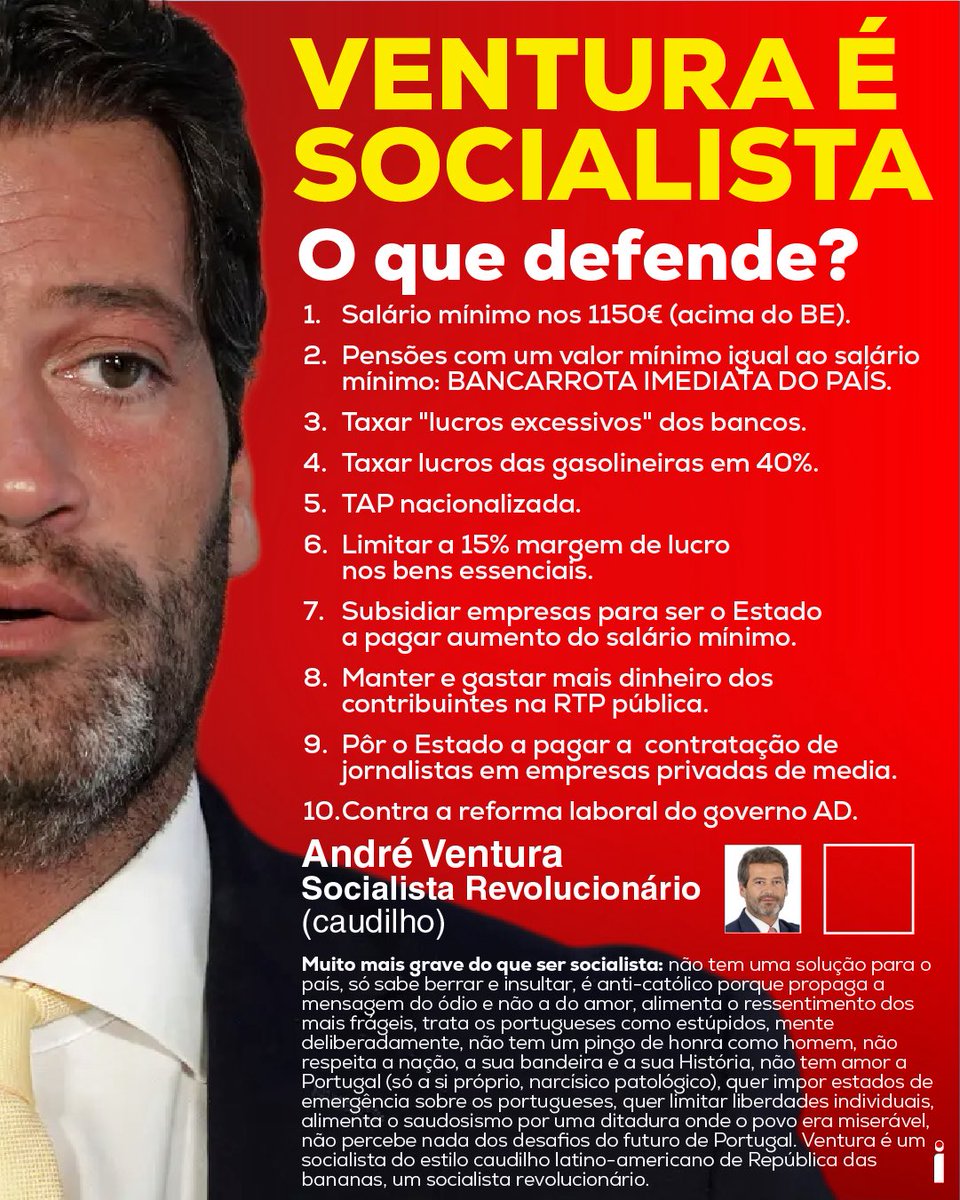
André Ventura acaba de se colocar "no espaço não-socialista".
Um disparate completo: Ventura é socialista.
Há muitas razões mais graves para nunca votar em Ventura, mas na política económica os factos demonstram que é socialista.
Não é um socialista democrático, é um socialista revolucionário do estilo caudilho sul-americano.
Português